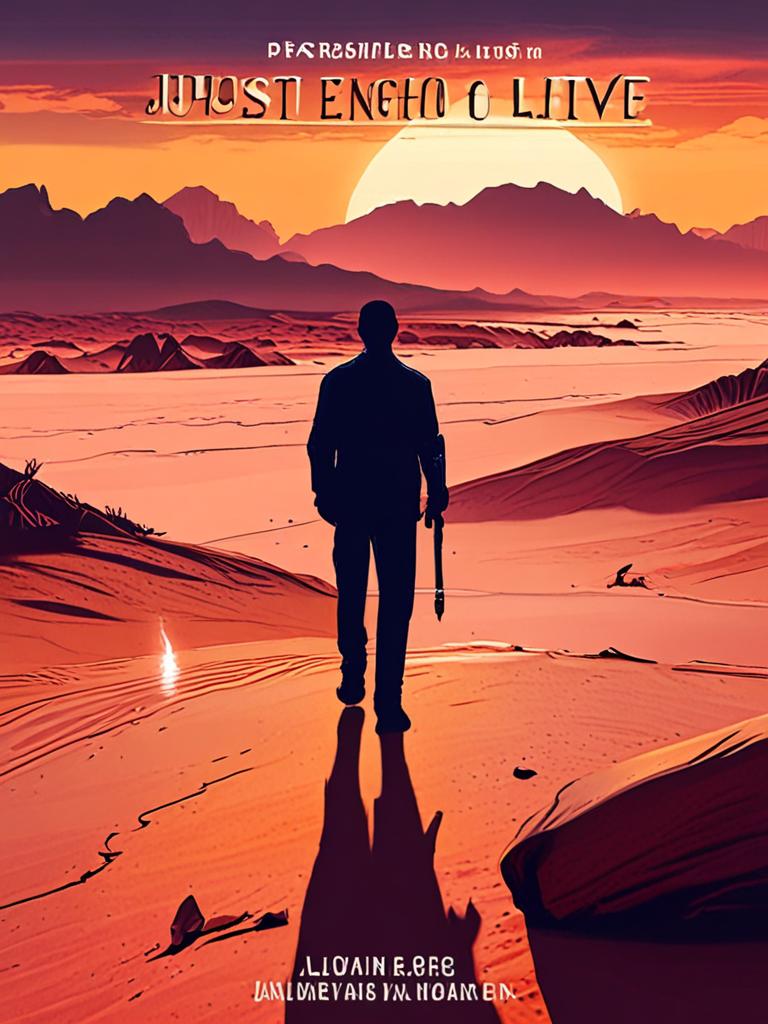
ID · just-enough-to-live-4c8c2376
JUST ENOUGH TO LIVE
By Sarp Atakan Çevik · Science Fiction · Dramatic · 35 pages
Table of contents
- 1. The Desert's Edge
Khoran leaves his village at the far edge of the water network, carrying a plan meant for two people, and begins his perilous journey to the capital. He must navigate the harsh desert landscape and negotiate with the owners of each well he encounters.
- 2. Cities of Dust and Stone
Khoran travels from city to city, each with its own unique culture and response to the catastrophe that devastated the planet. He meets a soldier from the capital who becomes a temporary companion and guide.
- 3. The Capital's Gates
Khoran finally reaches the capital, only to find that entry is not geographic but administrative, and he must navigate the complex bureaucracy to gain access. He discovers the dark secrets behind the city's gates and the true reason for his wife's death.
Chapter 1: The Desert's Edge
Khoran leaves his village at the far edge of the water network, carrying a plan meant for two people, and begins his perilous journey to the capital. He must navigate the harsh desert landscape and negotiate with the owners of each well he encounters.
Farewell to the Village
The sun hung low in the sky, a faint orange smudge on the horizon, as Khoran stood at the edge of his village. The air was thick with the scent of dry earth and the faint metallic tang of salt from the few crops that clung to life near the well. The village was small, no more than a dozen huts clustered together like the bones of some long-dead creature. Beyond that, the desert stretched endlessly, a shimmering expanse of sand and rock that seemed to breathe with the heat of the day.
Khoran’s hands were calloused and rough, the result of years spent hunting in the harsh landscape. He wore a patched leather tunic, its edges frayed from exposure to the wind and sand. A knife was strapped to his belt, its blade worn but sharp enough to carve flesh from bone. He carried little else—just a waterskin, a few strips of dried meat, and a map folded carefully in his pocket.
The villagers were gathered at the center of the settlement, their faces etched with lines of fatigue and worry. They had come to see him off, though none spoke of the journey ahead. Words were scarce in these parts, saved for when they were truly needed.
“Take care, Khoran,” one of the older men said, his voice gravelly and dry. “The desert is no place for a man alone.”
Khoran nodded, his expression stoic. “I’ve survived this long,” he replied. “I’ll survive a little longer.”
The others murmured their farewells, their eyes fixed on the horizon as if they could see the dangers that lay beyond the village. Khoran felt a pang of guilt for leaving them behind, but there was no other choice. The city had taken his wife, and now he would take his revenge.
He turned and began to walk, his boots sinking slightly into the soft sand. The village grew smaller with each step, until it was nothing more than a faint dot on the horizon. The desert swallowed him whole, its endless expanse stretching out before him like a living, breathing entity.
The first day was uneventful, save for the relentless heat that seemed to bake the life from everything it touched. Khoran walked steadily, his pace methodical and unbroken. He knew the importance of conserving water, of rationing his supplies carefully. Every step brought him closer to the city, closer to the truth he sought.
As the sun dipped below the horizon, casting the sky in hues of crimson and gold, Khoran found a small outcropping of rock to shelter him from the night’s chill. He drank sparingly from his waterskin, the cool liquid a welcome respite from the burning heat of the day. He ate a small portion of the dried meat, his stomach growling softly as he did so.
He sat for a time, staring out at the stars that dotted the sky like distant fires. They were beautiful, but they held no comfort for him. They were too far away, too unreachable, just like the life he had once known.
The night was quiet, save for the occasional cry of a desert owl or the distant rustle of sand. Khoran slept little, his mind racing with thoughts of his wife, of the city, and of the secrets he would uncover. He knew the journey ahead would be perilous, but he was determined to see it through.
As the first light of dawn crept over the horizon, Khoran stood and resumed his journey, his resolve unwavering. The desert would not break him, not yet. He had a purpose, a mission, and he would see it through to the end.
The First Well
The sun was a brutal weight in the sky when Khoran finally reached the first well. The desert had stretched before him like an endless ocean of sand, each step a battle against the heat and the fatigue that clawed at his bones. The well was little more than a crude structure carved into the side of a rocky outcrop, its entrance guarded by a man who looked as weathered as the land itself.
The man’s face was a map of deep grooves, etched by years of exposure to the elements. His eyes were sharp, like the blade of a knife, and they narrowed as Khoran approached. He leaned against a crude wooden post, his hands resting on a rifle that looked as old as the well itself.
“Who are you?” the man asked, his voice rough and gravelly. “And what business do you have at my well?”
Khoran stopped a few feet away, his breath coming in short, ragged gasps. He had walked for hours, the heat sapping the strength from his legs. His waterskin was already half-empty, the weight of it a reminder of how precious every drop had become.
“My name is Khoran,” he said, his voice steady despite the exhaustion that threatened to overwhelm him. “I’m heading to the capital. I need water.”
The man snorted, a sound that carried the weight of a thousand cynical thoughts. “Water? You think I’m just going to hand it over to you? You think I don’t know what happens to those who wander into the desert alone? They vanish. They dry up. They become nothing but dust.”
Khoran’s jaw tightened. He had expected this. The wells were the lifeblood of the desert, and those who controlled them held power over the lives of everyone who passed through. But he wasn’t going to let this man turn him away without a fight.
“I’m not asking for charity,” he said, his voice cold. “I’m offering a trade. I’ve got something you might be interested in.”
The man’s eyes narrowed further, his curiosity piqued despite his initial reluctance. “What?”
Khoran reached into his pocket and pulled out a small, intricately carved figurine. It was made of a dark, polished stone, its surface smooth and cool to the touch. The figure was of a hunter, his stance confident, his expression determined. It was a piece of his wife’s dowry, something she had prized above all else.
The man’s eyes lit up as he took the figurine in his hands, turning it over and examining it with a greedy intensity. “Where did you get this?” he demanded, his voice sharp.
“It’s mine to give,” Khoran said, his tone leaving no room for argument. “Take it. And give me water.”
The man hesitated, his fingers tightening around the figurine as if he were afraid it might vanish if he let go. Khoran could see the struggle in his eyes—between his greed and his caution. But in the end, the greed won.
“Fine,” the man said, his voice grudging. “But you take what you need and you leave. No lingering. No loitering. Understand?”
Khoran nodded, his relief evident in the way his shoulders relaxed. “Thank you.”
The man stepped aside, his rifle still in hand, and gestured toward the well. “Get what you need and be on your way.”
Khoran didn’t waste any time. He knelt beside the well, his hands trembling slightly as he dipped the waterskin into the cool, clear water. The relief of the water against his skin was almost overwhelming, a balm to the heat that had seared him for hours. He drank deeply, the cool liquid a welcome respite for his parched throat.
As he refilled the waterskin, he couldn’t help but glance up at the man who watched him with a wary expression. There was something about him, something that made Khoran’s instincts prick with unease. He wasn’t sure what it was, but he knew better than to trust anyone in the desert. Not entirely.
When he was done, he stood and slung the waterskin over his shoulder, his movements deliberate and calculated. He didn’t look back at the man as he turned and began to walk away, his steps sure and steady despite the exhaustion that still lingered in his bones.
The desert was still endless before him, but at least now he had water. And with water, he had a chance to survive.
The man watched him go, his eyes narrowing as if he could pierce the distance and see into Khoran’s soul. “You’ll regret this,” he muttered under his breath, more to himself than to Khoran.
But Khoran was already too far away to hear. The desert swallowed him once more, its endless expanse a reminder of the challenges that lay ahead. And somewhere in the distance, the city waited.
Shells and Legends
The sun was a relentless fire in the sky when Khoran finally found the next well. The desert had worn him down, the endless expanse of sand and rock a constant reminder of the fragility of life in this harsh world. His boots were caked with dirt, his throat raw from the dry air, and his skin was slick with sweat that evaporated almost as soon as it formed.
The well was hidden beneath a cluster of scrubby bushes, their gnarled roots clawing at the ground as if desperate for moisture. The air around the well was thick with the scent of damp earth, a stark contrast to the dry, acrid tang of the desert. Khoran knelt beside the well, his hands trembling slightly as he dipped his waterskin into the cool, dark water.
As he drank, his mind wandered to the life he had left behind. His wife, Lira, had always been a source of strength for him, her laughter a rare and precious thing in a world that seemed intent on crushing hope. She had been the reason he had stayed in the village, the reason he had fought to protect the fragile existence they had built together. But the city had taken her from him, and now he would make them pay.
The thought of revenge fueled him, gave him the strength to push forward despite the exhaustion that threatened to overwhelm him. He had come too far to turn back now. The city was waiting, and with it, the answers he sought.
As he refilled his waterskin, Khoran couldn’t help but notice the faint glint of something in the sand near the well. He reached out, his fingers brushing against a smooth, polished surface. It was a shell, its edges worn but still unmistakable. It was unlike anything he had ever seen before, its surface shimmering with a faint, otherworldly glow.
Khoran picked it up, turning it over in his hands as he tried to make sense of it. It was too perfect, too alien to have originated on this planet. There was something about it that felt… wrong. It was as if it didn’t belong here, as if it had been placed in the desert by some unseen hand.
The memory of the man at the first well flashed through his mind, the way his eyes had lingered on the figurine Khoran had traded for water. There had been something in his expression, something Khoran couldn’t quite place. Now, with the shell in his hands, he couldn’t help but wonder if the two were connected in some way.
He stood, the shell clutched tightly in his hand, and began to walk once more. The desert stretched out before him, endless and unforgiving, but now there was a new purpose to his journey. The shell was a puzzle, a piece of a larger mystery that he was determined to solve.
As the sun climbed higher in the sky, Khoran’s thoughts turned to the legends he had heard in his village, stories of the descendants of those who had abandoned the planet. They were said to be powerful, their technology far beyond anything the people of the desert could hope to understand. But there were darker tales as well, whispers of betrayal and greed, of a city that had been built on the bones of those who had come before.
The shell in his hand felt heavier now, its presence a reminder of the secrets that lay hidden in the desert. Khoran knew he was walking into the unknown, but he was determined to see it through. The city had taken everything from him, and now he would take his revenge.
The desert swallowed him whole once more, its endless expanse a reminder of the challenges that lay ahead. But Khoran was not afraid. He had a purpose, a mission, and he would see it through to the end.
A Glimpse of the Past
The shell in Khoran’s hand was cold, its surface smooth and unyielding. He had carried it with him for days, its presence a constant reminder of the mystery that lay hidden in the desert. The further he walked, the more the shell seemed to weigh on his mind, as if it carried the weight of the past with it.
As the sun climbed higher in the sky, Khoran came across a narrow canyon, its walls rising sharply on either side of him like the teeth of some ancient beast. The air was cooler here, the shade a welcome respite from the relentless heat. He paused for a moment, his hand resting on the hilt of his knife as he scanned the surroundings for any signs of danger.
It was then that he noticed the wall.
At first, it was little more than a faint outline against the rock, a shadow that seemed to shift and move as he approached. But as he drew closer, the outline resolved itself into something far more concrete—a carving, its lines deep and intricate, etched into the stone by hands long since turned to dust.
Khoran’s heart pounded in his chest as he stepped closer, his breath catching in his throat. The carving was unlike anything he had ever seen before. It depicted a city, its spires reaching toward the heavens, its streets alive with people who moved with a strange, otherworldly grace. But there was something about the carving that felt off, as if it had been crafted by a hand that did not belong here, in this desert world.
And then he saw the shell.
In the center of the carving, nestled among the spires and the people, was a depiction of a shell identical to the one he held in his hand. It was as if the carving had been created for the sole purpose of showing this one, fleeting glimpse of the shell, as if it were the key to some great secret.
Khoran’s fingers trembled as he reached out to touch the carving, his mind racing with questions. Who had created this? What was the shell’s significance? And why had it been left here, in this forgotten corner of the desert?
As he traced the lines of the carving with his fingers, a faint hum resonated through the air, so subtle that he might have missed it had he not been standing so close. The shell in his hand grew warm, its surface glowing faintly in the dim light of the canyon. For a moment, Khoran felt as though he were being pulled toward the carving, as though it held some hidden power that called to him.
But then the hum faded, and the carving was still.
Khoran took a step back, his mind reeling. He had spent his entire life in the desert, had seen strange things and heard stranger stories, but this… this was beyond anything he had ever imagined. The carving was a glimpse into the past, a window into a time long since forgotten, and the shell in his hand was the key to unlocking its secrets.
He turned and began to walk once more, the shell clutched tightly in his hand. The desert stretched out before him, endless and unforgiving, but now there was a new determination in his step. The city was waiting, and with it, the answers he sought.
The carving had shown him that the past was not as dead as it seemed, that the secrets of the city were deeper and darker than he had ever imagined. And now, with the shell in his hand, Khoran knew that he was closer than ever to uncovering the truth.
The desert would not yield its secrets easily, but Khoran was prepared to fight for them. The city had taken everything from him, and now he would take his revenge. The journey ahead would be perilous, but he was determined to see it through to the end.
As the sun dipped below the horizon, casting the desert in hues of crimson and gold, Khoran pressed on, his resolve unshaken. The carving had given him a glimpse of the past, but it would take more than that to reveal the full extent of the city’s secrets. And Khoran was prepared to dig until he uncovered the truth, no matter how deep it lay.
Chapter 2: Cities of Dust and Stone
Khoran travels from city to city, each with its own unique culture and response to the catastrophe that devastated the planet. He meets a soldier from the capital who becomes a temporary companion and guide.
The City of Worship
The sun hung low in the sky, a molten orb that cast long shadows across the dunes. Khoran trudged forward, the weight of his pack pulling at his shoulders. The air was thick with the scent of incense and the faint hum of prayers carried on the wind. He had been walking for hours, the desert stretching endlessly before him, until finally, the faint outline of a city emerged on the horizon.
As he drew closer, Khoran saw that the city was unlike any he had encountered before. Its walls were made of polished stone, smooth and gleaming, though they were cracked in places, as if the weight of the city itself was too much to bear. Above the walls, spires rose like fingers pointing to the heavens, each topped with a crystalline orb that shimmered in the sunlight. The closer he got, the more the air seemed to vibrate with an almost palpable energy, as though the city itself was alive.
Khoran's boots crunched on the gravel path that led to the gates. The soldiers stationed there turned to him, their expressions wary, but there was something else in their eyes—awe, perhaps, or fear. They exchanged a glance before one of them stepped forward.
"State your business," the soldier said, his voice gruff but oddly deferential.
"I seek water," Khoran replied, keeping his tone neutral. "And passage through your city."
The soldier nodded, but before he could speak, another voice cut through the air.
"Let him enter," a woman said, stepping out from the shadows of the gatehouse. She was dressed in a flowing robe adorned with intricate patterns that seemed to shimmer as she moved. Her hair was braided with strands of silver, and her eyes gleamed with an intensity that made Khoran pause.
"He is a stranger, but he carries the weight of a traveler," she continued, her gaze steady. "Let him pass."
The soldier hesitated, but Khoran could see the reluctance in his eyes. He had learned long ago that some cities were more welcoming than others, and this one seemed to guard its secrets closely.
"Thank you," Khoran said, his voice tight. He stepped through the gates, the heavy wooden doors creaking behind him.
The city within was a labyrinth of narrow streets and towering buildings. Khoran had never seen anything like it. The walls of the houses were adorned with carvings of waves and raindrops, and in some places, the stones seemed to weep, as though they were crying. The air was thick with the scent of incense, and the sound of chanting echoed from every direction.
"Welcome to the City of Worship," the woman said, falling into step beside him. "I am Sariah, a priestess of the temple. You are not from these parts."
Khoran nodded. "I am from the far edge of the desert. I am searching for the capital."
Sariah's lips curled into a faint smile. "The capital is far from here, but you are not the first to seek it. Many come seeking answers, but few leave with them."
Khoran's hand tightened on the hilt of his knife. He had heard stories of the capital, of the power it wielded and the secrets it guarded. But he had never imagined that the cities along the way would be so... strange.
"Where is the well?" he asked, his voice steady. "I need water."
Sariah led him through the winding streets, her steps sure and confident. "The well is at the heart of the city," she said. "But it is no ordinary well. It is a sacred place, a gift from the gods themselves."
Khoran's heart sank. He had heard enough stories to know that when a city called something a gift from the gods, it was often a lie. But he said nothing, following Sariah as she guided him through the maze of streets.
Finally, they came to a square surrounded by towering pillars. In the center stood a well, its stone rim polished smooth by the hands of countless supplicants. Above it, a crystalline orb hung from a chain, its surface rippling like water. The air around it shimmered, and Khoran could feel the heat radiating from it even from a distance.
"This is the Well of Worship," Sariah said, her voice reverent. "It is the gift of the gods, a fountain of life that sustains us even in the harshest of times."
Khoran's eyes narrowed. There was something unnatural about the well, something that made the hairs on the back of his neck stand on end. He stepped closer, his hand instinctively reaching for his knife.
"Do not touch it," Sariah warned, her tone sharp. "It is sacred."
Khoran ignored her, his fingers brushing against the cool surface of the well. The water inside was unlike anything he had ever seen. It shimmered with an otherworldly light, and as he dipped his hand into it, he felt a strange sensation, as though the water itself was alive.
"Drink," Sariah urged, her voice soft but insistent. "Drink, and you will know the blessings of the gods."
Khoran hesitated, his instincts screaming at him to stay away. But he was desperate for water, and the well was the only source in sight. He dipped his flask into the water, the liquid swirling in an unnatural way as it filled.
As he drank, Khoran felt a strange warmth spread through his body, as though the water itself was seeping into his veins. The world around him seemed to blur, and for a moment, he was consumed by a vision of the city as it once was—lush and green, with rivers flowing through its streets.
But then the vision shifted, and Khoran saw something else. He saw the well, but it was different. Instead of shimmering water, it was filled with something dark and viscous, and the air around it reeked of death. He saw the priests of the city, their faces twisted in grotesque masks, their hands raised in a ritual that seemed to draw life from the well itself.
Khoran stumbled back, the flask slipping from his grasp. The vision faded, but the memory of it stayed with him, a cold, sickening dread settling in the pit of his stomach.
"What is this place?" he demanded, his voice trembling.
Sariah's smile had faded, and her eyes were cold. "It is a city of worship," she said. "A city that honors the gods with offerings. And you, stranger, are no exception."
Khoran turned to run, but the streets had changed. The city that had seemed so familiar moments before was now a labyrinth of shifting walls and impossible angles. He ran, the weight of his pack pulling at his shoulders, the sound of Sariah's laughter echoing behind him.
He did not stop until he was outside the city walls, the gates closing behind him with a thunderous crash. He leaned against a boulder, his breath coming in ragged gasps, the flask still clutched in his hand.
The water inside was no longer shimmering. It was dark and still, and Khoran knew, deep in his bones, that he had just escaped a fate worse than death.
The Soldier's Tale
Khoran sat at the edge of the dunes, his back against a boulder, the flask of dark water still clutched in his hand. The city behind him loomed like a specter, its spires piercing the sky as though reaching for something beyond. He took a deep breath, the air still carrying the faint scent of incense, and tried to steady his racing heart.
The encounter with Sariah had left him shaken. The well’s vision had been a glimpse into a nightmare, a reminder of the dangers that lurked in the cities along his path. He had seen enough to know that the City of Worship was not what it claimed to be, and he was determined to avoid such places in the future.
But the desert was vast, and the next city was still days away. He would need to ration his water carefully, and perhaps find another well before he reached the next settlement. For now, he could only sit and wait, his mind racing with thoughts of his wife and the purpose that had driven him this far.
As the sun dipped lower, casting long shadows across the dunes, Khoran heard the sound of hooves crunching on the gravel. He tensed, his hand instinctively reaching for his knife, but then relaxed as he saw a lone figure approaching on horseback.
The rider was a man, his face weathered and lined with the kind of weariness that came from years of travel. He wore a tunic adorned with the emblem of the capital—a crest of a rising sun and a sword crossed over a map of the world. Khoran’s heart sank; the capital’s soldiers were not known for their kindness, especially to those like him who traveled without official sanction.
The man dismounted, his movements slow and deliberate. He approached Khoran, his eyes narrowing as he took in the hunter’s appearance.
“You’re not from around here,” the man said, his voice gruff but not unkind. “What brings you to this godforsaken place?”
Khoran hesitated, his instincts telling him to be cautious. This man carried the emblem of the capital, and Khoran had learned long ago that those who served the city often had their own reasons for asking questions.
“I’m passing through,” he said finally, his tone neutral. “I’m heading to the capital.”
The man snorted, a humorless sound that carried no warmth. “The capital? You’re mad. No one heads to the capital willingly. What’s your name?”
“Khoran,” he replied, his voice steady. “And yours?”
The man hesitated, his eyes flickering for a moment before he spoke. “Jarek. I used to serve in the capital’s guard, but I found myself... out of favor. Now I’m just another wanderer in the desert.”
Khoran studied the man, trying to gauge the truth in his words. Jarek’s demeanor was wary, but there was something in his eyes—a flicker of something that could have been regret or determination. Khoran wasn’t sure which, but he had learned to trust his instincts, and his instincts told him that Jarek was not to be trusted.
“What are you doing out here?” Khoran asked, his voice sharp. “The desert is no place for someone like you.”
Jarek’s lips curled into a faint smile, and for a moment, Khoran thought he saw something dark in the man’s eyes. “I could ask you the same question,” he said. “You look like you’ve seen some things, Khoran. Things that haven’t been kind to you.”
Khoran’s hand tightened on the hilt of his knife. He had no intention of sharing his story with this stranger, but he also couldn’t deny that the man had a certain... presence about him. A presence that made him feel as though he were being sized up, as though Jarek could see into his soul.
“Let’s not get personal,” Khoran said, his voice cold. “I’m just passing through. You should do the same.”
Jarek’s smile faded, and for a moment, Khoran thought he saw something flicker in the man’s eyes—a flicker of something that could have been anger or frustration. But then it was gone, replaced by a calm, almost eerie calmness.
“You know, Khoran,” Jarek said, his voice low and even, “I think you’re going to find that the desert has a way of making people talk. Whether they want to or not.”
Khoran’s heart sank. He had heard stories of the desert’s influence, of how it could drive men to madness, but he had always dismissed them as the ramblings of those who had spent too much time in the sun. Now, however, he couldn’t shake the feeling that Jarek was right. That the desert had a way of stripping away the lies and leaving only the truth.
For now, though, he could do nothing but sit and wait, his mind racing with thoughts of the road ahead and the secrets that lay hidden in the cities that still stretched before him. He had come too far to turn back now, but he knew that the journey ahead would be fraught with danger, and that the decisions he made along the way could mean the difference between life and death.
And as the sun dipped below the horizon, casting the desert in a deep, inky darkness, Khoran knew that he would need to be careful. For in the shadows of the desert, the truth could be a dangerous thing, and those who sought it often found themselves paying a price that they had not bargained for.
Trading Water for Survival
The sun blazed relentlessly as Khoran and Jarek approached the sparse settlement, a collection of weathered tents and makeshift shelters. The air was thick with the scent of dust and sweat, and the occasional wail of the wind through the dunes echoed ominously. Khoran's throat was dry, and the weight of his empty waterskin was a constant reminder of their dire need.
As they entered the settlement, they were met by a group of traders haggling over a small, decrepit cart. The traders, gaunt and weary, eyed the newcomers warily. Khoran's hand instinctively tightened on his knife, while Jarek stood with a calm demeanor, though his eyes betrayed a flicker of unease.
"Looking to trade?" a grizzled trader called out, his voice rough from the desert winds. "We've got water, but it's not for the faint of heart."
Khoran approached cautiously, his gaze sweeping the area. "How much?" he asked, his voice steady despite the internal storm of desperation.
The trader smirked, revealing yellowed teeth. "A good weapon or a story worth its weight. Either way, it's not cheap."
Jarek stepped forward, his presence commanding but measured. "We have neither," he stated, his tone leaving no room for negotiation. "But we can offer protection. We know the dangers of these lands."
The trader's eyes narrowed, assessing Jarek's figure. "Protection? Against what? The desert doesn't need enemies to kill you."
Khoran intervened, his voice firm. "We can offer something else. Information. Valuable information that could save lives."
The trader's interest piqued, and he leaned closer. "Information? What kind?"
Khoran hesitated, the weight of his wife's death pressing on him. "About the capital. Its secrets. The true intentions of those who abandoned this planet."
The trader's eyes widened, a flicker of greed replacing the wariness. "Capital secrets, huh? That's worth more than water. But I need to see what you have first."
Khoran exchanged a glance with Jarek, the tension between them palpable. "We need to see the water first," Khoran bargained, his voice hardening.
The trader nodded, gesturing toward a tattered tent where a single, cracked waterskin lay. Khoran's heart raced as he approached, the vision from the City of Worship haunting him. He hesitated, his hand trembling as he lifted the skin.
Jarek's voice broke the silence. "We need this," he said, his tone leaving no room for doubt. "For survival."
Khoran dipped the flask into the water, the liquid's unnatural shimmer warning him of its potential danger. But the need for water overwhelmed his caution. As he drank, the familiar warmth spread through him, the vision of the well's dark secret flashing before his eyes.
The trader watched, a sly smile forming. "Good, isn't it?" he taunted. "But be warned, stranger. The desert's truths can be as deadly as its sands."
Khoran's stomach churned, the vision of the well's darkness lingering. He turned to Jarek, their eyes meeting in a silent exchange of mistrust and necessity.
"We move," Jarek said, his voice cold. "We leave before the trader changes his mind."
As they departed, the settlement receded into the distance, the weight of their alliance growing heavier. Khoran knew the journey ahead would be fraught with such moments, each trade a gamble with their survival and trust.
The desert's truth, it seemed, was as much a burden as the water they carried, and Khoran was beginning to realize that the greatest danger might not lie in the cities ahead, but in the fragile trust between himself and the enigmatic Jarek.
Refusal and Rebellion
The sun hung low, casting a golden hue over the desert as Khoran and Jarek approached the next checkpoint. The air was thick with the scent of dust and the faint hum of distant machinery. The structure loomed ahead, a stark reminder of the capital's reach—a fortress of stone and iron, its walls adorned with the crest of the rising sun.
Upon arrival, they were met by a contingent of guards, their eyes sharp and their stances wary. The leader, a man with a stern expression and a scar that marred his cheek, stepped forward.
"State your business," the leader demanded, his voice commanding.
Khoran hesitated, his mind racing. He knew the risks of refusal but could not bring himself to comply with the demands of the capital's enforcers. "We seek passage," he stated firmly, his tone leaving no room for negotiation.
The leader's eyes narrowed, and he exchanged a glance with his men. "Passage is granted only to those who serve the capital. You will provide information or face the consequences."
Jarek stepped forward, his presence a silent challenge. "We offer no information," he declared, his voice steady. "We only seek to pass."
The leader's face darkened, and he signaled to his men. "Detain them," he ordered, his voice cold.
Khoran's hand instinctively reached for his knife, his resolve hardening. "You will not take us without a fight," he declared, his eyes blazing with defiance.
A tense standoff ensued, the air charged with anticipation. The guards moved to surround them, their weapons at the ready. Khoran and Jarek stood back-to-back, their determination unwavering.
In a sudden surge of rebellion, Khoran lunged forward, his knife slicing through the tension. The guards reacted swiftly, but Khoran's movements were precise, each strike calculated to disable without killing. Jarek followed suit, his actions a blend of skill and necessity.
As the conflict escalated, Khoran's rage boiled over, driven by the memory of his wife and the injustices he had witnessed. He targeted the fortress's communication device, destroying it with a swift, powerful strike. The explosion sent shockwaves through the structure, symbolizing his refusal to be controlled.
The guards hesitated, their resolve shaken by the unexpected rebellion. In the chaos, Khoran and Jarek seized the opportunity to flee, their escape marked by the desperate cry of a woman they had rescued—a victim of the checkpoint's oppression.
As they vanished into the desert, the weight of their rebellion settled upon them. Khoran knew the risks they had taken, but the act had been necessary. It was a small victory, a defiance against the oppressive structures that sought to control him.
The journey ahead was fraught with uncertainty, but Khoran's resolve was stronger than ever. He had refused to comply, had rebelled against the forces that sought to silence him. And in doing so, he had gained an ally—a woman whose story mirrored his own, a testament to the strength of those who dared to resist.
The desert stretched endlessly before them, a harsh and unforgiving landscape, but Khoran's spirit was unbroken. He would continue his quest, his rebellion a beacon of hope in the darkness, driven by the memory of his wife and the promise of justice.
Chapter 3: The Capital's Gates
Khoran finally reaches the capital, only to find that entry is not geographic but administrative, and he must navigate the complex bureaucracy to gain access. He discovers the dark secrets behind the city's gates and the true reason for his wife's death.
The Ledger of Lives
Khoran stood before the towering gates of the capital, their massive iron frames gleaming under the relentless sun. The air was thick with the hum of activity, yet the atmosphere felt oppressive, as if the very walls were breathing down his neck. He had traveled countless leagues, each step driven by the memory of his wife's smile, now etched into the contours of his soul.
The gates were not mere structures; they were sentinels of bureaucracy, guarded by officials whose expressions mirrored the steely indifference of their posts. Khoran approached the nearest desk, where a clerk sat with a ledger open before him, its pages yellowed with age. The ledger, as Khoran soon learned, was the gatekeeper of lives, a meticulous record of who entered and who remained outside.
"Name?" the clerk asked, his voice monotone, as if each syllable were a burden.
"Khoran," he replied, his tone steady despite the weight of his journey.
The clerk's eyes narrowed as he sifted through the ledger, his fingers brushing over entries like they held the power of life and death. Khoran's heart pounded, not from exertion, but from the anticipation of what this ledger might reveal.
As the clerk's gaze lingered on a particular entry, Khoran's mind drifted to the last moments he had shared with his wife. Her laughter, once a melody that filled their home, now echoed in his memories, a haunting reminder of what he sought to uncover.
The clerk looked up, his expression unreadable. "You have no record here," he stated, his words carrying the finality of a death sentence.
Khoran's breath hitched. No record meant no right to enter, a bureaucratic purgatory that could consume him. Yet, determination burned within him. He had come too far, endured too much, to be halted by a ledger.
"Must there be a record?" Khoran pressed, his voice firm. "Or is there a way to create one?"
The clerk's eyes narrowed, a flicker of interest replacing the indifference. "Creation requires approval. Approval requires sponsorship. Sponsorship requires..." His voice trailed off, leaving the implication dangling.
Khoran's jaw tightened. This was a labyrinth of rules and permissions, each a barrier designed to weed out the unworthy. Yet, he was not just any traveler; he was a hunter, resilient and resourceful. He would navigate this maze as he had the desert, with purpose andPersistence.
As he turned to leave, a thought struck him. The ledger was a record, but it was also a reflection of the city's soul. Each entry told a story, a life intertwined with the capital's fate. Perhaps within its pages lay the truth he sought, the reason his wife had died.
With renewed resolve, Khoran stepped away from the desk, his eyes fixed on the distant spires of the capital. The journey was far from over, but the path ahead was clearer. The ledger of lives was not just a barrier; it was a clue, a thread leading him closer to the truth.
And so, Khoran's quest continued, each step guided by the echoes of his wife's spirit and the promise of uncovering the secrets that lay within the capital's gates.
A Guarantor's Price
Khoran's boots echoed on the stone steps as he climbed toward the heart of the bureaucracy. The closer he drew to the capital, the more suffocating the air became, heavy with the scent of aged stone and the faint tang of fear. The soldier, Jaleh, walked beside him, her expression a mask of guarded concern. They had parted ways at the gates, but when Khoran mentioned his need for a guarantor, she had volunteered to guide him through the labyrinth of offices.
The guarantor system was a web of favors and debts, a shadow economy that thrived in the spaces between the city's rules. Khoran had heard whispers of it during his journey, but the reality was far more daunting. Each guarantor carried the weight of their sponsorship, their lives entwined with those they vouched for. To find a guarantor willing to take on a stranger like Khoran was a gamble, but it was the only path forward.
Jaleh led him to a dimly lit corridor, its walls lined with narrow windows that offered glimpses of the city below. The air here was cooler, flecked with the distant hum of machinery and the occasional murmur of distant voices. They stopped at a door marked with a simple brass plaque: E. Voss, Guardian of Passage. Jaleh knocked, her knuckles rapping against the wood with a practiced rhythm.
The door creaked open to reveal a man in his middle years, his face etched with lines of weariness. His eyes, sharp and calculating, flicked between Khoran and Jaleh before settling on the latter. "Captain Jaleh," he said, his voice tinged with a mix of recognition and suspicion. "What brings you here?"
Jaleh stepped forward, her posture relaxed but commanding. "Eldrin, this is Khoran. He seeks passage into the city, but the ledger does not recognize his name. I thought you might be able to help."
Eldrin's gaze returned to Khoran, appraising him with a clinical intensity. "Passage is not a right, Captain. It is a privilege, one that comes with a price. What makes you think I would risk my standing for a stranger?"
Khoran met Eldrin's stare without flinching. "I have no wealth, no influence. But I have a purpose. My wife died because of this city. I will not let her death be in vain."
The words hung in the air, heavy with the weight of his grief. Eldrin's expression softened for a moment, a flicker of empathy crossing his features before it was replaced by his customary stoicism. "Purpose is not currency, Khoran. My sponsorship is not freely given. If I vouch for you, I become responsible for your actions. If you fail, it is my name that will be tarnished."
Khoran's jaw tightened. "Then what price do you ask?"
Eldrin stepped aside, gesturing for them to enter. The room beyond was sparsely furnished, with a single desk dominated by a stack of ledgers and a small hearth that cast a flickering glow across the walls. "The price is simple," Eldrin said, closing the door behind them. "If you uncover something that threatens the city, you must let it go. The capital's secrets are not yours to bear."
Khoran's heart clenched. The words were a dagger to his resolve, but he knew Eldrin spoke the truth. The city's power was absolute, its secrets guarded with ruthless efficiency. To challenge it was to court destruction. Yet, the memory of his wife's death burned in his mind, a fire that refused to be extinguished.
"What if I cannot?" Khoran asked, his voice steady despite the turmoil within.
Eldrin's eyes narrowed. "Then you will have to live with the consequences. But know this, Khoran: the price of failure is not just your life. It is the lives of everyone who dares to stand beside you."
Jaleh shifted uneasily, her hand instinctively resting on the hilt of her sword. "Eldrin, you know Captain Jaleh and I are not easily swayed. If Khoran is determined, perhaps there is a way—"
Eldrin raised a hand, cutting her off. "Do not underestimate the gravity of this decision, Captain. Khoran is not the only one who will be affected. If he fails, it will be on your heads as well."
Jaleh's expression darkened, but she said nothing. Khoran's gaze met hers, and he saw a flicker of understanding in her eyes. She had made her choice, and now she would stand with him, whatever the cost.
Eldrin studied them for a long moment before nodding slowly. "Very well. I will vouch for him. But mark my words, Khoran—if you falter, it will not just be your life that ends. It will be the beginning of a chain reaction, one that could unravel everything this city holds dear."
Khoran's jaw tightened. "I understand."
Eldrin turned to Jaleh. "Keep him alive. For my sake, at least."
With that, Eldrin dismissed them, his expression once again a mask of indifference. Khoran and Jaleh stepped back into the corridor, the weight of their agreement pressing down on them like a physical force.
"How much longer until we reach the heart of the bureaucracy?" Khoran asked, his voice low.
Jaleh's lips pressed into a thin line. "Too long. But we have no choice. The deeper we go, the closer we get to the truth."
Khoran nodded, his mind already racing with the implications of Eldrin's warning. The capital's secrets were not his to bear, but he had come too far to turn back now. His wife's death was a debt that demanded repayment, and he would see it through, no matter the cost.
As they turned to continue their journey, Khoran couldn't shake the feeling that the city itself was watching him, its secrets lurking in the shadows, waiting to consume him. But he would not falter. He would face the darkness head-on, for her sake, and for his own.
The path ahead was fraught with danger, but Khoran was ready. The ledger of lives might deny him a place in the city, but he would carve his own name into its history, one step at a time.
The Ruins' Secret
The air grew thick with the scent of aged stone and the faint hum of unseen machinery as Khoran and Jaleh descended into the labyrinthine underbelly of the capital. The bureaucracy's heart pulsed here, a tangled web of corridors and offices where the city's secrets were woven into the very fabric of its existence. Khoran's boots echoed on the cold, damp floor, each step a reminder of the fragile thread upon which his quest hung.
Jaleh led the way, her eyes scanning the dimly lit corridors with a practiced intensity. "This way," she murmured, her voice barely audible over the distant clatter of unseen machinery. Khoran followed, his senses heightened, the weight of Eldrin's warning pressing heavily on his mind.
They approached a heavy, rusted door, its surface etched with symbols that spoke of a time long past. Jaleh hesitated, her hand hovering over the handle. "This is it," she said, her tone somber. "The archives. This is where they keep the records of the old world."
Khoran's heart quickened. This was the moment he had been preparing for, the chance to uncover the truth behind his wife's death. Yet, as he stepped through the door, the oppressive atmosphere of the room enveloped him, a tangible reminder of the city's determination to hide its past.
The archives were a vast, echoing chamber, its walls lined with shelves of ancient ledgers and scrolls. Dust motes danced in the faint light cast by flickering torches, casting eerie shadows across the room. Khoran's breath came in shallow gasps as he scanned the rows of documents, his mind racing with the weight of possibility.
Jaleh moved swiftly through the stacks, her eyes scanning the spines of the ledgers with a practiced efficiency. "Here," she said, her voice tinged with urgency. "This one. It dates back to the exodus."
Khoran's hands trembled as he pulled the ledger from the shelf, its pages yellowed with age. As he flipped through the brittle pages, a cold dread began to settle in his chest. The entries detailed the systematic rationing of water, the names of those who had been deemed surplus, their fates sealed by the stroke of a pen.
His wife's name was among them, her death not an accident but a calculated act of resource management. Khoran's vision blurred as the truth he had sought for so long came crashing down upon him. His wife had been a casualty of the city's survival, her life sacrificed to maintain the fragile balance of their world.
Jaleh placed a hand on his shoulder, her touch a grounding force in the storm of his emotions. "We need to leave," she said softly. "We have what we need."
Khoran nodded, his mind a whirlwind of grief and rage. As they made their way back through the labyrinth, the weight of the truth he had uncovered pressed heavily on his soul. The city's secrets were not just buried in its archives; they were etched into the lives of its people, a testament to the cost of survival.
The journey back to the surface was fraught with tension, each step a reminder of the peril they had narrowly avoided. Yet, as the familiar light of the capital's spires came into view, Khoran felt a flicker of resolve reignite within him. The truth he had uncovered was a double-edged sword, but it was a weapon he would wield with purpose.
The city's secrets were no longer his alone to bear. The ledger of lives had revealed the harsh reality of their world, and in that knowledge, Khoran found a newfound determination. He would not let his wife's death be in vain. The truth would be their justice, a beacon of hope in a world that had long since abandoned its humanity.
Beyond the Gates
Beyond the Gates
The grand hall of the capital shimmered under the weight of its opulence, a stark contrast to the dark truths that now hung in the air. Khoran and Jaleh stood at the threshold, their resolve tested by the formidable presence of the city's leadership. The Prime Architect, flanked by council members, their faces a mosaic of anticipation and apprehension, awaited Khoran's approach.
As Khoran stepped forward, his voice steady yet charged with emotion, he presented the ledger, its pages a testament to the city's darkest secrets. "These records speak of lives sacrificed for the sake of survival," he declared, his gaze unwavering. "Your names are etched here, each decision a mark upon the souls of those you've wronged."
The hall fell silent, the weight of the revelations casting a shadow over the assembled leaders. The Prime Architect's composure wavered, a flicker of guilt surfacing before they steadied themselves. "We acted to preserve life," they argued, their tone defensive yet tinged with remorse. "The cost was... necessary."
Khoran's eyes narrowed, his sorrow transforming into a fierce determination. "Necessary? My wife's name is among these pages. Her life, her love, all taken because you deemed her existence expendable. How do you quantify such loss?"
Jaleh stepped beside him, her presence a silent ally. "The truth cannot be buried," she interjected, her voice a calm yet firm counterpoint. "Justice demands accountability."
The council members exchanged uneasy glances, the ledger's revelations a catalyst for change. The Prime Architect, sensing the tide turning, nodded solemnly. "We must confront our past. The city will reckon with its actions, and from this reckoning, we shall strive to rebuild."
As the leaders dispersed, tasked with initiating reforms, Khoran felt a profound sense of closure. His wife's memory, once a haunting specter, now stood as a beacon of justice. Yet, the victory was bittersweet, the scars of loss enduring.
Khoran turned to Jaleh, their shared journey drawing to a close. "Thank you," he said, his voice heavy with gratitude. "For standing beside me, for seeing the truth when I could not."
Jaleh placed a hand on his shoulder, her expression a blend of empathy and resolve. "Your wife's spirit lives on, Khoran. Her story will be told, and from it, hope will grow."
With a nod, Khoran set forth, his path now leading beyond the gates of the capital. The city, though changed, held no more answers for him. His quest had been fulfilled, yet the echoes of his wife's laughter remained, a gentle reminder of the love that had sustained him.
As he walked away, the spires of the capital receded into the horizon, a symbol of resilience and the enduring quest for justice. Khoran's journey had ended, but the legacy of his wife's sacrifice would endure, a testament to the power of truth in the face of darkness.