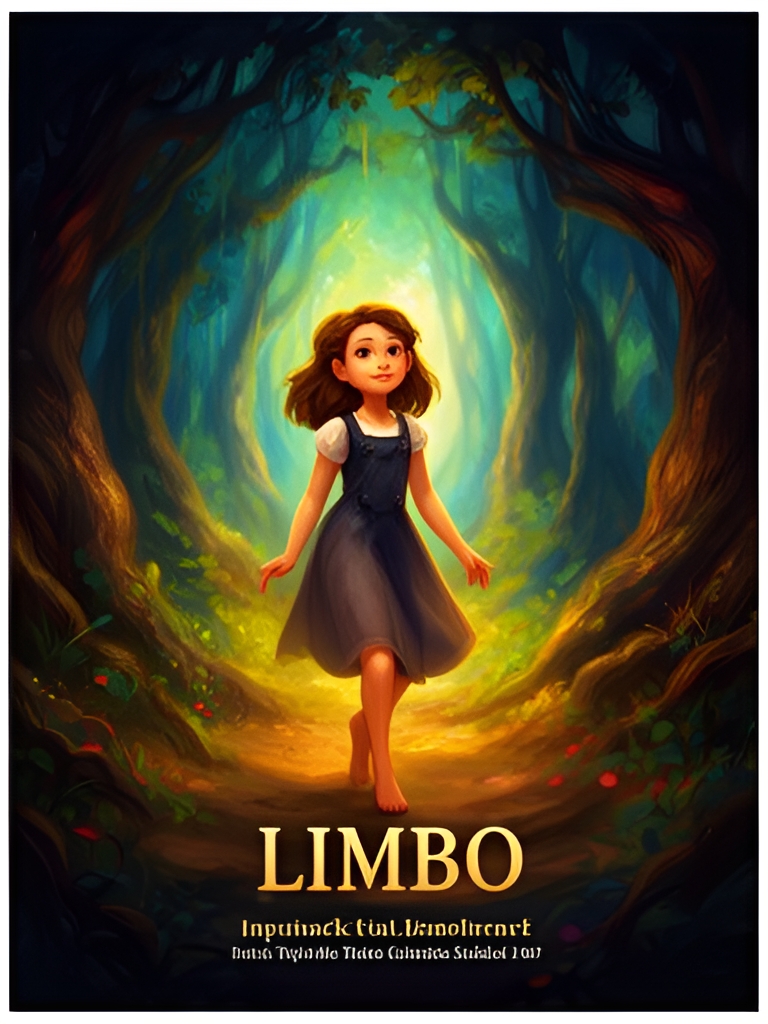
Children's
Limbo
by Thaynara Ferreira do nascimento
5 chapters34 min read
Chapter 1
The Door in the Attic
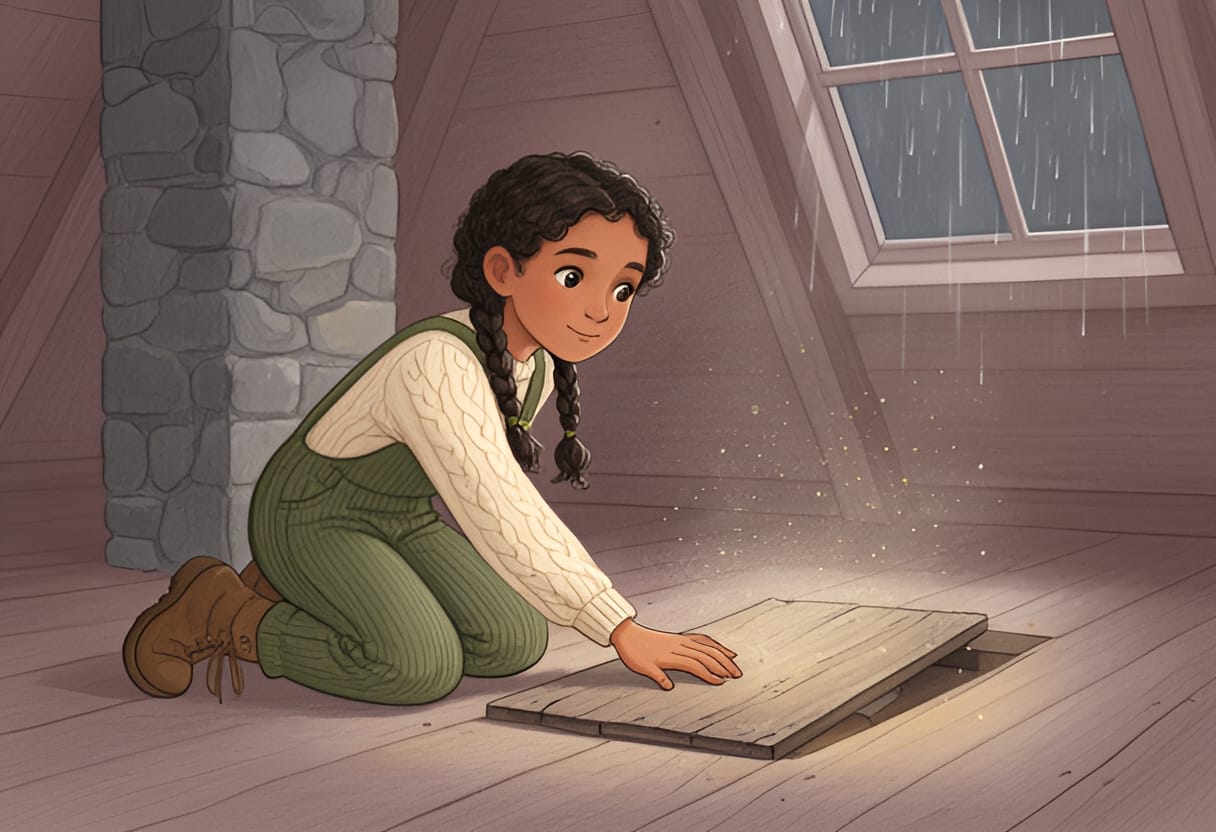
The rain tapped a steady rhythm against the attic window, turning the afternoon light into something soft and gray. Maya wiped her palms on her jeans and knelt beside an old trunk, its wood worn smooth by decades of small hands. She’d been up here for nearly an hour, poking through forgotten things— a music box that no longer played, a doll with one button eye, a stack of letters tied with faded blue ribbon. Nothing felt quite right. Nothing called to her.
Then she saw it.
Near the chimney, where the floorboards met the stone, a faint spiral was carved into the wood. Not deep, not obvious—just a whisper of lines, curling inward like a snail’s shell or the center of a fern. Her breath caught. She’d seen this before. Not here. In her dream.
It came back in flashes: the spiral glowing faintly blue, the air humming like a held note, the sense of stepping through something thin, like wet paper. She’d woken three times this week with her heart pounding, the image etched behind her eyelids.
She reached out, fingertip hovering over the carving. It was cool. Slightly rough, as if someone had scratched it with a nail or a pin long ago.
“Leo?” she murmured, though she knew it wasn’t him. He’d been gone for months. Vanished during hide-and-seek in the backyard, just after lunch. She’d been “it,” counting too fast, laughing when she thought she heard him sneak behind the hydrangeas. By the time she turned, he was nowhere. No footprints in the damp grass. No answer to her calls.
Her grandmother had cried. The neighbors had searched. The police had come. And still, no Leo.
But this—this spiral—it had to mean something.
Maya pressed her palm flat against the board beside the carving and pushed. It didn’t budge. She tried again, harder, fingernails scraping against the edge. On the third try, a sliver of light appeared beneath—a gap where the wood had come loose.
She pulled.
The panel swung inward with a soft sigh, revealing darkness beyond. Not the dark of shadows, but a deeper kind—cool, still, like the inside of a cave. A draft curled out, carrying the scent of rain on stone and something else, faint and sweet, like dried lavender.
Her pulse thrummed in her throat. She swallowed and slipped her fingers into the gap, feeling for a latch or a nail. Instead, her hand met smooth wood— the edge of a door, hidden behind the panel.
It was small. Just tall enough for her to duck through. And it was ajar.
Maya hesitated. The attic smelled of dust and cedar. The rain tapped on the roof. Downstairs, the kettle might be whistling soon. Grandma would call her for tea.
But the spiral. The dream. The cold breath of air from nowhere.
She pushed the door open wider.
Beyond it, the attic was not the attic.
The same beams crossed overhead. The same trunk sat against the wall. But the light was different—muted, as if seen through thick glass. The dust motes hung motionless in the air. The rain on the roof made no sound. Even her breath seemed to slow, each exhale lingering like smoke in cold air.
She stepped through.
The door clicked shut behind her.
No wind. No creak. Just silence, deep and absolute.
Maya turned slowly. The space was familiar, yet not. The colors were drained— the quilts on the trunks were shades of gray, the wood floor a pale ash. Even the sunlight, which should have been bright with summer, felt diffused, gentle, like dawn.
And the air— it felt thick. Not hard to breathe, but present, as if the atmosphere itself were listening.
She took a step forward. Her boot made no sound on the floor.
Then she saw it.
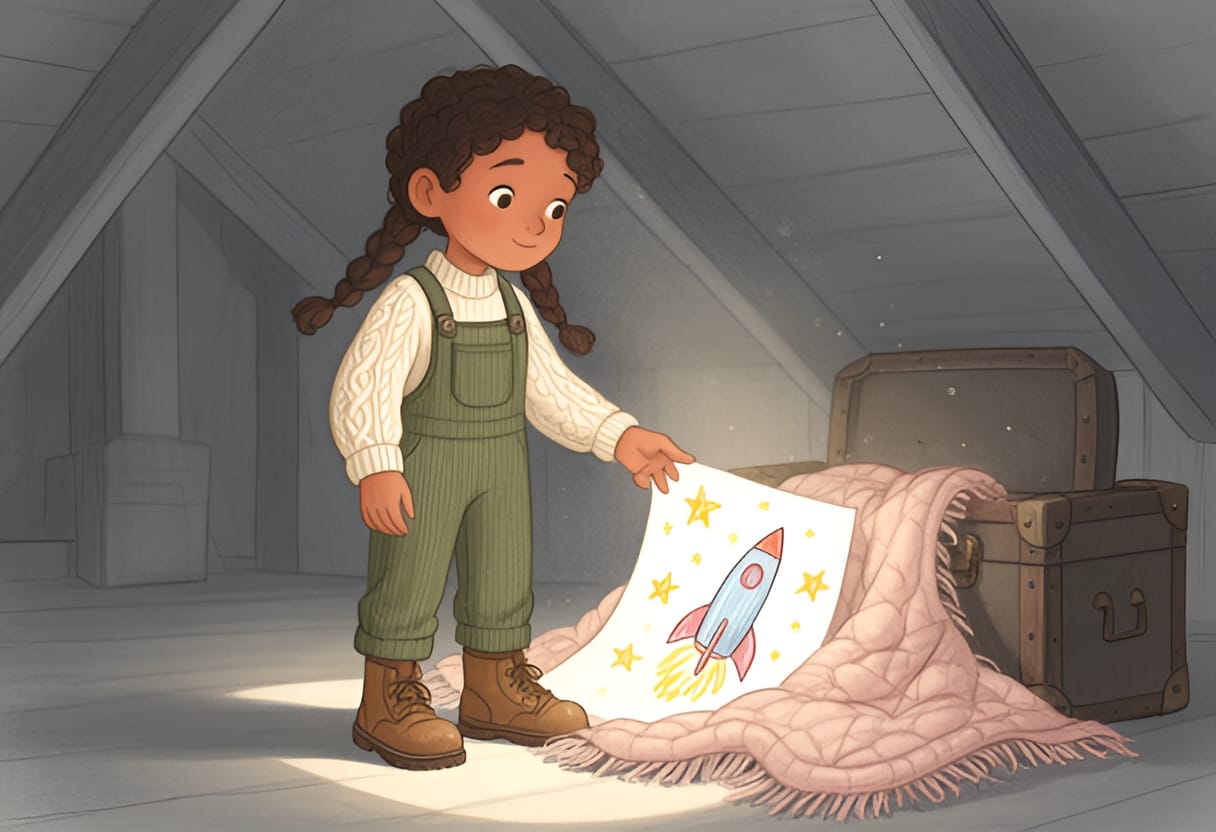
On the top of the nearest trunk, half-buried under a frayed quilt, lay a drawing.
It was done in crayon— bright red for the rocket’s body, yellow for the flames, blue for the stars. A stick-figure waved from the window. In the corner, in wobbly print: To Maya. I’m flying.
Her knees weakened. She didn’t remember seeing this before. But she knew, with a certainty that startled her, that Leo had made it.
She reached out, trembling, and touched the edge of the paper. It was warm.
“Leo?” she whispered, voice raw.
No answer came. But in the quiet, she felt it— not a sound, but a knowing. Like the press of a small hand in hers, fleeting and sure.
Tears burned her eyes, but she didn’t let them fall. Instead, she straightened her spine, squared her shoulders, and whispered back, “I’m coming for you.”
The mist beyond the trunk shifted, just slightly— parting like a curtain drawn by an unseen hand.
And deeper in the hushed, gray attic, a soft blue light began to pulse. Slow. Steady.
Like a heartbeat.
Maya’s breath hitched as the blue light pulsed again—steady, insistent—like a heart urging her forward. She wiped her cheeks with the back of her hand and stepped around the trunk, the drawing clutched tight in her fist. The air here felt thinner, colder near the far wall where the light throbbed, deepening and fading in a slow rhythm.
She hadn’t taken two steps when the mist near the chimney stirred.
Not with wind. With purpose.
A shape unfolded from the gray— not solid, not quite there. A silhouette of soft light, shifting like smoke given form. It had no face, no limbs, only a flowing outline that bent and rose as if listening. It hovered just above the floor, casting no shadow, yet somehow making the dim space feel more watched.
Maya froze. Her pulse jumped, not from fear, but recognition. This was the presence she’d felt in her dreams—the one that had guided her hand to the spiral.
The figure tilted, like a head turning. Then, slowly, it lifted a tendril of light and pointed—not at her, but past her shoulder, toward the farthest corner of the attic where the blue pulse throbbed strongest.
It waited.
Maya swallowed. “You… you’re showing me the way?”
The light shivered. A pulse rippled through its form—bright, then dim—like a nod.
She took a step forward. The figure glided ahead, just out of reach, leading her between trunks draped in gray quilts and stacks of moth-eaten books. As they moved, the air began to shimmer. Not everywhere, but in patches—soft glows that drifted like fireflies trapped in jelly.
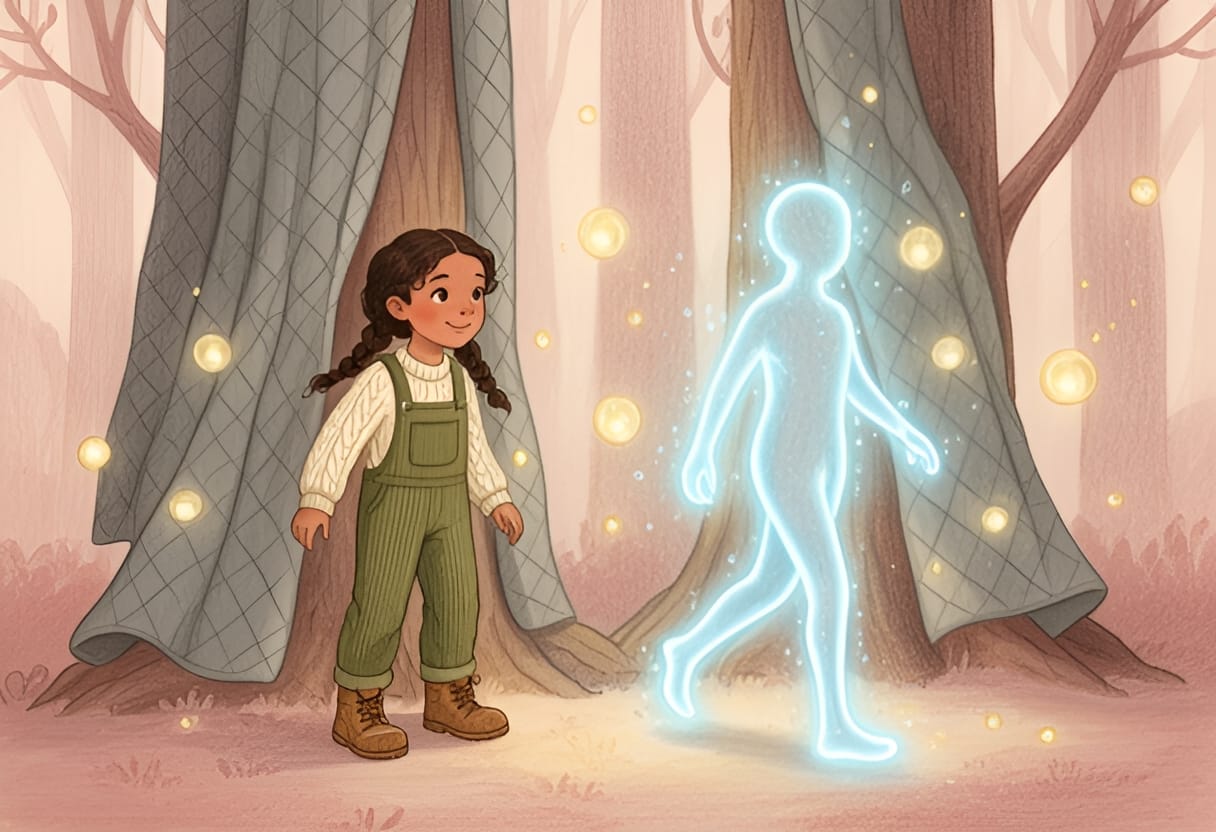
Maya reached out, startled, as one floated near her fingers. It passed through her hand, cool and weightless, leaving behind a fleeting sensation: the smell of suntan lotion, the sound of Leo’s laughter in the backyard, the way he’d scratched his nose when he was concentrating on a drawing.
A memory.
She pulled her hand back, eyes wide. “Those are… memories?”
The figure paused. It turned fully toward her, then swept its arm in a wide arc, illuminating dozens of the floating lights—some bright and close, others dim and distant, like stars behind fog. Then, gently, it pressed its light to its own chest—this is me—and swept outward again—these are yours.
Maya’s throat tightened. “You’re Echo,” she whispered. “The guardian Grandma mentioned in her stories. The one who helps those who’re lost.”
The light flared—soft blue, warm—and curled around her wrist like a bracelet before dissolving into the air.
She followed.
Deeper into the hushed attic, the mist grew thicker, but the memories grew clearer. One showed her and Leo building a fort out of couch cushions, another the way he’d handed her his last granola bar without a word. Each glow carried a feeling, pure and wordless, like a hum in the bones.
At the far wall, where the blue light pulsed like a slow star, the drawing lay exactly where she’d left it—but now, the crayon lines seemed to vibrate, as if the colors were breathing.
Maya knelt. “You left this for me,” she said, voice quiet but sure. “Not just to say you were here. To show me the way.”
The light from the drawing pulsed in time with the distant glow—three quick pulses, then a pause. Like a code.
Echo appeared beside her, not touching, but present—a steady shimmer in the corner of her eye. It pointed at the drawing, then at the pulsing light beyond, then opened its hands, palms up, as if offering understanding.
A trail. Not a message of fear or farewell. A path.
Tears came then, but she didn’t wipe them. She stood, squared her shoulders, and took a deep breath of the still, listening air.
“I’m coming, Leo,” she said, louder this time. “And I’m not stopping until I find you.”
The blue light flared—brighter, warmer—and for the first time, it didn’t just pulse. It beat, like a heart answering.
Echo stepped forward, not to lead, but to walk beside her. And together, they moved into the mist, where the memories glowed like stepping stones, and the silence no longer felt empty—it felt full of footsteps yet to come.
Chapter 2
The River of Unsaid Words
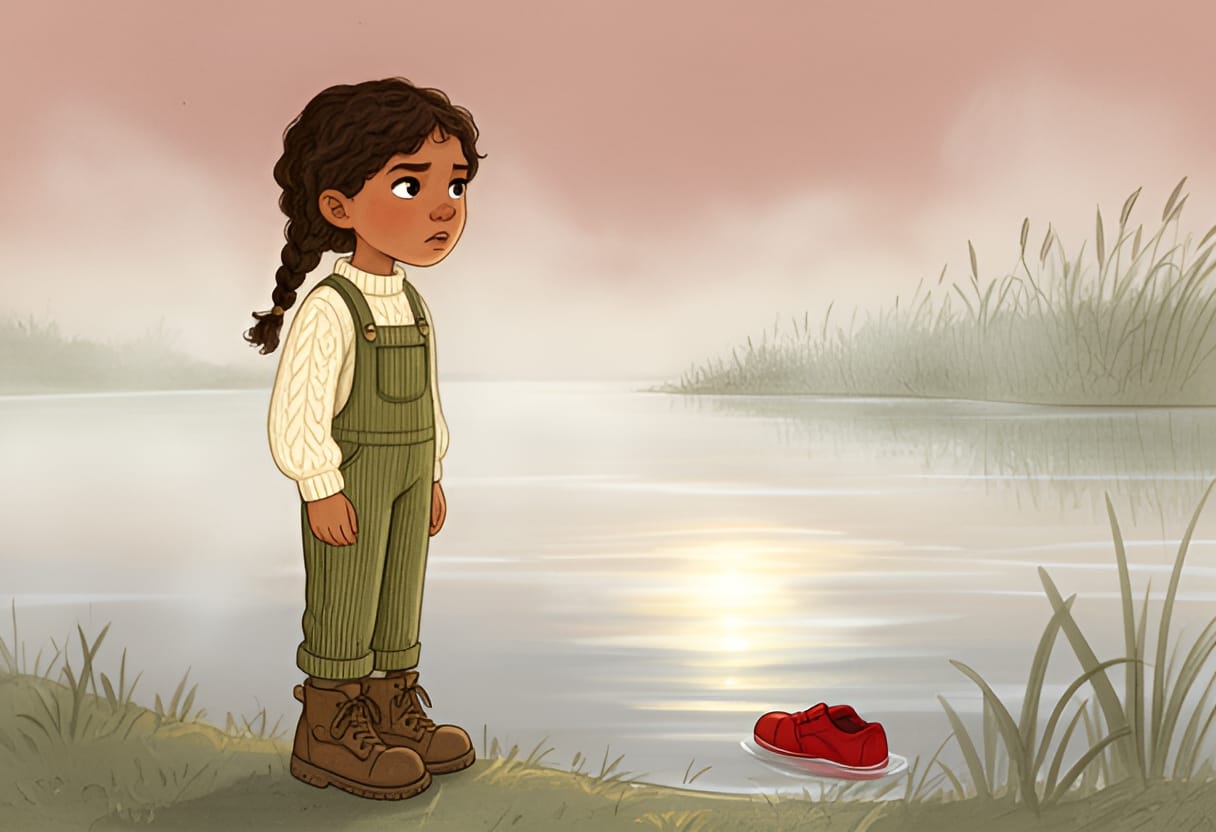
Maya’s breath fogged in the still air as she stepped beyond the attic’s edge. The mist clung to her skin, cool and damp, and ahead, where the memories had guided her, the world opened into a quiet expanse. A silver river wound through the landscape, its surface smooth as polished stone, reflecting no sky, no trees—only a soft, inner glow that seemed to come from within the water itself.
And there, caught in the reeds along the far bank, was Leo’s red shoe.
Maya’s heart lurched. She knew that shoe. The scuff on the toe from when he’d kicked a stone too hard on the porch steps. The frayed lace he always forgot to tie. She’d mended it herself, just last winter, after he came in crying because it had come undone during recess.
“Leo?” she whispered, though her voice sounded thin, swallowed by the hush.
She took a step forward. Her foot met resistance—not water, not air, but something firm and unyielding, like pressing against a pane of chilled glass. She pushed harder, but the surface didn’t yield. It only shimmered faintly where her fingers brushed it, sending ripples of light sideways, like a stone skipped across still water.
She stepped back, frowning. “Why won’t it let me through?”
Beside her, Echo shifted into view—a ripple of pale light, taller now, more defined. It didn’t speak. Instead, it turned slowly, sweeping its arm toward the river.
Maya followed the gesture. The water’s surface wasn’t empty. Drifting on the current, just beneath the glow, were thousands of faint shapes—like leaves, but not quite. They shimmered with a pale, inner light, and as she watched, one turned slowly in the flow. She could make out the curve of a letter. Then another. A fragment of a sentence, half-formed.
“I wish I’d—”
Another: “Sorry I—”
And another, fainter: “If only I had—”
They weren’t leaves. They were words. Unspoken. Left hanging in the air like breath on a cold day, now caught in the river’s slow pull.
Maya’s chest tightened. She recognized the shape of them—not just the letters, but the weight behind them. The hesitations. The things she’d started to say and swallowed. The apologies she’d rehearsed in her head but never voiced. The “I’m sorrys” that died on her tongue when Leo looked up at her with those quiet, trusting eyes.
She remembered the day he vanished. The backyard game of hide-and-seek. How she’d been distracted, scrolling on her tablet, how she’d called out, “Ready or not, here I come!” and turned away to check her messages—just for a second. How when she turned back, he was gone. Not behind the oak bush. Not under the porch. Just… gone.
She had looked, of course. She had screamed, run, begged the adults to help. But in the quiet hours after, when the searchlights swept the woods and the neighbors stood in their doorways with worried faces, the thought had come, unbidden: If I had just held his hand. If I had kept my eyes on him.
She had never said it aloud. Not to Grandma. Not to the police. Not even to herself, not really. She had only felt it—a stone in her chest, growing heavier with each passing day.
Echo drifted closer. It didn’t touch her. But its light softened, warming the air near her shoulder, like a hand held just above the skin, offering warmth without contact. Then it pointed once more—at the drifting words, then at her chest, then outward, toward the opposite bank.
Understanding came not as a thought, but as a release.
She had to speak it. Not think it. Not feel it. Say it. Out loud. Let the words leave her body, raw and true, so the river could know them.
Her throat closed. Her eyes burned.
She looked at the shoe. At the frayed lace. At the tiny, worn hole near the toe where Leo’s little toe always peeked through.
And she spoke.
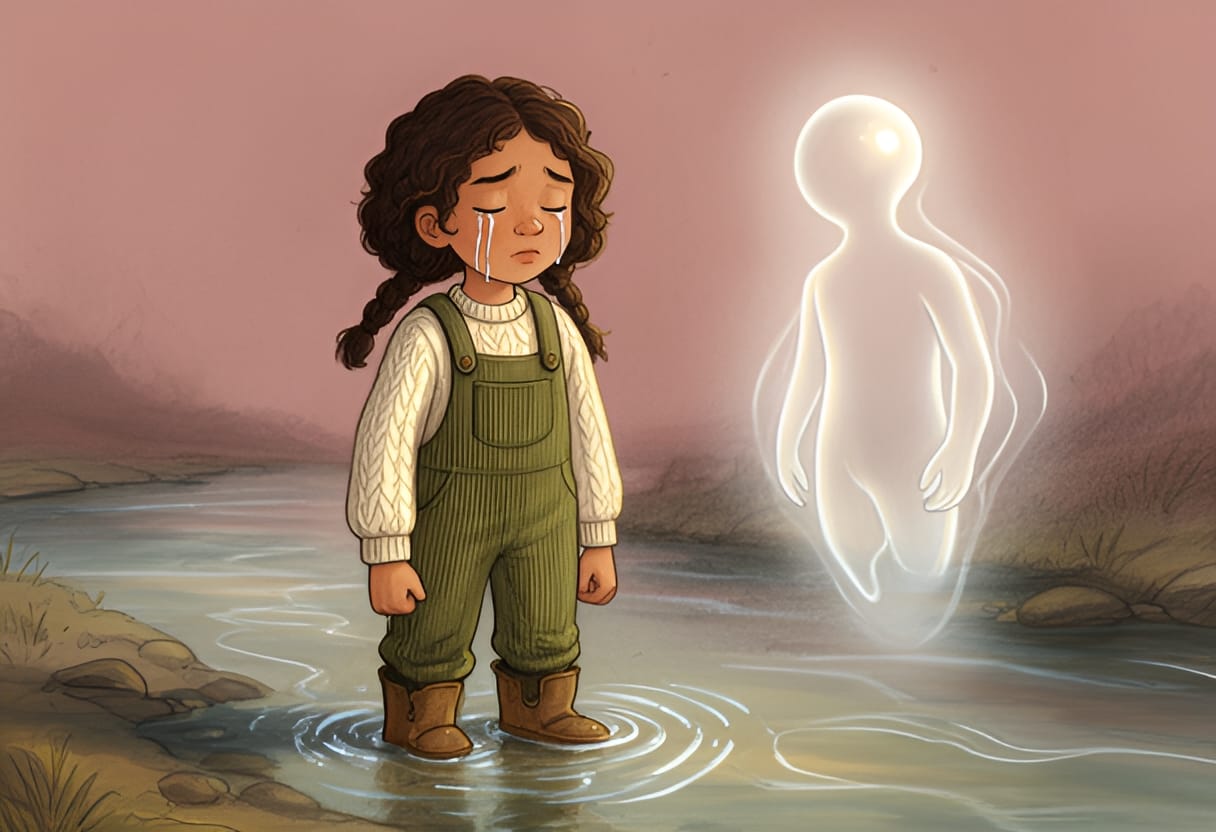
“I should have held his hand,” Maya said, her voice cracking. “It’s my fault he’s here.”
The words hung in the air—trembling, raw, unfinished.
For a moment, nothing happened.
Then the river shivered.
A single ripple spread from where her voice had touched the air. Then another. And another, spreading outward in concentric rings of light. The silver surface began to glow brighter, not with reflection, but from within—like veins of light waking beneath ice.
And then, slowly, the water parted.
Not with a crash, not with a roar, but with a quiet sigh, as if it had been waiting. The solid surface softened, retracted, and revealed a narrow path of smooth stones just beneath the surface, each one glowing faintly blue, like the pulse she’d seen in the distance.
Echo gave a single, gentle pulse of light—acknowledgment—and stepped back, leaving the way clear.
Maya didn’t hesitate. She stepped onto the first stone. It was cool and solid beneath her foot. She crossed quickly, eyes fixed on the reed-choked bank, on the red shoe caught in the tall grass.
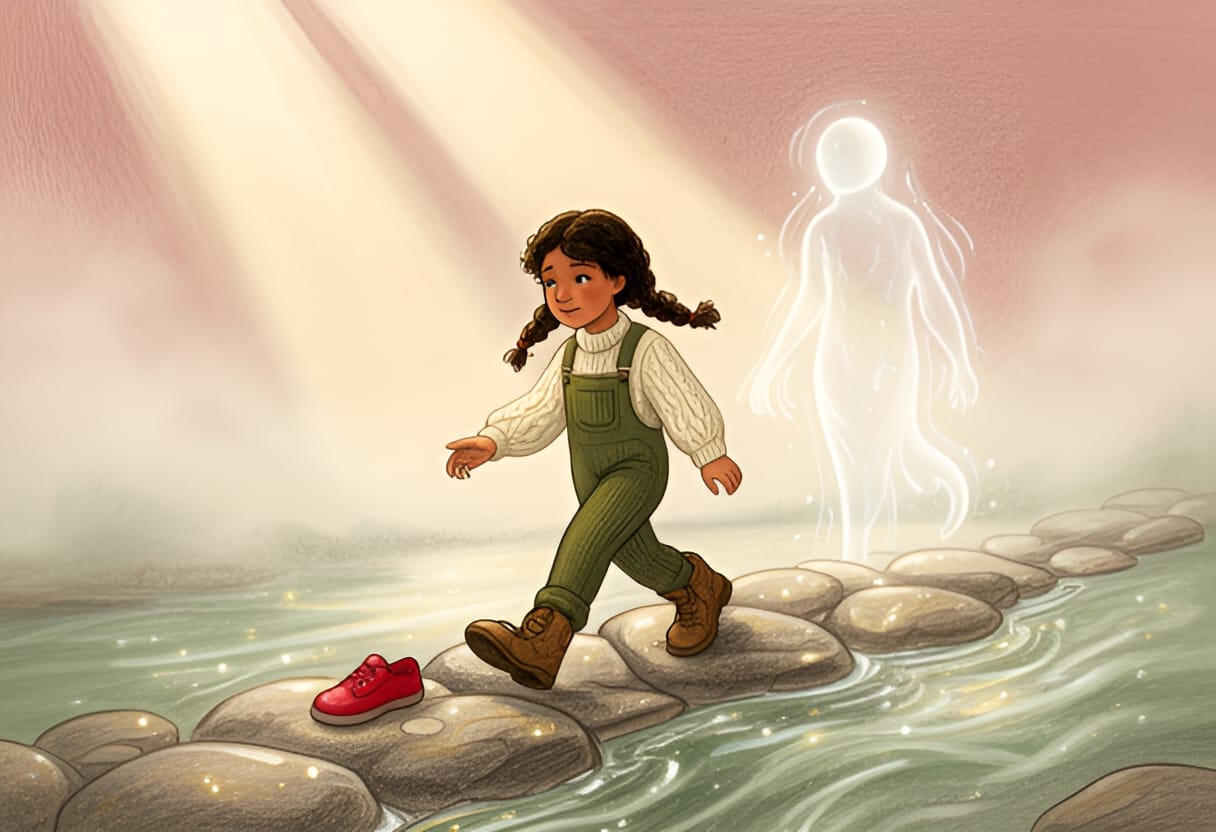
She reached it, fingers closing around the familiar fabric. It was still warm.
She held it to her chest for just a moment, breathing in the faint scent of grass and sunshine and her brother.
Then she turned, looking back across the river.
The water was already closing behind her, the stones fading, the surface smoothing once more. But the drifting words remained—still floating, still waiting.
And she knew, with a certainty that settled in her bones like roots, that this was only the first.
She had spoken one truth.
But there were more.
And she would need to speak them all to reach him.
Maya’s fingers tightened around the warm fabric of Leo’s shoe, the worn cotton soft against her palm. The river’s surface had already begun to smooth, the glowing stones fading like embers under ash. Silence pressed in again, thick and expectant, as if the realm itself were holding its breath.
She turned slowly, eyes scanning the opposite bank. The reeds swayed in a wind she couldn’t feel, and caught among them, half-buried in silt and root, was something else—a small, folded square of paper, its edges curled from damp.
She knelt, ignoring the chill that seeped through her trousers, and picked it up. The paper was thick, like the back of a sketchpad, and though the colors were faint, she recognized the lines immediately.
A stick-figure family stood beneath a lopsided sun—three figures holding hands. Maya, taller, her hair a scribble of lines. Leo, smaller, his smile a simple curve. And between them, a third figure, shapeless but radiant, like a burst of light—Echo, perhaps, or something else entirely.
Beneath the drawing, in Leo’s uneven but determined printing, were two words:
I’m not scared.
Maya’s breath hitched. She traced the letters with her thumb, smudging the graphite slightly. Not scared. Not of the dark. Not of the silence. Not of being lost.
She looked down at the shoe in her other hand, then back at the drawing. A warmth spread through her chest, not the heavy, guilty kind, but something lighter—like the first crack of sunlight after a long night.
She had spoken her guilt. The river had parted. She had found proof he was near.
And now, this.
Leo wasn’t just waiting. He was trying to tell her something. Not with fear, not with blame—but with courage. With trust.
A soft pulse of light stirred behind her. She didn’t need to turn to know it was Echo. The guardian hovered just at the edge of her vision, its light steadier now, less fragmented. It didn’t point. Didn’t gesture. It simply… waited.
Maya stood, tucking the drawing into the pocket of her jacket, close to her heart. She tightened her grip on the shoe—not as a relic, not as a burden, but as a promise.
She looked back across the river. The water was whole again, silver and still, the unspoken words drifting like forgotten leaves. But the path had been made. The truth had been heard.
And she knew, with a quiet certainty that settled deeper than guilt, that she wasn’t done speaking.
She took one last look at the drawing, then stepped forward—not toward the attic, not toward home, but toward the thicket beyond the reeds, where the trees grew close and the light grew dim.
Because if Leo could say I’m not scared in a place like this…
Then she could learn to say it too.
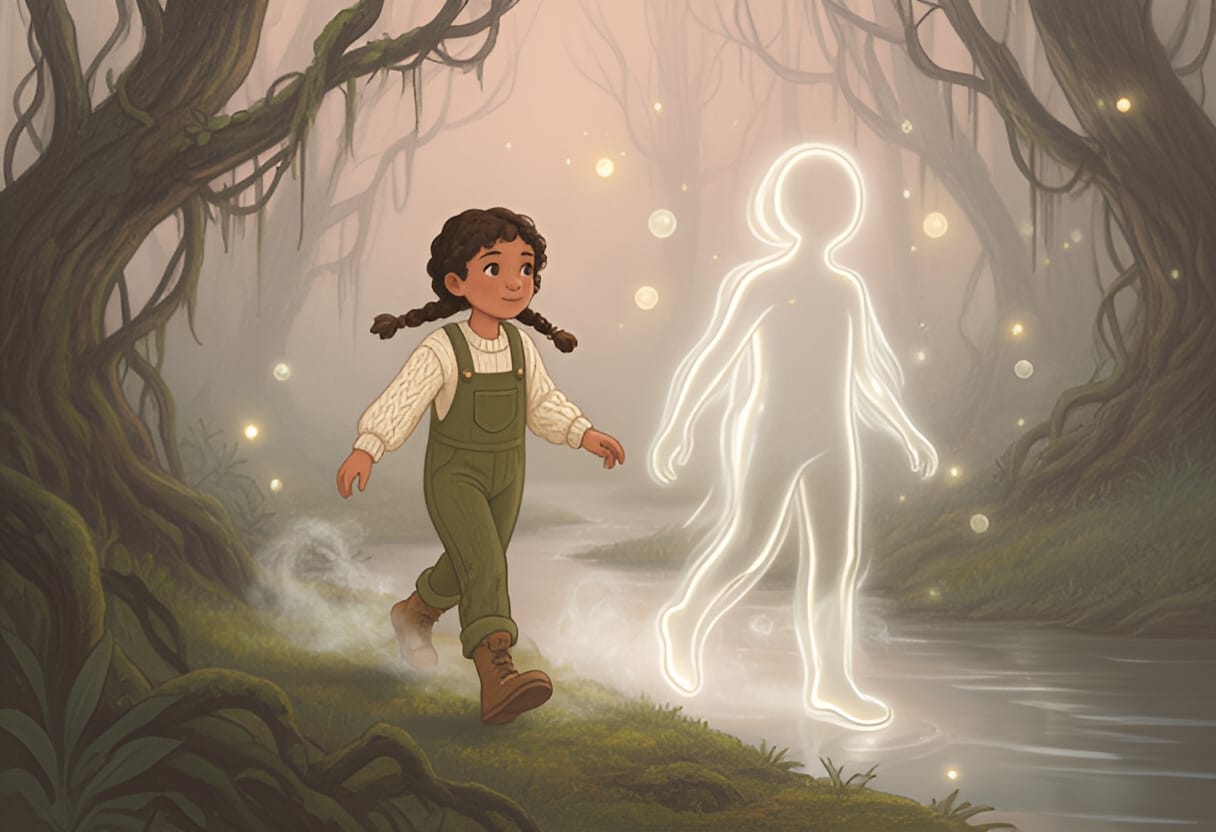
The air shifted as she stepped beyond the reeds, the silence deepening, taking on a new texture—like the hush between heartbeats. The trees here were taller, their trunks wrapped in thin, silver vines that pulsed faintly, echoing the rhythm of the blue light she’d seen in the distance. Leaves, if they could be called that, hung motionless in the air, each one inscribed with a single word in a script that shimmered when she passed: wait. remember. try.
Echo glided beside her, no longer just a ripple but a defined shape—taller, more deliberate, its light now streaked with soft gold at the edges, like dawn filtering through fog. It didn’t lead. It walked alongside, as if sharing the journey.
Maya’s boots crunched lightly on a path of crushed stone and petal-light, each step releasing a whisper of scent—rain on warm earth, the faint tang of lemon, the clean smell of paper just drawn on. She realized, with a quiet jolt, that these were the smells of Leo’s drawings. Of the attic trunk. Of the day he’d handed her the rocket sketch and said, I’m flying.
She paused, hand brushing a vine that trembled at her touch, sending a cascade of tiny lights drifting downward like fireflies in reverse. One landed on her wrist. She lifted her arm. It dissolved into a whisper—not in her ears, but in her chest: I waited.
Her eyes stung. She swallowed hard and kept walking.
Ahead, the thicket opened into a small clearing. In the center stood a stone bench, weathered and moss-covered, and on it, resting as if placed with care, was another drawing. This one was larger, done in thick crayon strokes—red, yellow, blue. It showed a house with a crooked chimney, a swing set swaying in a breeze, and two figures running toward each other across a yard. Above them, in bold, looping letters, Leo had written:
I knew you’d come.
Maya’s breath came short. She sat carefully on the bench, the drawing resting in her lap. The crayon was still warm. Not hot. Not feverish. Just… alive. Like it had been held. Like it had been made not long ago, in this place, by small, determined fingers.
She looked up. The trees here were different—smoother bark, leaves like stained glass, casting colored light onto the moss. And in the branches, nestled where trunk met limb, was a small door. Not hidden. Not locked. Just… there. A tiny arch of woven wood and vine, no bigger than a shoebox, with a latch shaped like a spiral.
Her heart hammered—not with fear, but with recognition.
She had seen this before. In her dreams. In the attic floor. In the quiet space between breaths.
Echo stepped forward, its light flaring gently, then dimming to a soft pulse—once, twice—like a knock.
Maya didn’t hesitate. She reached out, touched the latch, and whispered, so quietly the words were almost a thought:
“I’m here.”
The door clicked open.
Inside, instead of darkness, there was only light—soft, blue, and steady—and the faint, familiar sound of a child’s breath, even and sleeping.
Chapter 3
The Garden of Second Chances
The silvery riverbank faded behind Maya as she stepped onto the mossy path beyond, the air thickening with mist that curled around her ankles like cold fingers. Echo glowed steadily beside her, a soft pulse of light that seemed to breathe in time with her own uneven steps.
Ahead, the trees closed in, their branches knotted and bare despite the strange, timeless quality of Limbo. Vines hung low, dripping with dew that vanished before it could touch the ground. Leo’s crayon drawings—small, smudged sketches of rockets and stars—were tucked into the bark here and there, as if someone had pressed them into the wood for safekeeping. Maya followed them, her breath shallow.
Then, from the fog, shapes began to form.
Not solid, not quite real—more like stains on the air, shifting and thickening until they took the semblance of figures. Tall and thin, their edges blurred like smoke, they drifted forward without feet touching the earth. Their faces were indistinct, but their voices were clear, each whisper a barb wrapped in familiarity.
"You weren’t listening."
The voice sounded like her own, but younger—petulant, frustrated. Maya flinched. She remembered: the afternoon before Leo vanished, she’d been practicing her flute inside, ears covered against the squeak of her own notes. Leo had tugged her sleeve, pointing toward the woods, trying to show her a nest with blue eggs. She’d shaken him off, murmuring, Not now, Leo. I’m trying to get this right.
"You let go too soon."
This one was deeper, rougher—like the voice she used when she was tired and impatient. The day of the game, hide-and-seek in the backyard. Leo had giggled behind the old oak, his small hands gripping her wrists as she counted. When she reached “ten,” she’d spun around, calling his name… but she hadn’t searched the far side of the yard, past the compost heap, where the ivy grew thick. She’d assumed he’d doubled back. She’d been wrong.
More figures emerged from the mist, each one a echo of a moment she wished she could take back. "You were distracted." (When he’d shown her his drawing of the two of them holding hands under a rainbow, and she’d said, That’s nice, sweetie, without looking up from her phone.) "You didn’t hold on." (The memory surged—her fingers brushing his, then slipping as he darted away, laughing.) "You weren’t there."
Each whisper struck her like a cold hand on the chest. Her breath came shorter. Her vision swam at the edges. The thicket seemed to pulse inward, the trees leaning closer, the shadows coiling like ropes at her feet.
She stumbled, catching herself on a vine that felt unnervingly like a grip. Tears burned behind her eyes. I should’ve held tighter. I should’ve listened. I should’ve been better.
Her legs wanted to buckle. To turn back. To flee the accusing voices and return to the riverbank, where at least the truth had been simple: she blamed herself. Here, the blame had faces. It had weight.
But Echo did not waver.
The guardian remained at her side, not speaking, not reaching out—just glowing. A steady, quiet light, like a lantern held low in a storm. Not bright enough to banish the mist, but enough to show her where to place her next foot. Each time a whisper curled around her ear, Echo’s light gave a soft, rhythmic throb—here, here, I am here—as if saying, You are not alone in this.
Maya sank to her knees in the damp earth, pressing her palms into the moss. The whispers rose, a chorus of regret: Too loud. Too slow. Too harsh. Not enough.
She swallowed hard, tasting salt and damp soil. Her throat tightened. She couldn’t undo the past. Couldn’t replay those moments and change them. But maybe—just maybe—she didn’t have to carry them like stones in her pockets anymore.
Her voice, when it came, was barely more than a breath.
“I… I forgive myself.”
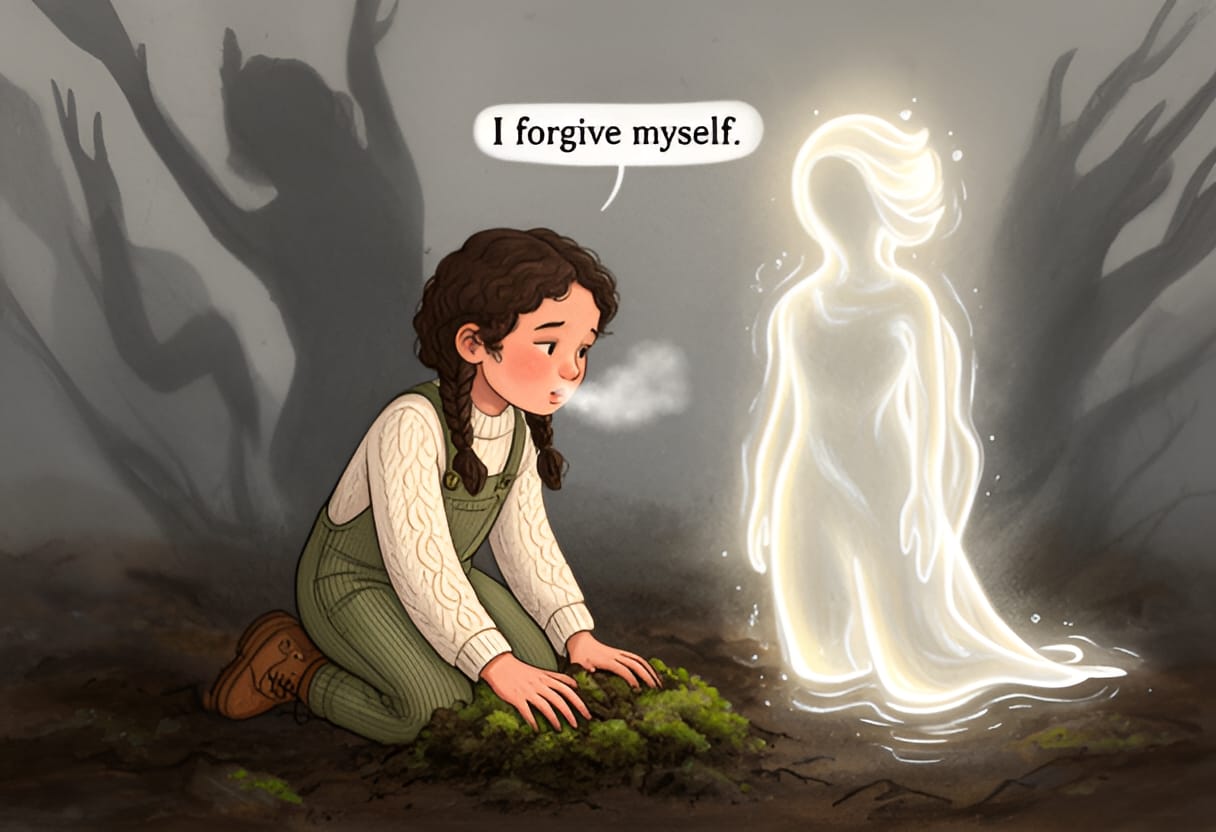
Not for what happened. Not for forgetting. But for being human. For being tired. For being a twelve-year-old girl who loved her brother fiercely and still failed him in small, quiet ways.
The words hung in the air, fragile as a spider’s thread.
And then—
The shadows shuddered.
Not with anger. With release.
Like smoke caught in a sudden breeze, the figures began to thin at the edges, their outlines softening, their voices fading into sighs rather than accusations. The mist lifted, just slightly, letting in a pale gold light that hadn’t been there before.
Maya stayed on her knees, her hands in the dirt, her heart hammering not with fear, but with the fragile, terrifying hope of being heard.
Echo’s light flared gently around her, warm and affirming—not as praise, but as acknowledgment.
You spoke. You are seen.
The thicket, which had felt like a wall, now seemed to breathe. The vines loosened their grip. Ahead, where only darkness had pooled, the trees began to part—not with a crash, but a quiet unfolding, like a flower opening to the sun.
And there, at the edge of the newly revealed space, kneeling in the soft earth with a stick in his hand, was Leo.
He was drawing something in the dirt. A circle. With lines radiating from it.
A sun.
He hadn’t looked up. But he knew she was there.
Maya didn’t move. Didn’t breathe.
She only watched, her tears finally spilling over, as the garden beyond began to wake.
Maya’s whisper hung in the air, a fragile thread of sound against the hush of the thicket. The words were simple, but they carried the weight of every sleepless night, every replayed moment, every “if only” that had coiled tight in her chest.
“I forgive myself for not being perfect.”
The shadows stilled. Then, as if exhaling after holding their breath for too long, they began to dissolve. Not with a scream or a struggle, but with a soft sigh, like mist lifting from a lake at dawn. The accusatory faces blurred, their edges fraying into silver threads that drifted upward and vanished into the growing light.
Echo’s glow swelled, warm and steady, wrapping around Maya like a breath returned. The guardian did not speak, but the light pulsed once—slow, deep, certain—as if to say: It is done.
Maya lowered her hands to the moss, feeling the damp earth cool against her palms. Her breath came easier now, not deep or dramatic, but real. The tightness in her throat eased, not gone, but softened—like a knot loosening after days of strain.
Ahead, where the thicket had been a wall of shadow and accusation, the trees parted fully now. Vines unfurled like sleepy arms stretching toward the sky. Light spilled through—not harsh or blinding, but gentle, golden, the kind that comes just after rain when the sun remembers how to shine.
And there, beyond the treeline, lay a garden.
It was not vast, but it felt infinite in its quiet grace. Wilted blossoms on twisted vines trembled, then opened—petals unfurling not with color, but with light. Soft blues, pale yellows, gentle pinks, each flower glowing from within, as if holding a captured piece of sky. The air smelled of damp soil and something sweet, like crushed mint and sun-warmed stone.
Leo had not moved from his kneeling place in the dirt. But as the light touched him, he finally looked up.
His eyes were wide, not with surprise, but with recognition—as if he had been waiting for this moment, not knowing its shape, but feeling its pull. A small, slow smile spread across his face, tentative at first, then sure. It was the smile he gave when he’d finished a drawing he was proud of, or when he’d caught a firefly in his cupped hands and didn’t want to let it go.
He didn’t speak. He didn’t need to.
Slowly, he rose to his feet, brushing dirt from his knees. In his hand, he still held the stick he’d been drawing with—the sun half-finished in the earth. He took one step forward, then another, his bare feet sinking softly into the loam.
And then he stopped, just within reach.
He looked at her—not through her, not past her, but at her. His gaze held hers, steady and clear. Then, slowly, he extended his hand.
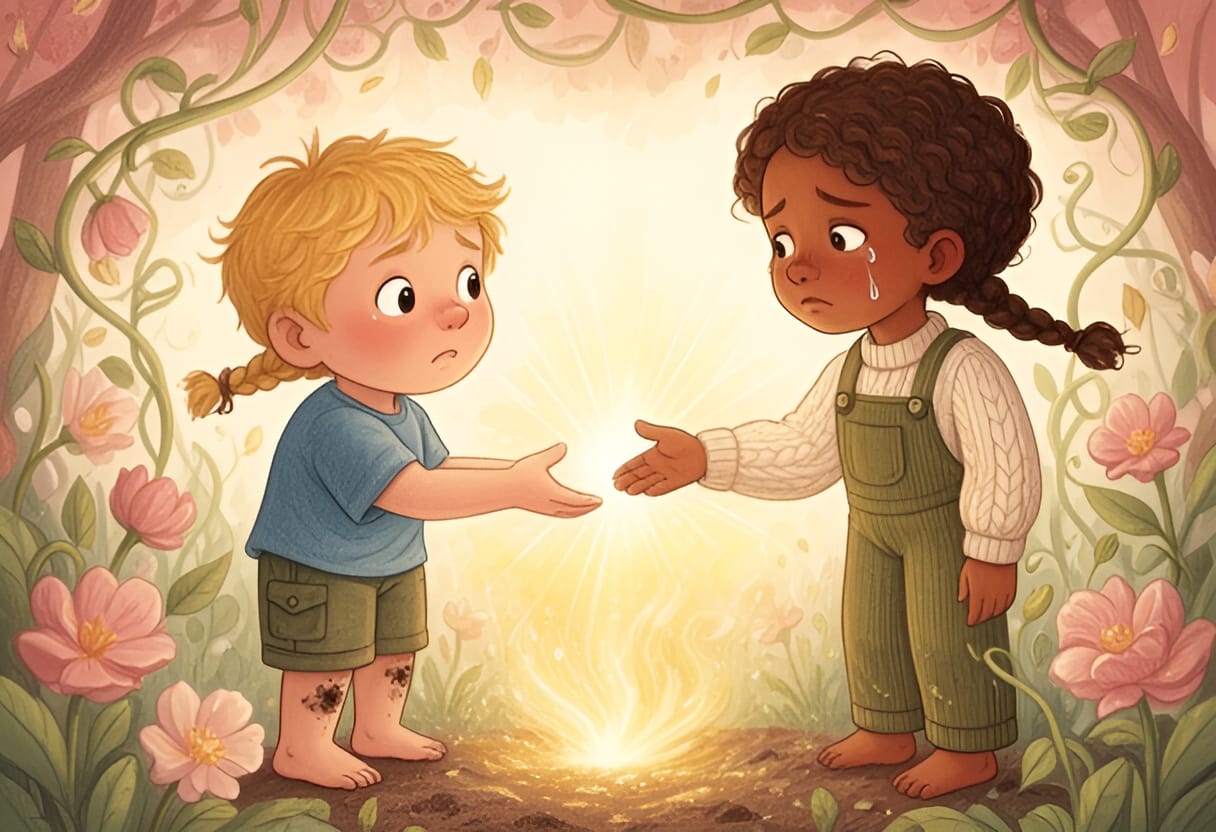
His palm was open, fingers relaxed. Not demanding. Not pleading. Simply offering.
Maya stared at it for a breath, then another. The memory of that day in the backyard surged—not the guilt, not the slipping grip, but the feeling of his small hand in hers, warm and trusting, before laughter pulled him away.
She thought of the crayon drawing on the trunk in the attic—the rocket, the words To Maya. I’m flying. She thought of the pulsing blue light, like a heartbeat under her feet. She thought of all the words she hadn’t said, all the moments she’d wished back.
And she thought of the quiet truth that had brought her here: forgiveness wasn’t about erasing the past. It was about making space in the present for something else to grow.
Maya reached out.
Her fingers trembled at first, then steadied. She met his hand in the air between them—skin to skin, warm and real. His grip was light but sure, like a bird choosing to rest on an open palm.
Echo’s light flared around them—not blinding, but encompassing, weaving through the garden, making the glowing flowers pulse in time with something deeper than sight. A quiet hum filled the air, not from any one place, but from the earth, the vines, the light itself—like the world was breathing with them.
Leo tilted his head, just slightly, as if listening. Then, without letting go of her hand, he pointed—not at her, not at the garden, but past her, toward the thicket they had just left.
Where the shadows had been, there was now a path. Not wide or grand, but clear—a trail of soft light winding through the trees, leading back toward the riverbank, toward the shoe in the reeds, toward the attic door and the spiral carved in the wood.
And at the end of that path, just visible through the trees, stood a figure.
Not solid, not quite real—but there. A woman with kind eyes and silver-streaked hair, her hands folded in front of her, a quiet smile on her lips.
Grandma Elara.
Maya didn’t turn to look. Not yet. She kept her eyes on Leo, on their joined hands, on the garden breathing around them.
But she felt it—the shift, the softening of the air, the sense that something long broken was beginning to mend.
She squeezed his hand, just once.
And Leo squeezed back.
Chapter 4
The Homecoming
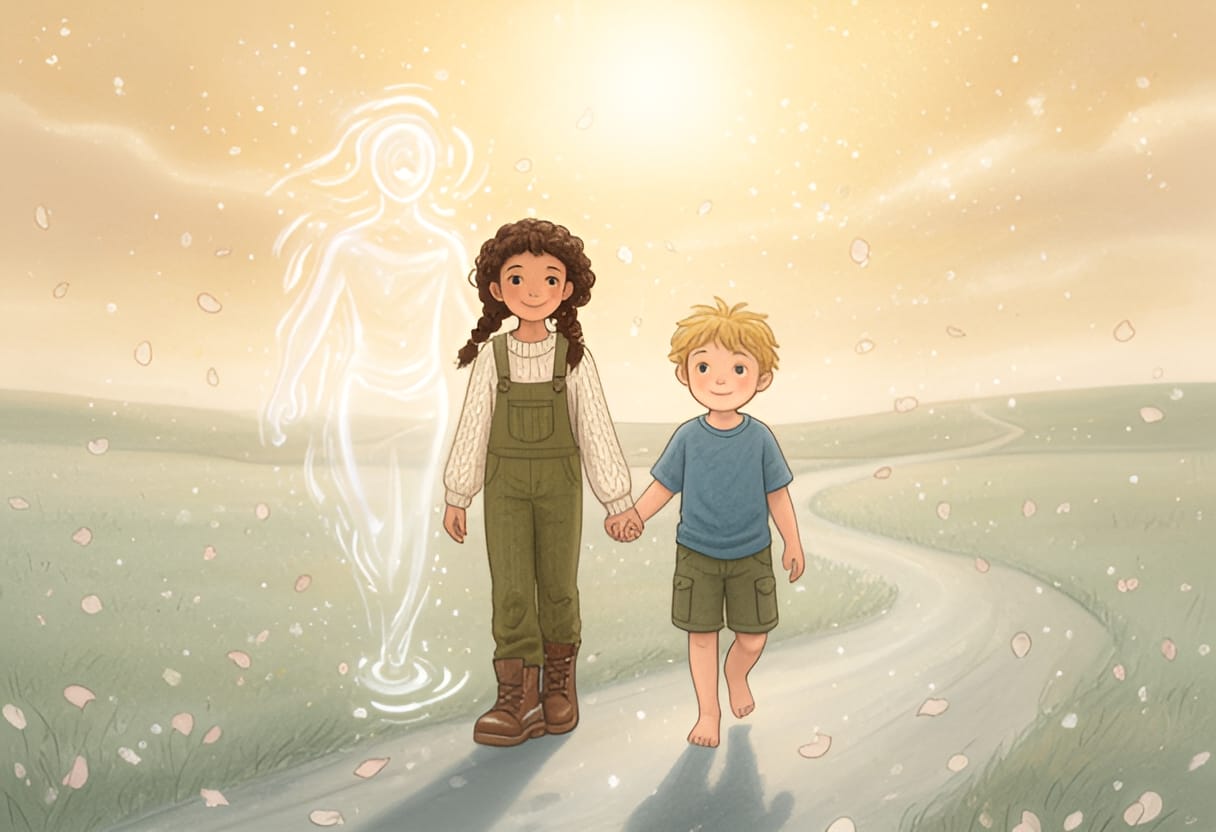
Maya’s fingers closed around Leo’s small hand, warm and real in hers. The garden’s glow softened around them, petals drifting down like slow-falling snow, each one catching the light before dissolving into mist. Leo squeezed back, his grip firm, and took a step forward without hesitation.
“Look,” he said, voice bright, pointing ahead. “The path’s all sparkly now.”
The thicket was gone. In its place stretched a wide trail of packed earth, lined with low bushes whose leaves shimmered silver-green. Above, the sky—if it could be called that—was a soft, luminous gold, as if dawn had decided to linger. The air hummed faintly, not with sound, but with a sense of release, like a held breath finally let go.
Echo walked just behind them, no longer a distinct shape but a gentle ripple in the light, like heat rising from stone. Their presence was felt more than seen—a warmth at Maya’s back, a quiet steadiness in her chest. With each step, the ripple grew thinner, the light more diffuse, as though Echo were pouring themselves into the space between Maya and Leo, sealing their return.
Leo swung their joined hands slightly as they walked. “I made lots of drawings,” he said, eyes scanning the path as if expecting pictures to rise from the ground. “In the thicket, when it was dark, I drew a moon on a rock so I wouldn’t forget what it looked like. And by the river, I made a boat out of sticks so I could pretend I was floating home.”
Maya smiled, guilt loosening its grip just a fraction. “You were brave,” she said. “Staying calm, making marks… that took courage.”
Leo shrugged, but his cheeks flushed. “I wasn’t scared when I knew you were coming. I felt the blue light—like a pulse. It went thoom… thoom… under my feet when I sat still. I knew it was you calling.”
Ahead, the trail began to rise gently, winding toward a familiar silhouette: the attic doorway, standing open in the middle of the plain, framed not by walls but by soft light. The spiral carved into its threshold glowed faintly amber, no longer a mark of mystery but a welcome.
Echo’s presence had softened to a breath of light against Maya’s neck, then to nothing at all. She glanced back. Only a faint shimmer remained in the air where they had been—like the afterimage of a camera flash—and then even that faded.
She turned to Leo, squeezing his hand. “We’re almost there.”
He nodded, eyes wide but unafraid. “I drew you a picture, too. Back by the river. It’s of us holding hands. I left it on a stone so you’d know I was waiting.”
They stepped through the doorway together.
The world shifted—not with a jolt, but a sigh. Dust motes danced in the slanted afternoon sun of the attic. The air smelled of old wood and lavender sachets. The hidden panel stood closed behind them, seamless once more, the spiral now just a faint groove in the floorboards, worn smooth by time.
And there, standing beside the chimney stack with tears tracing quiet paths down her cheeks, was Grandma Elara.
She opened her arms without a word.
Maya rushed forward, Leo tugging her sleeve to keep pace. They collided in a fierce, trembling hug—three hearts beating close, three breaths syncing in the quiet attic. Grandma Elara’s cheek rested against Maya’s hair, her hands rubbing slow circles on Leo’s back. Her whisper was barely audible, but it settled in Maya’s bones like a promise.
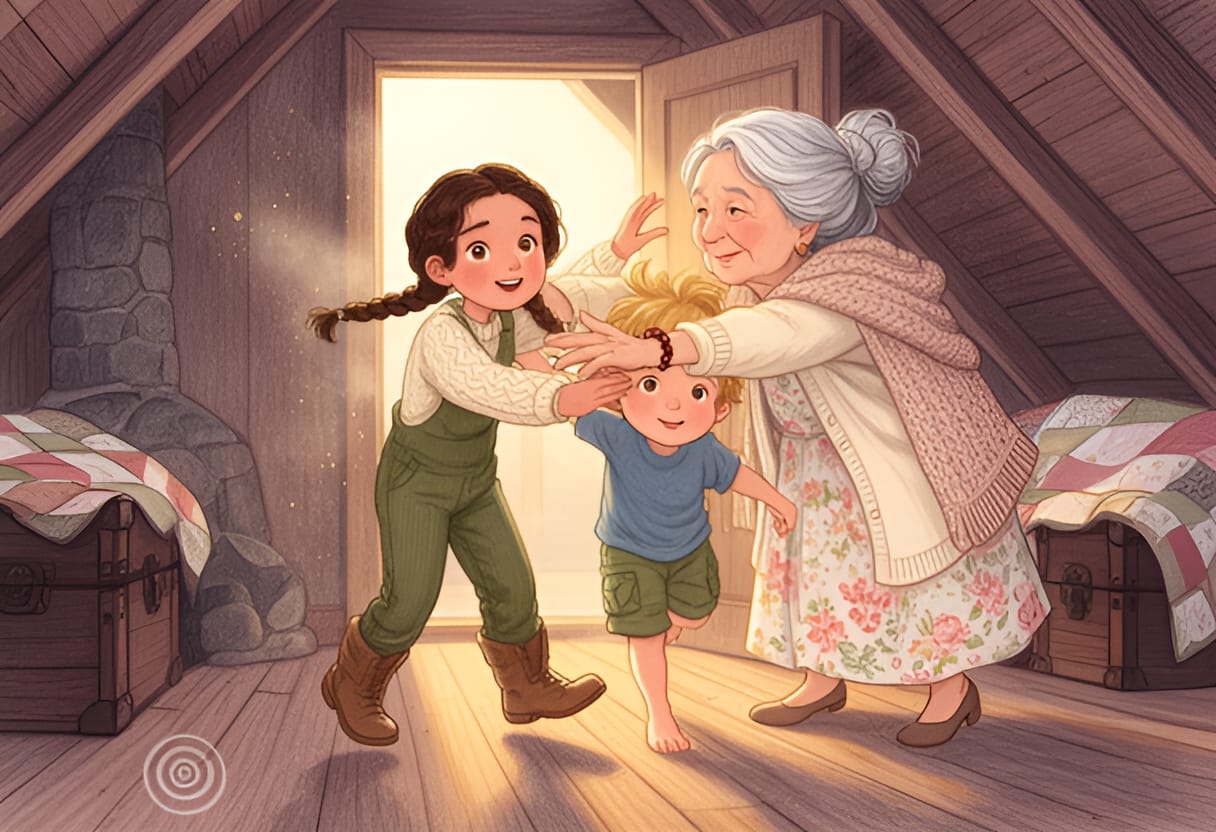
“You brought each other home.”
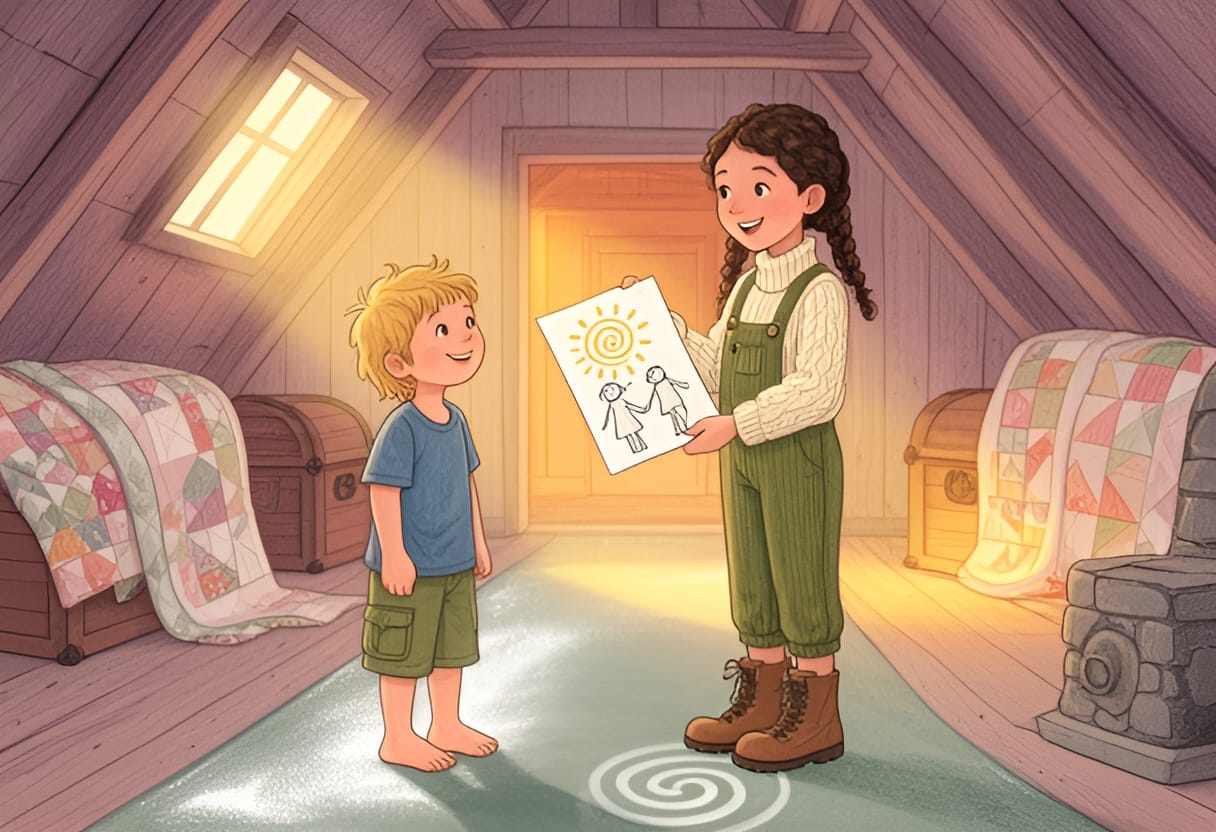
Leo pulled back first, wiping his eyes with his fist. He reached into his pocket and unfolded a crumpled piece of paper—a crayon drawing of two figures holding hands beneath a spiral sun. “I made this for you,” he said, voice small but clear. “So you’d know I was okay.”
Maya took it, her throat tight. On the back, in wobbly but deliberate letters, Leo had written: I knew you’d come.
She looked from the drawing to her brother’s face—really looked—and saw not the lost child she’d feared, but the boy who had waited, drawn, and believed. The guilt that had lived in her chest for months didn’t vanish, but it changed shape, no longer a stone, but a seed.
Outside, the wind stirred the trees. Somewhere, a screen door clicked shut.
And in the attic, where the light pooled warm on the floorboards, Maya finally let herself believe it: they were home.
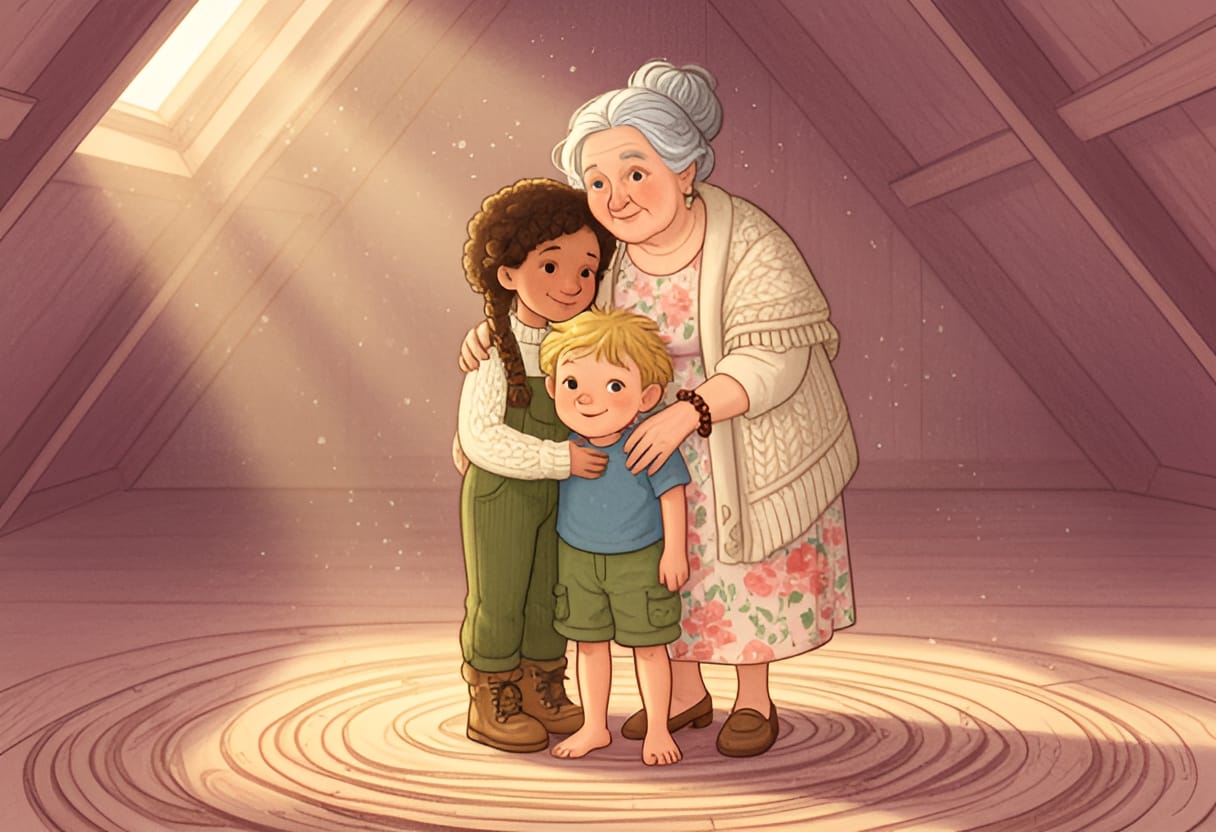
Grandma Elara’s arms tightened around them, her cheek pressing into Maya’s hair as she breathed in the scent of dust and lavender. “I used to come here,” she murmured, her voice thick but steady. “When I was your age, Maya. I followed a light just like yours.” She pulled back just enough to look at each of them, her eyes glistening. “I left the spiral for someone who’d remember. I didn’t know it would be you.”
Leo shifted his weight from one foot to the other, still clutching the drawing. “You knew the way back?” he asked.
Grandma Elara smiled, a soft, weary curve. “I remembered the feeling. The pull. Like a song you half-know.” She glanced at the sealed panel in the floor, where the spiral now lay dormant beneath layers of time and tread. “Some doors don’t stay open. But they don’t lock, either. They wait.”
Maya swallowed, the words thick in her throat. “Thank you—for waiting.”
Grandma Elara reached out, her fingers brushing Maya’s cheek. “You didn’t just find the door, sweetheart. You made it appear again.” She turned to Leo, her expression softening. “And you… you kept the light alive inside you. That’s how she found you.”
Leo ducked his head, a faint pink rising in his cheeks. He unfolded the drawing again, smoothing it against his palm. “I knew you’d come,” he said, quieter this time, but firm. He looked up, meeting Maya’s eyes. “I always did.”
A hush settled over the attic—not empty, but full. The afternoon sun slanted through the window, catching the gold in Leo’s hair, the faint freckles across Maya’s nose, the silver strands threading Grandma Elara’s braid. The air hummed with the quiet certainty of things made whole.
Maya tucked the drawing into her pocket, close to her heart. Outside, a breeze stirred the leaves, and somewhere far off, a screen door clicked shut—but here, in this sunlit room, time felt suspended, sacred.
She squeezed Leo’s hand one last time. Then, together, they stepped back into the ordinary world—where the attic was just an attic again, and the spiral was only a memory in the wood.
But she knew, now, that some doors never really close. They just wait for the right hands to find them.
Maya paused on the attic floor, her palm flat against the cool boards where the spiral had been. The wood felt ordinary now—just grain and age—but beneath her fingertips, she sensed something else: a faint warmth, like sunlight stored in stone. She looked up. Grandma Elara was wiping her eyes with the corner of her apron, a small, proud smile playing on her lips. Leo stood beside her, toe dragging in a slow circle on the floor, as if testing whether the air still hummed.
“Do you think it’ll stay closed?” Maya asked, her voice low.
Grandma Elara shook her head. “Not forever. But not for a long while, either. Limbo only opens when the heart is ready to speak what’s been silent.” She stepped closer, lowering her voice. “And sometimes, it opens for those who need to remember they’re not alone.”
Leo tugged Maya’s sleeve. “Can we come back?” he asked, not fearful, but curious—like asking if they could revisit a favorite hill or tree.
She knelt to his level. “Only if we need to,” she said. “And only together.”
He nodded, accepting that as enough. Then, suddenly, he grinned. “I’ll draw a map next time. With arrows. And a snack stop.”
Maya laughed—a real, light sound that surprised her. “Only if you promise not to feed the shadow birds.”
Grandma Elara chuckled, the sound warm and familiar. “I’ll keep the kettle on,” she said. “Just in case.”
They descended the creaking stairs together, the old wood groaning under their weight like a greeting. Downstairs, the smell of stew drifted from the kitchen—carrots, thyme, something savory and slow-simmered. Grandma Elara hung her apron on its hook and began ladling portions into chipped bowls, her movements steady, unhurried.
Maya carried hers to the window seat, where she could watch the backyard—the very place where Leo had vanished months ago, playing hide-and-seek behind the old oak. Now, the grass was trampled in places from recent play, a red ball lodged in the roots, a jump rope coiled near the fence. Ordinary. Alive.
Leo sat cross-legged on the rug, redrawing their hand-holding figures on a fresh sheet of paper, his tongue poking out in concentration. When he finished, he held it up. “For the wall,” he declared.
Maya took it, her chest light. She didn’t hang it just yet. Instead, she folded it carefully and slipped it into her pocket—next to the first drawing. Two proofs. Two promises.
Outside, a breeze lifted the leaves, carrying them in a slow spiral toward the sky. And for the first time in a long time, Maya didn’t look away. She watched them go, feeling not loss, but motion—forward, together, carried by something quieter than words, but stronger than fear.
Chapter 5
The Light We Carry
Maya’s hand was still warm from Leo’s as they stepped back into the attic. The spiral in the floorboards had sealed shut, smooth wood where the carving had been. Dust motes drifted in the slant of afternoon light, and the air smelled of old paper and lavender from Grandma Elara’s sachet tucked in the chest nearby.
“You were so brave,” Grandma Elara whispered, her arms still around them. “Both of you.”
Leo leaned into her, his small frame trembling slightly. Maya could feel the rapid beat of his heart against her palm where their hands had just parted.
“I knew you’d come,” Leo said again, his voice soft but clear.
Maya looked at him, really looked—at the freckle beside his nose, the way his eyelashes cast tiny shadows when he blinked. The guilt that had lived in her chest for months, a cold, heavy stone, had cracked open in the garden of second chances. It wasn’t gone, but it was lighter now, threaded through with something warmer.
Echo stood a few steps back, their form less defined than before—more a shimmer in the air than a shape, like heat rising off pavement. They tilted their head, not in farewell, but in acknowledgment. Then, slowly, they began to fade, their light softening until it was no brighter than the glow of a firefly caught in a jar.
The attic grew quiet. Only the creak of the old house settling and the distant chirp of a sparrow outside the window remained.
That night, Maya lay awake longer than usual, her mind replaying the day—the river of unsaid words, the garden waking to color, Leo’s hand in hers as they walked home. The attic was dark now, the only light coming from the streetlamp outside, painting silver bars across the floor.
She was on the edge of sleep when she felt it—a presence, gentle and familiar, at the foot of her bed.
Echo stood there, not as a shimmer this time, but clearer, as if they had gathered all their light into one steady glow. In their hands, they held a small stone. It pulsed with a soft blue light, steady and slow, like a heartbeat seen through skin.
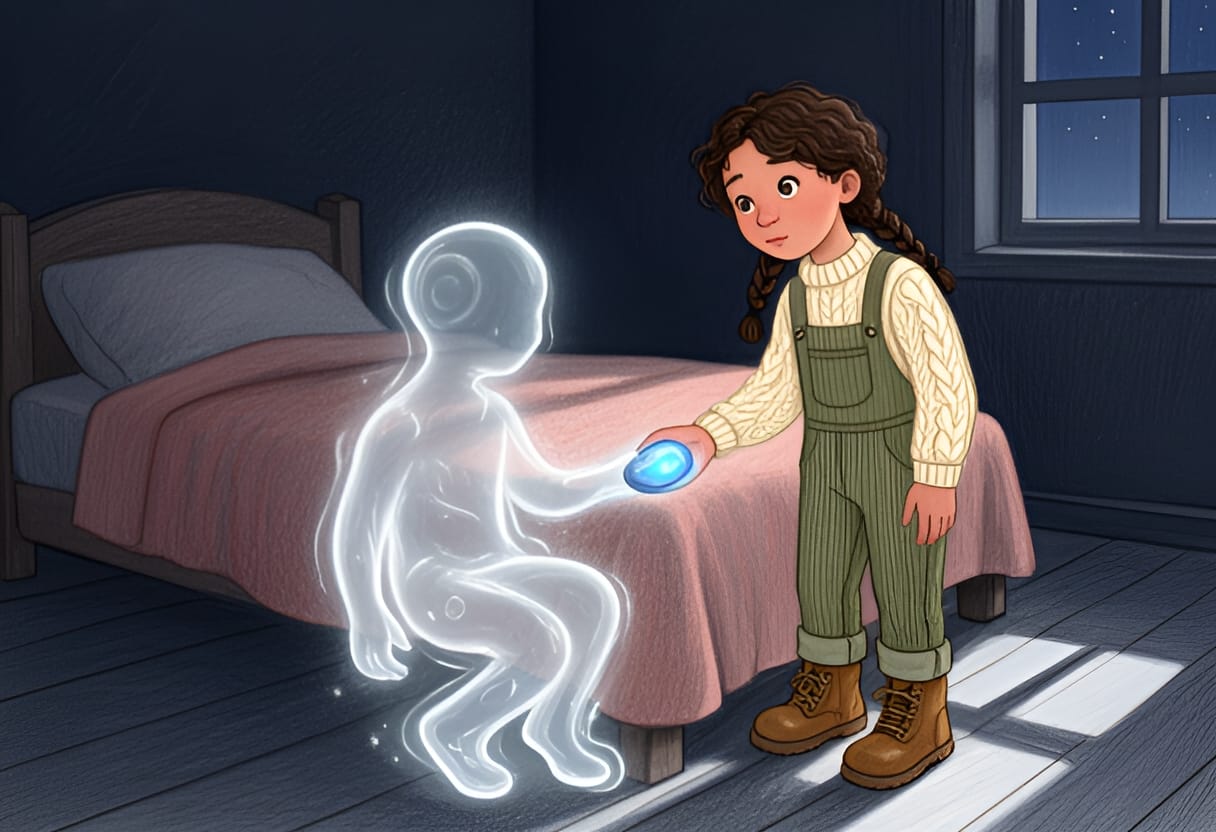
Maya didn’t speak. She didn’t need to.
Echo extended their hands. The stone rested in her palm the moment she opened them. It was warm—not hot, but alive with warmth, the kind that spreads from a cup of cocoa held between fingers on a winter day. The light pulsed once, twice, in rhythm with her own pulse.
A feeling washed over her—not a thought, but a knowing, like sunlight recognizing the curve of a leaf. This was courage. Not the loud kind, but the quiet kind that keeps walking when the path is hard. This was love—not just for Leo, but for herself, finally allowed to breathe. This was the truth she had spoken in the thicket: I forgive myself for not being perfect.
Echo smiled. Not with lips, but with the softening of their light, a gentle brightening that said I see you. You carried it well.
Then they began to fade again, not with a rush, but like mist lifting at dawn. The stone remained in her hand, its glow steady, its warmth seeping into her skin.
Maya’s eyes snapped open.
Her bedroom was dark again, the streetlamp’s bars now gray in the moonlight. But her palm was open, and there it was—the stone. Still warm. Still pulsing, faintly, like a sleeping breath.
She sat up slowly, heart pounding not with fear, but with wonder. She turned the stone over in her fingers. It was smooth, cool where the light didn’t reach, but warm at its center. No bigger than a robin’s egg, it fit perfectly in her palm.
She didn’t know how it had come to be real. She only knew it was.
Outside, a breeze stirred the leaves of the old oak. Somewhere in the house, the floorboard creaked—Grandma Elara, perhaps, checking the door one last time.
Maya slipped the stone beneath her pillow, close to her heart, and let the quiet settle around her. Not empty. Not silent. Full of the kind of quiet that hums.
Sleep came easier this time. And when she dreamed, it was not of doors or rivers or shadows, but of light—soft, steady, and hers to carry.
Maya slipped from her bed onto the cool attic floor, the stone still warm in her palm. The house slept, but not deeply—she could hear the slow tick of the kitchen clock, the sigh of wind through the eaves, the soft creak of Grandma Elara turning in her bed down the hall. Moonlight pooled through the attic window, silvering the quilts, the old trunk, the empty space near the chimney where the spiral had been.
She padded across the floor, bare feet silent on the worn boards, and paused at Leo’s door. It stood ajar, just as she’d left it that morning after their return. Inside, the nightlight cast a gentle glow, painting stripes of gold and shadow across the rug. Leo lay on his side, one arm curled around his stuffed rabbit, ears twitching slightly as he breathed.
Maya pushed the door open wider and stepped inside. The air smelled of lavender and beeswax from the polish on his toy chest. She walked to the edge of his bed and knelt, the stone held cupped in both hands like something fragile and alive.
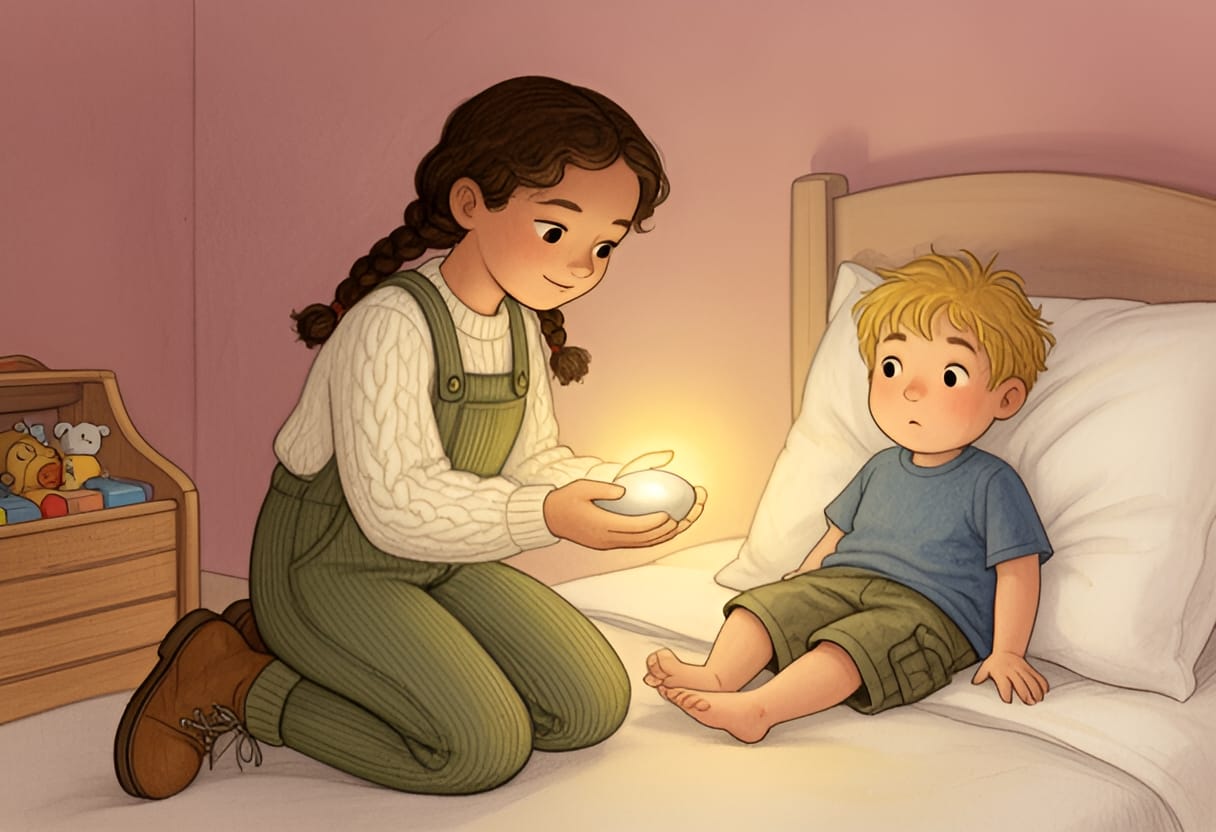
She lifted the corner of his pillow just enough to slip the stone beneath, placing it gently beside his cheek, near the rabbit’s worn ear. It settled into the fabric, its blue pulse faint but steady—a quiet throb against the cotton, like a second heartbeat woven into the dream.
She lingered, watching him. His brow was smooth, his lips slightly parted. The guilt that had once coiled tight in her throat was gone, not erased, but transformed—into something softer, something that breathed with her now. She remembered the weight of it in the garden, the way it had cracked open when she whispered forgiveness. Not forgotten, but no longer a stone. A seed.
She brushed a stray curl from his forehead and pressed her lips lightly to his skin. Warm. Sweet with sleep.
“I’ll always listen,” she whispered, the words barely stirring the air. “Even when it’s quiet. Especially then.”
She stayed a moment longer, feeling the rhythm of the stone through the mattress, feeling Leo’s breath rise and fall beneath her palm where it rested near his shoulder. Then she drew back, smoothed the blanket over his toes, and slipped silently from the room.
Dawn came softly, not with a burst, but a gradual thinning of night. The attic window grew lighter, the dust motes now visible in the pale gold light that crept across the floor. It touched the chimney, the old trunk, the spot where the spiral had lain—now just smooth wood, unmarked, unremarkable. No need for signs. The doorway was closed, not because it was lost, but because it had been walked through. Twice.
Maya stood at the window, her hands on the sill, watching the light spread. Below, the backyard was still wrapped in shadow, the swing set motionless, the grass wet with dew. Somewhere, a bird called—once, twice—then answered from the trees.
She turned and walked back to Leo’s room. The door was still open. She peered in.
He was awake.
Not startled, not calling out—just lying there, eyes open, staring at the ceiling with a quiet familiarity, as if he’d been waiting for the light. His hand lay near the pillow, fingers curled slightly. The rabbit was tucked under his arm.
Maya stepped inside and sat on the edge of the bed, careful not to jostle him.
He turned his head toward her, a small smile touching his lips—not wide, not loud, but deep, the kind that comes from knowing something sure.
“I felt it,” he murmured, his voice thick with sleep but clear. “The stone. It was warm.”
“I know,” Maya said. She reached out and tucked the blanket a little higher. “It’s supposed to be.”
He blinked slowly, then reached out, not for her hand, but for the spot on the pillow where the stone had been. His fingertips brushed the fabric, then stopped.
“It’s still here,” he said. Not a question. A statement.
Maya nodded. “Yeah. It is.”
He let his hand fall back to the blanket, his eyes drifting half-closed again. “You came back.”
“I did,” she whispered. “And I’m not leaving.”
His breathing softened. The smile lingered. He didn’t say more. He didn’t need to.
Outside, the light grew stronger, spilling across the attic floor, climbing the walls, touching the edge of the trunk, the shelves of forgotten things, the quiet space where the door had been. It didn’t shine on wood or dust or nail holes. It shone on what remained—the warmth in a pillow, the weight of a hand, the quiet certainty of a promise kept.
Maya leaned back on her heels, her heart full, not with the loud joy of triumph, but with the deep, steady peace of something restored. She didn’t speak. She didn’t have to.
She just stayed there, watching her brother breathe in the morning light, knowing that some bonds don’t need words to be heard. That some journeys end not with a shout, but with a whisper—and a stone, warm in the dark, and a boy who smiles in his sleep because he knows, without a doubt, that he was never truly alone.