Children's
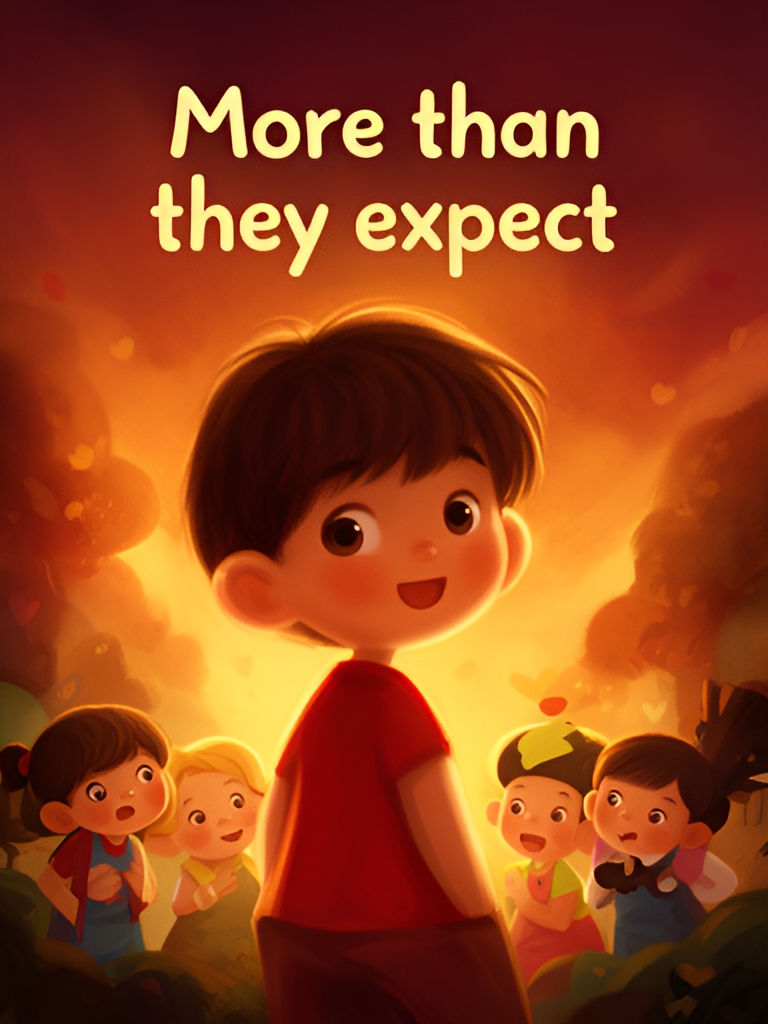
More than they expect
by Ilka Khan
3 chapters17 min read
Chapter 1
The Tall Tower
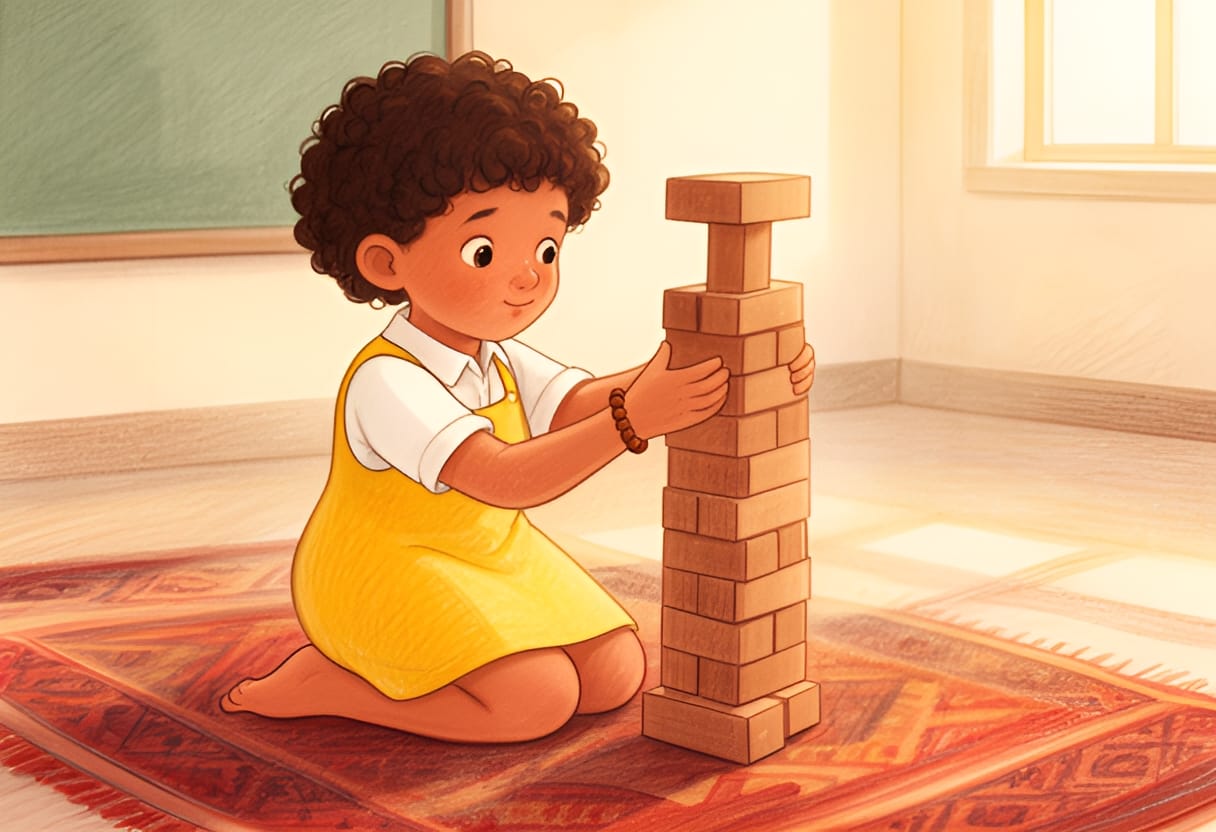
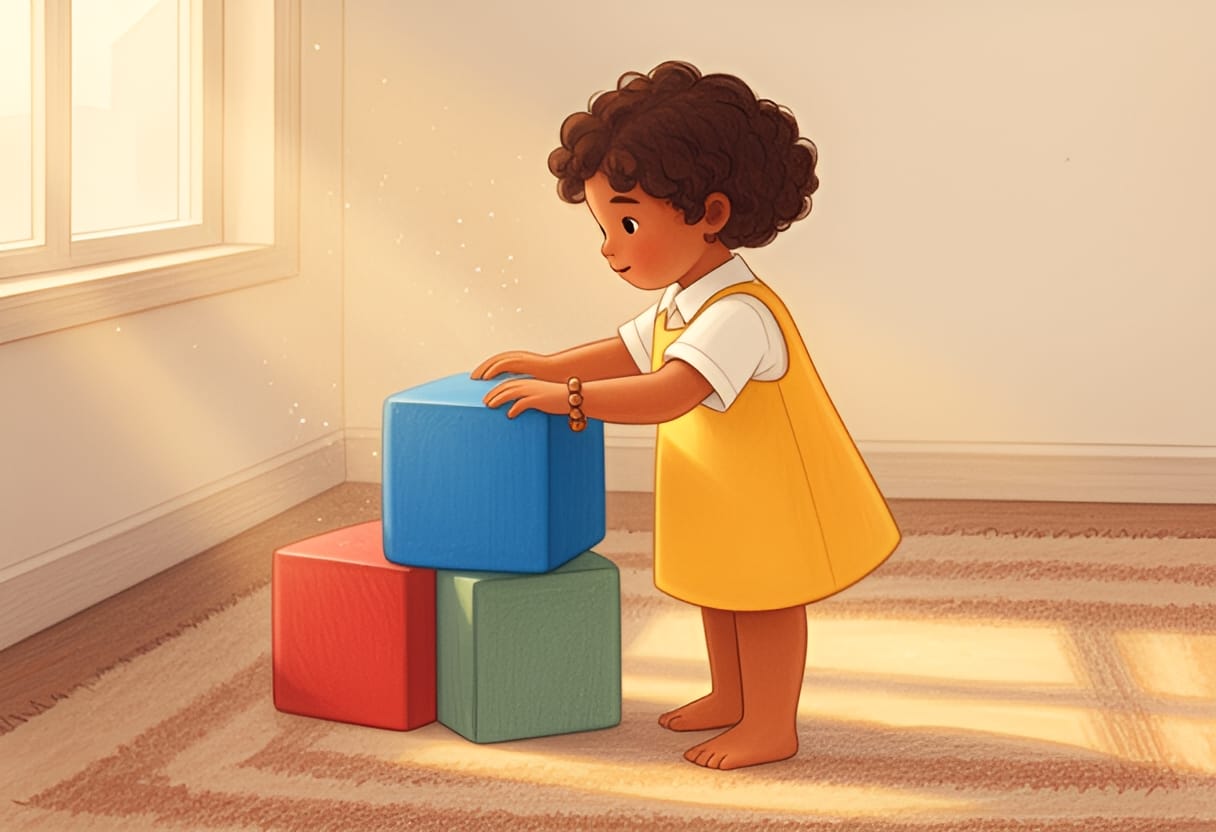
Maya knelt on the rug, her knees pressing into the soft fibers as she reached for another block. Her fingers, small but sure, selected a long rectangle from the bin and placed it carefully atop the growing stack. She tilted her head, squinting one eye, then nudged it a fraction to the left. Balance was everything. She had learned that from watching her grandmother fix the wobbly kitchen stool — how a tiny shift could make the difference between standing tall and tumbling down.
Around her, the classroom hummed with the usual morning activity. Some children drew at the tables, others raced miniature cars across the floor, and a few whispered over picture books in the corner. But Maya’s world had narrowed to the tower in front of her — a spiraling ascent of squares, triangles, and arches, each chosen not just for size, but for how it fit with the one below. Her tongue poked out slightly from the corner of her mouth, a sign of deep concentration she didn’t even notice.
She added a curved piece, then a flat square to level it, then a slender column that made the tower sway just a breath before settling. It was taller than her waist now, taller than her desk, and she had built it all by herself.
A shadow fell across her work. Maya blinked and looked up.
Liam stood beside her, arms crossed, one foot tapping lightly against the rug. He watched the tower for a moment, then let out a short, sharp laugh.
“Girls don’t build towers like that — it’s for boys,” he said, his voice loud enough that a few nearby heads turned.
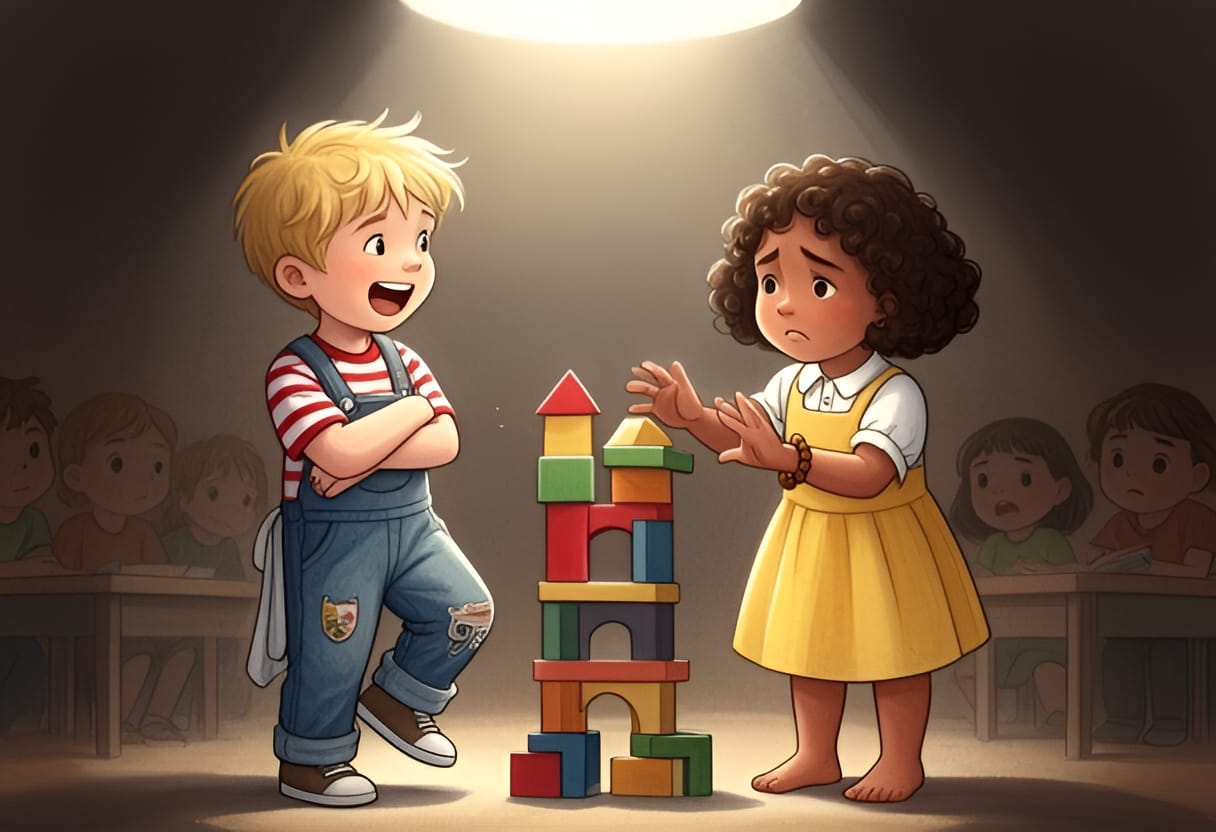
Maya’s hands froze halfway to the bin. The smile that had been spreading across her face drained away, leaving her cheeks warm and then cold, like water splashed unexpectedly.
She looked from Liam’s smirking face back to her tower. It stood straight and proud, each block aligned with care. But now, in the sudden quiet that had settled over her ears, it seemed to wobble — not from imbalance, but from doubt.
Was it really too tall? Too fancy? Too much?
Her fingers trembled as she reached for the top block — a bright yellow triangle she had saved for the peak. She lifted it, then lowered it again, hovering just above the tower. The pride she had felt moments ago, the quiet joy of making something strong and beautiful, began to crack, piece by piece.
She started to take the tower apart.
Not all at once, but slowly — removing the top block, then the one beneath it, placing each back in the bin with deliberate slowness. Her movements were careful, but her chest felt tight, as if someone had squeezed it gently but firmly.
Zara, who had been drawing nearby, paused her crayon mid-stroke. She tilted her head, watching Maya’s hands move over the blocks.
“Hey,” Zara said softly, “are you okay?”
Maya didn’t answer right away. She placed the last block she had taken — a smooth, blue square — into the bin and wiped her palms on her pants, though they weren’t dirty.
“I… I don’t know,” she murmured, her voice smaller than she meant it to be. “Maybe… maybe he’s right.”
She didn’t look up. She couldn’t.
The tower was gone now. Only the memory of its height remained — and the quiet, growing sense that maybe she didn’t belong here after all.
Maya’s fingers lingered on the edge of the bin, the smooth blue square still warm from her grip. She stared at her hands, then slowly unfurled them, letting the block rest where it had fallen. The tower was gone — not crashed, not fallen, but taken apart, piece by careful piece, as if she were undoing a mistake.
A quiet settled over the rug, thicker than the morning hum that had filled the room just moments before. The distant scratch of crayons, the soft thump of toy wheels, the murmur of voices — all seemed to come from far away, as though she were listening through water.
Liam had turned back to his own game, a line of red cars parked neatly along the edge of the block rug. He didn’t look at her. He didn’t need to. His words had already landed, and they were still falling.
Zara stayed where she was, one knee drawn up, her crayon hovering over the half-finished sun in the corner of her paper. She didn’t speak again. She just waited, her eyes kind and steady, like she was giving Maya space to find her voice.
Maya swallowed. Her throat felt tight, not from crying, but from the weight of something heavy and quiet settling in her chest. She looked at the empty space where her tower had stood — just the faint impression in the rug where the base had pressed down, like a ghost of height.
“I worked so long on it,” she whispered, more to the rug than to Zara. “I counted the blocks. I made sure each one fit. I even saved the yellow triangle for the top.”
Zara nodded slowly. “It was really tall. I saw you measuring it against your desk.”
Maya let out a shaky breath. “And then he said it… like it was a rule. Like there’s a sign somewhere that says ‘No Girls Allowed’ on the block shelf.”
She finally looked up, her eyes meeting Zara’s. “What if he’s right? What if building… isn’t for me?”
Zara’s brow furrowed, not in anger, but in concern. She set her crayon down and scooted a little closer on the rug. “Maya, you built that all by yourself. You didn’t ask for help. You figured out how to make it stand when it wobbled. That’s not luck. That’s skill.”
Maya looked down at her hands again. “But Liam said — ”
“I know what he said,” Zara interrupted gently. “And I heard how loud he said it. But just because someone says something loud doesn’t make it true. My mom says sometimes people say things because they’re scared — scared they can’t do it themselves, or scared that if girls can build too, then it’s not special anymore.”
Maya blinked. “But… what if it’s not special? What if I’m just pretending?”
Zara reached out, not to touch her, but to point toward the bin where the blocks lay scattered. “Then let’s find out together. You don’t have to build alone. I’ll help. We can make it even taller this time — wider at the bottom, so it doesn’t sway. We can use the flat pieces for steps, like a castle.”
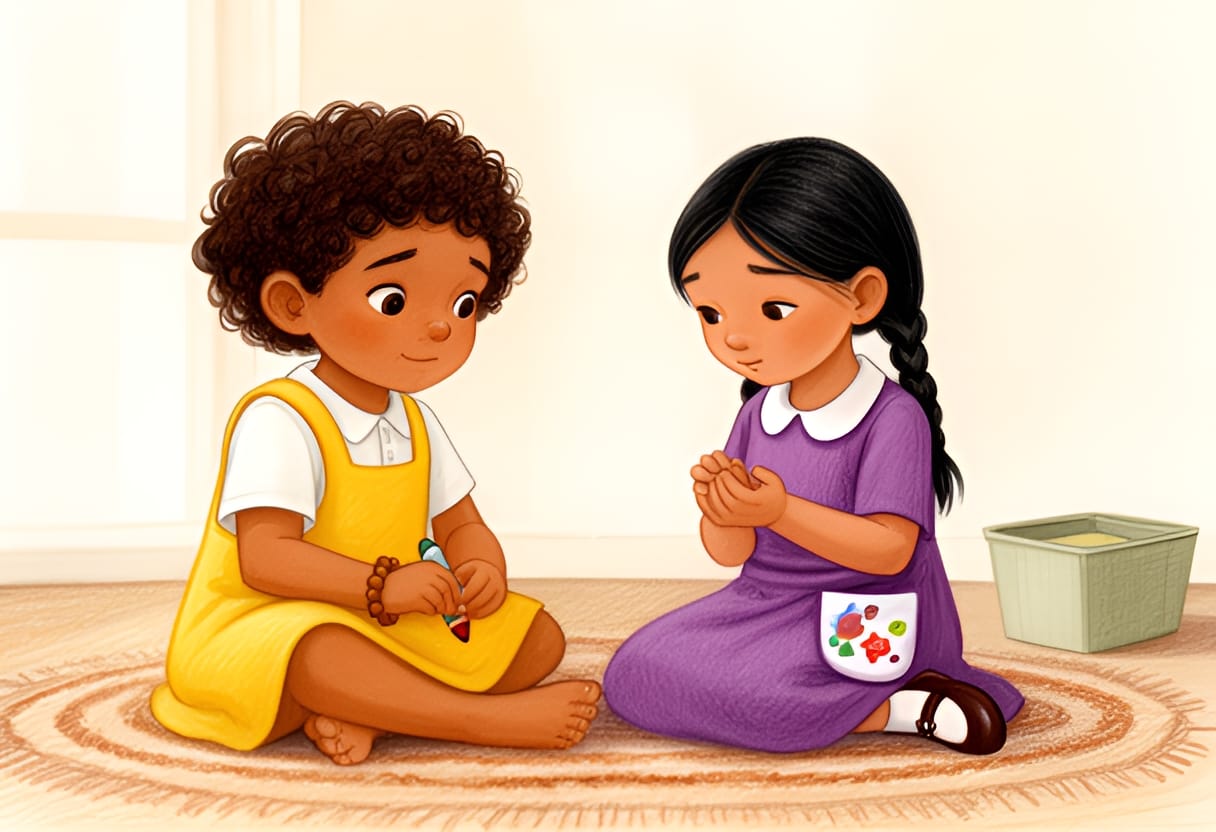
Maya’s lips parted. She hadn’t thought of that. She had been so focused on height, on going straight up, that she hadn’t thought about strength, about base, about sharing the work.
A small, hesitant breath escaped her. “You… you’d really build with me?”
“Of course,” Zara said, smiling now. “Best towers are built by teams. My grandma says the strongest bridges aren’t made by one person — they’re made by lots of hands, all caring about the same thing.”
Maya looked past Zara, toward the bookshelf in the corner where she had gone to sit alone after putting the last block away. The quiet there felt safe, but also lonely. She thought of her tower — not as something too tall, but as something that had simply stood too briefly.
She pushed herself up from the rug, her knees slightly stiff from kneeling. “Okay,” she said, her voice softer than before, but clearer. “Okay, let’s try again.”
Zara grinned and scrambled to her feet. “I’ll get the big squares. You find the long rectangles — the ones that lock tight.”
As Maya walked toward the bin, she didn’t look back at the spot where her tower had fallen. Instead, she watched her hands move — open, reaching, choosing. Not with doubt, but with purpose. The blocks were cool and smooth in her palms. And for the first time since Liam had spoken, she didn’t wonder if she belonged.
She wondered how high they could go — together.
Chapter 2
Grandma’s Hands
Maya’s fingers curled around the edge of the bin as she pulled out a long rectangle, its smooth sides cool against her palm. The classroom hummed behind her — chairs scraping, pencils scratching, Zara’s quiet voice already calling out, “Found a flat one for the base!” — but Maya stayed where she was, turning the block over in her hands, feeling its weight, its certainty.
The final bell rang. Backpacks zipped. Coats were shrugged on. One by one, the children filed out, laughing, shouting promises to meet at the swings or save seats on the bus. Maya lingered, helping Zara stack the stray blocks into neat piles, her movements slower now, thoughtful. When the last child disappeared down the hall and the teacher flicked off the lights, Maya slipped her small backpack over one shoulder and pushed open the classroom door.
The walk to Grandma Elena’s house was short — just three blocks past the bakery with the cinnamon rolls that always made Maya’s stomach rumble, and the park where the old oak tree had a hollow big enough to sit in. But today, her steps felt heavy, as if each one carried the echo of Liam’s voice: Girls don’t build towers like that.
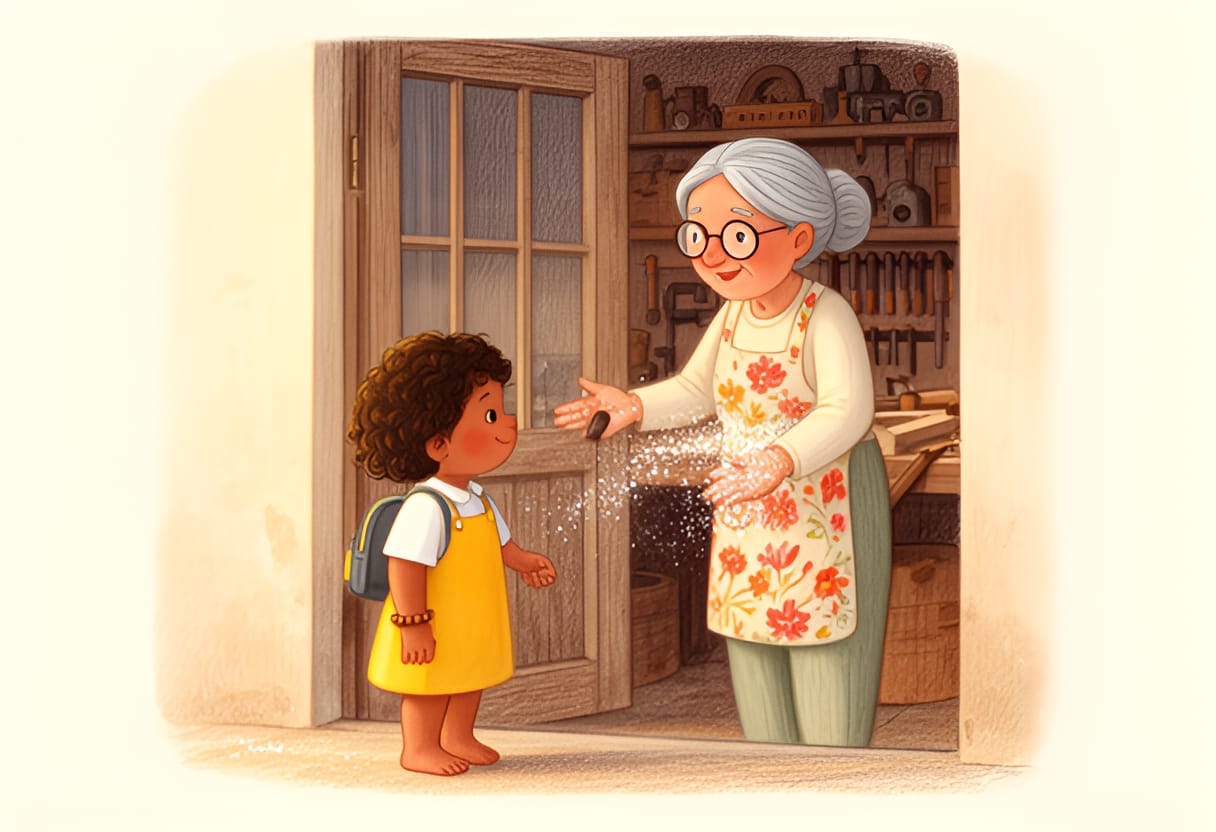
She didn’t knock. Grandma Elena was already at the screen door, her silver hair tucked under a faded bandana, her hands dusted with sawdust. She smiled when she saw Maya, not with questions, but with understanding.
“You look like you’ve carried something heavy all day,” she said, opening the door wider. “Come in. I’ve got a job that needs two pairs of hands.”
Inside, the workshop smelled of wood oil and beeswax. Shelves lined the walls, holding jars of nails, spools of wire, and tools hung in neat outlines — hammers, wrenches, pliers, and a set of screwdrivers with handles worn smooth by use. A radio played soft jazz in the corner, and a cat blinked lazily from a sunbeam on the workbench.
Grandma Elena led Maya to a low shelf near the back, where one corner sagged noticeably. A picture frame had slipped sideways, and a basket of yarn leaned at an angle.
“See how it wobbles?” Grandma Elena said, resting her palm lightly on the shelf. “It’s not the wood. It’s this screw.” She pointed to a small metal fastener near the top bracket, where the wood had begun to split slightly around the hole. “Worked loose over time. Happens when things carry weight — shelves, hearts, ideas. Sometimes all they need is a little tightening.”
She reached into her apron pocket and pulled out a screwdriver with a yellow handle. “You’ve got strong fingers, Maya. And you pay attention. That’s half the battle.”
She handed the tool to Maya, who took it cautiously, her thumb resting on the ridge where the metal met the plastic.
“Show me,” Grandma Elena said. “Where does it go in?”
Maya leaned in, squinting. “Right there,” she whispered, tapping the screw’s head with her fingertip.
“Good. Now, remember — lefty loosey, righty tighty. But we’re not in a hurry. Slow turns. Let the threads do the work.”
Maya positioned the screwdriver, feeling the tip settle into the slot. She pressed down, just as Grandma Elena had shown her, and began to turn.
At first, it felt stiff. Her wrist ached slightly. She glanced up. Grandma Elena nodded, not taking over, just watching.
“You’ve got it,” she murmured. “Keep going.”
Maya turned again. And again. Slowly, the screw began to rise, pulling the bracket snug against the wood. She could feel the resistance lessen, the motion grow smoother. Her brow furrowed in concentration, her tongue poking slightly from the corner of her mouth — just like when she was balancing the top block of her tower.
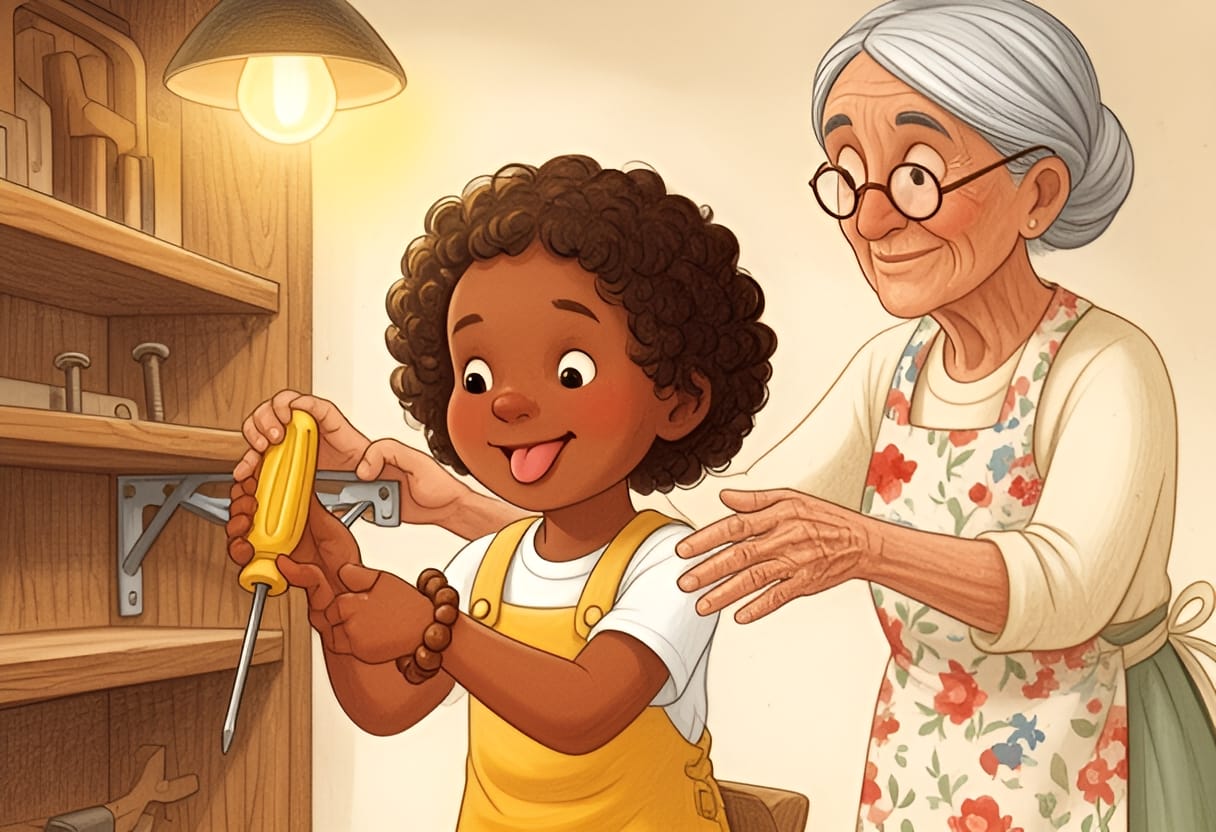
Then, with a soft click, the shelf stopped wobbling.
Grandma Elena placed her hand on the corner and gave it a gentle shake. “Solid as a rock,” she said. “You did that.”
Maya looked from the shelf to her hands, still gripping the screwdriver. The metal was warm now from her palm. She hadn’t thought about whether it was a “girl’s job” or a “boy’s job.” She had only thought: Turn. Hold. Fix.
A quiet pride unfurled in her chest, soft but sure — like the first block clicking into place at the base of a tower.
Grandma Elena wiped her hands on her apron and picked up a rag. “Now, let’s dust this off. And then…” She glanced toward the door, where Maya’s backpack lay by the shoe mat. “…I think you’ve earned a glass of milk and a cookie. Chocolate chip, if I’m not mistaken.”
Maya smiled — small, real — and followed her grandmother to the kitchen, the screwdriver still loose in her grip, not ready to put it down yet.
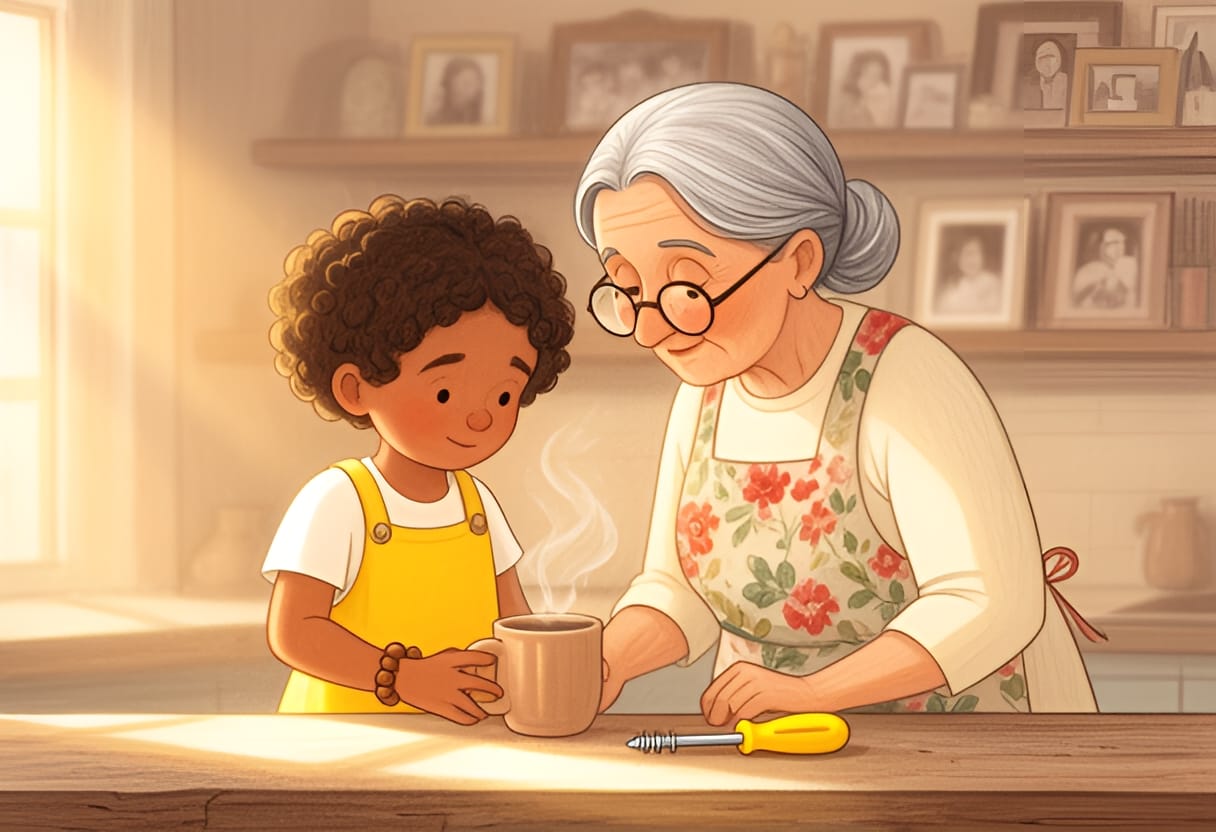
Grandma Elena set the mug of milk down in front of Maya, steam curling softly in the afternoon light that slanted through the kitchen window. The chocolate chip cookie sat on a small plate beside it, one chip melted into a golden puddle from the warmth of the mug. Maya wrapped her hands around the ceramic, feeling the heat seep into her palms, and took a small sip. The milk was cool and sweet, and for a moment, the only sound was the quiet hum of the refrigerator and the distant chirp of a sparrow outside.
She didn’t put the screwdriver down. It rested across her knees, the yellow handle bright against her jeans, the metal shaft still faintly warm from her grip.
Grandma Elena leaned against the counter, her arms crossed, watching her with soft eyes. “You know,” she said, “when I was about your age, my mama taught me how to fix the radio when it crackled and faded. Not because she thought I should — but because it needed fixing, and I was there.”
Maya blinked. “She fixed the radio?”
“Oh, yes. And not just that.” Grandma Elena pushed off the counter and walked to the wall beside the back door, where a narrow shelf held a few framed photos in mismatched wood. She pointed to one — a sepia-toned image of a woman in a dress with sleeves rolled to her elbows, standing beside a bicycle with a wrench in her hand and a smile on her face. “That’s my great-grandma, Rosa. She kept the whole block’s bikes running during the war — tires patched, chains oiled, bells fixed. Said a wobbly wheel was no different from a wobbly shelf: both just needed someone who cared enough to slow down and see what was loose.”
Maya leaned forward, her forehead nearly touching the glass of the frame. The woman in the photo had kind eyes and strong hands, dirt under her nails, a bandana tied like Grandma Elena’s — but red. “She didn’t think it was a ‘boy’s job’?”
Grandma Elena chuckled, low and warm. “She didn’t think in those terms at all. She thought in terms of ‘needs doing’ and ‘can I help?’ Same as you did today. You didn’t see a screw and think, Is this for girls or boys? You saw a shelf that was wobbling — and you made it steady.”
Maya looked down at her hands — the one that had turned the screwdriver, the other still curled around the mug. They were small, but they had done something real. She remembered the resistance, the slow turn, the click. Not magic. Not luck. Just her hands, learning.
“I think… I think I want to fix more things,” she said, quiet but sure. “Not just shelves. Maybe… bikes? Or radios? Or even towers?”
Grandma Elena’s smile widened, crinkling the corners of her eyes. “Then you will. And when someone says it’s not for you — well, you’ll just hand them a screwdriver and say, Lefty loosey, righty tighty. Want to try?”
Maya let out a soft laugh, the first real one since Liam’s words had echoed in the classroom. She looked at the screwdriver again, then at her grandmother’s hands — strong, sure, stained with oil and time — and then back at her own.
A spark didn’t flare. It glowed, low and steady, like the pilot light on the stove — small, but unextinguishable.
She slipped the screwdriver from her lap and placed it gently on the counter beside the milk mug. Not because she was done with it. But because she knew where to find it again.
And tomorrow, she would bring it to school.
Chapter 3
We Build Together
Maya stood at the block corner the next morning, sunlight slanting across the rug and catching the dust in the air like tiny stars. Her fingers tingled as she reached for a smooth blue square — the same one she’d returned to the bin the day before. She lifted it slowly, feeling its weight, its cool edges, and placed it firmly on the rug. It sat steady, true.
She didn’t look up right away. She just breathed — in, out — and let the quiet settle in her chest, not the hollow kind from yesterday, but something softer, like the space between heartbeats when you’re about to begin again.
Then she spoke, quiet but clear.
“Liam?” she said.
He was near the shelf, pretending to straighten a book, but his shoulders tensed at the sound of her voice. He turned, hesitant.
“Yeah?” he mumbled.
“Could you… find a long piece for the next layer?” Maya asked, keeping her eyes on the tower’s base. “One that’s flat on top and bottom? Like a bridge?”
He blinked. Then, without a word, he stepped toward the bin. His hands dug through the blocks — not quickly, not carelessly — but with focus, as if searching for something specific. He pulled out a long, rectangular piece, its surface worn smooth from use. He held it up, checking the light.
“This one?” he asked.
Maya nodded. “Perfect.”
He knelt beside her and placed it gently on top of the blue square. It fit exactly — no wobble, no gap. The tower stood two blocks high now, straight and strong.
A small smile touched Liam’s lips, quick and gone, but there.
Before Maya could say anything, Zara appeared at her elbow, holding a basket woven with bright yarn. Inside, triangular blocks in red, yellow, and green nestled together like a flock of birds.
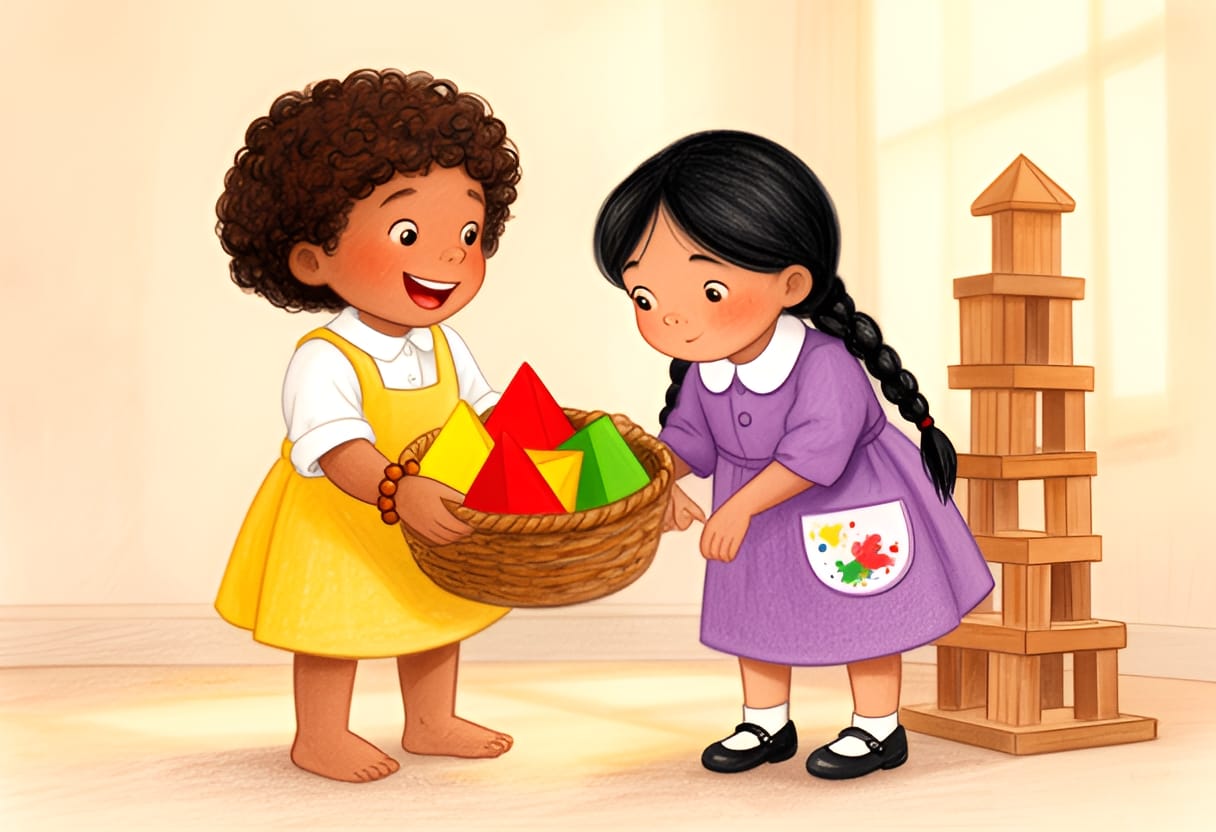
“I brought these,” Zara said, her voice soft but eager. “They’re pointy — like teeth or flags. What if we put them around the bottom? Make a pattern?”
Maya looked from the basket to the base of the tower, then back at Zara’s hopeful face. She imagined the colors marching in a line — red, yellow, green, red — like a celebration winding around the foundation.
“Yes,” she said, her voice brighter now. “Yes, let’s do that.”
Zara beamed and began placing the triangles along the edge, one by one, pointing outward. Maya watched how the light caught each angle, how the shadows pooled beneath them like quiet applause.
Liam stayed nearby, not speaking, but when a wobble trembled through the tower as Zara added a red piece, he shot a hand out — not to grab, not to fix — but to hover, steadying the air beside it until the block settled.
Maya didn’t tell him to move away. She didn’t need to.
She reached for another block — a tall, narrow one — and placed it carefully on the growing structure. The tower leaned into the sun now, taller than her wrist, her elbow, her shoulder. It wasn’t just hers anymore. It was made of hands that had doubted, hands that had hesitated, hands that had brought color and care.
And as she worked, Maya realized something warm and quiet spreading through her: she wasn’t just building a tower.
She was rebuilding the belief that she belonged here — one block at a time.
Maya’s fingers closed around another block — a wide, flat piece in sun-warmed yellow. She turned it over in her palm, feeling the familiar ridges where other hands had gripped it before. Without asking, she slid it onto the tower where the narrow blue block met the long rectangle Liam had found. It settled with a soft click, widening the base just enough to make the structure feel grounded, like roots gripping earth.
“Whoa,” breathed a voice beside her.
Maya glanced up. It was Leo, from the reading circle, his eyes wide as he stared at the tower. “It’s… really tall,” he said. “And it’s not falling.”
“It’s got good balance,” Maya replied, surprised at how easy the words came. “The wide pieces on the bottom help it stand tall without tipping.”
Leo nodded slowly, then reached into the bin and pulled out a squat, cube-shaped block in deep blue. “What about this one?” he asked. “Could it go here?” He pointed to a small gap near the middle, where a red triangle from Zara’s pattern left a tiny space.
Maya leaned in. “Yes — right there. It’ll lock it in.”
He placed it carefully. The tower shivered slightly, then held.
A ripple of movement caught her eye. Across the rug, two more children had paused their drawing to watch. Then another. Soon, a small cluster stood nearby — not crowding, not pushing in, but present, offering blocks, pointing to places where a curve might smooth or a color might brighten.
“Can I try?” asked a quiet voice. It was Sam, who usually stayed in the corner with picture books. He held a slender, arched block — pale green, like a slice of melon.
Maya smiled. “That’s perfect for the top curve. Want to put it on?”
He nodded, eyes fixed on the tower as he stepped forward. His hand trembled slightly as he reached up, but he placed the arch gently along the upper edge, where it caught the light and threw a soft shadow down the side.
“It looks like a rainbow slid down the side,” whispered Zara, who had returned with a sheet of paper and a crayon. She was sketching the tower now, her tongue poking out in concentration.
Liam, who had been watching from a few feet away, pushed off the shelf where he’d been leaning. He didn’t say anything at first — just walked over and picked up a set of three graduated blocks, each smaller than the last, in shades of gray.
“For the top?” he asked, holding them out.
Maya looked up, meeting his eyes. There was no hesitation in hers now. “Yeah. Let’s finish it together.”
He nodded and began stacking the gray blocks one by one, each smaller than the last, forming a neat spire that rose above the yellow base and the marching triangles below. When he placed the final piece — a tiny cube, no bigger than a thumbnail — he stepped back, hands on his knees, breathing a little fast.
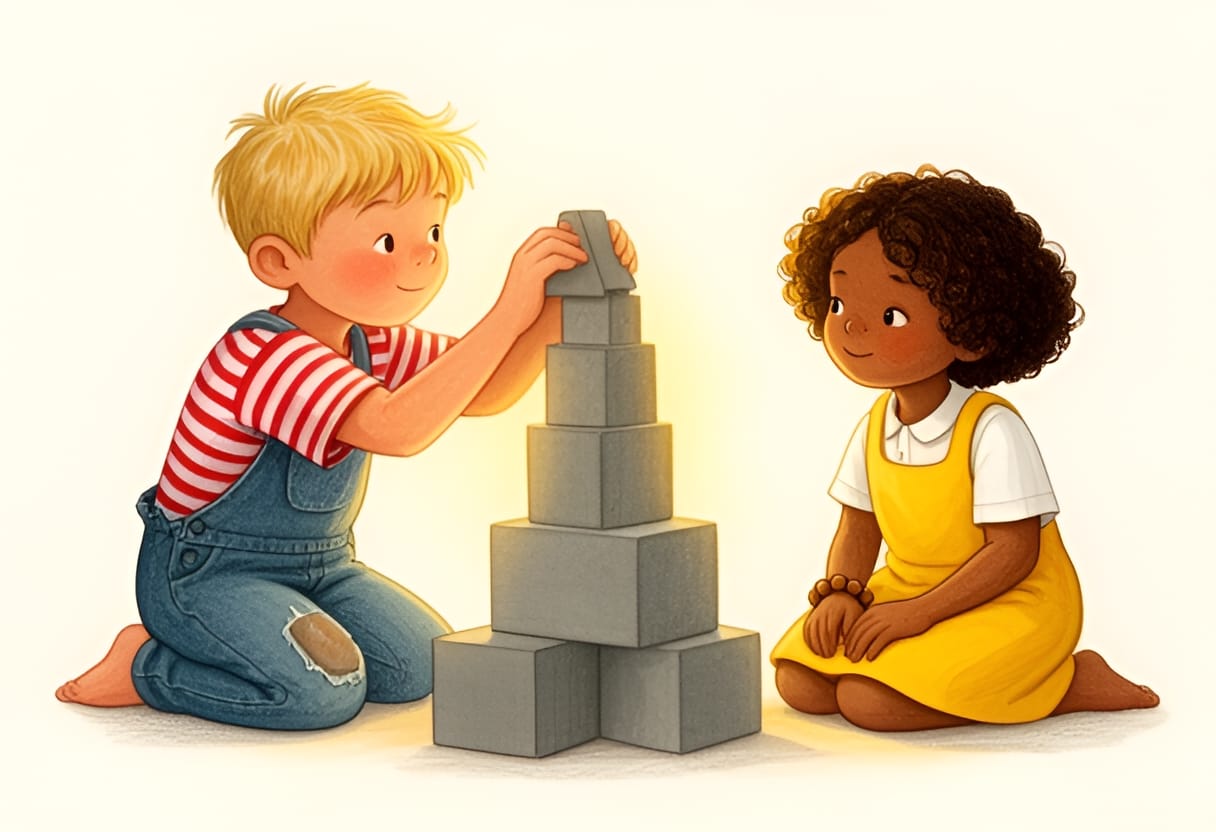
The tower stood taller than Maya’s head now, wider than her shoulders, a tapestry of color and shape: the steady blue square at the bottom, the long gray layer Liam had found, the marching pattern of red, yellow, and green triangles, the wide yellow base Leo had added, the locking cube from Sam, the graceful green arch, and the quiet spire of gray at the top.
Sunlight streamed through the window, gilding the edges, making the colors glow. Shadows pooled in the creases between blocks, soft and deep, like the quiet after a song.
No one spoke for a long moment. Then Liam let out a breath — not a laugh this time, but something lighter, almost shy.
“It… didn’t fall,” he said.
Maya looked around at the small group — Liam, Zara, Leo, Sam, and even a couple of others who had drifted in quietly, drawn by the quiet hum of cooperation. She felt no hollow doubt now, no weight pressing on her chest. Only warmth, spreading outward like light.
She lifted her chin, voice clear and sure, not loud, but carrying.
“See?” she said. “Building is for everybody.”
A few smiles broke out. Zara held up her drawing — a wobbly but proud rendition of the tower, complete with tiny figures beneath it, arms raised. Leo gave a small nod. Sam tucked his hands behind his back, rocking on his heels.
Liam didn’t say anything. But when Maya reached for the bin to put away the leftover blocks, he was already there beside her, handing her a stray green triangle that had rolled near the leg of the chair.
She took it. Their fingers brushed.
No one needed to say more.
The tower stood. The sunlight stretched. And in the block corner, where silence had once lived, now there was only the soft sound of breathing, the occasional click of wood on wood, and the quiet, steady certainty that some things — like belonging, like building, like being seen — are made stronger when they’re shared.