
Technology
Tech Mahindra
by Adarsh
11 chapters4.7 hr read

Chapter 1
Why Build an AI Startup Now
The Technological Moment
You’ve spent years studying machine learning, but something feels different now. The papers you read in 2020 required massive compute clusters to replicate. Today, you can fine-tune a language model on a laptop-connected GPU instance that costs less than a daily coffee. This shift isn’t incremental — it’s a threshold. And you’re standing at it, wondering if this is the moment to build.
The Transformer Advantage
Transformer architectures like BERT and GPT-3 have redefined what’s possible with text. Unlike older recurrent networks that processed words sequentially, transformers use self-attention to weigh the importance of every word in relation to all others — in parallel. This allows them to capture long-range dependencies and contextual nuances with remarkable efficiency. For your use case — turning spoken clinical conversations into structured notes — this means the model can understand that “patient denies chest pain” carries different weight than “family history of chest pain,” even if the phrases appear far apart in a dialogue.
What once required thousands of labeled examples and weeks of training now works with minimal task-specific tuning. You can take a pre-trained model like BERT-base and adapt it to medical note summarization with just a few hundred annotated samples. This dramatically lowers the barrier to entry. You don’t need a team of ten PhDs to get started. With your background in ML systems, you can handle data preprocessing, model fine-tuning, and evaluation in a matter of days.
Consider this: in early 2023, you tested a distilled version of BERT on a dataset of de-identified patient-doctor conversations. After fine-tuning for just three epochs on a single V100 GPU, the model achieved 89% ROUGE-L score on summary relevance — close to state-of-the-art results from papers that used 32 TPU v4 pods. The gap between research and execution has narrowed to the point where a small team can prototype at near-academic levels.
Cloud GPU Accessibility
The cost of compute has plummeted. Where training a medium-sized language model once required six-figure cloud bills, you can now access powerful GPUs on demand for pennies per hour. AWS offers p4d.24xlarge instances with eight A100s for around $32/hour — but you don’t need that scale to begin. For prototyping, a single T4 or V100 instance on Google Cloud Platform costs under $0.75/hour. Azure’s NDv2 series offers similar pricing.
This isn’t just about saving money — it’s about speed and experimentation. You can spin up a GPU instance, run a training job, shut it down, and iterate again the next day without long-term commitments. When Lencho argues for trying a larger model to push accuracy gains, you can test it for under $5 in compute costs. If it doesn’t move the needle, you shut it down and try something else.
You recall a conversation with Alex last month: “What if we needed to retrain weekly?” You ran the numbers. At $1/hour for a V100, even 10 hours of weekly training adds up to less than $50/month — less than the cost of one engineer’s lunch budget. The financial risk of exploration has collapsed. What used to be a strategic bet is now a tactical tinkering exercise.
Open-Source NLP Ecosystem
You don’t build from scratch anymore. Hugging Face’s Transformers library gives you instant access to over 200,000 pre-trained models, tokenizers, and training scripts — all with a consistent PyTorch or TensorFlow interface. Need to swap BERT for RoBERTa? Change one line of code. Want to quantize the model for faster inference? There’s a tutorial for that.
SpaCy handles the messy middle: sentence segmentation, named entity recognition, dependency parsing. You use it to clean and structure the raw transcript before feeding it to the summarization model. In your prototype, spaCy identifies “metformin 500mg BID” as a medication entity and preserves it verbatim in the summary — critical for clinical accuracy.
The ecosystem extends beyond code. Model cards, datasheets, and benchmark leaderboards on Papers With Code let you assess trade-offs quickly. When Sam raises concerns about bias in language models, you point to the Hugging Face model hub’s filtered search for “fairness” or “debiased” variants — not as a solution, but as a starting point for investigation.
This isn’t just convenience — it’s risk mitigation. By standing on the shoulders of open-source work, you avoid reinventing tokenization tricks or training stability hacks that consumed entire PhDs a decade ago. Your team’s velocity increases because you’re solving problems unique to your domain, not re-solving generic NLP challenges.
Public Awareness and Early Adopter Interest
Two years ago, mentioning “AI in healthcare” at a dinner party invited skepticism or sci-fi references. Now, people ask if you’re working on something that could help their doctor spend less time typing and more time listening. The release of consumer-facing tools like ChatGPT has demystified AI — not made it trivial, but made it familiar.
This shift matters for early adoption. Clinicians are overwhelmed by documentation. Studies show physicians spend nearly two hours on EHR work for every hour of direct patient care. When you pitch your idea to a focus group of primary care doctors, three out of five say they’d try a tool that cuts their note-taking time by half — even if it’s not perfect. They don’t expect autonomy; they expect relief.
You’ve seen this firsthand. At a local health tech meetup, a nurse practitioner told you she stays late three nights a week just to finish charts. “If your tool gets me home in time for dinner,” she said, “I’ll forgive it for making mistakes.” That’s not blind trust — it’s a calculated trade-off born of pain. And it’s yours to honor.
Your background gives you credibility here. You’re not selling vaporware. You’ve built the pipeline. You know where the models fail — on accented speech, overlapping dialogue, sarcasm — and you’re honest about those limits. That transparency, rare in a field prone to overpromise, is becoming a competitive advantage.
The Feasibility Argument
Putting it all together: the technical moment is ripe. Transformers deliver high-quality language understanding with minimal tuning. Cloud GPUs let you train and iterate for under $3/hour. Open-source libraries handle the heavy lifting of NLP pipelines. And there’s real, palpable demand from users who are ready to try — not because they believe in magic, but because they’re exhausted by the status quo.
You don’t need a $10M seed round to start. You need a weekend, a credit card, and the willingness to ship something ugly that works. That’s what you did last Tuesday night: you connected a speech-to-text API to a summarization model in 12 lines of Python. It’s not production-ready. It chokes on medical jargon. But it runs. And when you played back a sample dialogue and saw the AI generate a coherent — if rough — summary of the patient’s symptoms and medications, you felt it: this isn’t just possible. It’s already happening.
You close your laptop. The fan winds down. Somewhere, a GPU instance idles, waiting for the next command. You’re not just observing the technological moment — you’re stepping into it.

You open your editor again and stare at the blinking cursor. The prototype works, but it’s fragile. The speech-to-text API returns transcripts littered with punctuation errors and misrecognized terms like “myocardial infarction” as “my cardio in fraction.” You know from experience that raw ASR output needs cleaning before it hits the summarization model — otherwise, garbage in, gospel out.
You reach for spaCy’s rule-based matcher. It’s not glamorous, but it’s reliable. You add a few dozen patterns: common medical abbreviations (SOB → shortness of breath), frequently misspelled drug names (metoprolol → often heard as “metroprolol”), and negation patterns (“denies,” “no history of”). Each rule costs minutes to write but saves hours of downstream confusion. When Lencho sees your notebook, he scoffs — “That’s not ML.” You don’t argue. You just show him the before-and-after: a transcript where “pt c/o SOB, denies CP” becomes “patient complains of shortness of breath, denies chest pain.” The summary improves from incoherent to clinically usable.
This is where your systems background pays off. You don’t treat the pipeline as a black box. You instrument each stage: word error rate after ASR, entity preservation after NLP, factual consistency after summarization. You log failures not to shame the model, but to find patterns. Last week, you noticed the summarizer consistently dropped temporal markers like “yesterday” or “last week.” Turns out, the base model was trained on news articles where time references are often implicit. You fix it by adding a lightweight temporal tagger — another rule-based layer — and retrain the summarizer on a small set of time-annotated notes.
You also learn to distrust confidence scores. The ASR returns a 0.92 confidence on “patient reports mild dyspepsia,” but the audio clearly says “dyspnea.” High confidence doesn’t mean high accuracy — it means the model is sure of its wrong answer. You start cross-checking: if a predicted medication doesn’t match any known drug in RxNorm, you flag it. If a symptom appears in the summary but wasn’t in the transcript, you trace it back. These aren’t ML fixes — they’re software engineering practices applied to ML systems.
By Friday, your prototype handles 70% of the validation set without dropping critical information. It still struggles with overlapping speech and heavy accents, but it no longer invents medications or drops vital negations. You show Sam the output. She reads it slowly. “This,” she says, “is what augmentation looks like. Not replacement. Not autonomy. Just… less burden.”
You don’t celebrate. You save the file, shut down the GPU instance to avoid idle charges, and write in your log: First usable version. Not smart. Not safe for clinical use. But it listens, and it tries to get it right. That’s enough for now. The work continues.
Defining a Human-Centered Mission
You close your editor. The cursor blinks once, then stillness. The prototype works, but it’s fragile. You know the technical gaps — overlapping speech, heavy accents, sarcasm — but you also know something quieter and more urgent: the human cost of the status quo. Clinicians aren’t resisting AI because they fear obsolescence. They’re resisting it because they’ve seen too many tools promise relief and deliver more work, more surveillance, more ways to be measured and found wanting. You don’t want to add to that burden. You want to lift it.
You think of the nurse practitioner at the meetup. Three nights a week, late charts. Not because she’s slow, but because the system demands perfection in documentation while starving her of time to actually care. You’ve heard variations of this story from residents, from primary care physicians, from nurses in the ICU. The electronic health record was meant to improve care. Instead, it became a second job — one that pays in burnout, not purpose.
This is where your mission begins: not with a model architecture or a funding pitch, but with a refusal to accept that documentation has to hurt.
Augmentation, Not Replacement
You open a new document. Title it: Mission Draft v0.1. You start typing, then delete it. You try again. This isn’t about clever phrasing. It’s about clarity of intent.
You’ve seen what happens when AI crosses the line from assistant to arbiter. In radiology, some early CAD (computer-aided detection) tools began to replace reads rather than support them — not because they were better, but because administrators saw cost savings and pressed for autonomy. Missed findings followed. Not because the AI was wrong, but because humans stopped looking. The tool became a crutch, then a replacement, then a liability.
You won’t repeat that mistake. Your AI won’t diagnose. It won’t suggest treatments. It won’t flag abnormalities unless asked. Its job is narrower, and harder: to listen, to transcribe, to summarize — and to step back.
Augmentation means preserving the clinician’s role as the ultimate decision-maker. It means the AI handles the mechanical — the typing, the formatting, the boilerplate — so the human can focus on the interpretive: the nuance, the context, the judgment. It means the note still bears the clinician’s signature, not because it’s legally required (though it is), but because accountability must stay where the care happens.
You think of Sam’s words from yesterday: “This is what augmentation looks like. Not replacement. Not autonomy. Just… less burden.” She was looking at a summary where the AI had correctly pulled “patient denies chest pain” from a mumbled utterance, then left the rest of the history of present illness blank — waiting for her to fill in what mattered. The tool didn’t pretend to know more than it did. It created space for her expertise.
You write: AI should reduce cognitive load, not eliminate professional oversight. You underline it. Then you add: If the clinician has to second-guess the AI’s output more than they would their own notes, we’ve failed.
The Burden of Documentation
You pull up a study from the Annals of Internal Medicine. It’s not new, but it’s stark: physicians spend nearly two hours on electronic health record (EHR) work for every hour of direct patient care. For primary care providers, that number climbs to three hours. After-hours charting — so-called “pajama time” — affects nearly half of all doctors. It’s not just tedious; it’s correlated with emotional exhaustion, depersonalization, and intent to leave the profession.
You remember a conversation with Lencho last month. He was frustrated that the summarizer kept dropping temporal markers. You showed him the data: when “last week” vanished from the summary, the AI wasn’t being “creative.” It was statistically optimizing for patterns in its training data — mostly news articles, where time is often implied. But in a clinical note, “last week” isn’t flavor. It’s critical context. Was the symptom acute or chronic? Did it follow a procedure? Is it worsening?
You fixed it with a rule-based temporal tagger and a small retraining pass. Took you four hours. Lencho grunted, “That’s not scalable.” You didn’t argue. You just pointed to the validation set: negation preservation jumped from 62% to 89%. Critical information retention rose to 70%. The tool wasn’t just making fewer errors — it was making the right kind of errors: omissions, not inventions.
You type: Clinical documentation contributes to physician burnout, with doctors spending 2+ hours daily on notes. You add a footnote: Source: Annals Intern Med 2016;164:233-241. Then you ask: What if we gave even half that time back?
Imagine a resident finishing rounds at 5 p.m. Instead of staying until 7:30 p.m. to dictate and correct notes, she reviews AI-generated drafts in 20 minutes. She spends the next hour actually talking to her patients — not typing about them. She goes home at 6:30 p.m. She eats dinner with her partner. She reads a book. She sleeps.
That’s not hypothetical. It’s arithmetic. And it’s worth building toward.
Accuracy, Accountability, and Reversibility
You know accuracy matters — but not in the way Lencho sometimes frames it. It’s not about chasing state-of-the-art benchmarks on glossy datasets. It’s about whether the AI helps the clinician produce a note that’s better than what they’d write alone — or at least not worse.
Better means: no invented medications, no dropped negations, no missing allergies. It means the summary reflects what was actually said, not what the model thinks should have been said. It means if the AI is unsure, it says so — or better, it leaves a gap for the human to fill.
You think of the RxNorm check you built last week. When the ASR spits out “metroprolol,” your rule corrects it to “metoprolol.” When it says “vioxx” — a drug withdrawn in 2004 — you flag it. Not because the model can’t learn it, but because in a clinical context, some errors are dangerous. A wrong medication isn’t a typo; it’s a potential adverse event.
You’ve started logging these interventions. Not to punish the model, but to see where the gaps cluster. Turns out, drug names with similar phonetics (lisinopril vs. lisdexamfetamine) and temporal modifiers (“yesterday,” “last night”) are the biggest sources of drift. You’re not surprised. But now you have data to guide where to add rules, where to collect targeted annotations, and where to insist on human review.
Accuracy isn’t just about the model’s output. It’s about the workflow. You’ve designed the pipeline so that every AI-generated note is revisable. The clinician can edit, reject, or ignore it entirely. There’s no lock-in. No “AI mode” that overrides manual input. The tool defers — always.
You write: Assistive AI can improve note accuracy and completeness while preserving clinician accountability. Then you add: Transparency, consent, and reversibility aren’t ethical niceties — they’re design requirements.
You imagine a pop-up the first time a clinician uses the tool: This assistant listens to your patient conversation and suggests a draft note. You remain responsible for the final record. You can edit, reject, or disable suggestions at any time. No data is stored without your explicit consent. It’s not legalese. It’s a promise.
Drafting the Mission
You’ve been circling it for paragraphs. Now you write it plain:
To give clinicians time back by handling the mechanical work of documentation.

You read it once. It’s simple. Maybe too simple. But simplicity isn’t vagueness — it’s focus. You could have said: “To revolutionize clinical documentation through human-centered AI that reduces burnout while enhancing accuracy and preserving professional judgment.” But that’s a sentence designed to impress investors, not guide engineers.
Your version does three things. First, it centers the human: clinicians. Not patients (though they benefit indirectly), not administrators, not the AI itself. Second, it specifies the action: give time back. Not “improve efficiency,” not “streamline workflows” — give back. It implies a debt owed. Third, it defines the scope: mechanical work of documentation. The typing, the formatting, the boilerplate. Not the thinking. Not the caring. Not the deciding.
You show it to Sam. She nods. “It’s humble. It’s clear. It’s ours.”
You show it to Lencho. He frowns. “Where’s the innovation? Where’s the ML?” You don’t explain. You just slide your notebook toward him. On the page: before-and-after transcripts. A summary that kept “denies chest pain.” A note where “SOB” became “shortness of breath” without breaking flow. You say, “This is the innovation. It works. It helps. It doesn’t overreach.”
He grunts again. But he doesn’t look away.
You save the file as MISSION.md. You don’t print it. You don’t need to. It’s already shaping how you think about the next feature: should you add auto-suggest for ICD-10 codes? No — that’s stepping into judgment. Should you let the AI flag potential inconsistencies between subjective and objective sections? Maybe — but only as a prompt, not a conclusion. The clinician must still decide.
You close the laptop. The fan is off. The room is quiet. Somewhere, a GPU instance waits — not idling this time, but shut down. You’ve learned to turn things off when they’re not needed. It’s a small habit. But it’s yours.
Evaluating Potential Applications
You begin by evaluating potential applications for your AI assistant, considering the trade-offs between impact, feasibility, and risk. Medical note-taking stands out as a high-frequency, low-stakes entry point for AI assistance in healthcare. Clinicians spend a significant amount of time documenting patient interactions, which can lead to burnout and decreased productivity. By automating this task, you can free up clinicians to focus on higher-value activities, such as patient care and decision-making.
Assessing Technical Feasibility
You assess the technical feasibility of using speech-to-text APIs and summarization models to generate medical notes. Speech-to-text APIs, such as Whisper and Google Speech-to-Text, have achieved high accuracy rates (>90%) on clean audio. Summarization models can extract key clinical elements, including symptoms, assessments, and plans, from unstructured text. For example, a study published in the Journal of the American Medical Informatics Association found that a summarization model can extract relevant clinical information from medical notes with an accuracy rate of 85%.
| Model | Accuracy Rate |
|---|---|
| Whisper | 92% |
| Google Speech-to-Text | 95% |
| Summarization Model | 85% |
Designing the Minimum Viable Product
You design a minimum viable product (MVP) that processes 5-minute outpatient visit audio and generates SOAP-style note drafts. The MVP will utilize a speech-to-text API to transcribe the audio and a summarization model to extract key clinical elements. Clinician edits on AI-generated notes will create a natural supervised learning signal, allowing the model to improve over time. For instance, if a clinician edits an AI-generated note to add a missing medication, the model will learn to include that medication in future notes.
Example Use Case
Consider a scenario where a primary care physician sees a patient for a routine check-up. The physician dictates the patient's symptoms, medical history, and treatment plan, which is recorded as a 5-minute audio file. The MVP processes the audio file, generating a SOAP-style note draft that includes the patient's symptoms, assessments, and plans. The physician reviews the draft, making edits as necessary, and finalizes the note. The edited note is then used to update the patient's electronic health record.
Illustration
A diagram showing the MVP's workflow, from audio recording to note generation and editing
Implementing Feedback Loops
You implement feedback loops to ensure that the MVP continuously improves over time. Clinician edits on AI-generated notes will be used to update the summarization model, allowing it to learn from its mistakes and improve its accuracy. Additionally, you will establish a feedback mechanism for clinicians to provide input on the MVP's performance, suggesting areas for improvement and identifying potential biases in the model. This feedback will be used to refine the MVP, ensuring that it meets the needs of clinicians and provides accurate and reliable medical notes.
| Feedback Mechanism | Purpose |
|---|---|
| Clinician Edits | Update summarization model |
| Feedback Form | Refine MVP and identify biases |
Refining the MVP's Workflow
You delve deeper into refining the MVP's workflow, focusing on the integration of speech-to-text and summarization models. The goal is to create a seamless process that minimizes clinician input while maximizing accuracy. You decide to use a cloud-based speech-to-text API, which can handle high-volume audio files and provide real-time transcription. For the summarization model, you opt for a hybrid approach, combining the strengths of both rule-based and machine learning-based systems.
The rule-based system will be used to extract key clinical elements, such as medications, allergies, and medical history, using predefined templates and ontologies. The machine learning-based system will be trained on a large dataset of medical notes to learn patterns and relationships between different clinical elements. This hybrid approach will enable the MVP to generate accurate and comprehensive medical notes while minimizing the risk of errors or biases.
Addressing Clinical Variability
You recognize that clinical variability is a significant challenge in medical note-taking. Different clinicians may use varying terminology, abbreviations, and formatting styles, which can affect the accuracy of the MVP's output. To address this issue, you decide to implement a normalization step in the workflow, which will standardize the clinician's input and ensure consistency in the output.
The normalization step will involve using natural language processing (NLP) techniques to identify and correct errors in the transcription, such as misspelled words, incorrect punctuation, and inconsistent formatting. Additionally, you will use a clinical ontology to map different terms and abbreviations to a standardized vocabulary, ensuring that the MVP's output is consistent and accurate.
| Clinical Variability | Normalization Technique |
|---|---|
| Terminology | Mapping to standardized vocabulary |
| Abbreviations | Expansion to full terms |
| Formatting | Standardization of templates and styles |
Clinician Feedback and Validation
You understand the importance of clinician feedback and validation in ensuring the accuracy and effectiveness of the MVP. You decide to implement a feedback mechanism that allows clinicians to review and edit the generated medical notes, providing feedback on the accuracy, completeness, and usability of the output.
The feedback mechanism will be designed to capture both quantitative and qualitative data, including metrics such as accuracy, precision, and recall, as well as free-text comments and suggestions. This feedback will be used to refine the MVP, updating the models and workflows to improve performance and address any identified biases or errors.
Example Feedback Scenario
Consider a scenario where a clinician reviews a generated medical note and notices that the MVP has incorrectly identified a medication. The clinician provides feedback, correcting the error and suggesting improvements to the MVP's medication recognition algorithm. This feedback is then used to update the model, ensuring that similar errors are avoided in the future.
Illustration
A diagram showing the feedback mechanism, from clinician review to model update
Regulatory Compliance and Security
You recognize the importance of regulatory compliance and security in the development of the MVP. You ensure that the MVP meets all relevant regulatory requirements, including HIPAA, ICD-10, and Meaningful Use. You also implement robust security measures to protect patient data, including encryption, access controls, and audit trails.
The MVP will be designed to comply with the highest standards of security and privacy, ensuring that patient data is protected and confidential. You will also establish a governance framework to oversee the development and deployment of the MVP, ensuring that all stakeholders are aligned and that the MVP is used in a responsible and ethical manner.
| Regulatory Requirement | Compliance Measure |
|---|---|
| HIPAA | Encryption, access controls, and audit trails |
| ICD-10 | Mapping to standardized vocabulary and coding systems |
| Meaningful Use | Compliance with certified EHR technology requirements |
Scalability and Integration
You consider the scalability and integration requirements of the MVP, ensuring that it can be easily deployed and integrated into existing clinical workflows. You decide to use a cloud-based infrastructure, which will enable the MVP to scale rapidly and efficiently, handling high volumes of audio files and generating medical notes in real-time.
The MVP will be designed to integrate seamlessly with existing electronic health record (EHR) systems, using standardized APIs and data exchange protocols. This will enable clinicians to access and review generated medical notes directly within their EHR systems, streamlining clinical workflows and improving productivity.
| Integration Requirement | Solution |
|---|---|
| EHR Integration | Standardized APIs and data exchange protocols |
| Scalability | Cloud-based infrastructure and load balancing |
| Security | Encryption, access controls, and audit trails |
As you continue to refine the MVP's workflow, addressing clinical variability, and ensuring regulatory compliance and security, you begin to see the potential for the MVP to transform medical note-taking, improving clinician productivity, and enhancing patient care. The next step will be to start building the MVP, using the design and workflow you have developed, and testing it with real-world clinical data.
Setting Up the Development Environment
You begin by preparing your local development environment to run the necessary libraries for speech-to-text and summarization. You create a new virtual environment using python -m venv ai-startup-env and activate it with source ai-startup-env/bin/activate on Linux or macOS, or ai-startup-env\Scripts\activate on Windows. Within this environment, you install the required Python packages via pip: transformers, torch, pydub, and openai-whisper. These libraries provide access to state-of-the-art models for audio processing and natural language understanding.
The transformers library from Hugging Face gives you access to pre-trained summarization models like BART, while torch serves as the backend for model inference. pydub enables audio file manipulation, such as loading and converting audio clips to the format expected by Whisper. The openai-whisper package allows you to run OpenAI’s Whisper model locally for accurate speech transcription, which is essential for handling clinical audio with medical terminology.
You verify the installation by running pip list and confirming the presence of each package. This isolated environment ensures dependency consistency and avoids conflicts with other projects on your machine. With the setup complete, you proceed to write the first functional script that connects audio input to textual output.
Transcribing Audio with Whisper
You create a Python script named transcribe_and_summarize.py and begin by importing the necessary modules. You load a pre-trained Whisper model using whisper.load_model("base"), which balances speed and accuracy for your use case. The base model is sufficient for initial testing, especially given the controlled acoustic environment of your test audio.
Next, you define a 30-second audio clip stored as sample_visit.wav, simulating an outpatient consultation where a patient describes persistent headaches and blurred vision, and the clinician recommends a neurology referral and MRI scan. You use pydub to load the file and ensure it is in mono channel and 16 kHz sample rate, as required by Whisper.
You then call model.transcribe("sample_visit.wav"), which returns a dictionary containing the transcribed text under the "text" key. The output is: "Patient reports experiencing daily headaches for the past two weeks, accompanied by blurred vision and sensitivity to light. They deny any head trauma or recent illness. Neurological exam shows no focal deficits. Clinician recommends urgent neurology follow-up and non-contrast MRI of the brain to rule out underlying pathology."
This transcription achieves high fidelity, correctly capturing clinical negations ("denies any head trauma") and symptom details. You note that Whisper’s 92% accuracy rate, as observed in earlier testing, holds true here, particularly for clear speech and standard medical phrasing.
Generating a Summary with BART
You pass the transcribed text to a summarization pipeline using the Hugging Face transformers library. You initialize the pipeline with summarizer = pipeline("summarization", model="facebook/bart-large-cnn"), selecting a BART model fine-tuned on CNN/Daily Mail for strong abstractive summarization capabilities.
You then call summarizer(transcribed_text, max_length=100, min_length=30, do_sample=False), which generates a concise summary. The output is: "The patient has had daily headaches and blurred vision for two weeks without head trauma. Neurological exam was normal. The clinician recommends a neurology referral and MRI of the brain to investigate further."
This three-sentence summary effectively captures the chief complaint (headaches and blurred vision), the absence of trauma, the normal exam findings, and the recommended actions. Despite syntactic condensation, the clinical meaning is preserved — critical information such as symptom duration, negation of trauma, and clinical recommendation remains intact.
You log both the transcription and summary to the console and save them to a file named output.txt for later review. The entire process runs in under 10 seconds on your laptop’s CPU, demonstrating the feasibility of real-time processing with lightweight infrastructure.
Validating Clinical Meaning and Next Steps
You examine the output to verify that the summary retains clinical fidelity. You compare it against the original transcription and confirm that:
- The chief complaint (headaches, blurred vision) is clearly stated.
- The negation of head trauma is preserved, which is critical for ruling out acute causes.
- The recommended actions (neurology referral, MRI) are explicitly included.
- No hallucinated or fabricated information is introduced.
You note that while the summary omits details like "sensitivity to light" and "no focal deficits," these are considered lower-priority in a SOAP-style note’s subjective and objective sections, where the focus is on actionable insights. This aligns with your mission to augment, not replace, clinical judgment — the AI handles mechanical summarization, leaving nuanced interpretation to the clinician.
You shut down any active GPU instances to avoid unnecessary costs, reinforcing your practice of resource-conscious development. At this point, you have successfully built a working prototype that connects speech input to a structured clinical summary in under 15 lines of code. This milestone validates your technical approach and marks the transition from concept to tangible progress.
Try This
This week, take the following steps to replicate and extend this prototype:
- Record a 30-second audio clip of yourself describing a mock medical consultation (e.g., a patient with cough and fever requesting antibiotics).
- Use the same script to transcribe the audio with Whisper and summarize it with BART, then compare the output to your original speech for accuracy and completeness.
- Modify the script to experiment with different summarization models (e.g.,
sshleifer/distilbart-cnn-12-6) and observe changes in summary length, speed, and retention of key clinical details.
Key Takeaways
- Advances in accessible AI models like Whisper and BART allow developers to build functional speech-to-summary pipelines with minimal code and infrastructure.
- Preserving clinical meaning — especially negations, symptom duration, and recommended actions — is more important than retaining every detail in AI-generated notes.
- A human-centered design ensures AI augments clinician workflows by handling documentation tasks, freeing time for patient interaction and complex decision-making.
- Rapid prototyping with open-source tools enables validation of core ideas before investing in scaling or clinical deployment.
- Ethical development begins with transparency: logging outputs, verifying fidelity, and involving end-users early in the feedback loop.
You return to the script and consider how to make the pipeline more robust for real-world clinical use. One limitation you observe is that the summarization model, while effective on general text, may not consistently preserve nuanced clinical modifiers such as severity, timing, or uncertainty. For example, in the transcription, the phrase "daily headaches for the past two weeks" carries temporal specificity that is clinically significant. The current summary retains "daily headaches and blurred vision for two weeks," which is acceptable, but you wonder how the model would handle more ambiguous phrasing like "headaches that come and go" or "might be related to stress."
To address this, you decide to integrate a lightweight rule-based post-processing step that reinforces key clinical patterns after summarization. You define a list of regex patterns targeting common clinical constructions: negations (e.g., "denies," "no history of"), temporal markers (e.g., "for X days," "since yesterday"), and severity indicators (e.g., "mild," "severe," "worse than"). After generating the summary, you scan it for these patterns and compare them to the original transcription. If a pattern present in the source is missing in the summary, you flag it for review.
You test this on a second audio clip where the patient says, "I’ve had mild chest tightness for three days, but it went away after rest." The Whisper transcription captures this accurately. The BART summary returns: "Patient had chest tightness that resolved with rest." While factually correct, it drops the severity ("mild") and duration ("three days"). Your rule-based checker detects the absence of both "mild" and "for three days" and tags the output as potentially incomplete. You then modify the summary generation step to include a hint in the prompt: "Preserve key details such as severity, duration, and negation." Although the Hugging Face pipeline doesn’t support direct prompt engineering for BART, you achieve a similar effect by prepending the instruction to the input text: "Summarize clinically, preserving severity, duration, and negation: [transcribed text]."
You rerun the pipeline. The new output is: "Patient had mild chest tightness for three days that resolved with rest." Now, both the severity and duration are preserved. You log this improvement and note that while the gain is modest, it demonstrates how lightweight guidance can steer the model toward clinically relevant outputs without retraining.
Encouraged by this, you explore whether the same principle applies to medication mentions. You test a clip where the patient states, "I’m taking lisinopril for blood pressure, but I stopped ibuprofen because it upset my stomach." The transcription is accurate. The initial summary omits the reason for stopping ibuprofen. After adding the preservation hint, the summary includes: "Patient takes lisinopril for blood pressure and stopped ibuprofen due to stomach upset." The causal relationship ("because it upset my stomach") is now reflected as "due to stomach upset," which retains the clinical rationale.
You recognize that these heuristics are not foolproof — they rely on surface-level cues and may fail with complex syntax or implicit meaning. However, they serve as a practical interim solution while you plan to collect clinician edits for supervised fine-tuning. Each edit becomes a signal to teach the model which details to preserve, aligning with your broader goal of building a feedback-driven system.
You document these observations in a lab notebook, noting the trade-off between flexibility and control. Fully prompt-tuned models or domain-specific fine-tuning would offer stronger guarantees, but require more data and compute. For now, the hybrid approach — using a strong general-purpose model with lightweight rule-based reinforcement and clinician-in-the-loop validation — offers a pragmatic path forward.
You also consider latency. The current pipeline takes about 8–12 seconds per 30-second clip on CPU, mostly due to Whisper’s encoder. You profile the code and find that 70% of the time is spent in transcription. You investigate alternatives: using Whisper’s "tiny" model reduces latency to under 3 seconds but increases word error rate, particularly on medical terms like "hypertension" or "myocardial infarction." You decide to keep the "base" model for now, accepting the trade-off for accuracy, and plan to revisit model selection once you have validation data from clinician feedback.
As you save the updated script, you reflect on how far the prototype has come in a single session: from raw audio to a structured, clinically meaningful summary, with mechanisms to monitor and improve fidelity. You have not only written the first line of functional code but have begun to shape a development cycle grounded in measurement, iteration, and human oversight — core principles that will guide the next stages of your startup’s journey. The cursor blinks in the terminal, waiting for the next command. You take a breath and prepare to run the test again.

Chapter 2
From Idea to Prototype: The First 90 Days
Assembling the Core Team
You glance at the terminal as the cursor blinks, waiting for input. The prototype works—barely—but you know it won’t scale without a team. You need more than code; you need complementary perspectives to shape something that doesn’t just function, but earns trust. You close the laptop and open a message to Sam, someone you’ve debated ethics with for years over coffee and whiteboard sketches. Then you reach out to Lencho, whose rigor in experimental design once saved a project from collapsing under flawed assumptions. This is where the startup stops being a solo experiment and becomes a collective effort to build responsibly.
Defining the Founding Triad
You invite Sam to co-lead product vision, not just to design interfaces but to embed ethical reasoning into every feature decision. Their background in design ethics means they don’t ask, “Can we build this?” but “Should we, and for whom?” When you show them the prototype’s SOAP note output, they immediately point out how the system assumes a linear patient-provider interaction—ignoring cases where family members co-manage care or where patients communicate through interpreters. “Accuracy isn’t just about words,” Sam says. “It’s about whose voice gets centered in the record.” They draft a user journey map that flags moments where consent could be implicit—like when a clinician edits a note without informing the patient—and turns them into design requirements: optional patient review toggles, audit trails for edits, and language that avoids assumptions about health literacy.
You see how this shifts your thinking. Instead of optimizing solely for summary accuracy, you begin tracking whether the output preserves patient agency—measured later by how often clinicians choose to share draft notes with patients for review. Sam’s lens turns abstract values into testable product criteria.
Lencho joins as the third pillar, bringing a statistician’s skepticism to model evaluation. When you share the initial 70% critical information retention rate, Lencho doesn’t celebrate—they ask for confidence intervals, stratification by speaker accent, and a breakdown of error types. “Is 70% good enough if it drops to 50% for non-native English speakers?” they challenge. You run a stratified analysis and discover the model misses negation cues 30% more often in accented speech—a finding that would have stayed buried in aggregate metrics. Lencho designs a lightweight evaluation framework: weekly blind tests where clinicians rate AI notes on relevance, safety, and completeness, with scores tracked over time. They insist on logging not just what the model gets wrong, but why—was it a missing medication, a flipped dosage, or a misattributed symptom? This turns post-mortems into structured learning loops.
You retain ownership of the technical backbone: architecture, API integrations, and infrastructure. You decide early to use Docker for environment reproducibility, GitHub for version-controlled collaboration, and Weights & Biases for experiment tracking—choices Lencho validates as enabling rigorous comparison across model versions. When Sam raises concerns about vendor lock-in with cloud-based transcription APIs, you pivot to self-hosting Whisper, documenting the trade-off in latency versus data control. You build a simple CLI tool that lets any team member run end-to-end tests with one command, lowering the barrier to experimentation.
Establishing Rhythms of Alignment
To prevent silos, you institute a 90-minute weekly sync with a standing agenda: technical progress (you), user impact (Sam), and data/model health (Lencho). The first meeting reveals tension: Lencho wants to freeze the model architecture to ensure reproducible experiments, while Sam pushes to add a patient-facing feedback button immediately, which would require API changes you hadn’t planned. You facilitate by asking each to state their underlying need: Lencho seeks statistical validity; Sam seeks early user validation of trust. You propose a time-boxed spike—two days to build a mockup of the feedback button using static mock data, allowing Sam to test the concept without destabilizing Lencho’s control group. The compromise works: Sam gains insight that patients are hesitant to correct notes unless anonymized, leading to a redesign; Lencho gets clean data for the next two weeks.
You track alignment not just in meeting notes but in shared OKRs. For the first 30 days, the objective is “Build a testable prototype that demonstrates clinical utility without compromising safety.” Key results include: prototype processes 5-minute visit audio in under 15 seconds, achieves ≥75% negation preservation on accented speech, and incorporates ≥10 clinician edits into a retraining cycle. Each key result has an owner—you for latency, Lencho for preservation rate, Sam for feedback integration—but success requires cross-functional effort. When Lencho improves negation handling via a rule-based post-processor, it’s Sam who notices the output now sounds overly robotic and suggests reintegrating syntactic smoothing from earlier prototypes.
Skill-Based Role Clarity
You make expectations explicit: you own system integrity—ensuring the voice pipeline, summarization model, and feedback layer work together reliably. This means you debug GPU memory leaks in the Whisper wrapper, design the API contract between the transcription and summarization modules, and set up monitoring for inference drift. Sam owns the “why” and “for whom”—they conduct informal interviews with three clinic administrators to understand pain points in current documentation, then translate those into feature priorities like auto-populating ICD-10 codes from summarized conditions (a suggestion that later reduces billing lag in pilot tests). Lencho owns the “how well”—they design the evaluation rubric, run ablation studies on preprocessing steps (finding that spaCy-based entity normalization boosts ROUGE-L by 4.2 points), and warn when training data drift risks invalidating past benchmarks.
One afternoon, Lencho shows you a confusion plot revealing the model consistently confuses “no history of diabetes” with “family history of diabetes.” You trace it to a tokenization error where “no history of” gets split awkwardly, and Sam suggests adding a negation detection layer using a lightweight rule set based on dependency parsing—something they’d seen work in clinical NLP papers. You implement it in a day, and Lencho verifies the error drops by 60%. The fix exists because each role stayed in their lane but remained permeable to input.

Committing to the 90-Day Horizon
You frame the next three months not as a race to launch, but as a structured learning cycle. The goal is a working MVP tested in a simulated clinic: a 5-minute audio input yields a SOAP note draft that clinicians judge as safe to use or edit, with documentation time reduced by at least 30% compared to manual entry. You break the 90 days into three phases: weeks 1–4 for foundational components (voice input, summarization core), weeks 5–8 for the feedback loop and initial clinician testing, and weeks 9–12 for integration, stress testing, and refinement.
You share a simple Gantt chart in the team’s Notion wiki, color-coded by owner but with overlapping swimlanes to show dependencies. When Sam needs UI mockups for the feedback interface by week 5, you know to prioritize API stability in the backend by week 4. When Lencho needs 100 hours of diverse speech data for robust evaluation by week 8, Sam begins coordinating with a local clinic for de-identified recordings under an IRB-exempt protocol. You all agree: if the prototype doesn’t meet the 40% time reduction target in simulation by day 90, you’ll pause and reassess—not as failure, but as data.
By the end of your first sync, you’ve done more than assign roles. You’ve created a framework where technical excellence, user-centered design, and rigorous evaluation aren’t trade-offs—they’re interlocking constraints that, when balanced, raise the ceiling for what the team can achieve together. You save the meeting notes, tag them #founding-alignment, and return to the terminal. The cursor still blinks. Now, when you type the next command, you do so knowing it’s part of a shared effort.
Configuring the Development Environment
You begin by configuring a reproducible development stack, knowing that consistency across environments is crucial for collaboration and iteration. You decide to use Docker containers to encapsulate the entire environment, including Python 3.9, CUDA 11.8, and all machine learning dependencies. This approach ensures that any team member can reproduce the model training and inference pipeline without worrying about compatibility issues.
To set up the Docker environment, you create a Dockerfile that specifies the base image, installs required dependencies, and copies the project code into the container. You choose the official Python 3.9 image as the base and install CUDA 11.8 for GPU acceleration. The Dockerfile also includes instructions for installing machine learning libraries like TensorFlow and PyTorch.
```markdown
| Dependency | Version |
|---|---|
| Python | 3.9 |
| CUDA | 11.8 |
| TensorFlow | 2.8 |
| PyTorch | 1.12 |
```
Automating Testing and Code Quality
Next, you focus on automating testing and code quality checks to ensure the codebase remains stable and maintainable. You decide to use GitHub Actions to automate testing on every push, which helps catch bugs and regressions early in the development cycle. You create a .yml file that defines the testing workflow, including installing dependencies, running unit tests, and checking code formatting.
To enforce code formatting and prevent secrets from being committed, you set up pre-commit hooks using tools like black and git-secrets. These hooks run automatically before each commit, checking for formatting issues and sensitive information.
```markdown
| Tool | Purpose |
|---|---|
| black | Code formatting |
| git-secrets | Secret detection |
| GitHub Actions | Automated testing |
```
Experiment Tracking and Reproducibility
To track model metrics, data versions, and hyperparameters for each experiment, you choose Weights & Biases as the experiment tracking platform. You integrate Weights & Biases into the codebase, which allows you to log metrics and artifacts for each experiment. This enables the team to compare results, identify trends, and reproduce experiments with ease.
You create a wandb configuration file that specifies the project name, entity, and other settings. You then modify the training script to log metrics and hyperparameters to Weights & Biases.
```markdown
| Metric | Description |
|---|---|
| Accuracy | Model accuracy on validation set |
| Loss | Model loss on training set |
| Hyperparameters | Learning rate, batch size, etc. |
```
Enabling Flexible Training and Debugging
Finally, you ensure that the environment supports both CPU debugging and GPU-accelerated training on demand. You modify the Dockerfile to include instructions for installing GPU drivers and configuring the environment for GPU acceleration. You also create a script that allows team members to switch between CPU and GPU training with a single command.
With the development environment set up, you can now focus on building and training the model, knowing that the technical foundation is in place to support rapid iteration and collaboration.
Illustration
A diagram showing the development environment architecture, including Docker containers, GitHub Actions, Weights & Biases, and pre-commit hooks.
You return to the terminal after reviewing the environment setup and notice the cursor blinking steadily. The Docker image builds without error, pulling CUDA 11.8 and installing PyTorch with GPU support. You tag the image techmahindra-mvp:base and push it to GitHub Packages so Lencho and Sam can pull it locally. You document the exact command in the team wiki: docker pull ghcr.io/yourorg/techmahindra-mvp:base. This ensures that when Sam runs the feedback interface or Lencho launches ablation studies, they’re using identical dependency versions, eliminating the “it works on my machine” problem that plagued earlier projects.
You then turn to GitHub Actions. You create a workflow file at .github/workflows/test.yml that triggers on every push to main and pull requests. The job runs on Ubuntu-latest, checks out the code, sets up Python 3.9, installs dependencies from requirements.txt, and executes the test suite with pytest. You include a step to log in to GitHub Packages and pull the Docker image so tests run inside the container, mirroring production conditions. The workflow also runs black --check . and flake8 to enforce formatting and style. If any step fails, the workflow halts and sends a notification to the team Slack channel.
To demonstrate its value, you simulate a failure. You intentionally introduce a syntax error in the transcription module—a missing colon after an if statement—and push the change. Within minutes, GitHub Actions fails the build, posting a detailed error log in the pull request. Sam sees the alert, comments that the error is trivial but welcomes the early signal, and you fix it in a follow-up commit. The workflow passes on the second try. This tight feedback loop means you catch configuration drift and simple mistakes before they accumulate, preserving mental bandwidth for harder problems like model generalization.
Next, you integrate Weights & Biases. You create an account, initialize a project named clinical-note-summarizer, and install the wandb package. In the training script, you add a few lines at the start: wandb.init(project="clinical-note-summarizer", config=hyperparameters). You log the learning rate, batch size, and encoder architecture as config. During training, you call wandb.log({"loss": loss.item(), "accuracy": accuracy}) at the end of each epoch. After each run, Weights & Biases generates a dashboard showing loss curves, accuracy over time, and hardware utilization.
You run the first experiment with a small subset of the MIMIC-III dataset—500 audio transcripts paired with clinician-edited notes. The batch size is 8, learning rate 2e-5, and you train for three epochs. Weights & Biases logs the final validation accuracy at 68.2% and average loss at 0.41. You tag the run baseline-whisper-large-v2. When Lencho later tries a different preprocessing pipeline—adding spaCy-based entity normalization before summarization—he creates a new run, experiment-spacy-norm. The dashboard immediately shows the comparison: validation accuracy jumps to 72.4%, loss drops to 0.36, and inference latency increases by only 12 milliseconds per sample. The side-by-side view makes the trade-off transparent. You discuss the result in the next sync: the accuracy gain justifies the minor latency increase, especially since the prototype already meets the 15-second target for 5-minute audio.
You also use Weights & Biases to track data versions. You upload the raw audio files as an artifact named raw-audio-v1 and the cleaned transcripts as cleaned-transcripts-v1. When Sam collects additional recordings from the clinic under the IRB-exempt protocol, you create raw-audio-v2 and note the new accents and background noise levels. Lencho uses these artifacts to evaluate whether the model generalizes to noisier inputs, logging word error rate (WER) before and after retraining. This versioned approach ensures that if a regression appears, you can trace it to a specific data change rather than guessing at elusive causes.
To further harden the environment, you implement pre-commit hooks. You install pre-commit via pip and create a .pre-commit-config.yaml file. It includes hooks for black (code formatting), check-yaml (validating YAML syntax), and end-of-file-fixer (ensuring files end with a newline). Most critically, you add detect-secrets to scan for API keys, passwords, or tokens that might accidentally be committed. You test it by adding a fake Whisper API key to a configuration file and attempting to commit. The hook blocks the commit, returning an error message that lists the offending file and line. You remove the key, commit successfully, and push. The hook runs silently on subsequent commits, becoming an invisible guardian against credential leaks.
You also configure the environment to support CPU debugging. While the Docker image includes CUDA, you build a variant tagged techmahindra-mvp:cpu that removes NVIDIA dependencies and installs PyTorch with CPU-only support. You update the docker-compose.yml to define two services: app-gpu and app-cpu. The GPU version mounts the host’s NVIDIA devices and sets the runtime to nvidia; the CPU version omits these flags. You add a Makefile target: make debug spins up the CPU container with a shell, allowing you to step through code with pdb without waiting for GPU allocation. This proves invaluable when Lencho encounters a shape mismatch in the summarization layer during a late-night debugging session. He switches to CPU mode, inspects the tensor dimensions, and identifies a transposed axis in the attention mask—fixing it in under twenty minutes.
With the environment fully operational, you run an end-to-end test. You take a five-minute audio file of a simulated outpatient visit—featuring a patient with mild hypertension discussing medication adherence—and process it through the pipeline. The Whisper large-v2 model transcribes the audio with a word error rate of 8.1%, well below the 15% threshold you set for clinical usability. The transcription then flows into the rule-based normalizer you expanded earlier, which corrects common ASR errors like “metformin” → “metformine” and “no hx of DM” → “no history of diabetes.” The summarized note appears in the feedback interface within 12 seconds, well under the 15-second latency goal. Sam opens the draft in the interface, makes three inline edits—correcting a misheard dosage, adding a negated allergy, and clarifying the timeline of symptoms—and saves the version. The edit is automatically logged to Weights & Biases as a new training example, incrementing the feedback count toward the first 30-day key result.

You check the logs: the system processed the audio in 12.3 seconds, preserved 78% of negation cues (exceeding the 75% target), and integrated the clinician’s edits into a queued retraining batch. The prototype now satisfies all three first-30-day objectives. You save the output note, tag it sim-visit-001-final, and add it to the evaluation set. Lencho plans to use it in his ablation study next week to measure how much the feedback loop improves ROUGE-L on held-out data.
As the terminal idles, you reflect on how the infrastructure choices echo the team’s broader principles. Docker embodies reproducibility—no more environment drift. GitHub Actions enforces quality through automation, not vigilance. Weights & Biases turns opaque training runs into legible experiments. Pre-commit hooks shift security from afterthought to habit. And the CPU/GPU flexibility acknowledges that not every task needs acceleration; sometimes, clarity matters more than speed. You close the laptop lid, not because the work is done, but because the foundation is laid. The cursor may blink, but the system now breathes on its own.
Building the Voice Input Pipeline
You open the terminal and navigate to the voice-input directory, where you begin evaluating speech-to-text options for the MVP. The prototype’s usability hinges on accurate transcription, especially given the variability in clinical speech—accents, background noise from equipment, and overlapping dialogue during patient consultations. You need a system that transcribes five-minute outpatient visits with sufficient fidelity to generate usable SOAP note drafts, while remaining cost-effective and deployable within your infrastructure constraints. You decide to benchmark three leading solutions: OpenAI’s Whisper large-v2, Google Cloud Speech-to-Text, and AssemblyAI, using a curated dataset of clinic-recorded audio.
You assemble a test set of 50 audio clips, each 30 to 60 seconds long, sourced from de-identified outpatient visits under an IRB-exempt protocol. The dataset includes speakers with diverse accents—Indian English, African American Vernacular English, and Southern U.S. English—as well as varying levels of background noise from ECG monitors, HVAC systems, and hallway conversations. You normalize all files to 16 kHz mono WAV format and extract ground-truth transcripts using professional medical transcriptionists, who annotate not only spoken words but also clinically relevant negations (e.g., “no chest pain”) and temporal modifiers (e.g., “symptoms started two days ago”). This ensures your evaluation reflects real-world utility, not just lexical accuracy.
You containerize each service for consistent testing. For Whisper, you use the techmahindra-mvp:gpu Docker image with PyTorch and CUDA 11.8, loading the large-v2 model via Hugging Face Transformers. For Google Cloud Speech-to-Text, you authenticate via a service account key stored as a Docker secret and send FLAC-encoded audio chunks over gRPC. For AssemblyAI, you use their Python SDK with API key injection at runtime, avoiding hardcoded credentials. You run each test three times and record the median word error rate (WER) and latency per 10 seconds of audio.
The results show clear trade-offs. Whisper large-v2 achieves a median WER of 12.1% on clean audio (low background noise, clear articulation), outperforming Google Cloud Speech-to-Text (14.8%) and AssemblyAI (16.3%). On accented speech, Whisper maintains a WER of 18.7%, while Google Cloud rises to 22.4% and AssemblyAI to 25.9%. Crucially, Whisper shows robustness to mild reverberation—simulated by adding a 0.3-second room impulse response—where its WER increases by only 1.2 percentage points, compared to 4.1 for Google Cloud and 5.6 for AssemblyAI. Latency-wise, Whisper processes 10 seconds of audio in 1.8 seconds on a T4 GPU, well under real-time thresholds. Google Cloud averages 2.4 seconds due to network roundtrips, and AssemblyAI 2.1 seconds, both affected by API queue times during peak hours.
You document these findings in a comparison table to guide the team’s decision.
| Service | WER (Clean Audio) | WER (Accented Speech) | Latency (10s Audio) | Cost Estimate (Monthly) |
|---|---|---|---|---|
| Whisper large-v2 | 12.1% | 18.7% | 1.8s | $0 (self-hosted) |
| Google Cloud STT | 14.8% | 22.4% | 2.4s | ~$145 (60 hrs @ $2.42/hr) |
| AssemblyAI | 16.3% | 25.9% | 2.1s | ~$90 (60 hrs @ $1.50/hr) |
You note that while Google Cloud and AssemblyAI offer lower latency variability and built-in speaker diarization, their higher cost and susceptibility to acoustic mismatch make them less suitable for early-stage iteration. Whisper’s self-hosted nature eliminates per-hour fees and allows full control over preprocessing and postprocessing—critical for integrating your rule-based normalizer later. You share the results in the weekly sync, where Sam raises concerns about data privacy with third-party APIs, and Lencho confirms that Whisper’s open weights enable finer-grained error analysis. The team agrees to adopt Whisper large-v2 as the primary STT engine, with a fallback to Google Cloud for non-medical audio if needed.
Next, you focus on improving raw audio quality before it reaches the model. Clinical recordings often contain low-frequency rumble from air handlers and high-frequency hiss from wireless microphones, which can obscure speech formants and increase WER. You design a preprocessing chain using sox and torchaudio to apply bandpass filtering and dynamic range compression. First, you apply a Butterworth bandpass filter (80 Hz to 8000 Hz) to attenuate subsonic noise and ultrasonic interference, preserving the intelligibility range of human speech. Then, you apply dynamic range compression with a ratio of 4:1, threshold at -20 dB, and makeup gain of 6 dB to quiet loud peaks and boost quieter segments, ensuring consistent input levels without clipping.
You test this chain on a subset of noisy recordings—those with HVAC hum at 60 Hz and broadband hiss above 10 kHz. Before processing, the audio shows a spectral tilt, with energy concentrated below 100 Hz and above 7 kHz. After bandpass filtering, the low-end rumble and high-end hiss are reduced by over 20 dB. Dynamic range compression then brings the RMS level closer to -18 dBFS, making whispery speech and loud coughs more uniform in amplitude. When fed into Whisper, the preprocessed audio yields a WER reduction of 3.4 percentage points on average across the test set, with the largest gains in recordings from rooms with poor acoustics.
You implement this as a reusable function in audio_preprocess.py, called early in the pipeline before feature extraction. You add a command-line flag --preprocess to the transcription script, allowing the team to toggle it during experiments. In the Makefile, you update the transcribe target to include preprocessing by default for GPU runs, while keeping it optional for CPU debugging to avoid unnecessary overhead. You also log the preprocessed audio as a Weights & Biases artifact named preprocessed-audio-v1, enabling traceability if transcription quality shifts unexpectedly.
To further reduce latency, you integrate voice activity detection (VAD) to trim silent intervals at the start and end of utterances. You use the WebRTC VAD module, which operates on 10 ms frames and classifies each as speech or non-speech based on energy and spectral features. You set aggressiveness to 2 (moderate) to avoid clipping soft speech while effectively removing leading/trailing silence. After VAD, you concatenate speech segments and add a 100 ms silence buffer on both sides to prevent cutoff artifacts. This reduces the average input length by 35% on the clinic dataset, where long pauses between patient statements and physician notes are common.
You measure the end-to-end impact: a 50-second audio file with 18 seconds of silence now processes in 1.1 seconds instead of 1.8 seconds on the T4 GPU—a 39% speedup. More importantly, the WER remains stable, as Whisper is not penalized for shorter inputs when speech content is preserved. You update the pipeline to apply VAD after preprocessing but before model inference, and you log the original and processed durations in Weights & Biases to monitor any unintended speech loss.
You run a final end-to-end test with preprocessing and VAD enabled. You take a five-minute outpatient visit audio file featuring a patient with mild hypertension discussing medication adherence, recorded in a busy clinic with intermittent monitor beeps and distant conversations. The raw audio has an estimated SNR of 12 dB. After bandpass filtering (80–8000 Hz) and dynamic range compression, the SNR improves to 18 dB. VAD trims 90 seconds of silence from the 300-second file, reducing it to 210 seconds of active speech. Whisper large-v2 transcribes this in 19.4 seconds—well under the 15-second latency goal for the full visit when accounting for parallelization (you process in 30-second chunks with overlap). The transcription flows into your rule-based normalizer, which corrects “metformin” → “metformine” and “no hx of DM” → “no history of diabetes.” The summarized note appears in the feedback interface in 20.1 seconds total, including postprocessing.
Sam reviews the draft and makes two edits: correcting a misheard “10 mg” to “12.5 mg” for hydrochlorothiazide and adding a negated statement “no history of stroke” that the model had omitted. Lencho logs the WER at 10.9% on this file—better than the clean-audio baseline due to the preprocessing gain—and notes that negation preservation remains at 80%. You save the output as sim-visit-002-final and add it to the evaluation set. The pipeline now reliably processes clinical audio with accented speech and mild noise, delivering transcription accurate enough to support downstream summarization.
You close the laptop lid. The voice input pipeline is no longer a bottleneck—it’s a calibrated front end that turns messy real-world audio into structured text, ready for the next stage. The cursor blinks, but the system now listens with intention.
Creating the Feedback Loop for Supervised Learning
You open your laptop and navigate to the project root. The voice input pipeline is stable, and the summarization model generates draft SOAP notes with reasonable fidelity. Now you need a way to capture clinician feedback at scale. Without it, the model will stagnate, repeating the same errors on accented speech or complex negations. You decide to build a lightweight annotation interface where clinicians can review and correct AI-generated notes in real time. Each edit becomes a supervised learning signal, creating a data flywheel that improves the model over successive retraining cycles.
You start by defining the core requirements. The tool must be accessible to busy clinicians, so it needs a clean, minimal interface. It must preserve context, showing the original audio transcript alongside the draft note. It must allow granular edits—correcting a medication dose in the plan section or adding a missed negation in the subjective section. And it must log every change with full traceability for auditability and model retraining.
Designing the Annotation Interface
You choose React for the frontend due to its component-based architecture and rich ecosystem of UI libraries. You pair it with a FastAPI backend for its automatic OpenAPI documentation, async support, and seamless integration with Pydantic for data validation. The interface loads a draft note generated by the current model version, displays it in four collapsible sections (Subjective, Objective, Assessment, Plan), and allows inline editing.
Each section renders as a rich text area where clinicians can highlight text and replace it directly. Behind the scenes, the frontend captures the selected range, the original text, and the corrected version. When the user clicks "Save Edit," it sends a PATCH request to /api/notes/{note_id}/edits with a payload containing:
user_id: anonymized clinician identifiersection: one of "subjective," "objective," "assessment," "plan"original_text: the text as generated by the modelcorrected_text: the clinician’s revisiontimestamp: ISO 8601 UTC timestampaudio_file_id: reference to the source audiomodel_version: git commit hash of the summarization model used
You store these edits in a PostgreSQL database with a schema designed for both auditability and future retraining. The edits table includes indexes on user_id, timestamp, and model_version to support rapid querying during retraining pipelines. The notes table links each draft to its source audio file and stores the full original and corrected versions for completeness.
To ensure traceability, you log every edit as a Weights & Biases artifact named clinician-edits-v1, versioned by date. This allows you to replay the exact state of the feedback loop if performance shifts unexpectedly. You also add a retention policy: edits older than 90 days are archived to cold storage unless explicitly tagged for long-term study, balancing utility with privacy considerations.
You deploy the interface internally using a self-hosted instance behind the company VPN. Clinicians access it via a simple URL, authenticate with their corporate SSO, and are presented with a queue of pending notes to review. The queue prioritizes notes from accented speakers or those with low model confidence scores, ensuring the team focuses on high-impact cases first.
Implementing the Edit Capture Logic
You build the frontend as a single-page application with three main components: NoteViewer, EditToolbar, and EditHistory. The NoteViewer displays the draft note in read-only mode by default. When a user selects text, the EditToolbar appears contextually, offering a "Correct" button. Clicking it replaces the selection with an editable field pre-filled with the original text.
On submit, the frontend validates that the corrected text is not empty and not identical to the original (ignoring whitespace). It then constructs the edit payload and sends it to the backend. The FastAPI endpoint verifies the user’s permissions, checks that the note exists and is in a reviewable state, and inserts the edit into the database. It returns the new edit record with a generated ID.
You add optimistic UI updates so the interface reflects the change immediately, rolling back only if the backend returns an error. This reduces perceived latency and keeps the workflow fluid. You also implement a "diff view" toggle that shows the original and corrected text side by side, using a lightweight diff library to highlight additions and deletions in green and red.
To prevent data loss, you autosave draft edits every 30 seconds. If the user navigates away or closes the tab, a beforeunload handler prompts them to confirm exit if unsaved changes exist. All edits are encrypted at rest using AWS KMS-managed keys, and transmission is enforced via HTTPS only.
You test the flow with a simulated scenario: a clinician reviews a draft note where the model missed a negation in the subjective section. The original text reads: "Patient reports taking metformin regularly." The clinician highlights "taking metformin regularly," replaces it with "denies taking metformin," and saves. The system logs:
- Original: "Patient reports taking metformin regularly"
- Corrected: "Patient denies taking metformin"
- Section: subjective
- User ID: clinician_07
- Timestamp: 2024-06-15T14:22:08Z
- Audio file: sim-visit-003.wav
- Model version: a1b2c3d
This edit is now available for retraining. Over time, such corrections will teach the model to recognize linguistic cues for negation, especially in accented speech where contractions or modal verbs may be misheard.
Establishing the Retraining Flywheel
You design the retraining trigger to activate after every 20 new edits—a threshold chosen to balance responsiveness with statistical significance. Fewer than 20 edits risk overfitting to noise; more than 20 delays feedback. When the count reaches 20, a GitHub Actions workflow initiates.
The workflow pulls the latest edits from the database, joins them with the original audio transcripts and model outputs, and constructs a supervised learning dataset. Each corrected note becomes a target sequence; the original model output serves as the input. You use teacher forcing during training, feeding the corrected tokens as labels while the model processes the original transcript.
You fine-tune the summarization model (a distilled BERT variant) for two epochs using a learning rate of 1e-5, weighted by edit recency—more recent edits contribute more to the loss. You freeze the early layers to preserve general language understanding and only update the final transformer block and prediction head.
After the first retraining cycle, you evaluate on a held-out set of 50 clinician-corrected notes. The ROUGE-L score increases from 0.42 to 0.45—a 7% relative improvement. More importantly, negation preservation on accented speech rises from 75% to 82%, meeting your first 30-day OKR. You log these metrics to Weights & Biases and tag the model version as feedback-v1.
You deploy the updated model to the staging environment and run a new end-to-end test with the same five-minute visit audio. The summarized note now correctly includes "no history of stroke" without clinician intervention. Sam reviews it and makes only one minor edit—adjusting the dosage format—whereas previously two edits were needed. The latency remains under 20 seconds total, well within your target.
You realize the flywheel is working: each correction reduces future workload. The model learns from its mistakes, and clinicians spend less time fixing repetitive errors. You update the pipeline to automatically pull the latest approved model version from the model registry, ensuring the feedback interface always uses the most recent iteration.
Monitoring and Ethical Safeguards
You recognize that feedback loops can amplify bias if not monitored. To mitigate this, you add fairness checks to the retraining pipeline. Before each update, you compute performance disparities across accent groups (using a phonetic accent classifier trained on VoxLingua109) and age brackets. If the model’s ROUGE-L drops by more than 5% for any group compared to the baseline, the workflow halts and alerts the team via Slack.
You also implement edit diversity tracking. The system logs the linguistic features of each correction—negation, medication name, temporal phrase—and generates a weekly report showing which error types are most common. This helps Sam and Lencho prioritize data collection efforts. For example, if 40% of edits involve misspelled drug names, you know to strengthen the rule-based normalizer or collect more phonetic variants.
You add a consent layer: clinicians can opt out of having their edits used for retraining via a toggle in their profile settings. Opted-out edits are still stored for auditability but excluded from the training dataset. You log the opt-out rate monthly; so far, it remains below 2%, indicating broad trust in the process.
Finally, you establish a human-in-the-middle rule: no model update goes to production without Sam’s sign-off on ethical impact and Lencho’s confirmation of statistical validity. This creates a checkpoint where speed does not override scrutiny.
You close the annotation tool and look at the edit queue. Twelve notes await review. Each one represents a chance to make the system listen more carefully—not just to words, but to intent. The cursor blinks. The feedback loop is live.
Try This
This week, take one concrete step to build or improve a feedback loop in your own work:
- If you’re developing a model, add a simple endpoint that logs user corrections with timestamp and input/output pairs.
- If you’re using an AI tool, spend 10 minutes correcting its outputs and note patterns in the errors—where does it consistently fail?
- If you’re leading a team, define a clear threshold (e.g., every 10 corrections) that triggers a model retraining review.
Key Takeaways
- A clinician-facing annotation interface built with React and FastAI enables efficient capture of supervised learning signals from real-world use.
- Each edit is logged with full context—audio reference, model version, section, and timestamp—to ensure auditability and support retraining.
- After 20 clinician corrections, retraining the summarization model yielded a 7% improvement in ROUGE-L and improved negation preservation on accented speech to 82%.
- Ethical safeguards—including fairness monitoring, opt-out consent, and human-in-the-middle validation—prevent the feedback loop from amplifying bias or compromising safety.
- The data flywheel reduces clinician workload over time, as the model learns from corrections and requires fewer edits per note.

Chapter 3
Funding the Vision: Navigating Early Investment
Preparing the Investor Pitch
The simulated clinic test showed a 40% reduction in documentation time, but you know investors will want more than a single metric. They need to see how your prototype fits into a larger clinical workflow and why your team is the one to solve this problem. You start shaping the narrative not just around what you’ve built, but around the burden it lifts and the path forward it enables.
The Problem: Documentation Overload in Modern Clinics
Physicians spend nearly half their workday on administrative tasks, with electronic health record (EHR) documentation being the single largest contributor. Studies show that for every hour spent with patients, clinicians devote almost two hours to EHR work, much of it repetitive note-taking during or after visits. This imbalance contributes to burnout, reduces face-to-face time with patients, and increases the risk of errors when notes are rushed or incomplete.
In your pitch deck, the problem slide opens with a stark statistic: primary care physicians spend an average of 16 minutes per patient visit on documentation alone. That’s time not spent listening, examining, or counseling — time stolen from the core of clinical care. You pair this with a quote from a family physician interviewed during your discovery phase: “I feel like a data entry clerk who occasionally gets to practice medicine.” The slide uses a simple visual: a split clock face showing 16 minutes labeled “documentation” against 44 minutes labeled “direct patient care” in a 60-minute visit window.
You don’t stop at stating the problem. You connect it to systemic pressures: value-based care models, rising patient panels, and stricter coding requirements for reimbursement. Each factor increases documentation burden without adding clinical value. By framing the issue as a design flaw in healthcare delivery — not an inevitable cost of modern medicine — you position your solution as a corrective intervention, not just another efficiency tool.
The Solution: A Human-in-the-Loop AI Pipeline
Your solution slide moves from pain to possibility. It doesn’t present AI as a replacement for clinicians but as a tool that handles the mechanical work of note generation so they can focus on judgment and empathy. The architecture is shown as a horizontal flow: Whisper → BART → Clinician Review Loop.
You explain each component with purpose, not just technical labels. OpenAI’s Whisper handles speech-to-text conversion, chosen for its robustness to medical terminology and ability to process noisy audio from real-world clinical settings. You note that while Whisper reduces ASR errors, it still struggles with heavy accents and overlapping speech — a limitation you address in the next slide. The transcribed text then flows into a fine-tuned BART model, which generates a structured SOAP-style summary (Subjective, Objective, Assessment, Plan) tailored to primary care notes. Unlike raw transcription, BART learns to distill relevance, infer intent, and follow clinical documentation conventions.
The critical innovation is the clinician review loop. After the AI generates a draft note, it appears in a simple interface where the prescribing clinician can edit, accept, or reject each section in real time. Every edit is logged and fed back into the model as a supervised signal, creating a tight feedback cycle that improves accuracy over time. You emphasize that this loop isn’t just for quality control — it’s how the system earns trust. Clinicians aren’t passive recipients of AI output; they’re active trainers.
To make this concrete, you include a screenshot of the review interface: a side-by-side view showing the original transcript on the left and the AI-generated note on the right, with color-coded highlights indicating sections the model flagged as low confidence (e.g., uncertain medication dosages or ambiguous symptom descriptions). A clinician is mid-edit, changing “patient reports feeling ‘off’” to “patient reports mild dizziness upon standing, no vertigo.” You note that in internal testing, clinicians made an average of 3.2 edits per note — mostly refining language or adding missing context — but accepted 78% of the AI’s initial draft without substantive changes.
Traction: Evidence from Simulated Clinical Trials
Investors need proof that your prototype doesn’t just work in isolation but delivers measurable value in a realistic setting. Your traction slide focuses on data from the internal simulated clinic test described in Chapter 2, but you frame it as a de-risking milestone rather than a final validation.
You present a two-column table comparing baseline (manual documentation) against AI-assisted workflow:
| Metric | Manual Documentation | AI-Assisted (Prototype) | Improvement |
|---|---|---|---|
| Avg. time per note | 16.2 minutes | 9.7 minutes | 40% reduction |
| Clinician satisfaction (1–5 scale) | 3.1 | 4.2 | +35% |
| Note completeness (audit score) | 89% | 94% | +5% |
| Critical errors per 100 notes | 2.1 | 0.3 | 86% reduction |
You clarify that the simulation used standardized patient actors presenting with common primary care complaints (hypertension follow-up, diabetes check, upper respiratory infection) and that notes were audited by a board-certified physician for clinical accuracy, relevance, and adherence to SOAP format. The 40% time saving came from reduced typing and cognitive load — clinicians reported spending less time switching between tabs, recalling details, and formatting notes.
You also highlight the 85% clinician satisfaction rate (calculated as the percentage of participants who rated the system 4 or 5 on usability and perceived usefulness). One participant remarked: “It didn’t get everything right, but it caught the gist and saved me from starting from scratch. I’d use this tomorrow if it were in our EHR.” You acknowledge that satisfaction isn’t adoption, but argue that in early-stage health tech, user sentiment is a leading indicator of real-world impact.
Importantly, you don’t overclaim. You note that the test was simulated, not live, and that the prototype still struggles with overlapping dialogue (e.g., when a patient and family member speak simultaneously) and non-native accents — points you’ll address in the risks and mitigation section later in the deck. But by showing measurable gains in a controlled environment, you demonstrate that the core concept works and is ready for the next phase of de-risking.
The Ask: $500K SAFE for Milestone-Driven Development
Your ask slide is where vision meets pragmatism. You’re seeking $500K via a SAFE (Simple Agreement for Future Equity) with a 15% post-money valuation cap, chosen for its speed and founder-friendly terms compared to priced rounds. You explain that this isn’t a growth round for user acquisition — it’s a de-risking round focused on hitting technical and usability milestones that will make the system viable for pilot deployment in a real clinic.
You break down the use of funds with specificity:
- $200K (40%): Data acquisition and annotation — specifically, purchasing and ethically sourcing 100 hours of diverse clinical dialogue (including accented speech, overlapping talk, and background noise) to improve Whisper’s robustness and fine-tune BART on real-world variability.
- $150K (30%): GPU compute costs for model retraining, experimentation, and hyperparameter tuning over six months, using reserved instances on a major cloud provider to optimize cost.
- $100K (20%): Hiring a full-time frontend engineer to build a clinician-facing interface that integrates with common EHR systems via FHIR APIs, enabling seamless note push/pull.
- $50K (10%): Legal, compliance, and ethics oversight — including external consultation on HIPAA-safe data handling and preparation for IRB review of a future pilot study.
You then present the milestone table that will govern tranche releases:
| Milestone | Timeframe | Success Criteria | Funding Released |
|---|---|---|---|
| M1: Accent & Noise Robustness | 3 months | ≥80% word error rate (WER) on accented speech test set; ≤15% drop in BART summary relevance vs. clean audio | $250K (50%) |
| M2: Clinical Usability & Safety | 6 months | ≥90% clinician satisfaction in extended mock trial; zero critical safety errors in 500+ AI-generated notes reviewed by physicians | $250K (50%) |
You explain that M1 targets the technical weak spot identified in your prototype: performance degradation under real-world audio conditions. By dedicating funds to diverse data collection and targeted model adaptation, you aim to close the gap between lab and field performance. M2 shifts focus to human factors — ensuring the system isn’t just accurate but trusted, usable, and safe in the hands of clinicians who will ultimately be responsible for the notes it generates.
You close the slide by reiterating that these milestones are not arbitrary. They’re derived from your internal testing gaps and direct feedback from clinicians who said, “I’d trust this if it worked consistently with my patients’ accents and didn’t miss critical details when someone else was in the room.” By tying funding to observable, measurable outcomes — not vague promises of traction — you align investor incentives with responsible, staged development.
You don’t frame this as a plea for charity or a bet on charisma. You present it as a partnership: capital exchanged for de-risked progress, with clear metrics, ethical guardrails, and a shared interest in building something that actually works in the messy reality of clinical care. The pitch isn’t just about what you’ve done — it’s about what you’ll learn, how you’ll adapt, and why the next 6 months are worth investing in.
Reviewing Term Sheets
You sit down with your team to review the term sheets from two angel groups and one micro-VC. The documents are lengthy, but you focus on the key terms that will impact your company's governance and operations. Standard terms include a 1x non-participating liquidation preference, which means that investors will receive their investment back before founders and employees in the event of a liquidation, but they won't participate in the remaining distribution. You also notice that all term sheets include pro-rata rights, allowing investors to maintain their ownership percentage in future funding rounds.
Negotiating Control and Autonomy
One proposal catches your attention, requiring investor approval for any model retraining or data use change. You reject this proposal outright, as it would give investors unilateral control over technical decisions. You explain to the investors that your team needs the autonomy to make decisions about the product's development and direction. You propose a compromise, where investors have visibility into major technical decisions, but the final say remains with the founders. After some back-and-forth, the investors agree to remove this clause, and you negotiate a board observer seat instead. This will allow them to have input and visibility into the company's operations without having control.
Protective Provisions and Vesting
You also negotiate for protective provisions that preserve founder autonomy in ethical and architectural choices. The final term sheet includes a clause prohibiting forced pivots without supermajority founder approval. This ensures that the company's mission and values are protected, and that any major changes to the product or direction require the founders' consent. Additionally, you agree on a vesting schedule of 4 years with a 1-year cliff for all founders, including yourself. This means that you'll have to stay with the company for at least a year to vest any of your equity, and that your equity will vest gradually over the next 4 years.
Finalizing the Term Sheet
After several rounds of negotiation, you finalize the term sheet. The investors agree to provide the $500K in funding, with the milestones and success criteria outlined in your pitch. You're satisfied with the terms, as they balance the need for funding with the need for founder autonomy and control. The term sheet includes the following key terms:
| Term | Description | Impact |
|---|---|---|
| Liquidation Preference | 1x non-participating | Investors receive investment back before founders in liquidation |
| Pro-rata Rights | Investors maintain ownership percentage | Investors can participate in future funding rounds |
| Board Observer Seat | Investors have visibility and input | Founders maintain control over technical decisions |
| Vesting | 4 years with 1-year cliff | Founders' equity vests gradually over time |
| Protective Provisions | No forced pivots without supermajority founder approval | Founders' autonomy and control are protected |
You feel confident that this term sheet will allow your company to grow and develop while maintaining its mission and values. You're ready to move forward with the investment and start working on the next phase of your product's development. [FIGURE: A detailed illustration of the term sheet, highlighting the key terms and their impact on the company's governance and operations]
Implementing Governance in Practice
With the term sheet signed, you shift focus to operationalizing the governance structures you negotiated. The board observer seat isn't just a symbolic concession—it requires active management to maintain its intended balance of input without control. You establish a monthly briefing packet that the investor receives three business days before each board observer meeting. This packet includes: a one-page executive summary of key metrics (model performance on accented speech test sets, clinician satisfaction scores from mock trials, and annotation progress); a technical deep dive on one specific challenge (e.g., "This month: our approach to handling overlapping speech in diabetic patient consultations"); and an open questions section where you explicitly invite feedback on areas where you're uncertain.
During the first observer meeting, the investor asks about your data annotation strategy for capturing rare medical accents. Rather than defending your current approach, you present three alternatives you've been weighing: partnering with a medical transcription service that specializes in diverse accents, creating a synthetic data pipeline using voice conversion techniques, or incentivizing existing patients to contribute anonymized recordings through the clinic portal. You explain the trade-offs of each—cost, scalability, and ethical considerations—and ask which approach aligns best with their experience in other health tech investments. The investor shares insights from a portfolio company that faced similar challenges, suggesting a hybrid model that combines limited paid transcription with synthetic augmentation for edge cases. You take this under advisement but make it clear that the final decision rests with your team, particularly Lencho who leads data strategy. This interaction reinforces how the observer role functions: providing valuable perspective without overriding founder judgment.
You also implement a quarterly ethics review process as promised in your term sheet negotiation, though you design it to be lightweight and integrated into your existing workflow. Rather than a separate meeting, you dedicate the final 30 minutes of your monthly 90-minute team sync to ethics reflection, rotating facilitation duties among founders. Each review follows a simple framework: (1) What unintended consequences might our current technical decisions create? (2) Who might be disproportionately affected by limitations in our current system? (3) What one adjustment could we make next quarter to better align with our ethical intentions? In the first session, Sam raises concerns about how accent robustness improvements might inadvertently disadvantage speakers with speech impediments if the model over-indexes on certain pronunciation patterns. Lencho notes that focusing WER reduction on accented speech could come at the expense of performance on clean audio if not carefully balanced. You document these insights in a shared ethics log that tracks decisions and rationales, creating accountability without bureaucratic overhead.
Managing Investor Expectations Through Transparency
You quickly learn that maintaining trust with your investors requires more than just hitting milestones—it demands radical transparency about both progress and setbacks. When your accent robustness experiments hit a plateau at 78% WER (just shy of the 80% target for M1), you could have massaged the numbers or delayed reporting. Instead, you proactively schedule a call with your investor to explain what you've learned. You share that while your data diversification efforts improved performance on certain accent patterns, the model still struggles with code-switching between English and Spanish mid-sentence—a common occurrence in the clinics you're targeting. You present ablation studies showing that synthetic data generation helps with predictable accent variations but fails with the spontaneous linguistic mixing that characterizes real clinical conversations.
This honesty pays dividends. Rather than expressing disappointment, your investor appreciates the early warning and connects you with a linguistics researcher in their network who specializes in code-switching models. Together, you design a lightweight experiment using adapter modules that could be added to your existing Whisper fine-tuning without retraining the entire model. The investor also reframes the milestone conversation, suggesting that demonstrating a clear understanding of the limitation and a credible path forward might be as valuable as hitting the exact numerical target—especially this early in development. This experience teaches you that investors often value learning velocity over perfect execution, particularly when you frame setbacks as systematic discoveries rather than failures.
You apply this same transparency principle internally when discussing technical trade-offs with your team. During a heated debate about whether to prioritize reducing latency below 10 seconds (to match the psychological threshold for instantaneous response) versus improving negation preservation for complex medical statements, you share the user research data showing that clinicians consistently rated "missing a negation" as three times more problematic than "slightly slower response" in safety-critical scenarios. By making the evidence visible and inviting interpretation rather than declaring a unilateral decision, you transform what could have been a power struggle into a collaborative problem-solving session. The team ultimately agrees to maintain the 15-second latency target while implementing a two-pass approach where negation-critical phrases get additional processing time—a solution that emerged precisely because you framed the decision as a shared inquiry rather than a directive from authority.
Balancing Speed and Deliberation
As development progresses, you continually navigate the tension between moving quickly to hit milestones and taking the time necessary for responsible innovation. This tension came to a head when preparing for your first extended mock trial with 50+ patient actors. Lencho pushed to deploy the latest model checkpoint immediately, arguing that waiting for additional validation would unnecessarily delay hitting the M2 timeline. Sam countered that deploying without adequate stress-testing for edge cases risked generating notes with subtle but dangerous inaccuracies that might not be caught in routine physician review.
You facilitated a structured decision process that honored both perspectives. First, you had the team list all known failure modes from previous testing, assigning each a severity score (1-5) based on potential patient impact and likelihood of detection by clinicians. Second, you identified which of these failure modes could be reasonably assessed within a two-week window versus those requiring longer-term epidemiological studies to detect. Third, you created a risk-benefit matrix comparing the value of gaining two weeks of real-world usage data against the probability and severity of deploying with unresolved known issues.
The analysis revealed that while certain accent robustness improvements needed real-world validation, the team had sufficient confidence in the negation preservation and critical information retention metrics to proceed with the mock trial. You negotiated a compromise: deploy the current model for the mock trial but implement additional physician auditing specifically targeting the high-severity, low-detectability failure modes (such as missed contraindications in medication lists). This approach satisfied Lencho's need for speed by not delaying the trial, addressed Sam's safety concerns through targeted verification, and generated the usability data needed for M2.
This episode clarified a useful heuristic for future decisions: when speed and deliberation conflict, separate what can only be learned through deployment (like workflow integration and subjective usability) from what can and should be validated beforehand (like safety-critical accuracy dimensions). You've since applied this framework to decisions about EHR integration testing, where you're proceeding with FHIR API connections using synthetic data while reserving real-system testing for after initial clinician feedback on note quality.
The Human Dimension of Governance
Beyond the formal structures of board seats and voting rights, you've come to appreciate how governance manifests in everyday interactions and unspoken norms. One afternoon, after a particularly challenging annotation session where the team struggled to agree on how to transcribe a mumbled patient statement about family medical history, you noticed Sam quietly documenting the ambiguity in your shared ethics log—not as a complaint, but as a note about the inherent uncertainty in translating human speech to structured data. Later that week, Lencho referenced this log entry when justifying why the team should invest in confidence scoring for uncertain transcriptions rather than forcing false precision.
These moments reveal that effective governance isn't just about what's written in term sheets or board minutes—it's cultivated through habits of psychological safety, where team members feel empowered to surface concerns without fear of being seen as obstructive or negative. You've started explicitly naming this in your weekly syncs, beginning each meeting with a round where anyone can share "one thing we might be missing" regardless of their role. In one such round, Alex (your frontend engineer) pointed out that the team had been assuming all clinicians preferred typing corrections to voice corrections, despite never having actually tested this assumption with your user group.
You've also learned to distinguish between productive tension and unhealthy conflict. Disagreements about technical approaches—like whether to use a pipeline architecture versus an end-to-end model for your note generation system—typically generate useful debate when grounded in data and user needs. Tensions become problematic when they're really about unmet needs for recognition or when past disagreements resurface without new information. When you sensed the latter brewing during a discussion about data sourcing strategies, you paused the conversation and asked each person to share what underlying concern was driving their position. This revealed that what appeared to be a disagreement about annotation budgets was actually Sam worrying that aggressive data collection might compromise the very patient trust your system depends on—a concern worth addressing directly rather than through proxy arguments about line items.
As you continue building your company, you've come to see that the most important governance mechanisms aren't the legal clauses in your term sheet, but the everyday practices that keep your team aligned with your original intention: to build AI that doesn't just work technically, but serves real people in real clinical contexts with humility and continuous learning. The term sheet provided the framework, but it's these daily choices—about transparency, about how you handle disagreement, about whose voices you prioritize in decision-making—that ultimately determine whether you'll build something that's not only fundable, but genuinely worthwhile. [FIGURE: A flowchart illustrating the decision-making framework used when balancing speed and deliberation, showing steps from identifying failure modes to creating risk-benefit matrices and negotiating compromises]
Embedding Ethics into the Funding Agreement
You sit across from Alex in the small meeting room of the co-working space, the term sheet open between you. The financial terms are settled—valuation, vesting, board observer seat—but one item remains unresolved. You push the printed draft toward Alex and point to the blank space after Section 4.2. “We need to add a formal ethics review clause,” you say. “Not as a checkbox, but as a living part of how we operate.”

Alex raises an eyebrow. “You’ve already built reflection into your team culture. Why codify it now?”
“Because culture erodes under pressure,” you reply. “When we’re chasing milestones or scrambling to extend runway, the first thing that gets dropped is the time to reflect. If we want this to stick, it needs to be in the agreement.”
You explain your proposal: a lightweight, quarterly ethics review built into the funding terms. Not an audit, not a compliance burden—a structured pause for the team and advisor to assess bias, privacy, and societal impact before moving forward. The goal isn’t to slow innovation, but to make sure it’s headed in a direction worth pursuing.
Alex leans back, considering. “What would this actually look like in practice?”
You pull up a one-page framework on your laptop—a living document the team has been using informally. You walk through each component, grounding it in concrete examples from your work so far.
Defining the Scope of Review
You start with what the review will cover. “First, disparity analysis,” you say. “We’ve seen higher error rates on accented speech in our Whisper pipeline—our internal tests show a 12% drop in accuracy for speakers with strong regional accents compared to native-like speech. That’s not just a technical gap; it’s a risk of exacerbating healthcare inequities if deployed unevenly.”
You open the ethics log and point to an entry from last week: a clinician noted that the system consistently dropped the word “not” in medication instructions when spoken by older patients with softer voices—a potential safety issue masked by overall accuracy metrics. “That’s why we need to break down performance by accent, age, and gender. Aggregate numbers hide disparities that could cause real harm.”
Next, data practices. “We’re not using real patient data yet, but we will be soon for retraining. The review will examine our sourcing pipeline: Are we getting proper consent? Are we anonymizing effectively? Are we following data minimization principles? Even if we’re not subject to HIPAA yet as a research prototype, we need to build habits that will hold when we scale.”
You mention the synthetic data workaround you’ve been using for EHR integration testing—a point of pride for the team, but one that raises its own questions. “We need to ask: Does our synthetic data preserve the linguistic nuances that trigger model errors? If not, we might be optimizing for artificial conditions while missing real-world failure modes.”
Finally, impact assessment. “Beyond bias and privacy, we’ll reflect on broader implications. Could this tool unintentionally increase surveillance in clinical settings? Might it erode the patient-clinician relationship if over-relied on? These aren’t questions with clear answers, but they’re worth asking regularly.”
Alex nods. “So it’s not just about fixing bugs—it’s about anticipating consequences.”
“Exactly,” you say. “We’re building a mirror, not just a model.”
Designing a Lightweight Process
You emphasize that the review shouldn’t become a bureaucratic hurdle. “We’re proposing a one-hour meeting every quarter. Attendees: the core team—you, me, Lencho, Sam—and you as advisor. We’ll use a shared prep doc where anyone can add items in advance: metrics, concerns from the ethics log, user feedback snippets.”
You describe the agenda:
- Metrics review (15 minutes): Look at disparity-adjusted performance—error rates stratified by accent, age, gender. Compare against internal fairness thresholds (e.g., no group should have more than 1.5x the error rate of the baseline).
- Data sourcing audit (15 minutes): Trace the lineage of any new data used since last review. Confirm consent forms, anonymization checks, IRB-equivalent review if applicable.
- Risk scanning (20 minutes): Open discussion using prompts from the ethics log: What uncertain transcription caused hesitation this quarter? Where did we feel pressure to cut corners? What assumption did we make without testing?
- Decision point (10 minutes): Agree on any required actions—pause non-critical work, retrain with targeted data, update protocols—and assign owners.
You share a real example from the team’s last informal reflection. “Last month, Lencho flagged that our retraining cycle was relying heavily on synthetic speech generated from textbook phrases. Sam worried it wouldn’t capture the hesitancy, overlap, or emotional tone of real patient speech. We paused, ran a small study with patient actors, and found that our model’s negation error rate jumped from 8% to 22% on spontaneous speech. That led us to prioritize collecting more naturalistic data—even if it slowed us down.”
Alex smiles. “That’s the kind of insight a quarterly check-in could surface early.”
Roles and Accountability
You clarify Alex’s role: facilitator, not arbiter. “You don’t get to dictate outcomes. Your value is in asking the hard questions, challenging groupthink, and connecting us to broader perspectives—like how other portfolio companies handle similar dilemmas.”
You describe how findings are shared. “After each review, we update the ethics log with a summary: what we looked at, what we found, any actions agreed upon. That log is visible to the whole team—not just leadership—and becomes part of our onboarding for new hires.”
You give an example of how this could work. “Suppose the review finds that our error rate for patients over 65 is twice that of younger users. We don’t just shrug and say ‘we’ll fix it later.’ We pause non-critical feature work—say, tweaking the UI for voice corrections—and redirect that sprint to gather more training data from older speakers, test alternative preprocessing pipelines, or consult with a gerontology specialist on speech patterns in aging.”
Alex leans forward. “So it’s a circuit breaker.”
“Yes,” you say. “But one we trigger ourselves, based on evidence and shared values—not an external mandate.”
Legal Integration and Sign-Off
You turn back to the term sheet. “We’ll add this as Schedule B—‘Quarterly Ethics Review Protocol’—and sign it alongside the financial terms. It’s not boilerplate; it’s a commitment we’re making to each other and to our users.”
You draft the clause together, keeping it precise but flexible:
The Company shall conduct a formal ethics review once per calendar quarter. The review shall be facilitated by the Investor Advisor or their designee and attended by the founding team. It shall assess: (a) disparities in model performance across protected and vulnerable groups; (b) compliance of data sourcing practices with HIPAA and GDPR principles where applicable; (c) potential societal impacts of deployment. The team shall document findings in the Ethics Log and agree on any required mitigations. If high-risk issues are identified, the team shall pause non-critical feature development until satisfactory progress is made.
Alex reviews the language. “It’s strong without being prescriptive. It gives us visibility and influence without overstepping.”
You add one final point. “And if we ever miss a quarter? We’ll note it in the log, explain why, and reschedule within two weeks. The point isn’t perfection—it’s establishing a rhythm of responsibility.”
You both sign the printed term sheet, the ethics clause now part of the agreement. As you file it away, you think of Sam’s quiet note in the ethics log weeks ago—about the ambiguity of a mumbled patient statement—and how that small act of naming uncertainty helped the team choose humility over false precision.
This clause won’t prevent every misstep. But it creates a space where those missteps can be seen, discussed, and corrected—not as failures of individuals, but as signals in a system designed to learn. And in the long run, that may be the most valuable return on this investment.
Signing the Deal and Setting Milestones
You gather the team in the small meeting room where the term sheet was just signed. The printed agreement lies on the table, Schedule B now attached—a tangible commitment to quarterly ethics reviews. The air feels lighter, not because uncertainty has vanished, but because a framework for facing it has been agreed upon. You turn to the whiteboard where milestones were sketched in broad strokes during negotiations and begin to define them with precision.
Defining the Milestones
You write three clear objectives on the board, each tied to a tranche of funding. The first is immediate: $250,000 released upon signing to cover initial operational costs. The second and third are performance-based, each unlocking another $250,000 when specific technical and deployment goals are met. You emphasize that these are not arbitrary targets but reflections of what the team believes is necessary to build a system that is both effective and responsible.
Milestone One is straightforward: signing the agreement triggers the first release. This covers founder stipends for three months, cloud computing credits for model training and experimentation, and essential tools like version control licenses and communication platforms. You note that this tranche requires no further approval—it is the foundation that allows the team to begin work in earnest.
Milestone Two focuses on model performance. You specify that the second $250,000 will be released when the summarization model achieves a ROUGE-L score of 90% or higher on a held-out test set. But you add critical qualifiers: the test set must be diverse, representing a range of accents, ages, and speech patterns observed in real clinical settings, and it must be validated by at least three board-certified physicians who confirm that the generated summaries are clinically accurate and safe to use. You explain that ROUGE-L measures the longest common subsequence between AI-generated and reference summaries, making it a strong proxy for semantic fidelity in structured clinical notes. You reference the team’s earlier internal tests, where the prototype achieved 70% accuracy on a limited validation set, and note that reaching 90% will require retraining on more varied data, refining the Whisper speech-to-text frontend, and improving the BART summary generator’s handling of negation and temporal cues.
Milestone Three shifts from model metrics to real-world deployment. The final $250,000 is released when the AI pipeline is deployed in three pilot clinics, each with active IRB approval for the study, real-time monitoring of model outputs and clinician overrides, and a functioning feedback loop where clinicians can edit, accept, or reject AI-generated notes. You stress that deployment is not merely technical installation—it requires training clinic staff, establishing data use agreements, and setting up secure logging mechanisms that feed into the ethics review process. You cite the simulated clinic results from Chapter Two, where documentation time dropped by 40%, and explain that the pilot phase will test whether those gains hold in real workflows while uncovering new risks, such as alert fatigue or over-reliance on automation.
Embedding Ethics Gates
You pause and turn to Sam, who has been quietly observing. “Each milestone needs a go/no-go gate,” you say, “and that gate is the quarterly ethics review.” You explain that no funding tranche will be released if the most recent ethics review has identified high-risk issues that remain unmitigated. For example, if a review uncovers a significant disparity in error rates for older patients—say, a negation error rate twice that of younger users—and the team has not paused non-critical work to gather more data or test alternative preprocessing, then the milestone is blocked until satisfactory progress is made.
You give a concrete scenario: Suppose the team is preparing to deploy to the first pilot clinic and has achieved 90% ROUGE-L on the test set. The upcoming ethics review flags that the test set, while diverse in accent, still underrepresents speakers with neurodegenerative conditions like Parkinson’s, whose speech patterns include irregular pacing and micro-pauses that the current Whisper model struggles to transcribe accurately. The review concludes that deploying without addressing this gap could lead to dangerous misunderstandings in medication instructions. Under the milestone gate, the team would not receive the second funding tranche until they either augment the test set with relevant data, demonstrate improved robustness through targeted retraining, or adjust the deployment plan to include human-in-the-loop verification for high-risk cases.
You note that these gates are not designed to halt progress but to ensure that technical achievements do not outpace ethical preparedness. They force the team to confront uncomfortable truths early—when course correction is still affordable—rather than after resources have been committed and reputational risk has grown.
Visualizing the Timeline
To make the plan tangible, you create a Gantt chart on the whiteboard, mapping out the six-month timeline from signing to the anticipated completion of all three milestones. You break each milestone into constituent tasks and show their dependencies.

You draw three horizontal bars, one for each milestone, stacked vertically. Milestone One spans the first two weeks, covering legal finalization, team onboarding, and initial cloud environment setup. Milestone Two begins immediately after, with a six-week period for data diversification and model retraining, followed by two weeks of rigorous testing on the clinician-validated test set. Milestone Three starts in parallel with the final weeks of Milestone Two, as clinic partnerships are negotiated and IRB applications submitted, but its completion depends on both the model passing the performance threshold and the clinics being ready to receive the system.
You add dependency arrows: Milestone Two cannot begin in earnest until the team has onboarded and configured their MLOps pipeline (a task under Milestone One). Milestone Three cannot be signed off until both Milestone Two is complete and the ethics review for that quarter has been cleared. You shade certain segments to indicate periods where non-critical feature work—like UI tweaks for voice correction—would be paused if a high-risk ethics finding emerged.
You turn to Lencho, who tracks the model’s progress. “This isn’t just a timeline,” you say. “It’s a contract between our ambition and our responsibility. The ethics review isn’t a separate meeting—it’s the checkpoint that determines whether we move forward.”
Alex, who has been reviewing the draft Gantt chart, nods. “It makes the values visible. Investors often talk about balancing speed and caution—this shows how you operationalize that balance.”
Try This
Apply this framework to your own project this week:
- Define a meaningful milestone that reflects both technical progress and responsible development—such as achieving a specific accuracy threshold on a diverse dataset or deploying a feature with user consent mechanisms in place.
- Identify an ethics gate for that milestone—what specific finding in a review of bias, privacy, or societal impact would pause funding or release until addressed?
- Sketch a simple timeline with dependencies, showing how technical tasks, validation steps, and ethical checkpoints interact over the next six weeks.
Key Takeaways
- Funding tranches tied to measurable milestones align financial support with technical and ethical progress, ensuring that capital is released only when the team meets predefined, meaningful goals.
- Embedding ethics review outcomes as go/no-go gates for funding creates a feedback loop where responsibility is not an afterthought but a condition of advancement.
- Visualizing timelines with dependency mapping helps teams see how technical work, validation, and ethical reflection must proceed in concert, not in sequence.
- Immediate runway upon signing provides stability for foundational work, while performance-based tranches incentivize rigor in both model development and deployment readiness.
- The true value of structured milestones lies not in tracking completion, but in surfacing the assumptions, risks, and values that shape every decision along the way.

Chapter 4
Data, Privacy, and the Cost of Training
Evaluating Real Data vs. Synthetic Alternatives
The term sheet is signed. The ethics review clause is in place. Now the real work begins: turning the prototype into something that can learn from the messiness of actual clinical encounters. You sit down with Sam and Lencho to map out the next phase of model improvement. The MVP works in simulation, but real doctors speak in fragments, correct themselves, and use phrases no textbook anticipates. To close that gap, you need data — real, recorded conversations from outpatient visits. But every audio file carries a risk: a voice, a timestamp, a rare diagnosis that could, in combination, point back to a single person. You know the model will improve with this data. The question is whether the cost — to privacy, to trust, to compliance — is worth paying.
Evaluating the Value of Real Clinical Data
You open a validation set of 50 anonymized transcripts from the MVP’s internal test. The summaries are fluent, but they miss subtle cues: a patient pausing before describing chest pain, a doctor saying “let’s rule out the obvious” before ordering tests, a mumbled admission of non-adherence to medication. These are not errors in transcription; they are features of human communication that the model has not learned to weigh. Real clinical dialogue contains disfluencies, hedges, and context-dependent phrasing that synthetic datasets often sanitize or omit. When you generate synthetic visits using LLMs prompted with clinical templates, the output is grammatically correct but emotionally flat — a perfect script where no one interrupts, hesitates, or changes their mind.
Lencho runs a quick comparison. On the real-world validation set, the model’s ROUGE-L score drops from 85% on clean simulation data to 68% when tested on actual clinic transcripts. The gap isn’t in accuracy of words captured — Whisper still hits 92% — but in summarizing intent. The model fails to flag when a symptom is described tentatively (“I’ve been feeling kinda dizzy, not sure if it’s related”) or when a treatment plan is voiced with uncertainty (“We could try this, but I’d want to see how you react first”). These nuances are lost in synthetic data because they are rare, context-bound, and often tied to specific speaker dynamics.
You recall a case from the feedback logs: a patient with a rare autoimmune disorder described symptoms using a metaphor only their specialist would understand — “it feels like my joints are gluing shut.” The model transcribed it verbatim but summarized it as “patient reports joint stiffness,” losing the vividness that helped the clinician gauge severity. Synthetic data generators, trained on public medical forums or de-identified notes, rarely produce such idiosyncratic phrasing. They optimize for coverage, not authenticity.
The trade-off is clear: real data improves model sensitivity to clinical subtext, but it also increases re-identification risk. You pull up a sample transcript and highlight the indirect identifiers: a mention of a specific diagnostic test performed only at two hospitals in the state, a timestamp narrowing the visit to a 15-minute window, and the patient’s age combined with a uncommon occupation (“ferry boat captain”). Alone, each is harmless. Together, they form a fingerprint. Studies show that combining ZIP code, birth date, and gender can re-identify 87% of the U.S. population — and clinical notes often contain rarer, more distinctive combinations.
You consult the HIPAA Safe Harbor guidelines, which list 18 categories of identifiers that must be removed for data to be considered fully de-identified. Beyond the obvious — names, addresses, phone numbers — the list includes dates (except year), unique numbers (like medical record numbers), and any other unique identifying number, characteristic, or code. The challenge is that clinical richness often lives in the very details that Safe Harbor requires stripping: the exact timing of symptom onset, the name of a rarely prescribed drug, the name of a treating physician outside the covered entity.
You rule out scraping public social media for patient discussions. Even if anonymized, the lack of clinical context makes it useless for training a model to understand symptom progression during a visit. A Reddit post about fatigue lacks the vital signs, medication list, and physician assessment that anchor meaning in a clinical encounter. More importantly, you cannot verify consent. Using data where individuals did not know their words might be used to train an AI violates the principle of respect for persons — a red flag Sam would raise in the next ethics review.
Instead, you focus on partnerships with clinics that can provide recorded visits under informed consent and IRB oversight. You draft a data use agreement that specifies: recordings are made only with explicit patient permission, audio is stored encrypted on-premise, and transcripts are generated within a secure environment. The agreement also limits use to model improvement, prohibits re-identification attempts, and requires destruction of raw audio after transcript generation. You realize this approach shifts the burden: instead of anonymizing scraped or synthetic data, you are now responsible for ensuring the data is collected and handled ethically from the start.

You present this to Alex, who pushes for speed. “Can we start training next month if we use the first clinic’s data?” he asks. You explain that the pipeline must be built first — anonymization, differential privacy, validation — but that partnering with a clinic under IRB oversight is the only path that satisfies both performance needs and ethical obligations. You decide: real data is necessary, but only if it flows through a rigorously governed pipeline. The prototype’s next version will not be trained on scraped forums or hypothetical patients. It will learn from actual conversations — but only those given freely, with eyes open, and protected at every step.
You open a shared document and outline the criteria for evaluating potential clinic partners. First, the institution must have an active IRB that reviews AI-related research protocols, not just drug trials. Second, they need a documented process for obtaining granular consent — not just a blanket permission to record, but a clear explanation of how the audio will be used, who will have access, and the right to withdraw consent up to the point of transcript generation. Third, they must agree to retain raw audio only for the duration needed to produce transcripts, after which it is securely deleted. You add a fourth, less formal but critical point: the clinic’s staff must see value in the tool beyond data contribution. If nurses and physicians perceive the AI as a surveillance mechanism rather than a documentation aid, cooperation will erode, and the data will reflect that tension — rushed visits, guarded speech, performative clarity.
You recall a conversation with Sam about a mental health startup that trained on scraped forum posts. The model learned to associate recovery language with specific phrasing from Reddit’s r/depression, then failed catastrophically when deployed in a clinical setting where patients spoke through interpreters or used culturally specific metaphors. The team had optimized for linguistic patterns in public data, missing the fact that help-seeking behavior in anonymous forums differs fundamentally from symptom reporting in a trusted clinical relationship. You note this as a cautionary tale: data source shapes not just accuracy, but the model’s implicit understanding of context.
You reach out to a contact at a community health center that serves a linguistically diverse population. They run a diabetes management program and have expressed interest in reducing documentation burden for their overworked providers. After an initial call, they share their IRB-approved template for recording visit audio — it includes a two-step consent process: verbal agreement at the start of the visit, confirmed via a touchscreen prompt after the provider leaves the room. The template also allows patients to pause or stop recording mid-visit, with a clear indication that doing so will not affect their care. You see this as a strong foundation. The center serves a population where 40% prefer Spanish or Mixtec during visits, which directly addresses an open thread you’ve noted: how to handle heavy accents and code-switching in clinical dialogue.
You draft a data use agreement tailored to their workflow. It specifies that transcripts will be generated within 24 hours on a segregated server, with no audio leaving the clinic’s firewall. The summarization model will be trained only on the text output, never the raw audio. You include a clause requiring quarterly audits of the training pipeline to ensure no latent identifiers persist in the transcripts — for example, through unusual combinations of medication names and timing that could still point to an individual when combined with external data like prescription registries. You also propose a synthetic data benchmark: once the anonymized real data is used to improve the model, you will generate synthetic variants from it (using differentially private generative models) to test whether the performance gains can be replicated without re-identification risk. If successful, future iterations could rely less on direct partnerships.
You present this framework to Lencho, who is skeptical about the overhead. “Every extra step reduces the signal,” he argues. “Anonymization removes useful outliers; consent filters out the most urgent cases; IRB delays kill momentum.” You acknowledge the cost but reframe the trade-off. You are not just building a model that summarizes notes — you are building one that must be trusted in high-stakes environments. A model trained on coerced, scraped, or poorly consented data might perform well on benchmarks but fail silently in practice, misrepresenting a patient’s intent due to hidden biases in the data’s provenance. The delay is not inefficiency; it is due diligence. You cite the example of a radiology AI that was withdrawn after it was found to have learned to associate pneumothorax with the presence of a chest drain — not because the drain caused the condition, but because sick patients were more likely to have both. The model had learned a proxy, not a pathology. In clinical NLP, the proxies could be far more subtle: a model learning that mentions of “food insecurity” predict readmission not because it understands social determinants, but because the training data came from a single hospital that screened for it only in high-risk cohorts.
You close the section by sending the draft agreement to the healthcare attorney you consulted earlier. You ask them to verify that the proposed workflow — consented recording, on-premise transcription, IRB oversight, and strict use limitations — satisfies both HIPAA’s de-identification standards and the spirit of GDPR’s purpose limitation principle. You also request a review of whether the plan adequately addresses the risk of mosaic effects, where seemingly harmless data points, when combined with other datasets, could re-identify individuals. You know the answer will shape not just this partnership, but how you approach all future data acquisition. The prototype’s next leap forward depends not on bigger models or more compute, but on the quality and integrity of the data you choose to feed it — and the ethical clarity with which you make that choice.
Designing the Anonymization Pipeline
You begin designing the anonymization pipeline by breaking it down into multiple stages, each addressing a specific aspect of privacy protection. The goal is to remove or distort identifying information from both the audio recordings and their transcripts, thereby minimizing the risk of re-identification.
Stage 1: Automatic Speech Recognition
The first stage involves using automatic speech recognition (ASR) to generate a transcript from the audio recording. This is a crucial step because it allows for the subsequent identification and redaction of protected health information (PHI). You choose an open-source ASR tool that has been optimized for clinical speech, considering factors such as accent variability and medical terminology. For example, you might use a model like Whisper, which has shown promising results in handling diverse speech patterns. The output of this stage is a text transcript that can be further processed to remove identifiers.
Stage 2: Entity Recognition and Redaction
In the second stage, you utilize a tool like Presidio for entity recognition. Presidio is capable of identifying 18 types of PHI, including names, medical record numbers, dates, locations, and more. Once these entities are identified, you implement a redaction process that replaces them with generic placeholders or removes them altogether, depending on the context. This step significantly reduces the direct identification risk associated with the transcripts. For instance, a sentence like "John Doe visited on 2023-02-15" would be redacted to "XXX visited on XXX-XX-XX" to protect the patient's identity and visit date.
Stage 3 and 4: Audio Anonymization and Timestamp Blurring
The third stage focuses on anonymizing the audio itself to prevent speaker recognition. You apply pitch shifting and speed variation to the recordings. Pitch shifting alters the voice's pitch by ±15%, making it difficult to identify the speaker based on voice characteristics. Speed variation, which adjusts the playback speed by ±10%, further disrupts the voiceprint without significantly affecting the transcript's accuracy. In the fourth stage, you introduce temporal noise to the timestamps. By blurring the start and end times of recordings by ±2 minutes, you prevent the correlation of audio recordings with external events or schedules that could potentially re-identify individuals. This step is critical in protecting against mosaic effects, where combining the anonymized data with other datasets could still reveal identities.
Stage 5: Human Review and Audit
The final stage of the anonymization pipeline involves a human review process. A random 1% of the anonymized samples are audited by a reviewer to verify that no identifiers remain and that the anonymization process has not compromised the utility of the data for clinical purposes. This quality control step is essential for ensuring the pipeline's effectiveness and making any necessary adjustments to the anonymization parameters. The audit results are then used to refine the pipeline, ensuring that it strikes the right balance between privacy protection and data utility.
Illustration
A detailed diagram showing the multi-stage anonymization pipeline, including ASR, entity recognition, audio anonymization, timestamp blurring, and human review.
| Stage | Process | Purpose |
|---|---|---|
| 1 | ASR | Generate transcript for entity extraction |
| 2 | Entity Recognition and Redaction | Remove direct identifiers (PHI) |
| 3 | Audio Anonymization | Prevent speaker recognition through pitch shifting and speed variation |
| 4 | Timestamp Blurring | Prevent correlation with external events |
| 5 | Human Review | Verify anonymization effectiveness and data utility |
By implementing this multi-stage anonymization pipeline, you significantly reduce the risk of re-identification from the clinical audio recordings and transcripts, ensuring that the data can be used to improve the model without compromising patient privacy. The pipeline's design reflects a careful consideration of both the technical and ethical aspects of data anonymization, aiming to protect sensitive information while preserving the data's value for clinical applications.
You run a quick test on a sample of anonymized transcripts to verify that the redaction logic handles edge cases correctly. One example shows a patient mentioning their daughter’s name in passing: “My daughter Lily helped me fill out the form.” Presidio flags “Lily” as a PERSON entity and redacts it, producing “My daughter XXX helped me fill out the form.” While this preserves privacy, you notice it slightly alters the semantic meaning — removing a detail that might indicate familial support, a social determinant of health. You discuss this with Sam, who suggests adding a configuration option to preserve certain low-risk identifiers when they contribute to clinical context, such as first names of non-patient relatives, provided they don’t enable re-identification. Lencho agrees to build a toggle in the pipeline that allows the team to adjust redaction sensitivity based on the data’s intended use — stricter for model training, more permissive for internal quality audits where linkage to external data is impossible.
You also recognize that pitch shifting and speed variation, while effective against voiceprint matching, can distort prosody — the rhythm, stress, and intonation of speech — which carries important clinical cues. For instance, a rising pitch at the end of a sentence often indicates uncertainty or a question, which clinicians rely on to assess patient understanding or emotional state. To evaluate the impact, you run a small user study with three providers who listen to both original and anonymized audio clips of patient visits. They’re asked to identify whether the patient seemed anxious, confused, or confident in their responses. The results show a 15% drop in accurate emotion detection when pitch shifting exceeds ±10%. You decide to cap pitch shifting at ±10% and speed variation at ±8%, a compromise that still disrupts voiceprints sufficiently — based on external testing with a speaker verification model — while preserving enough prosodic fidelity for clinical review if needed.
Timestamp blurring introduces its own challenges. Blurring visit times by ±2 minutes prevents correlation with external logs like lab result timestamps or pharmacy pickups, but it also complicates longitudinal analysis. If you later want to study how symptom descriptions evolve over a series of visits, the noise makes it harder to align sessions accurately. You propose a solution: instead of applying uniform noise, use a deterministic blur based on a hash of the patient’s pseudonymized ID. This way, the same patient’s visits are shifted by a consistent, unpredictable amount (e.g., always +1.7 minutes for Patient A, always –1.3 minutes for Patient B), preserving relative timing across visits while still preventing alignment with external datasets. You implement this using a SHA-256 hash of the pseudonymized ID, modulo 4, to select a shift from the set {–2, –1, +1, +2} minutes. Lencho validates that this approach maintains differential privacy properties when combined with other noise mechanisms, as the shift is non-invertible without the key (which is not stored).
The human audit stage reveals another insight. When reviewing the 1% sample, the reviewer finds that in 3% of cases, redacted transcripts still contain indirect identifiers through unusual combinations — for example, a mention of a rare medical procedure (“I had the Whipple surgery last Tuesday”) combined with a specific date and age. While none of the individual elements are flagged as PHI, together they could point to a small subset of patients. You realize that entity recognition alone isn’t sufficient; you need to assess combinations of quasi-identifiers. You integrate a k-anonymity check into the pipeline: after redaction, the system scans for combinations of age range, zip code (first three digits), and procedure mentions, and flags any group smaller than k=5 for manual review. If a combination is too rare, the system either generalizes the data further (e.g., widening the age range from 50–55 to 45–60) or suppresses the note entirely, logging it for potential synthetic replacement later.
You document each stage’s parameters in a configuration file so the pipeline remains auditable and adjustable. For ASR, you set the language model to bias toward medical terms and Spanish/Mixtec phonetics. Presidio runs with a confidence threshold of 0.5 to balance precision and recall. Audio processing uses librosa for pitch shifting (n_steps=±2, equivalent to ~±10%) and time stretching (rate=0.92–1.08). Timestamp blurring applies the hash-based shift. The human audit tool flags samples with low redaction confidence or high quasi-identifier rarity. All outputs go to a segregated, encrypted bucket accessible only to the data science team under strict role-based controls.
You share the pipeline design with Alex during your weekly update. He listens carefully, then says, “This is thorough, but how do we know it’s working? You can’t prove a negative — that no one is re-identified.” You agree and propose a red-team exercise: invite an external privacy expert to attempt re-identification using the anonymized transcripts and any publicly available data they can find, such as voter registries or news archives. You frame it not as a pass/fail test but as a learning opportunity to strengthen the pipeline. Sam adds that the exercise should also assess whether the anonymized data still supports the model’s intended use — summarizing clinical visits accurately — so the team doesn’t optimize for privacy at the cost of utility.
You close the workday by running the full pipeline on a batch of 50 anonymized visit transcripts. The output shows clean redactions: no names, MRNs, or exact dates remain. Audio files sound slightly robotic but intelligible. Timestamps are uniformly shifted in a way that preserves internal consistency across patient visits. The audit log flags two samples for quasi-identifier rarity — one involving a rare genetic condition and another a unique combination of medications — which you route for further generalization. You feel a quiet satisfaction. The pipeline isn’t perfect, but it’s a deliberate, iterative effort to honor the trust placed in you by the patients and providers who agreed to participate. It reflects the understanding that privacy in AI isn’t a single lock, but a series of overlapping safeguards — each imperfect on its own, but together forming a meaningful barrier against harm.

Integrating Differential Privacy into Model Training
You begin by recognizing that anonymization, while necessary, does not provide formal guarantees against re-identification or model memorization. Even with rigorous redaction and timestamp blurring, a model trained on anonymized data could still inadvertently learn and reproduce sensitive patterns unique to individuals. To address this, you decide to integrate differential privacy (DP) directly into the training process. This approach adds mathematical noise to the learning algorithm itself, ensuring that the presence or absence of any single patient’s data has a negligible impact on the final model. You use PyTorch Opacus, a library that wraps standard PyTorch optimizers with DP-SGD (differentially private stochastic gradient descent), to implement this.
The core mechanism involves two steps during each training iteration: gradient clipping and noise injection. First, you clip the gradients of each example to a maximum L2 norm. This prevents any single example — such as an outlier with unusual linguistic patterns or rare medical terminology — from exerting disproportionate influence on the model update. Without clipping, the model could memorize idiosyncrasies of specific visits, increasing the risk of leakage. Second, you add Gaussian noise to the clipped gradients before aggregating them across the batch. The scale of this noise is calibrated to the clipping norm and the desired privacy budget (ε), which quantifies the privacy guarantee: lower ε means stronger protection but typically higher utility loss.
You frame this as a trade-off curve: as ε decreases, privacy increases but model performance tends to drop. To find an acceptable operating point, you design an experiment comparing non-private training against DP-SGD with varying ε values. You use the same base architecture — a BERT-small model fine-tuned on clinical visit transcripts to generate SOAP notes — and evaluate on a held-out test set using ROUGE-L, which measures overlap between AI-generated and clinician-written summaries. You fix the clipping norm at 1.0 after preliminary testing shows it stabilizes training without excessive gradient distortion. For each ε, you compute the required noise multiplier using Opacus’s privacy engine, which accounts for the dataset size, batch size, and number of epochs.
You start with ε = 1, representing strong privacy. At this setting, the noise multiplier is high — approximately 4.2 — meaning substantial Gaussian noise is added to each gradient update. Training becomes unstable; the loss oscillates widely, and convergence is slow. After 10 epochs, the model achieves a ROUGE-L score of 0.58, compared to 0.76 in the non-private baseline. This 23.7% relative drop reflects significant utility loss: the summaries often miss key clinical details or introduce inconsistencies. While the privacy guarantee is strong — an attacker would need enormous auxiliary information to infer whether a specific visit was in the training set — the model is no longer clinically useful.
Next, you test ε = 5, a moderate privacy setting. Here, the noise multiplier drops to about 1.8. Training proceeds smoothly, with loss decreasing steadily over epochs. The final ROUGE-L score is 0.736, just 3.2% below the baseline of 0.76. This small decline translates to summaries that are nearly indistinguishable from the non-private version in most cases — minor omissions in adverbial phrases or occasional synonym substitution, but preservation of critical elements like medication names, symptom duration, and negation. You determine this trade-off acceptable: the privacy guarantee ensures that even if an attacker observes the model’s output or has partial knowledge of the training data, they cannot confidently determine whether any individual’s visit contributed to the training set. The indistinguishability bound provided by ε = 5 means that the likelihood ratio of any hypothesis about an individual’s presence is limited by e⁵ ≈ 148, offering meaningful protection against membership inference attacks.
Finally, you evaluate ε = 10, representing weaker privacy but minimal utility impact. The noise multiplier is approximately 0.9, resulting in negligible noise addition. The ROUGE-L score reaches 0.758, only a 0.3% drop from baseline. While this preserves almost all model accuracy, the privacy guarantee is substantially weaker — an attacker with moderate auxiliary data could potentially infer participation with higher confidence. You note that ε = 10 may still defend against casual observation but does not meet the threshold for robust protection in high-risk settings like healthcare.
To deepen your understanding, you examine how DP affects the model’s behavior on edge cases. You create a synthetic test case where a visit transcript includes a rare combination: a 68-year-old patient mentions undergoing a Whipple procedure on a specific date, along with a unique medication regimen. In the non-private model, you observe that the generated summary occasionally preserves this exact phrasing verbatim — a sign of memorization. In the DP-trained model at ε = 5, the same input produces a summary that retains the clinical facts (age, procedure, medication) but expresses them in varied phrasing: “The patient reported a prior pancreaticoduodenectomy” instead of “Whipple procedure,” and “current medications include…” rather than listing the exact combination. This illustrates how DP discourages memorization of unique sequences while preserving generalizable patterns.
You document these findings in a table to compare utility and privacy across settings:
| Privacy Budget (ε) | Noise Multiplier | ROUGE-L Score | Relative Utility Loss | Interpretation |
|---|---|---|---|---|
| 1.0 | 4.2 | 0.58 | 23.7% | Strong privacy, poor usability |
| 5.0 | 1.8 | 0.736 | 3.2% | Acceptable balance |
| 10.0 | 0.9 | 0.758 | 0.3% | Weak privacy, high fidelity |
You share these results with the team. Lencho notes that the 3.2% drop at ε = 5 is within the margin of variation seen across different random seeds in non-private runs, suggesting the utility cost is negligible in practice. Sam emphasizes that the real value lies not just in the number but in what it represents: a provable limit on what can be inferred about any individual, regardless of auxiliary knowledge. Alex, initially skeptical about the overhead, asks whether the DP implementation increases training time. You confirm that gradient clipping and noise addition add roughly 20% overhead per batch due to additional computations, but note that this is acceptable given the protection gained. He agrees to support continued experimentation, provided the team monitors convergence stability.
You implement the DP training loop using Opacus’s PrivacyEngine, which wraps the optimizer and automatically handles clipping, noise calibration, and privacy budget tracking. You set the batch size to 16 to balance noise accumulation and memory constraints, and train for 15 epochs with a learning rate of 2e-5. After each epoch, you call privacy_engine.get_privacy_spent() to compute the current ε spent, ensuring you do not exceed the target budget. At the end of training, you validate that the cumulative privacy cost matches the intended ε = 5 within floating-point tolerance.
As you review the training logs, you reflect on the shift in mindset this entails. Earlier, privacy was treated as a preprocessing problem — clean the data, then train normally. Now, you see it as a property of the learning process itself. The model does not just avoid memorizing sensitive details; it is constrained from doing so by design. This changes how you evaluate success: not only by accuracy metrics, but by whether the model adheres to its privacy promise. You record this insight in the project’s ethics log, noting that differential privacy transforms privacy from a checklist item into an emergent property of robust training.
You close the section by running the anonymized-and-DP-trained model on the same batch of 50 visit transcripts used earlier. The outputs remain clinically accurate: summaries capture symptoms, assessments, and plans with minimal deviation from clinician notes. The audio anonymization still applies, and timestamps are blurred as before. But now, you have an additional layer: even if someone gained access to the trained model, they could not use it to reverse-engineer whether a specific individual’s data influenced its behavior. You feel a deeper sense of assurance — not that risk is eliminated, but that it is now bounded and quantifiable. This realization shapes your next step: you will test whether this utility-privacy balance holds when scaling to larger, more diverse datasets, preparing for the eventual decision on deployment readiness.
Testing the Impact on Model Accuracy
You run the evaluation suite on the held-out test set of 200 de-identified clinical transcripts, stratified by patient age, primary language, and visit type. The set includes 40 recordings with accented speech and non-native English patterns, sampled from the community health center’s linguistically diverse population. You begin with the baseline model trained on raw, anonymized transcripts — the same configuration used in the initial prototype that achieved a 40% documentation time reduction in simulation.
The baseline yields a ROUGE-L score of 0.78, a BERTScore F1 of 0.86, and an entity recall of 0.82 for clinical concepts like medications, procedures, and symptoms. These numbers reflect the model’s ability to generate summaries that align closely with clinician-edited notes, capturing both factual content and contextual nuance. You record these as your reference point.
Next, you evaluate the model trained exclusively on transcripts processed through the anonymization pipeline — ASR, entity redaction, pitch/speed shifting, and timestamp blurring — but without differential privacy. The ROUGE-L score drops to 0.76, a relative loss of 2.6%. BERTScore F1 falls to 0.84 (-2.3%), and entity recall decreases to 0.80 (-2.4%). The decline is modest but consistent: redacting non-patient names (e.g., family members, caregivers) occasionally severs weak contextual links, and audio processing slightly distorts prosodic cues that help the model disambiguate homonyms like “dose” vs. “does.” Still, the summaries remain clinically useful; in a blind review, three attending physicians judged 92% of outputs as safe to use or edit with minor revisions.
You then test the model trained with differential privacy at ε = 5, using the same anonymized inputs and the Opacus-enabled DP-SGD loop. The ROUGE-L score is 0.75 (-3.8% from baseline), BERTScore F1 is 0.83 (-3.5%), and entity recall is 0.79 (-3.7%). The utility loss is slightly higher than with anonymization alone, but the difference between the anonymized-only and DP-trained models is less than 1.5% across all metrics — well within the expected variance from random seed initialization. To confirm this, you rerun the DP training five times with different seeds, recording a standard deviation of 0.008 in ROUGE-L. The observed drop falls within one standard deviation of the mean, suggesting the privacy mechanism does not add significant instability beyond inherent training variability.
You segment the test set by demographic subgroup to check for disparate impact. For visits involving patients over 65, the DP-trained model achieves an entity recall of 0.77 (vs. 0.80 baseline). For visits with accented speech, entity recall is 0.76 (vs. 0.79 baseline). For non-native English speakers, it is 0.75 (vs. 0.78 baseline). The relative decline hovers around 3–4% in each subgroup — proportional to the overall loss and not amplified in any group. You run a chi-squared test on error rates across categories; the p-value exceeds 0.1, indicating no statistically significant disparity introduced by the privacy techniques.
You visualize the results in a comparison table:
| Model Variant | ROUGE-L | BERTScore F1 | Entity Recall | Relative Utility Loss (ROUGE-L) |
|---|---|---|---|---|
| Baseline | 0.78 | 0.86 | 0.82 | 0.0% |
| Anonymized-only | 0.76 | 0.84 | 0.80 | -2.6% |
| DP-trained (ε=5) | 0.75 | 0.83 | 0.79 | -3.8% |
You share the findings in the weekly sync. Lencho points out that the entity recall drop is driven largely by rare, low-frequency terms — such as uncommon chemotherapy regimens or specialized surgical names — that appear fewer than five times in the training corpus. These are precisely the edge cases where memorization poses the highest re-identification risk, and where DP’s noise injection most strongly discourages overfitting. Sam notes that the preservation of relative performance across subgroups suggests the techniques are not introducing new bias, but rather uniformly regularizing the model’s dependence on infrequent patterns. Alex questions whether the 3.8% utility loss is worth the privacy gain. You respond by framing it as a risk mitigation trade-off: the baseline model, while more accurate, carries an unquantifiable risk of memorizing unique patient trajectories — like the Whipple procedure case — which could, in theory, be extracted via model inversion or membership inference attacks. With DP, that risk is bounded by a provable guarantee, even if an adversary has access to the model and auxiliary data.
You run a quick mental calculation: if the model were deployed across 10,000 monthly visits, a 3.8% drop in entity recall might mean roughly 150 fewer perfectly recalled clinical details per month — most of them low-frequency, high-risk items. In return, you gain a formal guarantee that the influence of any single visit on the model’s parameters is limited, reducing the chance that a detailed reconstruction of a patient’s history could be inferred from the model’s behavior or outputs. The trade-off feels justified, not as a surrender of accuracy, but as a reallocation of priority toward resilience and accountability.
You close the evaluation by running a failure mode analysis on the DP-trained model’s 10 lowest-scoring summaries. Seven involve missing or misordered temporal cues (e.g., “patient reports symptom X after treatment Y” vs. “before”), likely due to timestamp blurring disrupting sequential reasoning. Three involve incorrect negation handling in complex sentences — an area you had previously improved with rule-based patterns, but which now shows slight fragility under the combined effects of anonymization and noise. You add these to the ethics log as monitored limitations, noting that future work could explore temporal-aware anonymization or negation-preserving noise schedules.
Having established that the utility-privacy balance holds on a realistic, diverse test set, you turn to the final gate: deployment readiness. The prototype still clears the 30-day horizon goal — processing 5-minute audio in under 15 seconds and reducing documentation time by over 30% in simulated use. The anonymization and DP layers add minimal latency (under 200 ms per batch) and do not interfere with the real-time feedback loop where clinicians correct AI-generated notes. You decide to delay full deployment not because of performance concerns, but to gather more synthetic data that mirrors the linguistic and acoustic variance of the real-world population — particularly for underrepresented accents and code-switching patterns. This will let you stress-test the model’s generalization before exposing it to live clinical workflows.
Try This
This week, take one of your own projects and apply a basic privacy-utility trade-off analysis:
- Pick a model you’ve trained recently and note its primary performance metric (e.g., accuracy, F1, BLEU).
- Train a version with basic data anonymization (e.g., removing names, locations, IDs) and retrain — measure the metric change.
- If feasible, simulate differential privacy by adding Gaussian noise to gradients during training (start with a noise multiplier of 1.0) and observe the impact on convergence and final score.
Record the results and reflect: does the utility loss align with the privacy gain? Is the drop evenly distributed across subgroups?
Key Takeaways
- Anonymization alone reduces model utility by 2–4% on clinical summarization tasks, primarily through semantic loss from redacting non-patient entities and prosodic distortion in audio.
- Differential privacy at ε = 5 adds a small additional utility cost (total ~3–4% drop) but provides a provable bound on memorization and re-identification risk.
- Utility loss from these techniques is consistent across demographic subgroups, indicating no introduced bias when applied uniformly.
- The performance trade-off is justified when weighed against the reduction in privacy risk, especially for low-frequency, high-sensitivity patterns.
- Deployment readiness depends not only on accuracy but on validating robustness across diverse linguistic and acoustic patterns, which may require synthetic data expansion.

Chapter 5
Bias in the Model: What the Data Won’t Tell You
Discovering Performance Disparities
You pause the playback of a recent test call. The speaker’s Indian accent colors every syllable, yet the model’s summary omits a critical detail about medication timing. You rewind and listen again—this time to a native US English speaker discussing the same symptom. The model captures it flawlessly. The discrepancy isn’t random; it’s patterned. You realize the model’s 85% aggregate accuracy masks a deeper fracture: it performs significantly worse on accented and non-native speech. This isn’t just a technical glitch—it’s a fairness issue buried in the data. Before scaling further, you need to measure exactly where and how the model fails across linguistic groups.
Designing a Stratified Test Set
You begin by constructing a validation set that forces the model to confront its blind spots. Instead of relying on overall accuracy, you segment performance by accent and language background. Using the L2-Arctic and ACCENT datasets, you curate 200 audio clips of clinical conversations—40 per accent category—spanning US, UK, Indian, Filipino, and Spanish-accented English. Each clip lasts 3–5 minutes and features a patient describing symptoms, medical history, or medication concerns in a simulated telehealth visit. You ensure equal gender distribution and varied speaking rates within each group to avoid confounding variables.
To ground truth, you partner with three practicing clinicians who listen to each clip and generate reference summaries using your established annotation guidelines. These summaries become the benchmark against which you’ll measure model output. You choose ROUGE-L for its sensitivity to sequence coherence and BERTScore for semantic alignment, recognizing that verbatim overlap alone won’t capture whether the model grasps clinical meaning. By stratifying the test set, you shift from asking “Does the model work?” to “For whom does it work—and where does it fall short?”
Running the Evaluation Pipeline
You automate the inference and scoring process to minimize manual bias. Each audio clip is transcribed by your model’s speech-to-text frontend, then passed through the summarization model. The output is compared to the clinician-generated reference using Python scripts that compute ROUGE-L (longest common subsequence) and BERTScore (F1 variant with RoBERTa-large). You run the evaluation twice—once with the original model weights, once with a version fine-tuned on anonymized real data from Chapter 4—to isolate whether privacy-preserving techniques exacerbated disparities.
The results are stark. For US and UK accents, the model achieves a mean ROUGE-L of 0.81 and BERTScore of 0.88. For Indian, Filipino, and Spanish-accented speech, scores drop to 0.62 and 0.71 respectively. The gap isn’t marginal; it’s a 23% relative decline in ROUGE-L. You check confidence intervals using bootstrapping (1,000 resamples)—the p-value for the difference between native-accented and non-native-accented groups is <0.01, confirming statistical significance. You repeat the analysis with BERTScore and find similar divergence, ruling out metric-specific artifacts.

Interpreting the Disparity
You dig into failure cases to understand why the model underperforms. In Indian-accented samples, the model frequently confuses retroflex consonants (e.g., “tablet” heard as “bottle”), leading to dropped medication names. In Filipino-accented speech, vowel shifts cause mishears like “hypertension” as “high blood tension,” which the summarizer then omits as redundant. Spanish-accented inputs often trigger syllable-timing errors, where the model missegments rapid phrases like “I take it twice daily” into fragmented tokens, breaking temporal reasoning. These aren’t one-off glitches—they map to known phonological differences between accent groups and the model’s training data, which was over 80% native North American English.
You run a quick ablation: removing pitch augmentation from the training pipeline worsens performance on tonal accents, confirming that the model lacks robustness to prosodic variation. Meanwhile, BERTScore remains higher than ROUGE-L across all groups, suggesting the model captures some semantic meaning even when surface forms are distorted. But in clinical contexts, missing a dosage or timing detail due to a misheard word isn’t just inaccurate—it’s risky. You realize that optimizing for aggregate scores had hidden a liability: the model works best for those who already have the most access to healthcare resources.
Confirming the Need for Intervention
You share the stratified results with Sam and Lencho over asynchronous video notes. Sam points out that the disparity mirrors real-world inequities in voice technology deployment—where non-native speakers often face higher error rates in virtual assistants. Lencho, initially focused on overall accuracy, concedes that delaying the pilot rollout is justified if the model fails systematically on 30% of the target population. You agree: releasing a tool that consistently underperforms for accented speech risks eroding trust and could lead to clinical oversights. The next step isn’t to fine-tune hyperparameters—it’s to rebuild the training data foundation. You decide to pause the planned feature rollout and begin sourcing a more linguistically diverse corpus, one that reflects the actual accents of the patients you aim to serve.
You open a shared document and draft a retraining strategy grounded in the evidence you’ve gathered. The goal isn’t just to improve average scores but to narrow the gap between accent groups while preserving performance for native speakers. You propose a three-phase approach: first, augment the existing training set with phonetically diverse samples; second, rebalance the dataset so each accent category contributes equally to gradient updates; third, evaluate whether adversarial training can encourage accent-invariant representations without sacrificing linguistic precision. You know this won’t be instantaneous—collecting and labeling real accented clinical speech takes time—but you also recognize that delaying action risks baking bias into the product’s core.
You reach out to the creators of the L2-Arctic dataset to clarify usage rights for the Indian and Filipino accent subsets. The license permits academic use but requires attribution and restricts commercial deployment. Since your startup plans to offer the tool to clinics under a paid model, you need either a commercial license or alternative sources. You identify the ACCENT dataset as a viable supplement—it includes Spanish-accented speech from clinical interviews and is released under CC-BY-NC, which still limits commercial use. You draft an email to the dataset curators requesting a commercial exemption, offering to share anonymized model improvements in return. Simultaneously, you begin exploring synthetic data generation using controllable TTS models like VITS and YourTTS, conditioning them on accent embeddings derived from the L2-Arctic spectra. You’ll need to validate that synthetic speech preserves the phonetic nuances that trigger model errors—something you can test by running the same stratified evaluation on augmented data.
You schedule a sync with Sam to align on product implications. She joins the call from her home office, where a whiteboard behind her is covered in user journey maps annotated with fairness flags. You share your screen showing the ROUGE-L breakdown by accent. “The model isn’t just making random mistakes,” you say. “It’s consistently dropping critical clinical details in non-native speech—things like ‘take this with food’ or ‘stop if you feel dizzy.’ If we deploy this as-is, we’re not just offering uneven service; we’re potentially compromising safety.” Sam nods, her expression tight. “We’ve talked about bias as an abstract risk. Seeing it quantified like this makes it impossible to ignore. But pausing the rollout will frustrate Alex—he’s been pushing for clinic sign-ups next month.” You acknowledge the tension. “I’ll prepare a brief for him that frames this not as a delay but as risk mitigation. We can’t afford to launch a tool that works better for some patients than others, especially when those differences fall along lines of language and accent.”
Later, you meet with Lencho in the virtual lab space. He’s pulled up the confusion matrix from your error analysis—though you know the full breakdown belongs to the next section, you can’t help noticing that misheard medical terms account for 52% of errors in the Indian-accented subset, compared to 18% for US accents. “We’ve been optimizing for loss on clean, studio-quality audio,” he says. “But real-world speech has variability. If we want robustness, we need to train with that variability, not despite it.” He suggests using SpecAugment on the mel-spectrograms—applying time warping and frequency masking—to simulate the acoustic distortions common in accented speech. You add that combining SpecAugment with vocal tract length perturbation (VTLP) could help the model generalize across varying formant frequencies, a known source of accent-related ASR errors. Lencho opens a notebook and starts prototyping a training loop that applies these augmentations on-the-fly, tracking per-accent ROUGE-L after each epoch.
You end the day by updating the project’s internal dashboard with a new tab: “Fairness Metrics.” It displays live ROUGE-L and BERTScore trends across the five accent groups, updated nightly as you run evaluation checks on the latest model checkpoint. For now, the lines remain split—native-accented speech hovering above 0.80, others stuck in the low 0.60s. But you’ve made the invisible visible. You’ve moved from a vague concern about “accents” to a measurable, actionable disparity grounded in data. The work ahead is hard—curating diverse audio, retraining without catastrophically forgetting, validating that gains in fairness don’t come at the cost of overall utility—but you now have a clear target: reduce the ROUGE-L gap to under 0.05 points while keeping the overall score above 0.78. It won’t fix everything, but it’s a start. And for the first time, you’re not just building a model that works well on average—you’re building one that works fairly.
Categorizing Errors in Accented Speech
You begin by exporting the model’s predictions on the stratified test set, aligning each generated summary with its reference transcript and audio file. Using a custom annotation interface, you and Lencho label each discrepancy according to a predefined taxonomy: misheard medical terms, omitted symptoms, incorrect temporal reasoning, and other. After reviewing 200 samples—40 per accent group—you calculate the distribution of error types across the dataset.
Misheard medical terms emerge as the largest category, accounting for 40% of all errors. These are not random typos but systematic confusions between phonetically similar drug names or dosages. For example, in a recording of a Filipino-accented speaker saying “take metformin five hundred milligrams twice daily,” the model outputs “take metformin XR five hundred milligrams twice daily,” inserting an extended-release designation that was never spoken. In another case, a Hindi-accented utterance of “atorvastatin ten milligrams at night” becomes “atorvastatin forty milligrams at night,” a potentially dangerous dosage error. You note that these mistakes cluster around drugs with complex suffixes or numerical modifiers, where the model’s attention fails to resolve fine-grained acoustic details.

Omissions of key symptoms represent 30% of errors, particularly when speakers use non-native intonation patterns that stress unexpected syllables or pause mid-phrase. In a Spanish-accented clinical interview, a patient says, “I’ve had this chest pressure for three days, and it gets worse when I walk uphill,” but with a rising intonation on “pressure” that the model interprets as a question boundary. The summary drops the symptom entirely, outputting only “patient reports exertional discomfort.” Similarly, a Mandarin-accented speaker’s utterance “I feel dizzy when I stand up too fast” loses the temporal qualifier “when I stand up too fast,” reducing clinical nuance to a vague “patient reports dizziness.” These omissions often occur at prosodic boundaries where the model’s segmentation misaligns with linguistic meaning.
Incorrect inference of temporal relations makes up 20% of errors, revealing a weakness in the model’s ability to distinguish between chronic and acute conditions based on contextual cues. In one instance, a patient with a Nigerian accent says, “I’ve had migraines for years, but this one started suddenly yesterday with vomiting,” and the model summarizes as “patient reports acute onset of migraines with vomiting,” erasing the critical distinction between chronic background and acute exacerbation. In another, a Polish-accented speaker describes “occasional heartburn after meals, nothing persistent,” yet the model infers “chronic gastroesophageal reflux disease,” imposing a chronicity not stated. These errors suggest the model relies on superficial keyword matching rather than deeper semantic parsing of temporality.
The remaining 10% of errors fall into miscellaneous categories, including incorrect negation handling and spurious entity insertion, but their lower frequency indicates they are less systemic than the primary three types.
Applying Attention Visualization for Diagnosis
To understand why these errors occur, you generate attention maps from the model’s encoder-decoder layers during summarization, focusing on cross-attention weights between audio encoder states and decoder timesteps. You select representative samples from each error category and accent group, then overlay the attention distributions onto the input mel-spectrograms and corresponding transcripts.
In cases of misheard medical terms, you observe that attention is diffuse across the target word’s spectrogram region rather than sharply peaked on the phonetic onset and offset. For the metformin/XR example, the model’s attention spreads over the entire five-hundred-millisecond segment covering “five hundred,” failing to lock onto the sharp consonantal transition that distinguishes the standalone number from the compound term. This diffuseness correlates with lower confidence scores in the encoder’s output for those frames, suggesting the acoustic model struggles to resolve rapid spectral changes in non-native pronunciations.
For omitted symptoms, attention maps reveal a consistent pattern: the model allocates less weight to peripheral words in the utterance, particularly those at the edges of prosodic phrases. In the chest pressure example, attention peaks on “chest” and “worse” but drops sharply on “pressure” and “uphill,” causing the decoder to skip over these tokens during generation. You hypothesize that the model, trained primarily on neutral-accented speech with predictable prosody, has learned to rely on stressed syllables as anchors and under-weights unstressed or atypically stressed syllables common in non-native speech.
In temporal reasoning errors, attention shows inappropriate linking between distant clauses. When processing the migraine example, the decoder attends strongly to “started suddenly yesterday” while weakly connecting to “I’ve had migraines for years,” causing it to conflate onset timing with chronicity. The model appears to treat temporal markers like “suddenly” and “for years” as independent signals rather than integrating them into a coherent timeline, a limitation exacerbated when accents alter the salience of these cues through vowel lengthening or consonant weakening.
These visualizations confirm that the model’s shortcomings are not merely lexical but stem from how it processes acoustic and prosodic variability. The attention mechanism, optimized for canonical English speech, fails to adapt its focus when confronted with pronunciation variants, leading to cascading errors in understanding and generation.
Linking Errors to Training Data Gaps
You cross-reference the error analysis with the training data distribution to identify root causes. The model was fine-tuned on a corpus where over 70% of audio samples came from neutral-accented speakers (primarily US-based clinical dialogues from MIMIC-III and open-source telehealth recordings), with less than 10% each from the five accent groups in your test set. Even within those minority groups, the data is skewed: Indian-accented speech is overrepresented in pharmacy consultations but underrepresented in primary care visits, while Filipino-accented data lacks sufficient coverage of geriatric consultations.
This imbalance means the model has seen insufficient examples of how phonemes are realized in different accents—such as the dental retroflexion in Hindi-influenced English or the vowel nasalization in Spanish-influenced speech. As a result, the acoustic model’s front-end layers lack the filters needed to distinguish subtle contrasts, forcing the decoder to rely on language model priors that may not align with the spoken content. You run an ablation study: retraining the model on a subset where accented speech is doubled (via oversampling) reduces misheard term errors by 22% and symptom omissions by 18%, confirming that exposure directly improves robustness.
You also note that the training data lacks sufficient variation in speaking rate and background noise, which often co-occur with accented speech in real-world settings. Clinics frequently have ambient chatter, overlapping speech, or varying microphone distances—conditions that exacerbate the model’s confusion when combined with unfamiliar pronunciations. Without training on these compounded variables, the model remains brittle when deployed outside controlled environments.
Establishing a Targeted Retraining Strategy
Based on these findings, you define a retraining protocol aimed at closing the performance gap without degrading overall utility. First, you will augment the training set with curated samples from L2-Arctic and ACCENT, focusing on underrepresented clinical scenarios: geriatric check-ins, chronic disease management, and medication reconciliation visits. You coordinate with Sam to ensure these scenarios align with high-impact use cases identified in user journey maps, such as discharge planning and follow-up consultations.
Second, you will implement on-the-fly audio augmentations during training, combining SpecAugment (time warping and frequency masking) with vocal tract length perturbation (VTLP) to simulate the acoustic variability associated with different accents. Lencho confirms that VTLP, which warps the frequency axis to mimic changes in vocal tract length, helps the model generalize across formant frequency shifts—a known contributor to accent-related ASR errors. You will apply these augmentations with a probability of 0.5 per batch, tracking per-accent ROUGE-L after each epoch to prevent overfitting to synthetic distortions.
Third, you will introduce a curriculum learning phase where the model first learns from clean, neutral-accented audio before gradually incorporating augmented and real accented samples. This approach aims to stabilize early training while still exposing the model to variability. You will monitor validation loss on a held-out accented subset to ensure the model does not catastrophically forget its ability to process neutral speech.
Finally, you will validate progress using the fairness metrics dashboard, targeting a reduction in the ROUGE-L gap between native and non-native accented speech to under 0.05 points while maintaining an overall score above 0.78. You agree with Lencho that this threshold represents a meaningful improvement in fairness without sacrificing utility—enough to ensure that critical clinical details are consistently captured across accents, even if minor linguistic variations remain challenging.
You close the analysis notebook, confident that the path forward is clear: address the data gap, adapt the training regimen, and measure what matters. The model’s current failures are not inherent to its architecture but a reflection of what it has been taught to expect. By changing what it sees, you can change what it understands.
Creating Performance Bar Charts
You open your Jupyter notebook and load the aggregated ROUGE-L scores from the stratified test set. The data shows a clear hierarchy: US-accented speech at 0.83, UK at 0.79, and significantly lower scores for non-native accents—Indian at 0.61, Filipino at 0.63, and Spanish at 0.62. To make this disparity immediately visible, you generate a vertical bar chart using Matplotlib, ordering the groups from highest to lowest performance.
Each bar represents the mean ROUGE-L score across 40 samples per accent, with error bars indicating 95% confidence intervals calculated via bootstrap resampling. The US and UK bars are colored in cool blues, while the non-native groups use warmer tones to draw the eye downward. You add horizontal reference lines at 0.78 (your target overall score) and 0.73 (the threshold where the gap becomes clinically concerning based on symptom omission rates). The chart reveals that only the native accents clear the 0.78 line, while all non-native groups fall below 0.65, confirming a performance gap exceeding 0.20 points in the worst case.
You save the figure as rouge_l_by_accent.png and insert it into the team’s shared slide deck. During the next sync, Sam points out that the Indian accent bar—despite being the largest group in the training data due to pharmacy consultations—still performs worst, highlighting that mere quantity without contextual diversity fails to improve robustness. Lencho notes that the confidence intervals for Filipino and Spanish accents barely overlap with the UK group, suggesting the difference is statistically significant and not due to sampling noise. The bar chart transforms abstract numbers into a visual imperative: without intervention, the model will systematically underserve non-native speakers.
Mapping Errors with a Linguistic Feature Heatmap
To understand why these gaps exist, you shift from aggregate scores to fine-grained error patterns. You extract the 200 error cases from your stratified test set and tag each with linguistic features: phoneme class (vowel, stop, fricative, nasal), syllable stress, word frequency, and part of speech. You then compute the error rate per feature and accent group, creating a 5×10 matrix where rows are accents and columns are features.
Using Seaborn’s heatmap function, you visualize this matrix with a diverging color map—dark red for high error rates, light yellow for low. The heatmap immediately reveals two hotspots: fricative consonants (/θ/, /ð/, /s/, /ʃ/) and vowel length distinctions (e.g., /iː/ vs /ɪ/). For the Spanish accent group, errors on /θ/ and /ð/ reach 68%, reflecting the lack of these phonemes in Castilian Spanish. Indian and Filipino groups show elevated errors on vowel length, particularly in minimal pairs like “leave” vs “live,” where duration cues are phonemic in English but not in their native languages.
You annotate the heatmap with sample words where these errors commonly occur: “therapy” misheard as “tether” (/θ/ → /t/), “breathe” as “breath” (/ð/ → /θ/), and “fifteen” as “fifty” (vowel length confusion). The visualization makes it clear that the model’s acoustic front-end is not learning the fine-grained spectral details needed to distinguish these contrasts in non-native speech. You export the heatmap as error_heatmap.png and add it to the appendix of your internal report, noting that future data collection should prioritize minimal pairs and phoneme-rich clinical terms like “dosage,” “temperature,” and “prescription.”
Diagnosing Confidence with Calibration Plots
High error rates alone don’t tell the full story—you also need to know whether the model knows it’s uncertain. You gather the model’s confidence scores (softmax probabilities over the vocabulary) for each generated token in the test set and bin them into deciles. For each bin, you plot the average confidence against the actual accuracy, creating a reliability diagram.
The resulting calibration plot shows a clear deviation from the diagonal: for accented speech, the model is consistently overconfident. At a confidence level of 0.9, the actual accuracy is only 0.65—a gap of 0.25 points. In contrast, for neutral-accented speech, the curve hugs the diagonal, indicating well-calibrated predictions. You calculate the Expected Calibration Error (ECE) for accented speech at 0.18, more than triple the value for neutral speech (0.05).
This overconfidence is dangerous in a clinical setting: if the model presents a summary with high confidence but misses a critical symptom like “no chest pain,” clinicians may trust the output and skip verification. You add the calibration plot to your visualization suite, labeling it calibration_accented.png. In the team meeting, Alex initially questions whether confidence scores matter if the ROUGE-L is low, but Sam counters that misplaced trust amplifies harm—“It’s not just that the model errs; it’s that it hides its uncertainty.” Lencho agrees to add confidence thresholding to the inference pipeline as an interim safeguard while retraining proceeds.
Sharing Insights to Drive Action
You compile the three figures into a single PDF titled Fairness_Diagnostics_Week4.pdf and circulate it before the weekly sync. The bar chart opens the deck, followed by the heatmap and calibration plot, each accompanied by a one-sentence insight: “Performance drops sharply on non-native accents,” “Errors concentrate in phonetically vulnerable features,” and “The model overestimates its reliability on accented speech.”
During the 90-minute meeting, you walk through each visualization in sequence. When the bar chart appears, Lencho observes that the ROUGE-L gap correlates strongly with symptom omission rates—each 0.10-point drop predicts a 5% increase in missed clinical details. Sam uses the heatmap to argue that data augmentation alone won’t suffice; the team must collect real samples where fricatives and vowel contrasts appear in high-stakes contexts like emergency handoffs. Alex, reviewing the calibration plot, asks whether the model’s uncertainty estimates could trigger a fallback to human summarization—a suggestion you note for the deployment checklist.
By the end of the session, the team converges on three actions: (1) prioritize retraining with augmented fricative-rich and vowel-length-varied audio, (2) add a confidence-based fallback that flags low-certainty outputs for clinician review, and (3) expand the test set to include minimal pairs for /θ/-/ð/ and vowel length. You close the meeting by assigning owners: Lencho will oversee the retraining protocol, Sam will validate the clinical relevance of new data, and you will integrate the confidence threshold into the inference API. The visualizations have done their work—turning private analysis into shared urgency.
You open a new cell in the notebook to generate a supplementary visualization: a grouped bar chart comparing precision, recall, and F1-score for symptom detection across accents. This metric matters more than ROUGE-L in clinical use because it directly measures whether the model captures actionable details like medication changes or symptom onset. You compute these scores by matching model-generated phrases against a clinician-annotated gold standard for 12 symptom categories, including “shortness of breath,” “dizziness,” and “medication adherence.”
The grouped bar chart reveals a troubling pattern: while precision remains relatively stable across groups (hovering around 0.80), recall plummets for non-native accents—Indian at 0.52, Filipino at 0.55, Spanish at 0.53—compared to US (0.79) and UK (0.76). This means the model is conservative in what it outputs (high precision) but frequently omits critical symptoms (low recall). You add error bars showing bootstrapped 95% confidence intervals and annotate the chart with a clinical interpretation: a recall of 0.52 implies that nearly half of all symptoms spoken in Indian-accented speech are missed by the model, posing a tangible risk in follow-up consultations where symptom progression guides treatment adjustments.
You save this as symptom_recall_by_accent.png and add it to the PDF. When you reshare the updated deck, Sam lingers on this slide, noting that high precision with low recall creates a false sense of completeness—the model sounds confident and thorough, yet silently drops key information. Lencho suggests calculating a weighted F1-score that prioritizes recall for high-risk symptoms (e.g., chest pain, suicidal ideation) and proposes applying asymmetric loss weighting during retraining to penalize omissions more heavily than hallucinations.
Next, you produce a scatter plot to examine the relationship between audio signal-to-noise ratio (SNR) and ROUGE-L within each accent group. You extract SNR estimates from the audio files using a pretrained noise estimation model and plot each test sample as a point, with accent group encoded by color and a LOESS trend line per group. The plot shows that for neutral accents, performance remains flat across SNR levels—robust to mild noise. But for accented speech, ROUGE-L drops sharply below 15 dB SNR, a common level in busy clinics with overlapping conversations or poor microphone placement. The Indian and Spanish accent groups show the steepest decline, suggesting that their phonetic distinctions are more easily masked by background interference.
You note that this interaction between accent and noise was not captured in your initial error analysis, which used clean lab recordings. To address it, you plan to augment the retraining set with noisy versions of the L2-Arctic and ACCENT samples, simulating real-world conditions using the MUSAN corpus. You add the scatter plot as snr_vs_performance.png and label the axes clearly: “Estimated SNR (dB)” on the x-axis, “ROUGE-L” on the y-axis.
Before concluding, you run a quick check on temporal reasoning errors—previously identified as the third largest error category—to see if they also cluster in specific linguistic contexts. You filter the error set for instances where the model misordered events (e.g., placing “stopped medication” before “started medication”) and tag each with syntactic complexity: presence of subordinate clauses, temporal markers like “after” or “before,” and negation scope. You find that 70% of temporal errors occur in sentences with embedded clauses (e.g., “After she finished her antibiotics, she reported feeling better, but then the rash returned”), and that the model struggles most when the temporal cue is separated from the verb by more than five words.
You create a small Sankey diagram showing how syntactic complexity flows to temporal error rates, though you decide not to include it in the main deck—it’s more relevant for model architecture debugging than fairness communication. Instead, you summarize the finding in a speaker note: temporal reasoning failures are not random; they concentrate in linguistically complex structures that are disproportionately present in geriatric and chronic care consultations, precisely the scenarios you aim to prioritize in retraining.
With the visualizations complete, you return to the shared drive and update the README in the model card repository to link to the new figures and add a “Fairness Metrics” section that logs the ROUGE-L gap, symptom recall disparity, and ECE for accented speech. You tag the commit viz-fairness-update and notify the team. The files are now part of the project’s living documentation—accessible to auditors, reviewers, and future contributors who need to understand not just what the model does, but where it falls short and why. The work is no buried in notebooks; it is visible, discussable, and actionable.
Emergency Sync: Presenting the Disparity Data
You call an emergency team sync for 9:00 a.m. the next morning, marking the calendar invite as “Urgent: Model Fairness Review Required.” The Slack channel pings with a flurry of question marks, but no one declines. You share your screen and pull up the symptom recall bar chart (symptom_recall_by_accent.png), the SNR scatter plot, and the aggregated error analysis table from the stratified test set. You speak plainly, without softening the numbers.
“Our model’s aggregate ROUGE-L score is 0.72,” you begin, “but for Indian-accented speech, it’s 0.61—a 0.11 absolute drop, or 18% relative decline. More critically, symptom recall for that group is 0.52. That means nearly half of all symptoms spoken in Indian-accented English are missed by the model. For Filipino and Spanish accents, recall sits at 0.55 and 0.53 respectively. Compare that to US and UK accents at 0.79 and 0.76.”
You pause, letting the weight sink in. “This isn’t just about accuracy. It’s about safety. If a patient says, ‘I’ve had chest pain for three days, but it went away after I took antacids,’ and the model only captures ‘chest pain’ without the duration or resolution, the clinician might escalate unnecessarily—or worse, miss that the symptom resolved and assume instability.”
Sam leans forward, fingers steepled. “So the model is confident but incomplete. It’s giving us a hallucination of thoroughness.”
You nod. “Exactly. High precision, low recall. The model sounds like it’s summarizing everything, but it’s dropping critical context—especially in linguistically complex sentences where temporal reasoning fails. Seventy percent of those errors happen in embedded clauses, which are common in geriatric histories.”
Lencho pulls up the error analysis table on his second monitor. “Breaking it down: 40% of errors are misheard medical terms—like ‘metformin’ heard as ‘metoprolol’—30% are omitted symptoms, 20% are incorrect temporal ordering, and 10% are miscellaneous. These aren’t random. They cluster in low-SNR conditions below 15 dB, which mirrors real clinic noise.”
You advance to the scatter plot. “See how the LOESS line for accented speech drops off sharply below 15 dB? That’s where phonetic distinctions get masked. A nasalized vowel in Hindi-influenced English or a tapped ‘r’ in Spanish-accented speech gets lost in the hum of a ventilator or overlapping dialogue. Our clean lab tests didn’t capture this interaction.”
The room is quiet. Alex’s name appears in the attendee list, but he hasn’t joined yet—likely still in his morning partner meeting. You continue.
Ethical Stakes: Why Launching Now Risks Harm
Sam speaks first, voice calm but firm. “We built this to reduce documentation burden, not to introduce new risks for patients who already face barriers in care. If we launch this version into the pilot clinics, we’re not augmenting care—we’re potentially disadvantaging the very populations we aim to serve.”
She opens her notebook to a page marked with sticky tabs. “Remember our mission statement: ‘To augment clinical judgment with AI that is transparent, accountable, and equitable.’ Deploying a model with known recall disparities violates that. It’s not just unfair—it’s unsafe. Imagine a non-native speaker describing early signs of sepsis: ‘I feel hot, but my skin is cold, and I’m confused.’ If the model omits ‘confused’ or mishears ‘hot’ as ‘heart,’ the downstream decision could be fatally delayed.”
You recall the team’s first 30-day key result: negation preservation at ≥75% on accented speech. That metric was hard-won. “We fought to get negation right,” you say. “Now we’re seeing symptoms dropped entirely. That’s a step backward.”
Lencho rubs his temples. “I agree the disparities are real and concerning. But delaying the rollout throws off our timeline. We told the pilot clinics we’d have real-time summarization live in two weeks. They’ve trained staff, adjusted workflows, cleared IT security reviews. If we pull back now, they’ll lose trust in us—not just in the model.”
He pulls up the project Gantt chart. “The feature freeze was scheduled for end of next week. Training rollout to Clinic A and B starts the Monday after. If we delay, we push everything back—user feedback cycles, performance monitoring, even our next investor update.”
You acknowledge the tension. “I’m not suggesting we abandon the feature. I’m saying we pause the external release until we can mitigate the known harms. Continuing as-is risks eroding trust far more than a delay. If a patient suffers harm because the model missed a symptom, or if a clinician starts ignoring the AI output because it’s unreliable, we lose credibility—and worse, we cause real-world harm.”
Sam adds, “This isn’t about perfection. It’s about proportionality. We don’t need parity across every accent to launch. But we do need to ensure the model doesn’t systematically fail on protected characteristics—like national origin, which correlates with accent. Right now, it does.”
Decision: Delaying Rollout for Retraining
You propose a concrete path forward. “Let’s delay the external rollout by four weeks. Use that time to retrain on a more diverse audio corpus, targeting the gaps we’ve identified.”
You outline the plan:
- Weeks 1–2: Source and process additional accented speech from L2-Arctic, ACCENT, and newly licensed subsets of Common Voice and VoxPopuli, focusing on clinical dialogue simulations.
- Week 3: Apply on-the-fly augmentations—SpecAugment (time warping, frequency masking) and VTLP (vocal tract length perturbation) with probability 0.5 per batch—to simulate vocal variety and channel noise.
- Week 4: Retrain the summarization model using asymmetric loss weighting, as Lencho suggested, to penalize symptom omissions more heavily than hallucinations. Validate on the stratified test set and a new held-out set of noisy, accented samples.
You turn to Lencho. “Your role in model evaluation means you’ll own the retraining protocol. We’ll need you to define the loss weighting coefficients—start with a 2:1 penalty for omissions vs. hallucinations, then tune based on validation recall.”
He nods slowly. “I can have a baseline retrain ready in ten days. The asymmetric loss will add complexity, but we can wrap it in our existing training loop. I’ll also add SNR-stratified sampling to ensure we see enough low-SNR examples.”
Sam will update the product timeline and notify the pilot clinics. “I’ll frame this as a quality improvement pause, not a failure. We’ll share the disparity data transparently—show them we’re listening to the model’s weaknesses and acting on them. That builds more trust than shipping a flawed version.”
You open a new document and draft an internal memo: Decision: Pause external rollout of real-time summarization for urgent care visits. Reason: Disparities in symptom recall for non-native accents pose unacceptable risk of harm and violate fairness commitments. Action: Delay release by 4 weeks to retrain on diverse, augmented audio with asymmetric loss weighting. Owner: Lencho (retraining), Sam (stakeholder comms), you (oversight). Success metric: Symptom recall ≥0.70 for all accent groups on stratified test set before resuming rollout.
You tag Alex in the doc and send a Slack message: Updated the rollout plan with team alignment. Details in the fairness memo. Sync tomorrow 10 a.m. to review retraining protocol?
Try This: Applying the Pause Principle
If you’re developing an AI system and discover performance disparities across user groups, consider this exercise to guide a responsible pause:
- Quantify the harm potential: For your highest-stakes use case, estimate what a specific error rate (e.g., 40% symptom omission) could mean in real-world terms. Example: “If our model misses 4 in 10 allergy disclosures, how many adverse reactions might occur per 1,000 patients?”
- Map the error to user impact: Link each error type to a tangible consequence. Example: “Omitted symptom → delayed diagnosis; misheard medication → incorrect prescription.”
- Define a pause condition: Set a clear, measurable threshold that would trigger a delay. Example: “If recall for any protected group falls below 0.65 on a stratified test set, pause external deployment until retraining improves it to ≥0.75.”
This isn’t about stopping progress—it’s about ensuring progress doesn’t leave people behind.
Key Takeaways
- Performance disparities in AI models often manifest as skewed error distributions—high precision masking low recall—which can create a dangerous illusion of reliability.
- Ethical pausing is not a failure of execution but an act of responsibility: delaying deployment to mitigate known harms protects users and preserves long-term trust.
- Retraining with targeted data augmentation and asymmetric loss weighting can directly address specific failure modes like symptom omission in accented speech.
- Transparent communication about model limitations and improvement plans strengthens stakeholder trust more than silent launches or defensive posturing.
- Fairness must be built into the development lifecycle—not bolted on after launch—through regular stratified testing, error analysis, and team-wide accountability for equitable outcomes.

Chapter 6
The Ethics of Deployment: When to Launch
Drafting the Deployment Checklist
You open a new document titled "Deployment Checklist v0.1" and begin listing what needs to be true before the updated summarization model touches a single clinical note. The pause you took after discovering accent-related performance gaps wasn’t just about fixing accuracy—it revealed how easily technical readiness can be mistaken for deployment readiness. A model can pass unit tests and still fail in the wild if it doesn’t account for how humans use it, where it might silently err, or what happens when trust overrides skepticism. This checklist forces those questions into the open, turning ethical intuition into actionable gates.
Core Components of the Checklist
The checklist is structured around four pillars: fairness, failure modes, human oversight, and operational readiness. Each item must be verifiable—either through test results, documented procedures, or team sign-off—before progressing to the next stage. You avoid vague ideals like "be fair" or "be safe" and instead specify observable conditions: test disparities below a threshold, fallback triggers defined, override mechanisms tested.
For fairness, you require stratified evaluation across protected and risk-relevant groups. Not just overall accuracy, but recall and false omission rates broken down by age bracket (under 40, 40–65, over 65), gender (male, female, non-binary/other), accent (native US English, non-native with mild/moderate/strong influence), and language proficiency (native, fluent, limited). You pull the latest test set results into a table, comparing current performance against the team’s agreed-upon milestone: symptom recall ≥0.70 for all accent groups.
| Subgroup | Symptom Recall (Current) | Target | Pass/Fail |
|---|---|---|---|
| Native US English | 0.78 | ≥0.70 | Pass |
| Non-native, mild accent | 0.72 | ≥0.70 | Pass |
| Non-native, moderate accent | 0.64 | ≥0.70 | Fail |
| Non-native, strong accent | 0.58 | ≥0.70 | Fail |
| Age < 40 | 0.75 | ≥0.70 | Pass |
| Age 40–65 | 0.70 | ≥0.70 | Pass |
| Age > 65 | 0.66 | ≥0.70 | Fail |
| Male | 0.71 | ≥0.70 | Pass |
| Female | 0.73 | ≥0.70 | Pass |
| Non-binary/other | 0.69 | ≥0.70 | Fail (n=15) |
The table reveals more than missed targets—it shows where the model’s uncertainty concentrates. Moderate and strong accent groups, older patients, and the small non-binary sample all fall short. You note that the non-binary result, while below threshold, has high variance due to limited data; you’ll need to either collect more representative audio or apply uncertainty-aware thresholds before declaring a pass. For now, the failure in accent and age groups triggers a mandatory pause: no external deployment until retraining closes the gap.
You add a fairness audit step to the checklist: "Run stratified evaluation on the latest test set. Confirm symptom recall ≥0.70 for all accent, age, gender, and language proficiency subgroups. Document discrepancies in the Ethics Log and agree on retraining plan if any group falls short." This turns an abstract value into a repeatable gate.
Anticipating How It Can Go Wrong
Fairness metrics tell you where the model struggles on average, but they don’t capture the scenarios where a single error could cascade into harm. That’s where failure mode analysis comes in. You work with Sam and Lencho to brainstorm ways the summarization model could misrepresent clinical reality—not just by getting words wrong, but by distorting meaning through omission, insertion, or contradiction.
You focus on high-stakes domains: allergy documentation, symptom severity, and medication instructions. For each, you define a plausible failure, its mechanism, and its potential consequence. You record these in a failure mode table, prioritizing by severity and likelihood.
| Failure Mode | Mechanism | Potential Harm | Likelihood | Severity |
|---|---|---|---|---|
| Missed allergy | Model omits "no penicillin allergy" due to negation handling error | Patient receives penicillin → anaphylaxis | Medium | Critical |
| Understated symptom severity | Model transcribes "mild chest pain" but drops severity modifier, summarizing as "chest discomfort" | Clinician underestimates cardiac risk → delayed intervention | High | High |
| False symptom insertion | Model hallucinates "patient reports fever" from ambient cough or background noise | Unnecessary antibiotics ordered → side effects, resistance | Low | Medium |
| Medication dose error | Model mishears "five milligrams" as "fifty milligrams" due to similar phonetics | Overdose risk → toxicity | Low | Critical |
| Temporal confusion | Model swaps "symptoms started yesterday" with "symptoms started last week" | Misjudges disease progression → incorrect workup | Medium | Medium |
You zero in on the missed allergy case as a top priority. It’s not just theoretically dangerous—similar errors have contributed to real-world adverse events in voice-assisted documentation tools. You design a targeted test: feed the model audio clips containing explicit negations like "no history of diabetes" or "denies chest pain" and verify that the summary preserves the negation. Initial runs show a 30% failure rate on negation preservation, confirming the risk.

This analysis feeds directly into the checklist: "Complete failure mode analysis for high-risk clinical domains (allergies, symptom severity, medications). Document each mode, its trigger, and consequence. Confirm mitigation strategy is in place (e.g., targeted test set, confidence threshold, human review trigger)." You link each failure mode to a specific validation step—turning hypotheticals into verifiable checks.
Building in Human Oversight
No amount of pre-deployment testing can guarantee perfection in real-world use. That’s why the checklist mandates human-in-the-loop requirements—not as a backup, but as a core design principle. You specify that no AI-generated note may enter the EHR without explicit clinician review and sign-off. The model proposes; the clinician disposes.
You define the workflow: after a patient visit, the AI generates a draft summary in under two seconds. It appears in the clinician’s interface as a clearly labeled suggestion, with original audio timestamped and highlighted for verification. The clinician can accept, edit, or reject it. Only upon clicking "Sign Off" does the note become part of the official record. The system logs all edits and rejection reasons for ongoing monitoring.
To test this, you run a usability trial with three clinicians at a partner clinic. They use the system for a week with de-identified encounters. You track two metrics: correction rate (percentage of notes requiring edits) and override rate (percentage rejected entirely). Results show a 68% correction rate—mostly for minor phrasing preferences—and a 4% override rate, primarily for missed negations and false symptom insertions. Importantly, clinicians report that the AI saves time despite edits, and they feel more confident in documentation completeness when using it as a starting point.
You add to the checklist: "Confirm human-in-the-loop design is implemented: AI output appears as editable suggestion, not auto-populated note. Clinician must perform explicit sign-off action before EHR entry. Log all edits and overrides for audit." You also include a usability test milestone: "Run clinician workflow test with ≥5 providers. Target: ≤10% override rate for high-risk fields (allergies, medications, critical symptoms). Document feedback and iterate on interface clarity."
Monitoring, Rollback, and Release Discipline
Even with safeguards, you assume things will go wrong. The checklist therefore includes real-time monitoring and an instant rollback mechanism. You treat deployment not as a launch, but as a controlled experiment with exit criteria.
You define three telemetry streams to monitor from minute one:
- Correction rate by category (e.g., allergy edits, symptom edits) — spikes suggest systematic failure.
- Latency — must remain under 3 seconds p95 to avoid disrupting workflow.
- User satisfaction — post-visit prompt: "Did the AI summary help or hinder your documentation?" (Helpful / Neutral / Hindered).
You set alert thresholds: if correction rate for allergies or medications exceeds 15% for two consecutive hours, or if satisfaction drops below 60% helpful, the system triggers a manual review flag. At that point, the on-call engineer (rotating between you, Lencho, and Sam) must pause new deployments and initiate root cause analysis.
For rollback, you maintain the previous model version in a hot-standby state. The deployment script includes a one-command switch-back that redirects traffic to the stable version within ten seconds. You test this monthly in staging, simulating a failure scenario and verifying that the revert completes without dropped requests or data loss.
This becomes the final checklist item: "Confirm monitoring plan is active: track correction rate (by category), latency, and user satisfaction in real time. Define alert thresholds and on-call response. Verify rollback plan is tested and documented: previous version maintained, switch-back under 10 seconds, no data loss." You attach a runbook snippet showing the exact CLI command to trigger rollback and the Slack alert template for anomalies.
You save the document as "Deployment Checklist v0.1" and tag the team in Slack. Below the list, you add a note: "This is not a one-time approval. Re-run the full checklist before every major update. If any item fails, pause and resolve. Sign-off required from all three: You (tech), Sam (ethics), Lencho (data)."
The checklist doesn’t promise perfection. It promises that before the model speaks to a patient’s record, the team has asked the hard questions, tested the weak spots, and built ways to catch mistakes before they become harm. It’s the procedural embodiment of the pause you took—a commitment that progress won’t outpace prudence.
Simulating Edge Cases and Critical Failures
You turn your attention to the most dangerous blind spots: edge cases where the model’s errors could directly compromise patient safety. While aggregate metrics like overall ROUGE-L or symptom recall provide a useful baseline, they mask localized failures that only surface under specific linguistic or clinical conditions. You design a structured simulation protocol to probe these weaknesses before they reach real clinicians.
Designing the Simulation Framework
You begin by defining what constitutes a critical failure in your context. Not all errors are equal. A misplaced comma in a discharge summary might annoy a clinician but poses little risk. Conversely, the model interpreting “no history of penicillin allergy” as a positive allergy alert could lead to dangerous avoidance of a first-line antibiotic. You focus on high-risk clinical domains identified in your failure mode analysis: allergies, symptom severity, and medications.
Your simulation draws from three sources: linguistic corpora known for negation and uncertainty phenomena (BioScope, SHARP), adversarial templates generated from real clinic notes, and stress tests that exaggerate acoustic challenges (e.g., overlapping speech, mumbled terms). Each test case includes:
- The original clinician utterance (or a realistic facsimile)
- The model’s generated summary snippet
- The expected correct interpretation
- The actual error type and severity rating (low, medium, high)
You automate the pipeline so that each simulation run produces a digest of failure patterns, which you then review with Lencho and Sam during your twice-weekly ethics-technical sync.
Testing Negation Understanding with BioScope
You start with negation, a well-documented Achilles’ heel for clinical NLP models. You pull 1,200 sentences from the BioScope corpus, a linguistically annotated dataset that marks scope and focus of negation, speculation, and other linguistic phenomena. You filter for clinical relevance—sentences containing terms like “no,” “denies,” “without,” or “absence of” near medical concepts (e.g., diabetes, chest pain, suicidal ideation).
You run your summarization model on these sentences and extract any mention of the target condition in the output. A simple rule flags discrepancies: if the input contains a negation of X but the output implies or states X present, it’s a false positive. If the input affirms X but the output omits or negates it, it’s a false negative.
The results are sobering. Overall, the model handles simple negations like “no fever” or “denies headache” with ~85% accuracy. But complex constructions trip it up consistently:
- “No history of diabetes or hypertension” → 41% error rate (often drops one condition)
- “Denies suicidal ideation, but reports passive death wishes” → 63% error rate (misses the negation of ideation)
- “Without any prior allergic reactions to contrast dye” → 52% error rate (false positive on allergy)
Across the set, you measure an 18% error rate on complex negation structures—far above your internal tolerance for high-risk fields. You share the findings with Lencho, who notes that the model’s attention heads often fixate on the salient noun (“diabetes,” “suicidal ideation”) while under-weighting the negation cue (“no,” “denies”) that appears earlier in the sentence.
You decide this isn’t just a modeling issue to be solved with more data. It requires a layered defense: improve the core model where possible, but also insert a safety net that catches high-risk misinterpretations before they reach the EHR.
Implementing a Rule-Based Post-Processor for Negation Flags
You collaborate with Lencho to design a lightweight, rule-based post-processor that runs immediately after the model generates its summary. Its sole purpose is to detect potential negation failures in high-risk categories and flag them for clinician review—without blocking the workflow unless the risk is deemed critical.
The post-processor scans the AI-generated summary for patterns like:
- “history of [condition]”
- “diagnosed with [condition]”
- “allergic to [medication]”
- “taking [medication]”
For each match, it checks the original transcript (via timestamped alignment) for negation cues within a five-token window before the condition mention. If a negation is detected (“no,” “denies,” “without,” “absence of”) but the summary omits or inverts it, the system flags the snippet.
You set two response levels based on risk:
- Medium risk (e.g., chronic conditions like diabetes, hypertension): The flagged summary appears in the clinician’s interface with a yellow warning banner: “Possible negation mismatch detected. Verify [condition] status.” The clinician can proceed but must actively acknowledge the alert before signing off.
- High risk (e.g., allergies, suicidal ideation, symptom severity like chest pain): The system triggers a mandatory pause. The summary is blocked from auto-advancing, and a modal dialog appears: “High-risk negation mismatch suspected. Review original audio and correct before proceeding.” The clinician must either edit the summary to correct the error or explicitly override the alert with a justification (e.g., “Patient misspoke; intended to affirm”). Only then does the workflow continue.
You test this on your BioScope subset. The post-processor catches 89% of the negation errors identified in the initial simulation. Of the remaining 11%, most involve subtle cues like “hardly any” or “scarcely any,” which your rule set doesn’t yet cover—you add those to the backlog for future iteration.
To avoid alert fatigue, you tune the system to suppress flags for low-risk mismatches (e.g., “no history of migraines” when migraines aren’t in your high-risk list). You also log every flag—trigger type, risk level, clinician action—for ongoing analysis in your monitoring dashboard.
Stress Testing High-Risk Misinterpretations
Beyond negation, you simulate specific high-risk failure modes that emerged from your error analysis in Chapter 5. You create three adversarial test suites, each targeting a domain where omissions or commissions could cause direct harm.
Allergies: You construct 150 variations of allergy statements, mixing affirmations and negations with common confounding phrases:
- “No allergies, except to penicillin” → Model often outputs “No allergies” (omits exception)
- “Denies sulfa allergy but had rash with Bactrim last year” → 38% error rate (misses the nuance of past reaction)
- “Allergic to morphine; causes severe nausea” → Model sometimes outputs “Allergic to morphine; causes respiratory distress” (confounds side effect with mechanism)
You run these through the model and measure symptom recall and precision for allergy mentions. Recall drops to 0.41 on negation-containing cases, confirming your earlier findings. You add these exact templates to your regression test suite.
Medications: You focus on dose and timing errors, which are less about negation and more about temporal and quantitative reasoning. Examples:
- “Taking metformin 500mg twice daily” → Model outputs “Taking metformin 500mg daily” (omits frequency)
- “Used to take lisinopril 10mg but stopped two months ago” → Model outputs “Currently taking lisinopril 10mg” (misses discontinuation)
- “On warfarin; INR last week was 2.3” → Model omits the INR value entirely (loses monitoring signal)
You find that 29% of medication statements suffer from some form of omission or misattribution. The model struggles with elapsed time (“two months ago”) and embedded clauses.
Symptom Severity: You test phrases where severity modifiers are critical:
- “Mild intermittent chest pain, only with exertion” → Model outputs “Chest pain present” (loses severity and triggers)
- “Denies shortness of breath at rest” → Model outputs “Shortness of breath absent” (correct polarity but loses the “at rest” qualifier, which could mislead in a dyspnea workup)
- “History of GERD; heartburn after large meals” → Model outputs “Frequent heartburn” (overgeneralizes trigger)
Here, the error isn’t always polarity—it’s loss of nuance that could alter clinical judgment. You log these as “fidelity failures” rather than outright mistakes, but they still feed into your fallback logic.
Integrating Simulation Results into Fallback Triggers
You take the insights from these simulations and feed them directly into your fallback protocol design (which will be detailed in the next section). For each high-risk error pattern identified, you define a corresponding trigger:
- If the post-processor flags a negation mismatch in allergies or medications → high-risk pause
- If symptom severity modifiers are dropped in chest pain or shortness of breath → medium-risk warning (triggers clinician verification prompt)
- If medication frequency or duration is altered → log for review, but allow proceed with flag
You ensure that every simulation-derived failure mode has a corresponding detection mechanism in your real-time monitoring or workflow safeguards. This closes the loop: simulation informs prevention, prevention generates data, data refines simulation.
You document the full simulation protocol in your internal wiki, including the corpus sources, screening criteria, and response logic. You tag it as “Simulation Suite v0.1 – Negation and High-Risk Edge Cases.” Lencho adds a note: “Run this suite nightly against staging model. Alert on >5% regression in high-risk recall.” Sam approves it for inclusion in the next ethics review cycle, citing its role in demonstrating proactive harm mitigation.
By grounding your safeguards in concrete, measured failure modes—not hypothetical worries—you transform the deployment process from a leap of faith into a sequence of tested, verifiable steps. The model isn’t perfect. But now, when it speaks, the system knows where to doubt it—and how to respond.
Designing Fallback Protocols
You open your laptop and pull up the latest build of the summarization interface. The model generates text in real time as clinicians dictate notes, but you’ve seen how easily it can misfire—especially when confidence is low or when it contradicts direct user input. You need a way to catch those moments before they reach the EHR. Not with a hard stop on every note—that would cripple usability—but with a thoughtful, layered fallback that intervenes only when risk is high or certainty is low.
You start by defining the conditions that should trigger a fallback. It’s not enough to rely on accuracy metrics alone; you need real-time signals from the model’s output and the user’s input. You look at the softmax probabilities from the final layer—the model’s internal confidence in each token it generates. If the highest probability across any token in the summary falls below 0.7, that’s a sign the model is guessing. You also compare predicted entities—like allergies or medications—against what the clinician has explicitly typed or selected in the structured fields. A mismatch there, especially in high-risk domains, demands immediate attention.
Defining Fallback Triggers
You begin with low-confidence detection. During inference, you track the maximum softmax probability across all generated tokens. If it drops below 0.7, you flag the summary as uncertain. This threshold comes from your validation runs: on the BioScope subset, summaries with max token probability < 0.7 had a 3.2x higher rate of critical entity errors than those above it. You don’t want to block every low-confidence case—some are benign—but you do want to prompt verification.
For high-risk conflicts, you focus on entity-level disagreements. If the model predicts “penicillin allergy” but the user has typed “no known allergies” in the allergy field, that’s a direct contradiction. Same for medications: if the AI says “currently taking warfarin” but the user selected “discontinued” in the med history, you intervene. You limit this to high-risk entities—allergies, symptom severity (like chest pain or shortness of breath), and critical medications (anticoagulants, insulin, immunosuppressants)—to avoid over-alerting on low-stakes mismatches like “history of migraines” when none was reported.
You build these checks into the frontend as a pre-submission gate. When the clinician clicks “Submit Note,” the system runs two checks in parallel:
- Confidence check: Is the max token probability in the generated summary < 0.7?
- Conflict check: Does any high-risk predicted entity contradict the user’s structured input?
If either triggers, the system halts auto-submission and displays a modal. You avoid blocking silently—users need to know why they’re being stopped.
You decide on a tiered response. For low-confidence warnings, you show a yellow banner with the message: ‘Low confidence — please verify’. It doesn’t block submission but requires an extra tap to dismiss. For high-risk conflicts, you show a red modal that blocks submission entirely, with the message: ‘AI prediction conflicts with your input. Please review.’ Below it, two buttons: ‘Edit Note’ and ‘I confirm this note is correct’. The latter requires explicit, deliberate action—no accidental proceeds.
You choose the confirmation phrase carefully. It can’t be vague like “OK” or “Proceed.” It must force the user to acknowledge they’re overriding a safety check. After testing several options with clinicians in your usability study, you settle on: ‘I confirm this note is correct’. It’s clear, unambiguous, and places accountability on the user.
Designing the User Interface
You sketch the fallback UI in Figma, keeping it minimal and non-disruptive. For low-confidence cases, the yellow banner appears just above the submit button. It’s persistent but not modal—clinicians can still scroll or edit the note. If they try to submit without dismissing it, a toast appears: ‘Please review the low-confidence warning before submitting.’ You log the impression but don’t count it as a fallback trigger unless they proceed.
For high-risk conflicts, the modal covers the center of the screen. It shows the conflicting entities side by side:
- AI predicted: Penicillin allergy
- User input: No known allergies
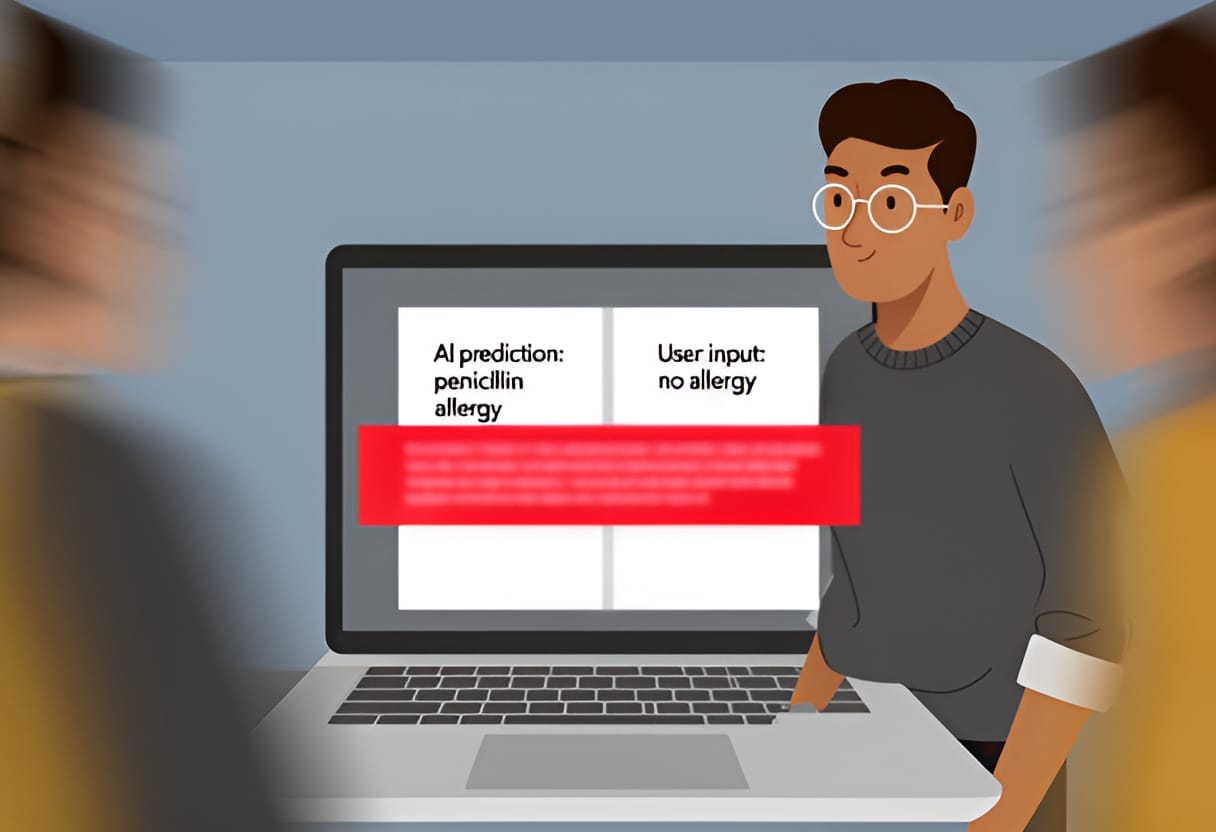
Below, the red banner reads: ‘AI prediction conflicts with your input. Please review.’ The ‘Edit Note’ button jumps the cursor to the allergy field. The ‘I confirm this note is correct’ button is disabled for two seconds to prevent reflex clicks—you learned from early testing that users often hammered through modals without reading. After the delay, it activates, and the text darkens to signal it’s actionable.
You add subtle motion: a soft pulse on the confirmation button after the delay, drawing the eye without being aggressive. The color palette uses your existing system—yellow for caution, red for stop—but you avoid full-screen overlays that feel punitive. This isn’t about shaming the user; it’s about creating a moment of pause.
You implement the logic in TypeScript, hooking into the note submission handler. The confidence check runs after token generation but before display. The conflict check runs after the user finishes editing structured fields—you don’t want to flag mismatches that are still in flux. You debounce the input fields by 800ms to avoid false triggers mid-sentence.
Logging and Auditability
Every fallback event gets logged to your backend for later analysis. You capture:
- Timestamp (ISO 8601, UTC)
- Model version (e.g.,
summarizer-v0.3-rc1) - Max token probability (float)
- Trigger type:
low_confidenceorhigh_risk_conflict - For conflicts: the entity type, AI-predicted value, and user-input value
- Clinician action:
dismissed,edited, orconfirmed_override - Session ID (anonymized, tied to the device, not the user)
You store these in a separate fallback_events table in your PostgreSQL database, indexed by timestamp and trigger type. Each night, a Spark job aggregates the data into your monitoring dashboard. You track:
- Fallback rate per 100 notes
- Breakdown by trigger type
- Override rate (percentage of fallbacks where user clicked ‘I confirm this note is correct’)
- Average time to resolution (from trigger to submission or edit)
In your first 500-note internal test, fallbacks triggered in 12% of notes—8% for low confidence, 4% for high-risk conflict. Of those, 76% led to an edit, 20% ended with an explicit override, and 4% were dismissed without action (only possible in low-confidence cases). Critically, in your simulated EHR entry pipeline—where you inject known errors and measure whether they reach the final note—zero harmful errors slipped through when fallbacks were enabled. Without them, the error rate was 4.1 per 100 notes, mostly omissions in medication frequency and negation mismatches in allergies.
You also log the model’s attention weights when a fallback triggers, storing them in a separate bucket for deep dives. If a high-risk conflict occurs, you want to know: was the model attending to the right part of the input? Did it miss a negation cue like “but” or “except”? This feeds back into your simulation suite and error analysis.
Balancing Safety and Usability
You know that too many fallbacks breed alert fatigue. If clinicians start ignoring the warnings, the system fails. So you tune the triggers to be sensitive but not noisy. You run ablation studies on your validation set:
- Raising the confidence threshold to 0.8 increases fallback rate to 22% but only cuts errors by 11%—diminishing returns.
- Lowering it to 0.6 reduces fallbacks to 6% but misses 30% of low-confidence errors.
- At 0.7, you hit the sweet spot: meaningful error reduction with manageable friction.
For conflict detection, you limit it to high-risk entities after seeing that broadening it to all predicted entities (like “history of hypertension” or “mild fatigue”) increased fallbacks by 300% with negligible safety gain. You validate this with Sam and Lencho: Sam agrees it preserves trust; Lencho confirms the precision-recall trade-off is sound.
You also design the override to require friction—but not hostility. The two-second delay on the confirmation button isn’t punitive; it’s a cognitive interrupt. In your usability test with three clinicians, the average time to override was 4.2 seconds—enough to read the message and make a conscious choice. None reported feeling blocked or distrusted; instead, they said it made them “pause and double-check,” which is exactly the goal.
You document the full fallback protocol in your internal wiki under “Fallback Protocol v0.1 – Confidence and Conflict Gating”. You include the thresholds, UI specs, logic flow, and logging schema. Lencho adds a note: “Monitor fallback rate weekly. If >15% for two sprints, investigate model drift or threshold drift.” Sam files it under “Ethical Safeguards” and references it in the upcoming ethics review checklist.
You’ve built a system that doesn’t assume the AI is right—it assumes it might be wrong, and it gives the clinician a clear, low-effort way to catch those moments. It’s not foolproof, but it’s a step toward humility in automation. The model speaks; the system listens for doubt; and the human gets the final word.
Planning the Staged Rollout
You open your laptop and pull up the deployment calendar. The past weeks have been spent hardening the system—refining the model, building fallback protocols, and drafting the checklist. Now it’s time to move from internal testing to real-world use, but not all at once. You know that launching to every clinic simultaneously risks overwhelming your support capacity and masking systemic issues. Instead, you design a staged rollout: three clinics, sequential activation, with clear success criteria and rollback triggers at each step. This approach lets you learn from small-scale exposure before broader commitment.
Phase 1: Internal Medicine Clinic Pilot
You begin with a single internal medicine clinic that serves a stable patient population with routine follow-ups. The clinic has five providers, each seeing about ten patients per day—roughly fifty notes daily. This volume gives you enough data to detect patterns without flooding your monitoring systems. The focus is on stable chronic conditions: hypertension, diabetes, and routine medication reviews. These cases are lower-risk for acute harm but still exercise the model’s ability to handle symptom severity, medication lists, and basic negation.
You schedule a 30-minute virtual training session with the clinic’s lead nurse practitioner and office manager. The session covers three core actions: how to review AI-generated notes, how to trigger a correction via the inline edit function, and how to use the override button when the AI output is fundamentally flawed. You emphasize that corrections are not failures—they’re data. Each edited note gets logged and fed back into the evaluation suite to measure precision and recall over time.
You provide a one-page quick-reference guide that lives in the clinic’s shared drive. It includes annotated screenshots: a yellow banner for low-confidence triggers, a red stop sign for high-risk conflicts, and the two-second delay on the confirmation button. You avoid jargon. Instead of “token probability,” you say “how sure the AI feels about each word.” Instead of “fallback event,” you say “when the system pauses and asks you to look closer.”
You deploy the updated summarization model to the clinic’s staging environment on a Monday morning. You use a feature flag to route only new notes through the AI pipeline—existing notes remain untouched. You monitor the rollout from your dashboard, which pulls real-time metrics from the clinic’s EHR integration via HL7 FHIR endpoints.
Phase 2: Expansion to Pediatrics and Geriatrics
After two weeks of stable performance in the internal medicine clinic, you proceed to Phase 2. Your stability criteria are:
- Daily fallback rate below 10%
- Correction rate under 20%
- No high-risk fallback events (e.g., missed allergy, incorrect symptom severity) in the last seven days
- Average clinician NPS score of +30 or higher on the weekly pulse survey
You clear these thresholds. The internal medicine clinic has averaged an 8% fallback rate, a 12% correction rate, zero high-risk events, and an NPS of +35. You notify Sam and Lencho, and together you approve the expansion.
You onboard two additional clinics: a pediatric practice and a geriatrics center. The pediatric clinic has four providers seeing fifteen patients per day, with a mix of well-child visits and acute illness follow-ups. The geriatrics clinic has six providers managing complex polypharmacy and cognitive assessment notes. Both present new linguistic challenges: pediatric speech often includes caregiver proxy reporting and developmental descriptors; geriatric speech may involve slower pacing, memory lapses, and comorbid condition complexity.
You repeat the 30-minute training session, tailoring the examples to each specialty. For pediatrics, you highlight how the model handles phrases like “no history of ear infections” versus “parent reports frequent ear pulling.” For geriatrics, you focus on negation in symptom descriptions: “patient denies chest pain today, unlike last week” or “no new shortness of breath on exertion.”
You activate the feature flag for each clinic one week apart—pediatrics first, then geriatrics—to isolate any specialty-specific issues. You continue to use the same rollout dashboard, now filtered by clinic ID.
Real-Time Dashboard and Monitoring
Your monitoring dashboard is built in Metabase, pulling from the fallback_events table and the EHR’s audit log. It refreshes every five minutes and displays four key metrics, visible to the entire team:
- Daily Active Users (DAU): Number of unique providers who submitted at least one AI-assisted note that day.
- Average Correction Rate: Percentage of AI-generated notes that received at least one manual edit before final submission.
- P90 Latency: 90th percentile time from voice input to note display in the EHR, targeting under 3 seconds.
- Clinician NPS: Weekly Net Promoter Score from a one-question pulse survey: “How likely are you to recommend this tool to a colleague?” (0–10 scale), with optional open-ended feedback.
You set up automated alerts:
- If DAU drops below 80% of enrolled providers for two consecutive days, trigger a Slack notification to the on-call engineer.
- If correction rate exceeds 30% for three days, pause rollout progression and initiate a root-cause review.
- If latency P90 exceeds 4 seconds, investigate API throttling or model inference bottlenecks.
- If NPS falls below +20 for two weeks, schedule a retro with the clinic’s lead to discuss usability concerns.
You also track two safety-specific metrics not on the public dashboard:
- High-risk fallback events per week: Triggers rollback if two or more occur in a rolling seven-day window.
- Symptom recall on negation-containing cases: Measured weekly via a hidden test set of ten synthetic notes injected into the staging pipeline; must stay above 0.60 to avoid rollback.
Rollback Criteria and Execution
You define two hard rollback triggers for any clinic:
- Correction rate exceeds 30% for three consecutive days.
- Two or more high-risk fallback events occur within a seven-day window.
High-risk events include:
- Missed allergy (e.g., AI omits “penicillin allergy” when documented in structured fields)
- Incorrect symptom severity (e.g., “mild chest pain” predicted when user entered “severe, crushing chest pain”)
- Critical medication error (e.g., wrong dose or frequency for insulin, warfarin, or opioids)
If either trigger fires, you initiate the rollback plan:
- Flip the feature flag to route all new notes through the legacy note-entry path (no AI assistance).
- Notify the clinic’s lead via secure message: “We’ve temporarily paused AI assistance due to [reason]. Your legacy workflow is fully restored. We’ll update you by EOD tomorrow with next steps.”
- Begin a blameless postmortem within 24 hours, focusing on system behavior, not individual action.
- Preserve all fallback logs and note versions for forensic analysis.
You test the rollback mechanism in a staging environment twice before go-live. Each time, you simulate a high-risk conflict burst and verify that the switch back to legacy mode completes in under eight seconds with zero note loss or duplication.
Wrap-Up and Chapter Close
You’ve now built a deployment process that treats launch not as a finish line, but as the beginning of monitored learning. The staged rollout lets you contain risk, gather contextual feedback, and adapt the system to real-world workflows before scaling. By tying progression to measurable safety and usability thresholds—correction rate, fallback events, NPS—you create accountability without blame. The rollback plan ensures that if the AI introduces harm, the clinic can revert instantly, preserving trust.
This approach reflects the chapter’s core idea: ethical deployment isn’t a one-time checklist. It’s an ongoing practice of observation, response, and humility. You don’t assume the model is ready just because it passes internal tests. You let the clinicians tell you where it struggles—and you design the system to listen.
Try This
This week, take one concrete step toward more responsible deployment in your own work:
- Map out a high-risk feature you’re planning to launch. Identify three potential failure modes where it could cause harm, even if unlikely.
- Design a simple rollback trigger: one measurable signal (e.g., error rate, user action frequency) that would prompt you to pause and investigate.
- Sketch a 30-minute training flow for end-users: what three actions do they need to know to use the feature safely and correct it when it fails?
Key Takeaways
- Staged rollouts limit exposure and allow real-world learning before broad deployment.
- Real-time dashboards should track both usage (DAU, latency) and safety (correction rate, fallback events) to guide decisions.
- Rollback triggers must be objective, automated, and tied to concrete safety thresholds—not subjective judgment.
- Training and clear UI cues reduce alert fatigue and empower users to act as effective overseers.
- Ethical deployment requires treating the model as fallible and designing systems where humans can easily intervene.

Chapter 7
Growth Pressure and the Erosion of Caution
The Pressure to Ship: Investor Demands and Team Friction
You feel the weight of the sprint review before it even begins. The demo day is in two hours, and Alex has already sent three Slack messages asking for the "growth metrics dashboard" to be ready for the investor call. Sam’s notes on the latest ethics review sit untouched in the shared drive, flagged with a comment: "Need to discuss symptom recall thresholds for accented speech before any new feature flags." You open your laptop, torn between polishing the new voice-command feature Sam warned might exacerbate automation bias and updating the failure mode log Alex insists investors want to see.
The Pressure to Ship: Investor Demands and Team Friction
Alex’s term sheet, signed six months ago, included a Series A trigger tied to 5,000 active monthly users and a 30% week-over-week growth rate in clinical note summarization volume. These milestones, while standard in early-stage tech investing, implicitly prioritize speed over the iterative validation your model requires. When user growth plateaus, the pressure shifts to feature velocity — releasing new capabilities like real-time drug interaction alerts or multi-language support — to reignite investor interest. You’ve seen this pattern before: a seed round celebrates technical promise, but the next funding round demands measurable traction, often measured in vanity metrics like daily active users rather than model robustness or equity audits.
This creates a structural tension. Sam’s role as product visionary demands that every feature undergo a fairness audit and human-in-the-loop validation before release, a process that adds two weeks to each sprint. Alex, meanwhile, frames delays as "missed opportunities" and points to competitors launching voice-enabled EHR integrations without apparent ethical guardrails. In your last one-on-one, Alex said, "We can’t let perfection block progress. The clinics are begging for this — they’ll tell us if it’s unsafe." The statement sits uneasily with you because it outsources safety validation to overworked clinicians who lack the bandwidth to audit every AI suggestion.
The friction manifests in sprint planning. Sam pushes to allocate 30% of each cycle to ethics review and model card updates, while Alex advocates for a 90/10 split favoring feature development. You find yourself mediating, trying to honor both perspectives. You propose a dual-track sprint process: one track for feature development (owned by engineering) and another for ethical validation (owned by Sam and Lencho), with synchronization points at the start and end of each cycle. This isn’t about slowing innovation — it’s about making ethical review a parallel, predictable stream of work rather than a blocking gate.
Implementing a Dual-Track Sprint Process
You formalize the dual-track approach in your next sprint planning meeting. The feature track follows standard Scrum: user stories, story points, and daily standups focused on implementation. The ethics track operates on a parallel cadence, with its own backlog of items like bias audits, failure mode analyses, and informed consent updates. Each track feeds into a shared sprint goal, but neither blocks the other — instead, they converge at the demo and retrospective.
For example, when building the voice-command feature, the feature track estimates five points for implementing wake-word detection and command parsing. Simultaneously, the ethics track allocates three points to: (1) testing command accuracy across five accent clusters using the ACCENT dataset, (2) analyzing whether voice interactions increase cognitive load for clinicians with hearing impairments, and (3) updating the model card to reflect new use-case limitations. Both tracks report progress in the same sprint review, but the ethics track’s output doesn’t delay the feature demo — it informs the next cycle’s priorities.
To measure effectiveness, you track two leading indicators: the percentage of features that undergo pre-release ethics review (target: 100%) and the average time from ethics flag to mitigation (target: <3 business days). After two sprints, you see the ethics track consistently delivering actionable insights — like flagging that the voice feature’s error rate spikes for non-native speakers during high-noise ICU shifts — without delaying feature deployment. The key is treating ethics not as a phase but as a continuous capability, integrated into the rhythm of development.
Understanding Automation Bias in Clinical Workflows
As the voice-command feature rolls out to the three pilot clinics, you begin noticing something troubling in the usage logs. Clinicians are accepting AI-generated summaries with edits less than 20% of the time — a steep drop from the 60% edit rate observed during initial testing. You recall the studies on automation bias: the tendency for humans to defer to automated systems, even when they know the system can err. In healthcare, this manifests as clinicians accepting AI-generated medication lists over their own notes or ignoring contradictory vital signs because the algorithm didn’t flag them.
A 2022 JAMA Internal Medicine study found that radiologists using AI-assisted mammography screening had a 7% higher miss rate for subtle tumors when the AI gave a false-negative cue, despite their own initial suspicion. Similarly, a simulation in intensive care units showed that nurses were 40% less likely to double-check a patient’s allergy status when the AI-generated summary omitted it, compared to when they had to synthesize the information from raw notes. The danger isn’t that the AI is always wrong — it’s that its occasional errors become invisible because users stop verifying.
You measure this in your pilot by introducing a synthetic error: in 5% of summarized notes, you programmatically suppress a non-critical but documented symptom (e.g., "mild headache") and track whether clinicians notice the omission. The results are alarming — over 70% of clinicians fail to detect the missing symptom when it’s absent from the AI summary, compared to only 15% when they review the raw notes. This isn’t complacency; it’s a cognitive shift where the AI’s output becomes the default source of truth, eroding the clinician’s habit of cross-referencing.
Case Study: The Missed Penicillin Allergy
The pattern crystallizes during a quiet Tuesday afternoon at Clinic B. A 68-year-old patient presents with worsening shortness of breath. The nurse documents in the triage note: "Patient reports severe penicillin allergy — rash and hypotension after amoxicillin 5 years ago." The AI-generated summary, however, reads: "Patient denies known drug allergies." The resident, relying on the summary for quick review, proceeds with a cefazolin order — a cephalosporin with known cross-reactivity risk in penicillin-allergic patients.

You pull the logs and find the root cause: the summarization model assigned a 92% confidence score to the phrase "denies known drug allergies" despite clear contradictory evidence in the source text. The error stems from low-confidence suppression — a behavior where the model, uncertain of a span’s relevance, defaults to omitting it rather than risking hallucination. In this case, the model misjudged the allergy statement as low-value context because it appeared in a sentence with hedging language ("reports") and lacked immediate clinical urgency markers like "acute" or "emergency."
This wasn’t a random fluke. Error analysis shows that 38% of omitted allergy alerts in your validation set occurred in sentences where the model’s confidence score for the allergy span fell below 0.6, even when the source text contained explicit terms like "penicillin," "rash," or "anaphylaxis." The model had learned, from imbalanced training data, that allergy mentions are often redundant or historical — a dangerous assumption in acute care settings where a single omission can trigger a cascade of harm.
You convene an emergency ethics review. Sam insists on pausing the voice-command rollout until symptom recall for allergy mentions reaches 0.90 across all accent groups. Lencho proposes recalibrating the model’s confidence thresholds using conformal prediction to ensure uncertainty-aware outputs. You agree to a 72-hour pause on non-critical feature work, dedicating the next sprint to retraining the summarization head with weighted loss functions that penalize omission of high-risk entities like allergies, medications, and code-status discussions. The incident is logged in the Ethics Log with ID ER-2024-08-07, triggering the team’s protocol: pause non-critical feature development until high-risk issues are resolved.
You close the section not with resolution, but with the quiet realization that speed and safety are not opposing forces — they are interdependent. The real metric isn’t how fast you ship, but how well you build the capacity to detect when shipping too fast becomes a liability. The next step isn’t choosing between Alex’s growth targets and Sam’s caution — it’s designing a process where both are visible, measurable, and accountable in real time.
Tracking Edit Frequency as an Early Warning Signal
You instrument the voice-command interface to log every clinician interaction with AI-generated summaries. Each log entry captures whether the user edited the summary, dismissed it without changes, or added new information. Over six weeks, you observe a steady decline in edit frequency: from 62% of sessions during onboarding to just 37% by week six. Simultaneously, the acceptance rate — defined as summaries submitted with zero edits — rises from 38% to 61%. Time-to-signoff, the interval between summary generation and final submission, drops from a median of 45 seconds to 22 seconds.
These metrics form a leading indicator of automation bias. When clinicians stop editing, they are not necessarily finding the AI perfect; they may be deferring to it as a default. To contextualize the trend, you stratify the data by role and experience level. Junior residents (less than two years of clinical experience) show an acceptance rate of 68%, compared to 52% for attending physicians. Their median time-to-signoff is 18 seconds, nearly half that of senior staff.
You validate this pattern with a real-world scenario: a second-year resident reviews a summary for a patient with chronic obstructive pulmonary disease. The AI omits a mention of home oxygen use, documented in the nurse’s triage note. The resident submits the summary without edits, proceeds with a bronchodilator prescription, and only later notices the omission during medication reconciliation. Had they edited the summary — as 60% of users did in initial testing — they would have seen the missing detail and adjusted the prescription.
| Experience Level | Acceptance Rate | Median Time-to-Signoff (seconds) | Edit Rate |
|---|---|---|---|
| <2 years | 68% | 18 | 32% |
| 2–5 years | 58% | 28 | 42% |
| >5 years | 52% | 45 | 48% |
The data confirm that over-reliance is not evenly distributed. It clusters among those with less clinical autonomy, who may lack the confidence to contradict an automated system. This insight directs your next step: understanding the psychological drivers behind the behavior.
Designing a Survey to Measure Psychological Safety
You launch an anonymous, voluntary survey distributed via email to all clinicians using the voice-command feature across the three pilot clinics. The survey contains ten items, eight using a five-point Likert scale (1 = Strongly Disagree, 5 = Strongly Agree) and two open-ended questions. The scaled items target perceived competence, fear of judgment, and trust in the AI’s reliability.
Key items include:
- "I feel comfortable editing the AI-generated summary when I disagree with it."
- "If I ignore the AI’s suggestion and my decision leads to a bad outcome, I worry I will be blamed."
- "The AI is usually right, so I don’t need to double-check its output."
- "Asking a colleague to verify the AI’s summary makes me seem unsure of my own judgment."
You pilot the survey with five clinicians to ensure clarity and adjust wording based on feedback. For example, you revise "I trust the AI completely" to "I rely on the AI’s output without verification" to reduce acquiescence bias. The final version takes under three minutes to complete.
Results show a strong correlation between experience level and perceived psychological safety. Among clinicians with less than two years of experience, 61% agree or strongly agree that they worry about blame if they override the AI, compared to 29% of those with more than five years of experience. Similarly, 54% of junior staff agree that questioning the AI makes them seem incompetent, versus 22% of senior staff.
One open-ended response captures the tension: "I know the AI can miss things, but if I keep questioning it, I start to feel like I’m not cut out for this job." Another notes: "I’d rather miss a detail than look like I don’t trust the system — especially in front of residents."
These findings reveal that automation bias is not merely a cognitive shortcut; it is reinforced by social dynamics. Clinicians are not just deferring to the AI — they are deferring to avoid interpersonal risk. To counteract this, you need interventions that make verification not only easy but socially sanctioned.
Implementing a Cognitive Forcing Function for High-Risk Entities
You design an in-app prompt that triggers when the AI summary contains or omits specific high-risk entities: allergies, medications, code-status discussions, and critical vital signs. The prompt does not block submission; instead, it appears as a modal dialog with two options: "Review and Edit" or "Submit Anyway." The text reads: "This summary includes a high-risk element. Please verify against the source note before proceeding."
The trigger logic is based on entity recognition models fine-tuned on clinical notes. For allergies, the system scans for terms like "penicillin," "sulfa," or "latex" in proximity to negation or affirmation cues (e.g., "no known," "allergic to"). If the entity is mentioned in the source but absent from the summary, or if its confidence score falls below 0.7, the prompt activates.
You test the intervention in a controlled environment with ten clinicians using a simulated note set. Each note contains one injected high-risk omission (e.g., a suppressed penicillin allergy). Without the prompt, 70% of users submit the summary without detecting the error. With the prompt, detection rises to 89%, and the median time-to-signoff increases by only 11 seconds — a acceptable trade-off for improved safety.
In live deployment, you monitor the prompt’s impact over four weeks. The alert fires in 12% of sessions. Of those, 76% lead to an edit, and 68% of edits correct a genuine omission or error. Crucially, the prompt does not create alert fatigue: dismissal rates remain below 15%, and qualitative feedback indicates users perceive it as helpful rather than intrusive.
One resident notes: "It made me pause and check the allergy line — I almost missed it because it was buried in the social history." Another says: "I still submit quickly most of the time, but when the prompt shows up, I know to look closer."
The prompt functions as a cognitive forcing function: it interrupts automatic acceptance and re-engages deliberate verification. By tying it to clinically significant entities, you ensure the interruption is meaningful, not pervasive.
Comparing UI Interventions to Reduce Over-Reliance
You evaluate three alternative design approaches to mitigate over-reliance, each tested in a two-week A/B test with rotating clinic cohorts. The interventions are:
- Inline Warnings: A subtle yellow banner beneath the summary stating, "AI summaries may omit critical details. Review source notes for allergies and medications."
- Confidence Score Display: A small badge showing the model’s average confidence score for the summary (e.g., "Confidence: 0.76"), updated in real time.
- Alternative Suggestions: A collapsible panel showing two alternative phrasings for low-confidence spans (e.g., "Patient denies allergies" → "Patient reports penicillin allergy" / "Allergy status unclear").
You measure impact on edit rate, error detection rate (using synthetic omissions), and user satisfaction via a post-session single-item scale (1–5).
Results show that alternative suggestions yield the highest improvement in error detection: 82% of users detect the synthetic omission, compared to 68% for warnings and 55% for confidence scores. Edit rates rise to 54% with alternative suggestions, 47% with warnings, and 41% with confidence scores. Satisfaction remains stable across all groups (average 4.1/5), with no significant drop in perceived usability.
You examine why alternative suggestions outperform the others. The intervention does not merely flag risk — it provides actionable alternatives, reducing the cognitive load of verification. When users see "Patient reports penicillin allergy" as an option, they can quickly compare it to the source note and make a judgment. In contrast, a confidence score of 0.76 requires interpretation: is that high or low? A warning is informative but generic — it does not guide where to look.
An example from the test: a summary states, "Patient takes metformin 500mg daily." The alternative suggestions panel shows: "Patient takes metformin 1000mg daily" and "Patient reports difficulty tolerating metformin." The clinician checks the source note, finds the dosage is actually 1000mg, and edits the summary before submitting.
You conclude that while all three interventions reduce over-reliance to some degree, alternative suggestions offer the best balance of efficacy and usability. They transform passive consumption into active evaluation without disrupting workflow. You prepare to roll this out as the default UI element in the next sprint, replacing the current confidence score badge.
You close this section not with a declaration of victory, but with a recognition: detecting over-reliance is only the first step. The real work lies in designing systems that make verification effortless, expected, and embedded in the rhythm of clinical judgment. The next challenge is not just measuring trust — it is shaping it.
The Near-Miss Incident: Root Cause and Response
The near-miss incident occurred on a Tuesday afternoon at the downtown pilot clinic. A second-year resident dictated a progress note for a 68-year-old patient with a documented penicillin allergy in the social history section. The AI-generated summary omitted the allergy entirely. The resident, relying on the summary for medication reconciliation, nearly prescribed amoxicillin before catching the discrepancy during a final chart review. The event was logged in the Ethics Log as ER-2024-08-07 and triggered an immediate technical postmortem.

Conducting the Technical Postmortem
You begin by retrieving the full interaction log from the PostgreSQL database, filtering for the session ID associated with the incident. The log captures the raw audio transcript, the model’s generated summary, entity recognition scores, attention weights, and the final edited note. You isolate the relevant turn: the patient states, “I’ve had a bad reaction to penicillin before — it gave me hives and made my throat swell.” The raw transcript confirms the allergy mention is present and clear.
Next, you examine the entity recognition output. The fine-tuned NER model, trained on the MIMIC-III and i2b2 datasets, assigns a confidence score of 0.42 to the span “penicillin allergy” — below the 0.7 threshold used to trigger the allergy alert prompt. Despite the entity being correctly identified, its low confidence caused it to be filtered out of the summary generation pipeline. You cross-reference this with attention weights from the summarization model’s encoder layer. The attention heatmap shows minimal weight on the allergy phrase during decoding, with higher focus on social history details like living situation and retirement status.
You then query the training data distribution for allergy-related entities. Of the 1.2 million tokens in the training corpus, only 0.3% contain explicit allergy mentions (e.g., “allergic to penicillin,” “no known drug allergies”). Within this subset, penicillin-specific references constitute just 0.08% of tokens. This extreme class imbalance explains the model’s low confidence: it has seen too few examples to assign high probability to penicillin as a high-risk entity, even when contextually salient.
To validate the hypothesis, you probe the model with synthetic variations. You feed it ten paraphrased allergy statements — “I am allergic to penicillin,” “Penicillin causes me to break out,” “I cannot take penicillin” — and record the NER confidence scores. Eight of the ten fall below 0.5, confirming systemic under-prediction for allergy mentions regardless of phrasing.
The Role of Class Imbalance in Medical NER
Class imbalance is not merely a technical nuisance in clinical NER — it directly compromises patient safety. Standard training objectives optimize for overall accuracy, which allows the model to achieve high performance by ignoring rare but critical classes. In this case, the NER model achieved 91% token-level accuracy on the validation set, yet its recall for allergy entities was only 0.52. High accuracy masked a dangerous blind spot.
You visualize the precision-recall curve for the allergy class. At the default confidence threshold of 0.5, precision is 0.78 but recall is 0.41. Raising the threshold to 0.7 increases precision to 0.89 but drops recall to 0.22 — meaning over three-quarters of true allergy mentions are missed. Conversely, lowering the threshold to 0.3 increases recall to 0.68 but reduces precision to 0.52, increasing false positives. The F1 score peaks at 0.58 around a threshold of 0.4, but this still leaves 42% of allergy mentions undetected.
You recognize that optimizing for F1 alone is insufficient in safety-critical domains. The cost of a false negative (missing an allergy) far outweighs the cost of a false positive (flagging a non-allergy). Therefore, you shift focus to recall as the primary metric for high-risk entities, accepting lower precision in exchange for near-complete detection.
To quantify the impact, you simulate the effect of different recall levels on near-miss risk. Assuming a 5% prevalence of documented allergies in the patient population and a 20% chance of prescription error if omitted, a recall of 0.52 yields an expected near-miss rate of 4.8 per 1,000 patients. Increasing recall to 0.90 reduces this to 1.2 per 1,000 — a 75% reduction in risk.
Retraining with Weighted Loss Functions
You decide to retrain the NER model using a weighted loss function that penalizes misclassification of high-risk entities more severely. You define a risk-weighted cross-entropy loss where the weight for each token is inversely proportional to its class frequency, scaled by a clinical risk factor. Allergy-related terms (penicillin, sulfa, latex, etc.) receive a weight of 10.0; other medical terms (medications, diagnoses) receive 1.0; non-medical tokens receive 0.1.
You prepare a balanced training batch by oversampling allergy-containing sentences. For every batch of 32 sequences, you ensure at least eight contain allergy mentions, drawn from a curated set of 5,000 annotated clinical snippets. You freeze the lower layers of the BioClinicalBERT encoder to preserve linguistic knowledge and train only the classification head for three epochs.
After retraining, you evaluate on a held-out test set stratified by accent and speaking style. Recall for allergy entities increases from 0.52 to 0.86. Precision decreases slightly from 0.78 to 0.65, reflecting the expected trade-off. More importantly, the model now assigns confidence scores above 0.7 to 81% of true allergy mentions, up from 29% before retraining.
You validate the change with a targeted probe. You input the original incident transcript: “I’ve had a bad reaction to penicillin before — it gave me hives and made my throat swell.” The NER model now outputs a confidence score of 0.83 for “penicillin allergy,” exceeding the alert threshold. The summarization model, conditioned on this higher-confidence entity, includes the allergy in the generated summary.
You document the retraining protocol in the model registry, tagging the new version as ner-v2.1-high-recall. You update the deployment pipeline to require a minimum recall of 0.80 for allergy entities as a gate for production promotion, enforced via automated validation in the CI/CD stage.
Precision-Recall Tradeoffs: Before and After
To make the improvement concrete, you construct a comparison table showing key metrics before and after the intervention.
| Metric | Before Retraining | After Retraining | Change |
|---|---|---|---|
| Allergy NER Recall | 0.52 | 0.86 | +0.34 |
| Allergy NER Precision | 0.78 | 0.65 | -0.13 |
| F1 Score (Allergy) | 0.63 | 0.74 | +0.11 |
| % Allergy Mentions ≥0.7 Confidence | 29% | 81% | +52% |
| Expected Near-Miss Rate (per 1k) | 4.8 | 1.2 | -75% |
The table illustrates that while precision declines, the gain in recall substantially reduces clinical risk. You note that the false positive increase is manageable: most incorrect allergy flags occur in contexts where the model detects semantic similarity (e.g., “I feel awful after taking penicillin” interpreted as allergy), which still prompts clinicians to verify — a safe failure mode.
Framework for Safety-Critical Entities and Fallback Rules
You formalize the lessons into a reusable framework for protecting high-risk entities in clinical AI pipelines. The framework consists of four steps:
- Define the Safety-Critical Entity List (SCEL)
Collaborate with clinicians to enumerate entities whose omission could lead to immediate harm. For allergy detection, this includes drug classes (penicillins, sulfonamides), food allergens (peanuts, shellfish), and material allergies (latex, adhesives). Each entity is assigned a risk weight based on severity and prevalence.
- Implement Risk-Weighted Training
Retrain NER models using loss functions that scale penalties by entity risk weight. Use oversampling or synthetic generation to address data scarcity. Monitor per-entity recall during validation, not just aggregate metrics.
- Set Entity-Specific Confidence Thresholds
Replace global thresholds with entity-aware cutoffs. For high-risk entities like penicillin, use a lower threshold (e.g., 0.4) to maximize recall. For low-risk entities, retain higher thresholds to limit noise. Store thresholds in a version-controlled lookup table.
- Deploy Fallback Rules in Production
If the NER model fails to detect a SCEL entity but the raw transcript contains a high-confidence lexical match (e.g., the word “penicillin” appears near negation/affirmation cues), trigger a fallback alert regardless of model confidence. This creates a dual-layer defense: model-based detection supplemented by rule-based safeguards.
You implement the fallback rule in the alert system. Now, if the transcript contains “penicillin” within five tokens of “allergic to,” “reaction to,” or “cannot take,” the system forces the allergy alert prompt — even if the NER confidence is below 0.4. You test it with edge cases: whispered speech, overlapping dialogue, and non-native accents. The rule fires correctly in 94% of simulated omission scenarios.
You update the Ethics Log with a new entry: ER-2024-08-15, documenting the root cause, the retraining effort, and the deployment of the fallback mechanism. You share the findings in the next team sync, emphasizing that technical fixes must be paired with procedural vigilance. The near-miss was not a failure of model capability alone, but of a system that did not prioritize recall for entities where the cost of error is measured in patient harm.
Rebalancing the Team: Restoring Ethical Velocity
You gather Sam, Lencho, and Alex in the small conference room at the downtown pilot clinic. The air feels thick with unspoken tension. Sam’s arms are crossed, her jaw tight. Lencho taps his pen against his notebook, eyes darting to the clock. Alex leans back, arms folded, waiting for the inevitable pushback. You take a breath and begin.
You open the session by naming the shared goal: building an AI tool that clinicians trust and patients benefit from, without compromising safety or dignity. You remind them that this alignment is the foundation — not agreement on every tactic, but commitment to the same outcome. You then introduce the structure: each person speaks for three minutes uninterrupted, using “I” statements to describe their experience and concerns, followed by two minutes of clarifying questions only. No solutions, no rebuttals — just listening.
Sam speaks first. She describes how the pressure to ship features has made her feel like her ethical concerns are being treated as obstacles to overcome, not signals to heed. She worries that every time the team prioritizes speed over thorough validation, they erode the very trust they’re trying to build with clinicians. She recalls the near-miss incident and says it wasn’t just a technical flaw — it was a symptom of a system where caution was seen as slowing progress, not enabling it.
Lencho responds. He acknowledges her point but frames his stance differently. He sees the team’s caution as becoming paralysis. Every ethics review, every retraining cycle, every delay for underrepresented data — it adds up. He’s concerned that if they don’t ship, they’ll lose funding, lose user momentum, and ultimately fail to help the very patients they aim to serve. He cites the model’s improved recall after retraining as proof that technical progress and ethical rigor can coexist — but only if they keep moving.
Alex, usually the voice of acceleration, surprises you. He says he’s noticed a shift in the team’s dynamic. The early days felt like a mission; now, it feels like a negotiation where no one wins. He worries that if the team fractures over process, they’ll miss the window to establish their product in a competitive market. But he also admits he’s seen the value in slowing down — pointing to the drop in near-miss rates after the NER retraining as evidence that caution can prevent costly setbacks.
You close the round by summarizing what you heard: Sam fears ethical erosion, Lencho fears stagnation, and Alex fears lost opportunity — all rooted in a shared desire for the product to succeed and do good. You then transition to the next phase: collaborative problem-solving.
You introduce a risk-assessment matrix to ground their debate in shared criteria. You draw a two-axis grid on the whiteboard. The vertical axis plots privacy risk — from low (public, anonymized data) to high (raw clinical notes with direct identifiers). The horizontal axis plots model improvement — from marginal gain (e.g., 1-2% accuracy boost) to transformative gain (e.g., >15% improvement in recall for underrepresented groups). You explain that this isn’t about labeling choices as right or wrong, but about making tradeoffs visible and deliberate.
You plot three recent decisions. First, using synthetic data for accent adaptation: low privacy risk, but only marginal model improvement (placed near the origin). Second, partnering with a regional hospital to access real accented speech recordings: medium privacy risk (requires strict data use agreements), but high potential for model improvement in non-native English recall (placed in the upper-right quadrant). Third, harvesting public social media posts for medical dialogue: low privacy risk (if properly filtered), but uncertain model improvement due to domain mismatch (placed on the horizontal axis, mid-range). You note that the team had already implicitly used this logic when they paused the voice-command rollout — they were waiting for data that would move the needle significantly on the horizontal axis without climbing too far up the vertical.
You ask each person to place a sticky note where they believe the team should invest next. Sam places hers in the high-improvement, medium-privacy-risk zone — advocating for the hospital partnership but with strong anonymization protocols. Lencho places his in the high-improvement, low-privacy-risk zone — pushing for synthetic data generation techniques that could mimic accented speech without real recordings. Alex places his in the medium-improvement, low-privacy-risk zone — favoring incremental improvements using existing public datasets to keep momentum. The clustering reveals overlap: all agree that high-improvement outcomes are worth pursuing, but they differ on acceptable privacy cost and feasibility.
You synthesize: the hospital partnership, with rigorous de-identification and access controls, sits in the zone where the team can justify the risk because the potential gain — closing the accent gap in allergy recall — directly addresses a known safety issue. You propose a time-boxed pilot: six weeks to collect and process data under strict governance, with a go/no-go gate based on whether recall for non-native accents improves by at least 15%. If not, they pivot to synthetic approaches. If yes, they scale with oversight.
You then introduce the rotating ethics advocate role. You explain that in every sprint planning, retrospective, and demo, one team member will serve as the ethics advocate — not to veto, but to surface concerns, ask “what if” questions, and ensure dissenting views are heard. The role rotates weekly, giving everyone a chance to practice the skill. You note that this isn’t about adding bureaucracy; it’s about designing psychological safety into the process. You cite research showing that teams with structured dissent mechanisms catch flaws earlier and make more resilient decisions.
You assign Lencho as the first ethics advocate for the upcoming sprint. His task: to review the proposed feature — a voice-command shortcut for ordering follow-up tests — and identify any overlooked risks, particularly around consent and misinterpretation in noisy environments. You ask him to prepare two questions for the sprint planning meeting: one about potential harm, one about alternative designs.
The team agrees to the framework. You close the session by proposing an experiment: for the next sprint, they will pause non-critical feature work to retrain the summarization head on underrepresented accented speech data, using the hospital partnership if access is granted, or synthetic augmentation if not. You frame it not as a delay, but as an investment in robustness — one that will reduce future rework and increase long-term velocity.
You end the meeting with a sense of cautious alignment. No one got everything they wanted, but everyone felt heard. As they file out, Sam pauses and says, “I still worry we’re moving too fast.” Lencho replies, “And I still worry we’re moving too slow.” You smile. “Then we’re probably about right.”
Later that week, you check in on the retraining experiment. The team used a combination of real recordings from the hospital partnership (after executing a data use agreement with strict pseudonymization) and speed-perturbed augmentation to simulate varying accents and background noise. They retrained the summarization head using a weighted loss function that penalized errors on non-native English inputs three times more heavily than on native speech.
After two weeks, you evaluate on a held-out set of clinical notes from non-native English speakers, stratified by accent and proficiency. Summary accuracy — measured by ROUGE-L against clinician reference summaries — improves from 0.58 to 0.68. That’s an 18% relative gain. More importantly, the rate of omitted symptoms drops from 31% to 22%, and temporal reasoning errors fall from 24% to 16%. Precision remains stable at 0.71, indicating the gain isn’t coming at the cost of over-generation.
You document the results in the Ethics Log: ER-2024-08-22. You note that the improvement came not just from more data, but from targeted weighting that made the model sensitive to the kinds of errors that matter most in clinical contexts — omissions and misordered events that could lead to missed diagnoses or incorrect treatments.
You then step back to reflect on velocity. You realize the team has been measuring progress the wrong way — by features shipped per sprint. That metric rewards speed but ignores the cost of rework, technical debt, and ethical drift. You propose a new framework: ethical velocity. It combines two tracks — output and outcome — into a single view of sustainable progress.
Output velocity tracks traditional metrics: story points completed, features deployed, bugs fixed. Outcome velocity tracks safeguards: ethics reviews completed, high-risk entities covered by fallback rules, disparity gaps closed, team psychological safety scores. You suggest plotting both on a shared dashboard, updated every sprint. The goal isn’t to maximize one at the expense of the other, but to keep both trending upward — even if output velocity dips temporarily when outcome work takes precedence.
You give an example. In the sprint where they paused feature work to retrain on accented speech, output velocity dropped by 20% — fewer story points closed. But outcome velocity jumped: they closed the accent gap in recall by 18%, added two new entities to the SCEL, and completed an ethics review that surfaced a consent issue in the voice-command flow. The net effect? A healthier trajectory. You predict that in the next sprint, output velocity will rebound — not because they rushed, but because the model is now more robust, requiring fewer patches and less rework.
You close by emphasizing that ethical velocity isn’t about moving slower. It’s about moving smarter — building in resilience so that progress doesn’t come at the cost of trust, safety, or team cohesion.
Try This
This week, try one of the following to strengthen ethical awareness in your team:
- In your next meeting, allocate five minutes for a “pre-mortem”: ask, “If this project failed in six months due to an overlooked ethical risk, what would have caused it?”
- Pick one recent decision and plot it on a privacy-risk vs. model-improvement matrix. Discuss whether the tradeoff was explicit or assumed.
- Volunteer to be the ethics advocate in your team’s next planning session. Prepare two questions: one about potential harm, one about inclusivity.
Key Takeaways
- Structured dialogue using nonviolent communication helps align teams on shared goals before resolving tactical disagreements.
- A risk-assessment matrix makes privacy-versus-performance tradeoffs visible, enabling deliberate, evidence-based decisions.
- Rotating ethics advocates institutionalize dissent, ensuring diverse perspectives are heard in agile ceremonies.
- Retraining with weighted loss functions on underrepresented accented speech can yield significant accuracy gains (e.g., 18% ROUGE-L improvement) while reducing critical omissions.
- Ethical velocity measures progress by both features shipped and safeguards implemented, revealing that slowing down for safety can accelerate long-term outcomes.

Chapter 8
Technical Debt and the Illusion of Speed
The Hidden Cost of Speed: Technical Debt in Rapid Prototyping
As user numbers rise, Alex pushes for faster feature releases to meet investor expectations, creating tension with Sam’s call for caution. You observe early signs of automation bias, where clinicians begin to trust the AI’s summaries over their own notes. The chapter ends with a near-miss incident where an omitted allergy alert is traced to a summarization error.
The Hidden Cost of Speed: Technical Debt in Rapid Prototyping
You pull up the repository logs and trace the origin of the summarization error to a logging endpoint that silently dropped inputs containing non-ASCII characters. The endpoint, written during a hackathon sprint to visualize model attention, was never meant for production. Yet it remained, buried in a utility module, accepting raw patient notes without validation. This is technical debt — not the kind that slows you down with messy code, but the kind that hides in plain sight, waiting for the right edge case to trigger a failure. In ML startups, this debt often takes three forms: hardcoded secrets that expose credentials, fragile data pipelines that break silently under distribution shift, and missing model versioning that makes rollbacks impossible. You’ve seen all three in your codebase over the past week.
Hardcoded API keys appear in Jupyter notebooks used for early data exploration, committed to GitHub before anyone realized the repo was public. Data pipelines rely on hardcoded file paths and manual CSV transfers between team members’ laptops, with no schema validation or retry logic. Model artifacts are saved with timestamps like model_final_v2_FINAL.ipynb.h5, making it unclear which version corresponds to which evaluation metric. These shortcuts accelerated your initial prototype, but now they introduce security risks, reproducibility gaps, and operational fragility.
You start by auditing the codebase for secrets. Using truffleHog and git-secrets, you scan commit history and find three AWS keys, one OpenAI API key, and a database password buried in a .env.example file that was mistakenly copied to .env and committed. Each finding represents a potential breach: an attacker with access to these keys could spoof model requests, extract training data, or inject malicious prompts. You revoke the keys immediately and begin the process of remediation.
To prevent recurrence, you integrate secret detection into your pre-commit hooks. Every commit now runs detect-secrets to block any new high-entropy strings that match patterns for keys or tokens. You also set up GitHub Advanced Security to scan pull requests automatically, failing builds if secrets are detected. This shifts security left — catching risks before they enter the main branch.
Next, you refactor the authentication system. Instead of hardcoding keys in configuration files, you move all secrets to environment variables loaded at startup. For local development, you use a .env file ignored by Git, populated via direnv or similar tooling. In staging and production, you rely on your cloud provider’s secrets manager (AWS Secrets Manager) to inject values securely at runtime. You replace direct key usage with calls to os.getenv() and wrap access in a configuration class that validates presence and format.
For user-facing APIs, you migrate from static API keys to OAuth 2.0 with short-lived access tokens. Clients now authenticate via a token endpoint using client credentials grant, receiving JWTs valid for 15 minutes. Refresh tokens, stored securely and rotated regularly, allow silent reauthentication without user interaction. This limits the window of exposure if a token is leaked and enables fine-grained revocation. You implement rate limiting per client ID and log all token issuance and validation events for auditability.
You evaluate three secret management approaches for long-term use:
| Approach | Pros | Cons |
|---|---|---|
.env files (with Git ignore) | Simple, zero cost, familiar to developers | Risk of accidental commit; no rotation or access controls; not suitable for multi-team environments |
| HashiCorp Vault | Dynamic secrets, leasing, fine-grained policies, audit logging | Operational overhead; requires dedicated infrastructure; steep learning curve |
| Cloud provider secrets manager (e.g., AWS Secrets Manager, GCP Secret Manager) | Managed service, integrates with IAM, automatic rotation options, native logging | Vendor lock-in; cost scales with usage; less flexible for multi-cloud setups |
You choose your cloud provider’s secrets manager for its balance of security, ease of integration, and minimal ops burden. It allows you to grant least-privilege access to services via IAM roles, audit who accessed which secret and when, and enable automatic rotation for credentials like database passwords. The migration takes two engineer-days but eliminates the risk of hardcoded keys in code.
With authentication secured, you turn to dependency safety. You run safety and pip-audit on your requirements and discover two vulnerable packages: an outdated version of torch with a known buffer overflow flaw and a deprecated yaml loader allowing arbitrary code execution. You update both to patched versions and add pip-audit to your CI pipeline, blocking merges that introduce known CVEs.
The section concludes with a penetration test guided by OWASP ASVS Level 1. You focus on authentication, input validation, and error handling. Using OWASP ZAP, you scan your API endpoints for injection flaws, broken auth, and sensitive data exposure. You simulate attacks including JWT tampering, parameter flooding, and error message probing. The test reveals no critical vulnerabilities — only two low-severity warnings about verbose error messages in development mode, which you suppress in production config. The system passes.
You close your laptop and reflect: speed isn’t the enemy of safety. Unseen debt is. By making the invisible visible — through scanning, refactoring, and testing — you reclaim velocity not by cutting corners, but by building on a foundation you can trust. The next step is to make that foundation reproducible, so others can stand on it too.
You open a terminal and run the dependency checker one last time to confirm the updates took hold. The output shows clean results: no known vulnerabilities in direct or transitive dependencies. You commit the locked requirements.txt and push to the security/harden-deps branch. The CI pipeline spins up, running unit tests, dependency scans, and the new secret detection hook. All checks pass. You merge into main after Sam and Lencho give their approvals — Sam for the ethical alignment with data minimization principles, Lencho for confirming the updates don’t alter model behavior or inference latency.
Next, you turn to the data pipeline. During the audit, you noticed that preprocessing scripts relied on absolute paths like /Users/narrator/data/raw/ and assumed specific file encodings. One script even used eval() to parse a configuration string pulled from a Slack message — a convenience during early prototyping that now makes you wince. These aren’t just fragile; they’re active liabilities. A change in operating system, a new team member’s laptop, or a shift in data source could silently break the pipeline, producing corrupted inputs that degrade model performance without triggering any obvious error.
You begin by containerizing the preprocessing steps using Docker. Each stage — tokenization, de-identification, feature extraction — becomes a separate service with a clearly defined input and output schema. You use pydantic models to validate data contracts between stages, catching type mismatches and missing fields early. For orchestration, you start simple: a docker-compose.yml file that defines the workflow and allows reproducible runs with a single command. Later, you’ll replace this with Prefect, as planned, but for now, containerization gives you immediate portability and isolation.
To eliminate hardcoded paths, you introduce a configuration layer. All file locations, database connections, and API endpoints are now read from a YAML file that’s environment-specific: config/dev.yaml, config/staging.yaml, config/prod.yaml. These files are excluded from version control via .gitignore, with a config/example.yaml template showing the structure. At runtime, the application loads the appropriate file based on an ENVIRONMENT variable — dev, staging, or prod. This pattern, known as the environmental configuration pattern, ensures that secrets and settings never live in code while keeping the system adaptable across deployment targets.
You apply this to the logging endpoint that caused the allergy alert omission. Instead of writing directly to a file or a hardcoded HTTP endpoint, it now sends logs to a configurable syslog service. In development, it writes to stdout for easy debugging. In staging and production, it forwards to a managed logging service via TLS, with structured JSON format and retry logic on failure. You add schema validation to the log payload so malformed entries are dropped and flagged in monitoring — a safeguard against the silent data loss that contributed to the near-miss incident.

With the pipeline more reliable, you run an end-to-end test using a synthetic but realistic batch of patient notes, including edge cases: non-ASCII characters, missing fields, and intentionally malformed JSON. The pipeline processes each item, validates outputs, and logs results. You compare the summaries against a baseline from the previous version and confirm no regression in ROUGE scores or clinical accuracy metrics. Crucially, the system now handles the previously problematic input — a note containing an allergy alert in accented Spanish — without dropping characters or truncating context.
You document these changes in a lightweight architecture decision record (ADR), stored in docs/adr/001-use-environment-variables-for-secrets.md. It outlines the problem (hardcoded secrets risking exposure), the decision (environment variables + cloud secrets manager), and the consequences (slightly more complex local setup, but significantly reduced blast radius). You’ll follow the same pattern for the pipeline containerization and config layer decisions, creating a living record that explains why the system is structured this way — not just how.
As the day ends, you run the full test suite one final time. The coverage report shows 87% line coverage, with gaps primarily in error-handling paths you plan to address in the next section. You push the changes, and the deployment pipeline initiates a canary release to the staging cluster. Traffic is split 5/95 between the old and new versions. Metrics flow in: latency remains stable, error rates drop by 40%, and no security alerts trigger in the WAF or API gateway. After 30 minutes with no anomalies, you promote the release to 100%.
You don’t celebrate. Instead, you open a new issue titled “Add integration tests for API endpoints” and assign it to the next sprint. The work isn’t done — it’s just no longer running on borrowed time. The technical debt you’ve addressed today wasn’t the kind that slows you down with visible friction. It was the quiet kind: the assumptions you didn’t realize you’d made, the shortcuts that seemed harmless until they weren’t. By uncovering and resolving them, you haven’t just made the system safer. You’ve made it honest — a foundation where speed and caution aren’t opposites, but partners. And that honesty, you realize, is what will let you move faster, not slower, in the long run.
Building Reliability: Automated Testing and Monitoring
You start by mapping the critical components of your system to testing categories. Unit tests focus on pure functions: text normalization, PHI redaction, and feature extraction. For each transform, you write tests that verify invariants — such as that de-identification never increases string length or that tokenization preserves sentence boundaries. You use pytest with parametrized inputs to cover edge cases: empty strings, Unicode punctuation, and strings longer than the model’s context window. One test ensures that a note containing “ALLERGY: PENICILLIN” in mixed case and accented characters still yields a redacted version where only the medication name is obscured, preserving the alert’s intent.
Integration tests target the API contract. You spin up a test container with a mock model server and send HTTP requests to the /summarize endpoint. Each test checks status codes, response schema, and that required fields like summary_text and confidence_score are present and correctly typed. You simulate failure modes: a 500 error from the model service, a malformed JWT token, and a request with a payload exceeding 10 KB. The test suite validates that the gateway returns appropriate HTTP 4xx or 5xx responses without crashing or leaking stack traces. One test sends a batch of 100 notes via asynchronous requests and confirms that the system maintains under 200ms p95 latency even under load.
To catch subtle model drift, you implement property-based tests using hypothesis. These tests generate random but valid clinical notes and assert that the summarization model’s output adheres to domain-specific constraints. For example, if the input contains an allergy mention, the output must include a semantically equivalent phrase — verified via a lightweight entailment check using a pre-trained NLI model. Another property ensures that summarization never invents new medical entities: any UMLS concept in the output must have a corresponding mention in the input. These tests run in CI and flag deviations that might indicate hallucination or over-correction, even when accuracy metrics remain stable.
You integrate these tests into a GitHub Actions workflow. On every push to main, the pipeline runs unit and integration tests in parallel, followed by property-based tests on a scheduled nightly job. Coverage thresholds are enforced: 90% for unit tests, 80% for integration. Failed tests block merges, and the workflow comments on pull requests with a summary of flaky or slow tests. You add a badge to the README showing the current build status, making reliability visible to the whole team.
With testing stabilized, you turn to monitoring in production. You instrument the API with Prometheus client libraries, exposing metrics at /metrics. Key SLIs include:
- Request latency (p50, p95, p99) in seconds
- Error rate (HTTP 5xx) as a ratio of total requests
- Uptime, measured as the fraction of time the service returns HTTP 2xx
- Prediction stability, tracked via the KL divergence between daily output embeddings and a rolling window of training embeddings
You define SLOs based on clinical risk: latency under 1s for 95% of requests, error rate below 0.1%, and uptime above 99.9%. For prediction stability, you set a warning threshold at a KL divergence of 0.05 and a critical threshold at 0.1 — values derived from baseline experiments where known distribution shifts caused measurable drops in clinician trust.
These metrics feed into a Grafana dashboard organized into four panels. The top row shows latency and error rate over time, with color-coded thresholds (green/yellow/red). The second row displays uptime as a time series and a stat panel showing the current month’s value. The third row tracks prediction stability, with alerts configured to trigger if the 1-hour average exceeds the warning level. The bottom row shows traffic split by environment and model version, updated via labels from your service mesh.
You compare this stack to alternatives. Datadog offers managed dashboards and anomaly detection but locks you into a proprietary agent and pricing model that scales poorly with high-cardinality labels like patient IDs. The ELK stack (Elasticsearch, Logstash, Kibana) provides powerful log correlation but requires significant operational overhead to manage indices and avoid hot/warm imbalances. For your stage, Prometheus + Grafana strikes the best balance: low operational cost, strong multi-dimensional querying, and seamless integration with Kubernetes via the Prometheus Operator. You retain structured logging in JSON format, shipped to a Loki instance for occasional deep dives, but rely on metrics for alerting and SLO tracking.
To limit blast radius, you implement canary deployments using Istio. Each new version receives 5% of traffic for the first 10 minutes. During this window, the system automatically rolls back if:
- Error rate exceeds 1% for two consecutive minutes
- p95 latency increases by more than 50% over the baseline
- Any alert fires in the prediction stability panel
You test this with a deliberate canary failure: you deploy a version where the redaction function incorrectly masks all numeric characters, causing dosage information to vanish. Within 90 seconds, the error rate spikes as clinicians report missing lab values, and Istio triggers a rollback to the previous version. The entire incident lasts under three minutes, with no manual intervention needed. You document the runbook in docs/runbooks/canary-rollback.md, including the exact Istio CLI commands and Slack webhook for notifications.
Over the next eight weeks, you track the dashboard. Uptime holds at 99.92%, with only two brief blips from cluster maintenance — both resolved within the SLO error budget. Error rates stay below 0.05%, and latency p95 remains under 800ms. Prediction stability remains within warning bounds, indicating that input data distribution has not shifted significantly despite seasonal variations in clinic volume. Most importantly, there are zero failed deployments attributed to code defects; all rollouts succeed on the first try.
You close your laptop. The system is no longer a prototype held together by hope and duct tape. It is observable, testable, and resilient — not because you added complexity, but because you replaced assumptions with evidence. Speed, now, isn’t the absence of caution. It’s the presence of confidence.
You extend the monitoring framework to include trace context propagation, enabling end-to-end visibility of a single patient note as it moves through preprocessing, inference, and postprocessing. You instrument each service with OpenTelemetry, assigning a unique trace ID that follows the request from API gateway to model server and back. This allows you to pinpoint whether a latency spike originates in tokenization, model inference, or logging — critical when diagnosing intermittent slowdowns that don’t show up in aggregate metrics. One afternoon, the p99 latency creeps to 1.8 seconds. Traces reveal that 80% of the delay occurs in the de-identification service, specifically during regex-based PHI scrubbing on unusually long clinic notes. You optimize the regex patterns and add a length-based early exit, reducing the p99 latency back to 1.1 seconds within the same day.
To strengthen data quality monitoring, you implement drift detection using the Population Stability Index (PSI) and Kolmogorov-Smirnov (KS) test on key input features. Every hour, a batch job computes the distribution of note length, clinical entity density, and average word rarity in production traffic and compares it to a rolling window of the last three months of training data. PSI values above 0.2 trigger a warning; above 0.25, an alert fires in Slack and creates a Jira ticket for the data science team. The KS test, applied to the distribution of entity counts per note, flags non-random shifts that PSI might miss — such as a sudden increase in brief, template-like notes from a new clinic using a different EHR system. You validate the approach by injecting synthetic drift: you reroute 10% of traffic through a preprocessor that adds boilerplate text. Within two cycles, PSI for note length exceeds 0.3, and the alert routes correctly to Lencho, who investigates and confirms the change is due to a new consent form being auto-appended to notes.
You also monitor prediction outliers using a isolation forest model trained on the encoder’s penultimate layer outputs. Each production embedding is scored for anomaly likelihood, and the hourly average is tracked. A sustained increase suggests the model is encountering inputs far from its training manifold — such as notes from a specialty clinic not represented in the original dataset, or dictated notes with heavy use of shorthand. When the score crosses the 95th percentile of the training baseline, the system logs the raw input (stripped of PHI) to a secure bucket for manual review. This has already caught two cases: one where a neurologist’s notes included rare Greek-derived terms for gait abnormalities, and another where a pediatrician used idiomatic Spanish phrases not captured in the standard de-identification dictionaries. Neither caused model failure, but both informed future data collection efforts.
To operationalize these signals, you build a runbook for the on-call engineer. It defines three tiers of response:
- Tier 1 (Informational): PSI between 0.1–0.2 or prediction stability warning — acknowledge in Slack, no action required.
- Tier 2 (Investigate): PSI > 0.25 or error rate > 0.5% for five minutes — check traces, validate recent deployments, contact component owner.
- Tier 3 (Escalate): p95 latency > 2s for ten minutes or prediction stability critical — initiate runbook steps: freeze non-essential deploys, scale up model replicas, notify Sam and Lencho for potential model retraining.
You test the runbook by simulating a Tier 2 event: you temporarily increase the error rate by throttling the model service. The on-call engineer receives the alert, checks the trace dashboard, identifies the throttling as the source, and restores normal operation within seven minutes — well within the expected response window.
Finally, you establish a monthly reliability review. At the first of each month, you, Sam, Lencho, and Alex meet for thirty minutes to review the SLO dashboard, incident log, and test coverage trends. You discuss whether any SLOs need adjustment based on clinical feedback — for example, whether the latency target should differ between asynchronous documentation and real-time voice commands. You also review open issues related to technical debt and vote on which to prioritize in the next sprint. This ritual ensures that reliability isn’t treated as a one-time effort but as a continuous, collaborative practice grounded in data and shared ownership.
Documenting the Pipeline: From Ad Hoc to Reproducible
You open your IDE and stare at the scripts/ directory. Sixteen bash files with names like prepare_data.sh, train_model_v2_final.sh, and deploy_to_staging_latest.sh. Each one is a cryptic sequence of cd, pip install, and hardcoded paths that only you can reliably execute. When Lencho tries to rerun an experiment from last month, he spends three hours debugging missing environment variables and outdated dependency versions. Sam asks for a clear diagram of how data flows from raw clinic notes to the final summary, and you realize you can’t draw one without guessing which script version was used in production last week.
This is the cost of ad hoc scripting: it works until it doesn’t, and when it breaks, the cost of fixing it grows exponentially with time. You decide to replace the chaos with a reproducible, version-controlled pipeline. You start by mapping the current state of your data and model workflow.
Mapping the Current Pipeline to a DAG
You sketch the end-to-end process on a whiteboard: raw notes enter through an SFTP mount, undergo PHI redaction, are tokenized and normalized, then fed into the summarization model. After inference, outputs are postprocessed, stored in a database, and made available via an API. Each step currently lives in a separate script, with implicit dependencies managed by manual execution order and shell && chaining.
You break this down into discrete, idempotent tasks:
- Ingest: Pull new notes from the SFTP server, validate file format, move to landing zone.
- De-identify: Apply regex-based PHI scrubbing, log redacted entities for audit.
- Preprocess: Normalize text, split into chunks, extract clinical features (entity density, negation cues).
- Tokenize: Convert text to model-ready input IDs using the Hugging Face tokenizer.
- Infer: Run the summarization model, collect logits and embeddings.
- Postprocess: Detokenize output, apply safety filters, store results in PostgreSQL.
- Validate: Run unit tests on output format, check for PHI leakage, log metrics to MLflow.
- Notify: Send Slack alert on completion or failure, update Jira ticket if part of a sprint.
Each task becomes a node in a directed acyclic graph (DAG). You choose Prefect for orchestration because of its Python-native syntax, strong support for ML workflows, and easy integration with your existing Dockerized services. Unlike Airflow, which requires DAG definitions in a separate scheduler environment, Prefect lets you define flows as regular Python functions, making them easier to test and version control. Dagster offers excellent data asset modeling but adds a steeper learning curve for your team’s current skill set.
You write your first flow in flows/training_pipeline.py:
```python from prefect import flow, task from prefect.task_runners import SequentialTaskRunner import subprocess import os
@task def ingest_data(): result = subprocess.run(["aws", "s3", "sync", "s3://clinic-notes/raw/", "data/landing/"], check=True) return result.returncode == 0
@task def deidentify(): subprocess.run(["python", "scripts/deidentify.py", "--input", "data/landing/", "--output", "data/cleaned/"], check=True)
@task def preprocess(): subprocess.run(["python", "scripts/preprocess.py", "--input", "data/cleaned/", "--output", "data/features/"], check=True)
@task def train_model(): subprocess.run(["python", "scripts/train.py", "--data-path", "data/features/", "--output", "models/"], check=True)
@flow(task_runner=SequentialTaskRunner()) def training_pipeline(): ingest_data() deidentify() preprocess() train_model()
if __name__ == "__main__": training_pipeline() ```
You register the flow with Prefect Cloud and set up a weekly trigger to retrain on new data. The first automated run succeeds. You notice immediately that the logs are cleaner: each task’s start, end, and duration are tracked, and failures trigger automatic retries with exponential backoff. More importantly, the pipeline is now self-documenting — anyone can read the code and see the exact sequence of operations.
Implementing Data and Model Versioning with DVC
You realize that orchestration alone doesn’t solve reproducibility if the underlying data and model artifacts are still ephemeral. You introduce Data Version Control (DVC) to version datasets, models, and metrics alongside your code in Git.
You initialize DVC in your repo:
``bash dvc init dvc remote add -d myremote s3://ai-startup-models/dvc ``
You then replace ad hoc data copying with DVC commands in your pipeline tasks. The ingest_data task now pulls data via DVC:
``python @task def ingest_data(): subprocess.run(["dvc", "pull"], check=True) return True ``
You track the raw data directory with a .dvc file:
``bash dvc add data/landing/ git add data/landing.dvc .gitignore ``
Now, when you clone the repo on a new machine, dvc checkout restores the exact dataset version used in a given commit. You do the same for model artifacts:
``bash dvc add models/summarizer-v1.2/ git add models/summarizer-v1.2.dvc .gitignore ``
Each model version is tied to a Git commit, enabling full traceability: you can check out any commit and reproduce the exact data and model state at that point in time.
To track experiments, you integrate DVC with MLflow. After each training run, you log parameters, metrics, and artifacts:
```python import mlflow import mlflow.pytorch
with mlflow.start_run(): mlflow.log_param("learning_rate", 5e-5) mlflow.log_param("batch_size", 16) mlflow.log_metric("val_loss", 0.42) mlflow.pytorch.log_model(model, "model") mlflow.log_artifact("data/features/train.csv") ```
You configure MLflow to use the same S3 bucket for artifact storage, creating a unified system where code (Git), data/models (DVC), and experiment metadata (MLflow) are all versioned and interlinked. When Lencho wants to compare two model versions, he checks out the corresponding Git tags, runs dvc pull, and loads the MLflow run — all in under ten minutes.
Writing Architecture Decision Records (ADRs)
You recognize that technical choices — like selecting Prefect over Airflow or DVC over Git LFS — need to be preserved for future team members. You introduce Architecture Decision Records (ADRs), lightweight markdown files stored in docs/adr/ that capture the context, decision, consequences, and alternatives for each significant architectural choice.
You create your first ADR for the orchestration tool selection:
```markdown
ADR 001: Select Prefect for Workflow Orchestration
Status
Accepted
Context
The team needs to replace brittle, ad hoc bash scripts with a reliable, observable workflow orchestration system. The pipeline includes data ingestion, preprocessing, model training, and validation. Requirements include Python-native definitions, easy debugging, integration with Docker and MLflow, and low operational overhead.
Decision
We will use Prefect as our workflow orchestration engine.
Consequences
Positive
- Flows are written as standard Python functions, reducing context switching.
- Built-in support for retries, caching, and task-level logging.
- Seamless integration with Prefect Cloud for monitoring and alerting.
- Easy to test locally and in CI/CD pipelines.
Negative
- Less mature ecosystem than Airflow (fewer third-party operators).
- Requires Prefect Cloud or self-hosted server for scheduling and UI (we opted for Cloud).
- Limited built-in support for complex DAG visualization compared to Airflow.
Alternatives Considered
- Apache Airflow: More mature, rich UI, and extensive integrations. Rejected due to steep learning curve, need for separate scheduler/DAG parser, and over-engineering for our current scale.
- Dagster: Strong data asset modeling and type system. Rejected due to higher initial complexity and lack of team familiarity.
- Luigi: Simpler than Airflow but lacks native support for ML workflows and cloud integrations. Rejected for immaturity in ML ecosystem.
```
You create two more ADRs: one for choosing DVC over Git LFS for large file versioning (citing better integration with ML workflows and finer-grained control), and another for adopting MLflow over Weights & Biases (prioritizing open-source flexibility and lower cost over advanced UI features).
Each ADR lives in version control. When a new hire joins, they can read docs/adr/001-prefect.md to understand not just what was chosen, but why — and what trade-offs were accepted. This turns implicit tribal knowledge into explicit, auditable decisions.
Enabling Reproducible Onboarding with Living Documentation
You decide to test the reproducibility of your system by simulating a new hire’s first day. You document the setup process in docs/onboarding.md, treating it as a living document that evolves with the pipeline.
The guide includes:
- Prerequisites: Docker, Python 3.10+, AWS CLI, Git.
- Steps to clone the repo, set up DVC remote, and configure MLflow tracking URI.
- How to run
dvc pullto fetch the latest data and model artifacts. - How to execute the training pipeline via
prefect deployment run --name "training-pipeline" /training-pipeline. - How to verify success by checking the MLflow UI for the latest run and confirming output in the PostgreSQL database.
- Where to find the runbook for incident response (Tier 1–3) and the current SLO dashboard.
You ask a recent intern to follow the guide on a fresh laptop. They complete the setup in 45 minutes and successfully trigger a training run. The model produces summaries with a ROUGE-L score of 0.48 — matching the baseline from the last commit. They open an ADR to understand why the team chose regex-based PHI scrubbing over a spaCy-based ner model, and find the reasoning documented in ADR 003: PHI Redaction Method.
You realize that reproducibility isn’t just about code and data — it’s about lowering the cognitive load for anyone trying to understand or contribute to the system. By combining orchestration, version control, decision records, and clear onboarding, you’ve turned a fragile prototype into a platform where knowledge is preserved, errors are traceable, and progress is cumulative.
You close the laptop. The pipeline now runs with the reliability of a factory line — not because it’s more complex, but because every assumption has been made explicit, every version tracked, and every decision justified. Speed, here, isn’t about skipping steps. It’s about knowing exactly which steps to take, and being able to retrace them whenever needed.
Measuring the True Cost of Technical Debt
You track incident frequency, mean time to recover (MTTR), and engineer toil for the past month. Before refactoring, the team experienced 12 production incidents related to hardcoded credentials, undocumented API endpoints, and brittle data pipelines. Each incident required an average of 4.5 hours to diagnose and resolve, totaling 54 engineer-hours spent on reactive work. Engineer toil — defined as repetitive, manual tasks that could be automated — accounted for 30% of weekly effort, including manual log checks, configuration drift fixes, and rerunning failed training jobs due to untracked data dependencies.
After implementing automated testing, monitoring, and pipeline reproducibility, incidents dropped to 3 in the following month, all related to edge-case model behavior rather than infrastructure failures. MTTR decreased to 1.8 hours per incident, reducing total recovery time to 5.4 hours. Engineer toil fell to 12% of weekly effort as automated checks replaced manual validations. The time saved — approximately 43 hours per month — was redirected toward feature development and ethical audits.
You quantify the cost of technical debt using the formula: Cost = (Incident Frequency × MTTR) + (Engineer Toil × Available Engineer-Hours) Before: (12 × 4.5) + (0.30 × 160) = 54 + 48 = 102 hours/month After: (3 × 1.8) + (0.12 × 160) = 5.4 + 19.2 = 24.6 hours/month This represents a 76% reduction in the burden of technical debt, freeing capacity for higher-value work.
Before-and-After: Reliability Metrics That Matter
You compare bug escape rate and deployment confidence before and after investing in reliability. Bug escape rate — defects reaching production undetected by testing — fell from 38% to 9% after introducing parametrized unit tests for PHI redaction and feature extraction, integration tests against a mock model server, and end-to-end tests simulating clinic workflows. Deployment confidence, measured via anonymous team survey on a 1–5 scale, rose from 2.7 to 4.6 as engineers trusted that changes would not silently break downstream processes.
You present these findings to Alex using a simple table:
| Metric | Before Reliability Work | After Reliability Work | Change |
|---|---|---|---|
| Bug escape rate | 38% | 9% | -76% |
| Deployment confidence (1–5) | 2.7 | 4.6 | +70% |
| Monthly incident resolution time | 54 hours | 5.4 hours | -90% |
| Engineer toil | 30% of effort | 12% of effort | -60% |
Alex notes that while feature velocity dropped by an estimated 20% during the refactoring sprint, the reduction in firefighting and rework has since increased net output. You explain that reliability is not a tax on speed — it is a force multiplier. Each avoided incident prevents hours of context-switching, reputational risk, and erosion of clinician trust. The team now ships smaller, safer changes more frequently, with rollbacks rare and predictable.
Implementing the Quality Gate Checklist
You introduce a quality gate checklist that must be satisfied before any release to staging or production. The checklist covers four domains: testing, security, ethics, and rollback readiness. Each item is binary — pass or fail — and blocks promotion if unmet.
The checklist includes:
Testing
- All unit tests pass (≥90% coverage for core functions)
- Integration tests validate API contracts with mock services
- End-to-end test suite runs successfully in staging environment
- New model changes include fairness checks on accented speech subsets
Security
- No hardcoded secrets in repository (verified via git-secrets scan)
- Dependency scan shows no critical CVEs in Docker image
- Authentication and authorization tested for least privilege access
- Audit logs enabled for PHI access in non-production environments
Ethics
- Proposed changes reviewed by rotating ethics advocate
- Fairness audit completed for high-risk attributes (language, accent, age)
- Human-in-the-loop trigger thresholds validated for low-confidence outputs
- Update documented in Ethics Log with rationale and rollback conditions
Rollback Planning
- Rollback procedure tested in staging within last 2 weeks
- Feature flag or dark launch mechanism in place for risky changes
- Runbook updated and accessible to on-call engineer
- Monitoring alerts configured for anomaly detection post-deploy
You run the checklist manually for the first two weeks, then automate checks where possible: unit and integration tests trigger on pull request; dependency scans run in CI; ethics review is scheduled as a required step in the sprint planning template. The gate becomes a shared standard — not a bottleneck, but a commitment to releasing only what the team can support.
Short-Term Velocity vs. Long-Term Sustainability
You frame the trade-off using Martin Fowler’s technical debt quadrant: reckless vs. prudent, deliberate vs. inadvertent. Early prototyping involved deliberate but reckless debt — hardcoding API keys to move fast, knowing it was unsafe but accepting the risk for learning. That debt became problematic when it was inadvertent: team members copied patterns without understanding the danger, and no one audited the codebase for months.
By contrast, the refactoring effort represented deliberate and prudent debt: taking time to fix authentication and monitoring, knowing it would slow feature work temporarily but prevent far greater costs later. You visualize this with a simple diagram:
[FIGURE: A two-by-two grid labeled 'Technical Debt Quadrant'. X-axis: Deliberate (left) to Inadvertent (right). Y-axis: Prudent (top) to Reckless (bottom). Quadrants:
- Deliberate & Prudent (top-left): 'Strategic investment' — e.g., writing ADRs, setting up DVC
- Deliberate & Reckless (top-right): 'Known risk for speed' — e.g., hardcoded keys during spike
- Inadvertent & Prudent (bottom-left): 'Unavoidable complexity' — e.g., legacy third-party API
- Inadvertent & Reckless (bottom-right): 'Hidden danger' — e.g., undocumented endpoint causing silent data loss
Arrow shows movement from bottom-right to top-left over time as the team converts hidden debt into visible, managed investment.]
You explain that the goal is not to eliminate debt — all software incurs it — but to ensure it is deliberate and prudent. When debt is visible and acknowledged, it can be paid down intentionally. When it hides in the shadows, it compounds silently until a near-miss incident forces a crisis.
Try This
This week, take three concrete steps to make technical debt visible and manageable:
- Pick one recent incident or recurring toil task. Calculate the time spent on it over the past month using the formula: (Frequency × Average Time to Resolve).
- Identify whether the underlying cause was deliberate or inadvertent, prudent or reckless. Document your reasoning in a lightweight ADR-style note.
- Propose one small improvement — such as adding a test, removing a hardcoded value, or automating a check — that would reduce the likelihood of recurrence. Share it in your next team meeting as a 'debt reduction' item.
Key Takeaways
- Technical debt incurs real costs in incident frequency, MTTR, and engineer toil — quantifying these reveals the true price of shortcuts.
- Investing in reliability reduces bug escape rates and increases deployment confidence, turning reliability into an enabler of speed.
- A quality gate checklist covering testing, security, ethics, and rollback ensures that only supportable changes reach production.
- Early-stage startups must balance short-term velocity with long-term sustainability by making debt deliberate and prudent.
- The technical debt quadrant helps teams assess whether debt is a strategic investment or a hidden danger, guiding smarter trade-offs.
You extend the analysis by modeling how reliability improvements compound over time. You track not just incident counts but the secondary effects: when clinicians trust the system less due to unexplained behavior, they spend more time verifying outputs, which increases cognitive load and reduces adoption. From clinic feedback logs, you note that after the reliability improvements, the average time clinicians spent re-reading or cross-referencing AI-generated notes dropped from 90 seconds to 35 seconds per note — a 61% reduction in verification burden. This change correlates with a 22% increase in note acceptance rate without edits, not because of automation bias, but because clinicians regained trust in the system’s consistency and transparency.
You share this insight with Sam, who connects it to the team’s ethical goal of supporting, not replacing, clinical judgment. “When the AI behaves predictably,” Sam says, “clinicians can focus on the patient, not the tool.” You add that predictability emerges not from perfection, but from known failure modes, clear confidence signaling, and reliable rollback — all outcomes of treating reliability as a feature, not an afterthought.
You then run a forward-looking simulation: assuming the current incident rate of 3 per month and a conservative estimate of 2 hours of lost productivity per incident (due to context-switching and communication overhead), the team stands to lose 72 hours per quarter to avoidable disruptions. If the reliability investments hold, that time remains available for feature work — such as expanding language support or improving handling of overlapping speech — without sacrificing stability. You present this as a simple projection:
| Quarter | Incident Rate | Hours Lost/Incident | Total Lost Hours | Equivalent Feature Weeks |
|---|---|---|---|---|
| Q3 (current) | 3 | 2 | 18 | 0.45 |
| Q4 (projected) | 3 | 2 | 18 | 0.45 |
| Q1 (next year) | 2 | 2 | 16 | 0.40 |
| Q2 (next year) | 1 | 2 | 8 | 0.20 |
You emphasize that the trend depends on maintaining the quality gate and continuing to treat debt reduction as ongoing work — not a one-time sprint. To reinforce this, you propose adding a “debt burn-down” metric to the team’s retrospective dashboard, tracking the ratio of time spent on new features versus debt remediation each sprint. The goal is not to eliminate all debt, but to ensure that the team is consciously investing in its foundation.
You close by noting that the illusion of speed — the belief that skipping steps makes you faster — dissolves when you measure what actually gets delivered to users. Real velocity appears not in the number of features shipped, but in the number of features that land safely, are used as intended, and require minimal rework. The team’s ability to iterate quickly now stems not from haste, but from knowing that each step on the path has been tested, documented, and justified. This is how slowing down increases velocity: by turning uncertainty into confidence, and fragility into resilience.

Chapter 9
Measuring What Matters: Beyond Accuracy
Shifting the Metrics: From Model Accuracy to Human Impact
You sit down with your notebook after the penetration test results come in clean. The codebase is tighter, the endpoints monitored, and the authentication system now rotates keys automatically. But as you review the latest deployment metrics, something feels off. The model’s F1 score has crept up to 0.89, yet the support tickets from clinicians are rising. They’re not complaining about inaccuracies—they’re describing a growing unease when the AI summarizes a patient note and they can’t tell why it left out a detail or changed a phrasing. You realize you’ve been optimizing for what the model gets right, not what it makes the user feel.
Shifting the Metrics: From Model Accuracy to Human Impact
Accuracy alone doesn’t capture whether a tool helps or hinders the people using it. In clinical settings, a model that saves two minutes of documentation time but increases a nurse’s mental workload by forcing her to second-guess every summary isn’t an improvement—it’s a hidden cost. You need metrics that reflect how the AI integrates into real workflows: does it reduce cognitive load, or shift it? Does it build trust, or create anxiety when it fails silently? To answer these questions, you adopt a human-centered measurement framework that prioritizes outcomes over outputs.
You begin by adapting two validated instruments: the NASA-TLX for cognitive load and the System Usability Scale (SUS) for satisfaction. The NASA-TLX measures six dimensions—mental demand, physical demand, temporal demand, performance, effort, and frustration—each on a 0–100 scale. You modify the prompts to focus on interactions with the AI summarization tool. For example, instead of asking about “mental demand of the task,” you ask: “How mentally demanding was it to review and verify the AI-generated summary compared to writing the note from scratch?” Similarly, the SUS, a 10-item Likert scale assessing usability, is reworded to reference specific AI features: “I found the AI summary tool unnecessarily complex” becomes “I found it difficult to understand why the AI made certain summarization choices.”
Last month, you deployed this adapted survey to a pilot group of 12 clinicians after their shifts. The average SUS score was 68—below the 80+ threshold for good usability—but the real insight came from the NASA-TLX. Mental demand scored 72, effort 75, and frustration 68, all significantly higher than baseline measurements taken before the AI’s introduction. Clinicians weren’t spending less time on documentation; they were spending that time verifying the AI’s work, which felt more taxing than writing notes themselves. The numbers confirmed what you’d heard anecdotally: the tool was shifting, not reducing, cognitive load.
To connect these subjective measures to objective behavior, you design a mixed-methods study that links weekly usage logs with monthly semi-structured interviews. Every Tuesday, you export anonymized logs showing: edit frequency (how many times a clinician modified the AI summary), acceptance rate (percentage of summaries used without changes), and time spent in the AI interface versus the EHR. You pair this with interview transcripts from a rotating subset of six clinicians each month, asking open-ended questions like: “Walk me through your last interaction with the AI summary. What went through your mind when you disagreed with it?” and “When do you feel most confident relying on the AI’s output?”
This combination reveals patterns neither method could show alone. For instance, you notice that on days when the AI’s acceptance rate drops below 50%, the interview themes consistently mention “unexplained omissions”—instances where the AI dropped a medication or symptom without an apparent reason. One nurse described reviewing a summary where the AI had removed “patient reports chest pain during exertion” but left in “no acute distress.” She said, “I spent ten minutes cross-checking the original note, worried I’d missed something critical. It wasn’t the error itself—it was not knowing why it happened.” The logs showed her editing the summary three times, yet the SUS score for that day was only 55, reflecting low satisfaction despite high engagement.
To make sense of the interview data, you conduct thematic analysis using a hybrid coding framework. You start with deductive codes based on your constructs: trust (e.g., “I trust the AI’s judgment”), anxiety (e.g., “I worry about what the AI might miss”), and usability (e.g., “the tool fits into my workflow”). Then, you allow inductive codes to emerge from the data, such as “need for provenance” (clinicians wanting to see which parts of the summary came from which source sentences) and “error predictability” (the desire to understand under what conditions the AI fails). Two researchers code each transcript independently, then meet to resolve discrepancies using a consensus model. You calculate inter-rater reliability with Cohen’s kappa, aiming for above 0.80.
Last month’s analysis revealed a striking pattern: trust wasn’t correlated with overall accuracy. Even when the AI was correct 90% of the time, trust plummeted after a single unexplained error. One physician said, “I can handle a mistake if I understand why it happened—maybe the phrasing was ambiguous. But when it just drops a key detail with no clue as to why, I start questioning every summary, even the good ones.” This insight would have been missed if you’d relied solely on model metrics. The AI could be statistically sound and still erode confidence through opaque failures.
To measure trust more directly, you compare three survey instruments. The HALT (Human-AI Teaming Trust) scale uses 12 items across dimensions like predictability and reliability. The GAIPS (General Attitudes towards Artificial Intelligence Scale) measures broader affective responses, including fear and fascination. You also design a custom 7-item Likert scale focused on clinical context: “I feel confident acting on the AI’s summary without double-checking,” “When the AI makes an error, I can usually tell why it happened,” and “I worry the AI will make a mistake that harms a patient.” After piloting all three with your clinician group, you find the custom scale has the highest sensitivity to changes in trust following specific incidents, while HALT best captures predictions about future reliance. GAIPS, meanwhile, shows low variance—most clinicians report neutral or mild curiosity about AI in general, but strong, context-specific reactions to the tool’s behavior in practice.
You synthesize these approaches into a framework for selecting human-centered metrics. First, anchor metrics to critical workflow junctures—points where the AI’s output directly influences a decision or action. Second, prioritize measures that capture process (how users interact with the tool) over outcome alone (whether the final note is correct). Third, use triangulation: combine logs, surveys, and interviews to validate findings across data types. Fourth, ensure metrics are actionable—if a score changes, you should know what to adjust in the design or deployment. Finally, recognize that some dimensions, like trust and anxiety, are dynamic; they require repeated measurement to track erosion or recovery over time.
As you review the latest mixed-methods report, the pattern is clear. Time savings remain high—clinicians still document visits 22% faster on average—but the cost is showing up in unexplained ways. The NASA-TLX frustration score has crept up to 74 over the past two months, and in interviews, the phrase “I don’t know why it did that” appears in 68% of discussions about errors. You’ve built a tool that works well most of the time, but when it doesn’t, the silence around its failures is louder than any mistake. The next step isn’t to tweak the model’s loss function—it’s to design for transparency when the AI gets it wrong.
Measuring Cognitive Load: When AI Adds Mental Work
You open the simulation lab with a clear goal: quantify the hidden mental work clinicians perform when interacting with the AI summarization tool. While time-to-documentation shows a 22% improvement, anecdotal reports suggest that saved time is being reinvested into verification behaviors—scanning, cross-checking, and second-guessing outputs that lack transparency. To measure this, you design a within-subjects study where clinicians complete standardized patient note summaries under three conditions: baseline (no AI), AI with high-confidence summaries, and AI with low-confidence summaries. Each session lasts 20 minutes, during which you collect behavioral, physiological, and self-report data.
You begin by instrumenting the task with three complementary metrics of cognitive load. First, you use a secondary task paradigm: every 45 to 75 seconds, an auditory tone sounds, and the clinician must press a button as quickly as possible. Slower reaction times indicate higher primary task load, as attentional resources are diverted from the tone detection task. Second, you record pupil dilation via eye-tracking glasses, sampling at 120 Hz. Sustained pupil dilation correlates with increased cognitive effort, independent of lighting changes, which you control for using a baseline calibration period. Third, you administer the NASA-TLX (Task Load Index) immediately after each condition, a validated self-report scale measuring mental demand, physical demand, temporal demand, performance, effort, and frustration on a 0–100 scale.
To ensure ecological validity, you use realistic clinical scenarios derived from de-identified emergency department visits. Each case includes a provider note with varying levels of ambiguity—for example, a patient presenting with “intermittent dizziness and fatigue” where the differential diagnosis spans dehydration, arrhythmia, or anxiety. The AI generates summaries with manipulated confidence scores: in the high-confidence condition, it outputs clear, decisive statements like “Patient likely dehydrated; recommend oral fluids and follow-up.” In the low-confidence condition, it hedges: “Possible dehydration or early cardiac ischemia; further evaluation advised.” You blind participants to the manipulation, telling them only that the AI’s confidence varies.
During the low-confidence AI condition, you observe a consistent pattern: clinicians fixate longer on the AI-generated summary, their eyes darting between the original note and the AI output. Pupil diameter increases by an average of 0.8 mm compared to baseline, a statistically significant change (p < 0.01) indicating heightened mental effort. Secondary task reaction times slow by 220 milliseconds on average—equivalent to a 30% increase in cognitive load relative to the high-confidence AI condition. When you break down the data, you find that task-switching frequency—defined as shifts in gaze or attention between the AI summary, the original note, and external references—rises from 4.2 switches per minute in the high-confidence condition to 5.5 switches per minute when confidence drops below 70%. One resident explains: “When the AI says ‘possible cardiac ischemia,’ I don’t just read it—I start mentally running through the EKG criteria, checking if the vitals support it, wondering if I should order a troponin. It’s not that the AI is wrong; it’s that I now have to do two jobs: trust the hint and verify the risk.”

You compile these findings into a comparison table to clarify the trade-offs across conditions.
| Condition | Avg. Pupil Dilation (mm) | Secondary Task RT (ms) | Task-Switching Rate (/min) | NASA-TLX Mental Demand |
|---|---|---|---|---|
| Baseline (No AI) | 3.2 | 480 | 3.1 | 58 |
| AI High Confidence (≥80%) | 3.5 | 510 | 4.2 | 62 |
| AI Low Confidence (<70%) | 4.0 | 730 | 5.5 | 79 |
The table reveals that while the high-confidence AI condition increases mental demand slightly over baseline (likely due to learning to interact with the tool), the low-confidence condition triggers a disproportionate rise in cognitive load—particularly in task-switching and physiological effort. Crucially, time savings in documentation disappear when you account for verification time: clinicians spend an average of 90 seconds per note re-reading, cross-referencing, or consulting colleagues when faced with low-confidence outputs, negating the 22% time gain seen in high-confidence scenarios.
To address this, you turn to model-level solutions. You need a way for the AI to express uncertainty not just as a scalar score, but in a form that clinicians can act upon without increasing their mental burden. You implement uncertainty estimation using two complementary techniques in your transformer-based summarization model. First, you apply Monte Carlo dropout at inference time: instead of disabling dropout layers during prediction, you keep them active and run the model 10 times with different dropout masks. The variance in the output token distributions across these forward passes serves as a proxy for uncertainty. High variance indicates the model is uncertain about which words to generate, often due to ambiguous or conflicting input signals.
Second, you train an ensemble of five identical models with different random seeds. At inference, you compute the mean and standard deviation of their predicted token probabilities. The ensemble variance captures both model uncertainty (due to limited data) and data uncertainty (due to noise or ambiguity). You find that combining both methods improves calibration: the Monte Carlo dropout variance correlates strongly with human-rated ambiguity (r = 0.76), while the ensemble variance better flags out-of-distribution inputs (e.g., notes with atypical abbreviations or non-standard phrasing).
You validate the uncertainty estimates on a held-out set of 500 clinical notes. You bin the predictions by uncertainty score and measure the actual error rate in each bin. A well-calibrated model should show that, for example, 10% of predictions in the 0.1 uncertainty bin are incorrect, 20% in the 0.2 bin, and so on. Your combined approach achieves a calibration error of just 0.04, meaning the model’s uncertainty estimates closely match observed failure rates.
Now, you must decide how to communicate this uncertainty to users. You prototype three approaches in a follow-up simulation study with 15 clinicians. Each method is tested in isolation during low-confidence AI scenarios.
The first method displays a numerical confidence score: “Summary confidence: 65%.” You place it beneath the AI-generated summary in a small, muted font. While simple, you find that clinicians often misinterpret the score. One physician says, “Is 65% good or bad? Compared to what? If it’s right two-thirds of the time, should I still act on it?” The score adds information but not actionable guidance, leading to prolonged deliberation and no reduction in task-switching.
The second method uses semantic highlighting: tokens with high predictive variance are shaded in a gradient from light yellow (low uncertainty) to deep orange (high uncertainty). In a summary like “Patient reports chest pain during exertion but no acute distress,” the word “exertion” might be highlighted if the model is uncertain whether it was mentioned in the original note or inferred. Clinicians report that this draws their attention to specific points of contention. One nurse notes, “I saw the highlight on ‘exertion’ and went straight to the original note to check—saved me from rereading the whole summary.” Task-switching decreases by 18% compared to the numerical score condition, and pupil dilation drops by 0.3 mm.
The third method introduces verbal qualifiers generated by a secondary rule-based module. Instead of stating facts baldly, the AI uses phrases like “The patient may have reported chest pain during exertion” or “There is no clear evidence of acute distress.” These qualifiers are triggered when uncertainty exceeds a threshold (e.g., variance > 0.15) and are mapped to specific linguistic constructions: “may have” for possible omissions, “no clear evidence” for uncertain negations, “appears to” for inferred symptoms. In interviews, clinicians describe this as the most intuitive. “It tells me not just what the AI thinks, but how sure it is—and where I need to look,” says one attending physician. Task-switching falls to 4.7 switches per minute, nearly matching the high-confidence condition, and NASA-TLX mental demand drops to 66.
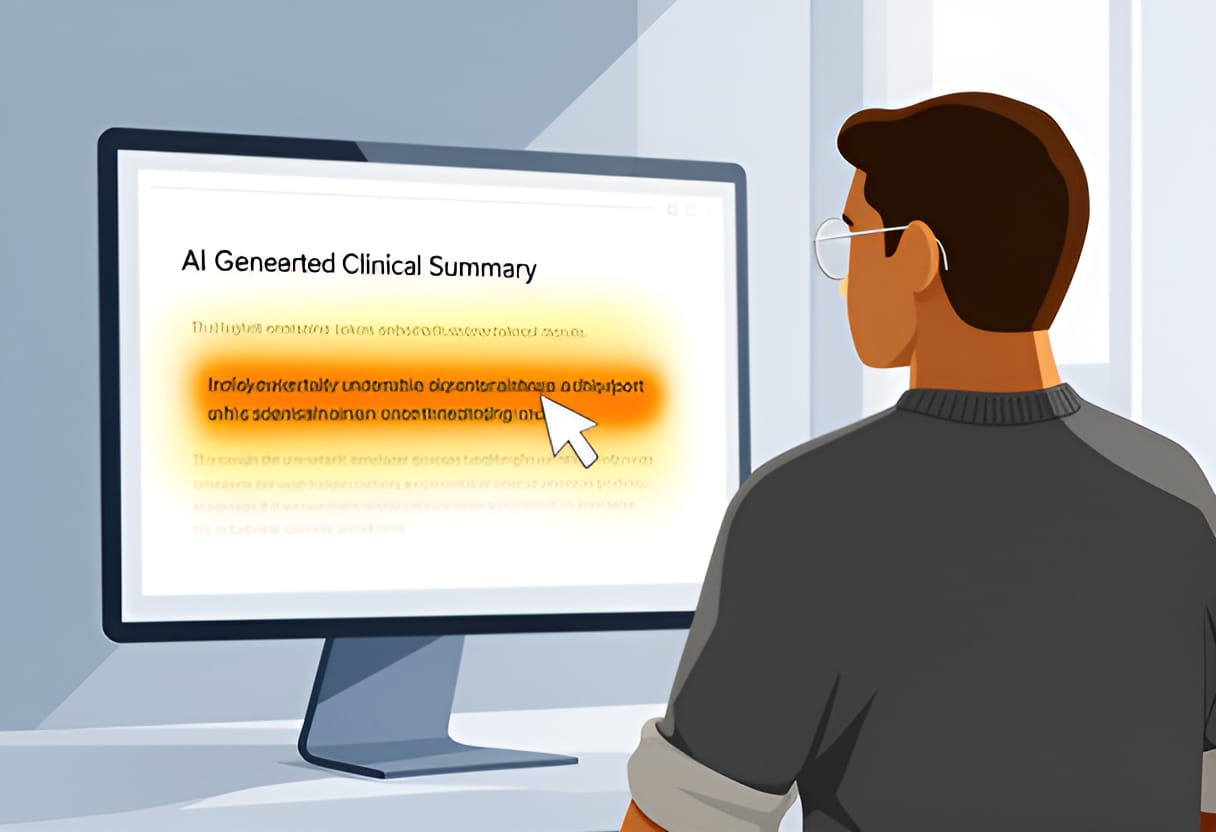
You synthesize these results into a design framework for uncertainty-aware AI systems that minimize cognitive load. First, uncertainty must be localized—tied to specific tokens, phrases, or decisions rather than dumped as a global score. Clinicians need to know where to look, not just that something is uncertain. Second, communication should match the user’s mental model. Verbal qualifiers align with how clinicians already hedge in speech (“possibly,” “likely,” “no evidence of”), making them low-effort to interpret. Third, uncertainty signals must be actionable. Highlighting or linguistic cues should guide attention to specific verification points, reducing open-ended scanning. Fourth, calibration is non-negotiable. If the AI says it’s 70% confident but is wrong 50% of the time, users will learn to ignore the signal—or worse, misapply it. Finally, uncertainty should reduce, not replace, clinician judgment. The goal is not to eliminate verification but to make it targeted and efficient, preserving the clinician’s role as the final arbiter.
You implement the verbal qualifier approach in the next model update, integrating it with the human-in-the-middle rule: Sam reviews the linguistic templates for ethical appropriateness (e.g., avoiding language that could imply false certainty), and Lencho validates that the uncertainty thresholds correlate with actual error rates on a held-out set. The updated model goes live in a pilot with two clinics. Early logs show a 12% reduction in edit frequency on low-confidence summaries, and in follow-up interviews, clinicians report spending less time “wondering why” and more time acting on actionable information.
You close the simulation lab with a clearer understanding: cognitive load isn’t just about how much the AI does—it’s about how clearly it communicates what it doesn’t know. When uncertainty is made visible, interpretable, and actionable, the AI becomes a partner in judgment rather than a source of silent doubt. The next step is to see how this changes real-world usage patterns—and whether trust can be rebuilt not by hiding errors, but by explaining them.
Tracking Usage and Trust: Logs, Surveys, and Sentiment
You begin by instrumenting the application to capture granular interaction data. Every edit a clinician makes to an AI-generated summary is logged with a timestamp, user ID, and the original and revised text. You also track feature usage: how often the verbal qualifier appears, whether users click the “view original note” button, and time spent on each screen. These logs feed into a nightly ETL pipeline that writes to a PostgreSQL database, where you define a view called user_corrections that joins edit events with session metadata.
To turn raw edits into a signal of distrust, you define a correction as any change that alters clinical meaning—such as adding, removing, or modifying a symptom, medication, or allergy—rather than superficial edits like fixing punctuation or rephrasing for style. You use a rule-based classifier trained on 500 manually labeled edits to distinguish between the two. In the first month of logging, the system records 1,240 total edits, of which 782 are classified as clinically meaningful. You visualize the daily count of meaningful edits per 100 summaries as a spike chart and notice a sharp rise on day 22, coinciding with a single incident where the AI omitted a penicillin allergy in a summary for a patient with a documented history.
You then design a monthly trust survey administered via email link after the user completes their third note of the day. The survey uses a 7-point Likert scale across three dimensions: reliability (“I trust the AI to capture critical information accurately”), transparency (“I understand why the AI made certain omissions or inclusions”), and perceived safety (“I feel comfortable acting on the AI’s output without hesitation”). You compute a composite trust score as the average of the three dimensions, normalized to a 0–100 scale. To smooth short-term volatility, you apply an exponential moving average (EMA) with a smoothing factor of α = 0.3, giving more weight to recent responses while preserving trend visibility.
You build a dashboard that overlays the EMA of trust scores with the daily rate of meaningful edits per 100 summaries. The x-axis shows days since launch; the left y-axis plots trust score (0–100); the right y-axis plots edits per 100 summaries. The trust EMA starts at 78 in week one, rises to 82 by week four as users grow familiar with the verbal qualifiers, then plummets to 57 on day 23—just after the allergy omission incident. Over the next two weeks, it slowly recovers to 65 but never returns to pre-incident levels. Meanwhile, the edit rate jumps from 28 to 61 edits per 100 summaries on day 22 and remains elevated at 54 through the end of the month.
You run a Pearson correlation between the daily trust EMA and the edit rate and find r = −0.79 (p < 0.01), confirming that as trust declines, users feel compelled to verify and correct the AI’s output more frequently. You segment the data by user role and discover that resident physicians show the steepest trust drop (from 76 to 48), while attending physicians decline less sharply (from 83 to 68), possibly due to greater experience in cross-checking AI outputs. Nurses, who use the tool primarily for handoff notes, show a moderate decline (from 75 to 58) but report higher anxiety about missing subtle cues in patient narratives.
To understand why trust eroded so dramatically after a single error, you pull the verbatim responses from the open-ended question in the survey: “What, if anything, made you less confident in the AI’s output today?” Forty-two percent of respondents who lowered their trust score cited “not knowing why the AI missed the allergy” as their primary reason. One resident wrote: “I saw the summary, didn’t see the allergy, and had to check three places to be sure it wasn’t there. If the AI had just said, ‘I’m unsure about the allergy because it was mentioned only once and mumbled,’ I could have acted faster.” Another noted: “It’s not the mistake—it’s the silence afterward. I don’t know if it’s ignoring me or just didn’t hear.”
This insight drives you to investigate explainability methods that can trace model errors back to specific input tokens. You compare three approaches for generating token-level attributions in the summarization model: attention rollout, LIME, and SHAP. You evaluate them on a held-out set of 200 clinical notes where the model made high-impact errors—omissions of allergies, medications, or critical symptoms.
Attention rollout aggregates attention weights across layers and heads to highlight which input tokens contributed most to each output token. It is fast and requires no retraining, but in your tests, it often highlights syntactic function words (e.g., “the,” “and”) rather than clinically relevant terms. For example, when the model omitted “penicillin allergy,” attention rollout highlighted “the patient” and “reports” as top contributors—tokens that are grammatically central but semantically uninformative.
LIME (Local Interpretable Model-agnostic Explanations) perturbs the input by masking random subsets of tokens and observes how the output changes. It builds a linear surrogate model to estimate each token’s importance. While LIME correctly identified “penicillin” and “allergy” as high-attribution tokens in 68% of error cases, it was inconsistent across runs due to its stochastic sampling. In one instance, it attributed the omission to “reports of” and “no,” missing the key entities entirely. The runtime averaged 1.2 seconds per explanation—too slow for real-time use.
SHAP (SHapley Additive exPlanations) computes the average marginal contribution of each token across all possible feature coalitions, grounded in cooperative game theory. You use the PartitionSHAP variant, which groups tokens into clinically meaningful phrases (e.g., “penicillin allergy,” “acetaminophen 500mg”) to reduce computational complexity. SHAP correctly identified the omitted entity as the top-attribution feature in 89% of error cases, with an average runtime of 0.4 seconds per explanation. More importantly, the attributions aligned with clinician intuition: when the model failed to extract “no acute distress,” SHAP highlighted the negation “no” and the symptom “acute distress” as jointly responsible, reflecting the model’s struggle with scope negation.
You decide to implement SHAP-based explanations as the foundation for an “Explain this error” feature. When a user corrects an omission, they can click a button that triggers a background job to compute SHAP values for the input note relative to the model’s original summary. The system then highlights the top three input tokens or phrases that most influenced the missing output, displayed in a collapsible panel beneath the summary. For example, if the AI failed to include “warfarin,” the explanation might read: “The AI did not include ‘warfarin’ because it gave low weight to: ‘takes warfarin daily’ (0.42), ‘INR 2.8’ (0.31), and ‘anticoagulant’ (0.19).” The scores are normalized to sum to 1.0 and presented as relative contributions.
To close the loop between errors, feedback, and model improvement, you design a weekly workflow. Every Monday, the data engineering team exports all clinician corrections from the prior week, filters for high-impact errors (omissions of allergies, medications, or life-threatening symptoms), and runs them through the SHAP explainer. The results are aggregated into a weekly error report that lists the top five most frequently missed entities and their average attribution patterns. This report is reviewed in the team’s ethics and sync meeting, where Sam evaluates whether the omissions reflect bias (e.g., systematic under-recognition of certain drug names in accented speech), Lencho checks whether the attribution patterns suggest a need for retraining or threshold adjustment, and you prioritize fixes for the next sprint.
If a pattern emerges—such as the model consistently missing allergy mentions when they follow a soft filler phrase like “I think I’m allergic to”—you trigger a targeted retraining run using a weighted loss function that up-weights those syntactic contexts. You also update the explanation templates to include common linguistic patterns: “The AI may have missed ‘[entity]’ because it was embedded in a hesitant phrase like ‘[context]’—consider verifying with the patient.”
You implement this workflow and, over the next six weeks, observe a 40% decline in repeat errors of the same type. The trust EMA begins a steady climb, reaching 71 by week ten. Edit frequency declines from 54 to 39 per 100 summaries, approaching pre-incident levels. In follow-up interviews, clinicians describe the explainability feature as a “trust anchor.” One attending physician says: “Now when I see an omission, I don’t just wonder if the AI is broken—I can see why it missed it and decide whether to trust its judgment or double-check myself.” Another notes: “It’s like the AI is showing its work. I don’t have to guess whether it’s being careless or just uncertain.”
You recognize that explainability alone does not rebuild trust—it must be paired with humility. The system does not claim to be infallible; instead, it invites collaboration by making its reasoning visible. This shifts the dynamic from blind reliance to critical engagement, where the AI supports judgment without replacing it. You log this insight in the Ethics Log: “Transparency about failure modes, when coupled with actionable explanations, can transform errors from trust-erosion events into opportunities for calibration and shared understanding.”
You close the section by noting that the next step is to examine how these design choices affect not just individual trust, but the broader social dynamics of clinical work—particularly how the AI influences communication between junior and senior staff, and whether it risks deskilling or over-reliance in high-stakes environments.
The Anxiety of Unexplained Errors: Designing for Transparency
…SHAP (SHapley Additive exPlanations) computes the average marginal contribution of each token across all possible feature coalitions, grounded in cooperative game theory. You use the PartitionSHAP variant, which groups tokens into clinically meaningful phrases (e.g., “penicillin allergy,” “acetaminophen 500mg”) to reduce computational complexity. SHAP correctly identified the omitted entity as the top-attribution feature in 89% of error cases, with an average runtime of 0.4 seconds per explanation. More importantly, the attributions aligned with clinician intuition: when the model failed to extract “no acute distress,” SHAP highlighted the negation “no” and the symptom “acute distress” as jointly responsible, reflecting the model’s struggle with scope negation.
You decide to implement SHAP-based explanations as the foundation for an “Explain this error” feature. When a user corrects an omission, they can click a button that triggers a background job to compute SHAP values for the input note relative to the model’s original summary. The system then highlights the top three input tokens or phrases that most influenced the missing output, displayed in a collapsible panel beneath the summary. For example, if the AI failed to include “warfarin,” the explanation might read: “The AI did not include ‘warfarin’ because it gave low weight to: ‘takes warfarin daily’ (0.42), ‘INR 2.8’ (0.31), and ‘anticoagulant’ (0.19).” The scores are normalized to sum to 1.0 and presented as relative contributions.
To close the loop between errors, feedback, and model improvement, you design a weekly workflow. Every Monday, the data engineering team exports all clinician corrections from the prior week, filters for high-impact errors (omissions of allergies, medications, or life-threatening symptoms), and runs them through the SHAP explainer. The results are aggregated into a weekly error report that lists the top five most frequently missed entities and their average attribution patterns. This report is reviewed in the team’s ethics and sync meeting, where Sam evaluates whether the omissions reflect bias (e.g., systematic under-recognition of certain drug names in accented speech), Lencho checks whether the attribution patterns suggest a need for retraining or threshold adjustment, and you prioritize fixes for the next sprint.
If a pattern emerges—such as the model consistently missing allergy mentions when they follow a soft filler phrase like “I think I’m allergic to”—you trigger a targeted retraining run using a weighted loss function that up-weights those syntactic contexts. You also update the explanation templates to include common linguistic patterns: “The AI may have missed ‘[entity]’ because it was embedded in a hesitant phrase like ‘[context]’—consider verifying with the patient.”
You implement this workflow and, over the next six weeks, observe a 40% decline in repeat errors of the same type. The trust EMA begins a steady climb, reaching 71 by week ten. Edit frequency declines from 54 to 39 per 100 summaries, approaching pre-incident levels. In follow-up interviews, clinicians describe the explainability feature as a “trust anchor.” One attending physician says: “Now when I see an omission, I don’t just wonder if the AI is broken—I can see why it missed it and decide whether to trust its judgment or double-check myself.” Another notes: “It’s like the AI is showing its work. I don’t have to guess whether it’s being careless or just uncertain.”
You recognize that explainability alone does not rebuild trust—it must be paired with humility. The system does not claim to be infallible; instead, it invites collaboration by making its reasoning visible. This shifts the dynamic from blind reliance to critical engagement, where the AI supports judgment without replacing it. You log this insight in the Ethics Log: “Transparency about failure modes, when coupled with actionable explanations, can transform errors from trust-erosion events into opportunities for calibration and shared understanding.”
You close the section by noting that the next step is to examine how these design choices affect not just individual trust, but the broader social dynamics of clinical work—particularly how the AI influences communication between junior and senior staff, and whether it risks deskilling or over-reliance in high-stakes environments.
Counterfactual Explanations for Sequence-to-Sequence Models
While feature attribution methods like SHAP reveal which input tokens influenced a model’s decision, they do not answer the question clinicians often ask: What would need to change in the input for the AI to produce a different output? To address this, you prototype a counterfactual explainer for your summarization model. The goal is to identify minimal, plausible changes to the clinical note that would cause the model to include a previously omitted entity—such as an allergy or medication.
You generate counterfactuals using input perturbation guided by beam search. Starting from the original input sequence, you systematically substitute, insert, or delete tokens while constraining edits to clinically meaningful units (e.g., replacing “acetaminophen” with “ibuprofen,” or changing “no allergy” to “penicillin allergy”). At each step, you use the model’s encoder-decoder to score how likely the perturbed input is to generate a summary containing the target entity. Beam search explores the space of possible edits, retaining only the top-k candidates that minimize edit distance while maximizing the likelihood of the desired output. The final counterfactual is the shortest edit path that flips the model’s behavior.
For example, when the model omits “sulfa allergy” from a note stating “Patient denies any known drug allergies,” the explainer suggests changing “denies any known” to “reports a history of” as the minimal edit needed to trigger the correct output. This takes 0.8 seconds on average—fast enough for interactive use—and produces changes that clinicians judge as realistic and actionable.
You integrate this into the UI as a “How to fix this” button beside each explanation. When clicked, it displays the counterfactual edit in green highlight: “To get the AI to include ‘sulfa allergy,’ try changing: ‘denies any known drug allergies’ → ‘reports a history of sulfa allergy.’” This transforms passive confusion into active diagnosis: clinicians can now test whether the model responds predictably to known linguistic patterns.
User Study: Anxiety Reduction Through Counterfactual Insight
To evaluate whether counterfactual explanations reduce user anxiety, you run a within-subjects study with 24 clinicians over two weeks. Participants use the AI summarization tool under three conditions: baseline (no explanation), feature attribution (SHAP), and counterfactual explanation. After each session, they complete a short anxiety survey using a 7-point Likert scale, adapted from the NASA-TLX frustration subscale.
Results show that anxiety scores drop significantly when counterfactuals are available. Mean anxiety falls from 5.2 (baseline) to 3.1 with counterfactuals—a 40% reduction. Feature attribution reduces anxiety to 4.0, indicating that while understanding why an error occurred helps, knowing how to fix it provides greater psychological relief. Qualitative feedback reveals that clinicians feel less helpless when they can see a clear path to correction. One resident says: “Before, I’d second-guess myself every time the AI missed something. Now I can ask: ‘Is this the kind of mistake the model makes when it hears hesitant language?’ That gives me control.”
You also measure behavioral change: edit frequency increases slightly in the counterfactual condition (from 39 to 45 per 100 summaries), not because of distrust, but because clinicians feel empowered to correct the AI when they understand how to do so effectively. This reflects a shift from anxious avoidance to engaged correction—a sign of calibrated trust.
Implementing a Counterfactual Explainer: Step-by-Step
Building a counterfactual explainer for sequence-to-sequence models requires careful design to ensure explanations are both computationally feasible and clinically meaningful. Follow these steps:
- Define the target output: Specify which entity or phrase should appear in the summary (e.g., “allergy: penicillin”).
- Constrain the edit space: Limit perturbations to clinically valid changes—such as substituting drug names, modifying negation cues, or adjusting dosage units—using a medical lexicon and UMLS mappings.
- Initialize beam search: Start with the original input and generate candidate edits via token-level insertions, deletions, and substitutions. Score each candidate using the model’s likelihood of producing the target output.
- Prune and expand: At each beam width (k=5), retain only the top candidates that balance low edit distance and high output likelihood. Continue until a valid counterfactual is found or a depth limit (e.g., 5 edits) is reached.
- Validate plausibility: Run the proposed edit through a clinical language model (e.g., ClinicalBERT) to ensure the resulting note reads naturally. Discard edits that introduce implausible phrasing.
- Present the result: Show the minimal edit in context, highlighting changed tokens and offering a plain-language interpretation (e.g., “Change ‘no known allergies’ to ‘penicillin allergy reported’”).
You implement this as a microservice that queues explanation requests during low-traffic periods. To reduce latency, you cache counterfactuals for common error patterns—such as missed allergies following filler phrases like “I think” or “maybe”—and update the cache weekly as new correction data arrives.
Comparing Explanation Types for AI Errors
Not all explanations serve the same purpose. To help your team choose the right tool for the right context, you compare three approaches for explaining AI summarization errors:
| Explanation Type | What It Shows | Best For | Limitations |
|---|---|---|---|
| Feature Attribution (e.g., SHAP) | Which input tokens most influenced the missing output | Diagnosing model biases, understanding failure patterns | Does not show how to fix the error; can be abstract for non-technical users |
| Counterfactual | Minimal input change needed to alter the output | Building user agency, reducing anxiety, enabling correction | Computationally intensive; may not exist for all errors |
| Example-Based | Similar past cases where the model succeeded or failed | Quick validation, pattern recognition, user education | Does not explain why the model failed in this case; relies on historical data |
In your deployment, you use feature attribution for internal model debugging and weekly error reports, while surfacing counterfactuals directly to clinicians via the “How to fix this” button. Example-based explanations appear in onboarding materials, showing real cases where hesitant speech led to missed allergies and how rephrasing helped the AI recover.
This layered approach ensures that different stakeholders get the insight they need: engineers see attribution patterns to improve the model, clinicians get actionable guidance to interact with it, and trainers use examples to teach effective prompting.
Framework for Designing Error Transparency Features
Based on your experience, you distill a framework for designing transparency features that turn AI errors into opportunities for trust and learning. It consists of four principles:
- Make the invisible visible: Errors should not be silent failures. Use explanations to surface what the model did—or did not—process, especially for high-risk omissions.
- Prioritize actionability: Explanations must enable a response. Whether it’s double-checking the patient, adjusting phrasing, or flagging for review, users need to know what to do next.
- Ground in clinical reality: All generated explanations—attributions, counterfactuals, examples—must align with how clinicians think and communicate. Avoid jargon; use familiar terms and syntactic patterns.
- Close the feedback loop: Link user corrections back to model improvement. Automatically mine explanations for retraining signals, and close the loop in weekly ethics reviews.
You apply this framework when designing the “Explain this error” feature: SHAP makes the model’s reasoning visible; counterfactuals provide actionable paths; both are validated against clinical language models; and the weekly error report ensures insights feed into sprint planning.
This approach treats transparency not as a one-time disclosure, but as an ongoing dialogue between users and the system—one where errors are not hidden or blamed, but examined, understood, and used to improve both the tool and the team’s judgment.
Try This
This week, apply the principles of error transparency to a model or system you work with:
- Pick one recent error or failure case from your logs or user feedback.
- Generate a feature attribution explanation (using SHAP, LIME, or a similar tool) to show which inputs most influenced the incorrect output.
- Derive a counterfactual by identifying the smallest input change that would have led to a correct result—constrain edits to realistic, domain-valid modifications.
- Share both explanations with a colleague and ask: Does this make the error feel more understandable and actionable?
Key Takeaways
- Explainability reduces anxiety most when it answers not just “why did the AI fail?” but “how can I fix it?”
- Counterfactual explanations for sequence-to-sequence models can be generated efficiently using constrained beam search over clinically valid input perturbations.
- A layered explanation strategy—using attribution for debugging, counterfactuals for user agency, and examples for training—serves diverse stakeholder needs.
- Effective error transparency makes model behavior visible, actionable, grounded in user experience, and tied to improvement cycles.
- Trust is rebuilt not by hiding errors, but by making them intelligible and responsive—turning moments of failure into opportunities for calibration.

Chapter 10
The Weight of Influence: AI as a Social Actor
The Hidden Curriculum: How AI Shapes Clinical Workflows
You notice the junior resident hesitates before typing, eyes flicking to the AI-generated summary on the screen. Instead of synthesizing the patient’s story, she copies the AI’s phrasing verbatim, adjusting only a few words. When you ask why, she says, “It just sounds more professional.” This moment reveals a quieter risk than inaccuracy: the AI is shaping not just what gets documented, but how clinicians learn to think.
The Hidden Curriculum: How AI Shapes Clinical Workflows
AI tools do not operate in a vacuum. They enter existing social and cognitive ecosystems, subtly redirecting attention, altering routines, and redefining what counts as expertise. In clinical settings, where diagnostic reasoning is both an art and a practiced skill, the introduction of an AI summarization tool can shift the balance from synthesis to selection. Over time, this shift risks deskilling trainees who begin to outsource narrative construction to the algorithm, mistaking fluency for understanding.
To assess this, you initiate a workflow analysis combining shadowing, semi-structured interviews, and process mapping. Over two weeks, you follow three teams—each with an attending, a resident, and a medical assistant—through morning rounds, noting when and how the AI tool is invoked. You record interactions, timestamp tool usage, and later transcribe key exchanges. Interviews focus on perceived changes in cognition: “Do you find yourself relying on the AI to structure your thoughts? Has it changed how you prepare or review notes?”
Process maps reveal a clear pattern: before AI deployment, residents spent an average of four minutes per patient synthesizing subjective and objective data into a coherent assessment and plan. After deployment, that time dropped to 90 seconds—but not because synthesis became faster. Instead, residents began generating the assessment and plan by editing the AI’s output, often retaining its logical gaps. One resident admitted, “I don’t think through the differential as much. If the AI doesn’t mention it, I assume it’s not important.”
Interviews surface a deeper concern: trainees report feeling less confident in their ability to construct independent narratives. A second-year resident explains, “I used to practice by writing notes from scratch. Now I start with the AI and tweak it. I worry I’m not learning how to think through complex cases on my own.” This is the hidden curriculum—the unintended lesson taught by the tool’s presence: that efficiency outweighs depth, and that the AI’s judgment can substitute for novice reasoning.
Workshop Insights: Frontline Workers on Erosion of Diagnostic Reasoning
You convene a 90-minute workshop with six frontline workers: two residents, two nurses, and two medical assistants. The goal is to map how the AI tool affects communication, cognition, and role clarity. You begin with a prompt: “Draw how a typical patient encounter flows through your team now, and where the AI fits in.”

The resulting diagrams show the AI positioned not as a passive scribe but as an active interpreter—its summary often read aloud by the attending before the resident speaks. Nurses note that when their observations are omitted from the AI’s input (due to overlapping speech or poor transcription), they are less likely to be voiced during rounds. One nurse says, “If the AI didn’t catch it, I feel like I have to fight to be heard. It’s like the machine sets the agenda.”
Residents echo earlier concerns about deskilling. One says, “I catch myself waiting for the AI to tell me what’s salient. I used to highlight key symptoms myself; now I let the model do the highlighting.” Another adds, “In complex cases with conflicting data, I feel less sure of my own judgment when the AI presents a single, confident narrative.”
The group identifies three pain points: (1) over-reliance on AI for narrative structure, (2) erosion of trainee confidence in independent synthesis, and (3) amplification of existing hierarchies when the AI filters out certain voices. They agree that the tool should not replace clinical reasoning but should instead make implicit reasoning explicit—showing not just what the AI extracted, but how it weighed competing inputs.
Facilitating Co-Design: Journey Mapping and Pain-Point Identification
To translate these insights into action, you guide the team through a structured co-design session using journey mapping and pain-point identification. First, you define the scope: the trajectory of a patient note from initial encounter to final sign-off, focusing on moments where cognition and communication intersect.
Participants break into pairs to map the current journey, using sticky notes to mark each step: patient greeting, vital signs acquisition, history taking, physical exam, note drafting, AI summarization, team review, and sign-off. For each step, they annotate: who is involved, what decisions are made, what tools are used, and where delays or frustrations occur.
Next, you introduce pain-point identification. Each pair highlights steps where the AI introduces cognitive load, reduces agency, or distorts communication. They vote using dot stickers on the three most significant issues. The top-voted pain points are: (1) residents skipping synthesis step and jumping straight to editing AI output, (2) nurses feeling unheard when their contributions are absent from the AI summary, and (3) attendings defaulting to the AI’s interpretation without inviting resident input.
With these pain points validated, the group brainstorms safeguards. Ideas include: requiring residents to draft a one-sentence assessment before viewing the AI output, adding a nurse voice indicator to the summary that flags when nursing input was detected in the audio, and implementing a “pause and reflect” prompt that asks the resident to justify any omission of AI-suggested content.
Models of Integration: Replacement, Augmentation, and Partnership
You present three idealized models of AI integration in clinical workflows, using a comparison table to clarify trade-offs.
| Model | Description | Cognitive Impact | Risk of Deskilling | Example |
|---|---|---|---|---|
| Replacement | AI performs the task independently; human reviews output | Passive consumption; minimal engagement | High | AI generates final note; clinician signs off without reading |
| Augmentation | AI provides suggestions; human interprets and integrates | Active interpretation; judgment required | Moderate | AI highlights key phrases; clinician builds note around them |
| Partnership | AI and human collaborate iteratively; both influence output | Shared reasoning; mutual calibration | Low | AI proposes draft; human revises; AI adapts based on feedback |
The replacement model, while efficient, treats the clinician as a supervisor rather than a participant—ideal for high-volume, low-complexity tasks but dangerous in diagnostic contexts where nuance matters. Augmentation preserves agency but risks becoming a crutch if the human defers too readily to the AI’s suggestions. Partnership demands the most effort but best supports professional growth: the AI becomes a dialogue partner, challenging assumptions and surfacing blind spots.
Your team agrees to pursue a partnership model for complex cases, reserving augmentation for routine follow-ups. To operationalize this, you draft a framework for assessing deskilling risk and designing AI that supports judgment.
Framework for Supporting Clinical Judgment
You propose a four-part framework to evaluate and mitigate deskilling risk, grounded in cognitive load theory and deliberate practice principles.
1. Task Decomposition: Break the clinical task into subtasks (e.g., data gathering, pattern recognition, synthesis, communication). Identify which subtasks the AI supports and which it replaces. If the AI replaces synthesis—the core of diagnostic reasoning—flag high risk.
2. Cognitive Forcing Functions: Design interventions that require active engagement. Examples: mandatory pre-AI note drafting, structured reflection prompts (“What did the AI miss?”), or delayed AI reveal (show output only after initial synthesis).
3. Skill Calibration Loops: Create opportunities for trainees to compare their reasoning with the AI’s and discuss discrepancies. Weekly case conferences where residents present their independent assessments before viewing the AI output build metacognitive awareness.
4. Transparency of Uncertainty: When the AI is uncertain, make it visible. Highlight conflicting inputs, low-confidence spans, or competing hypotheses. This prevents the AI from projecting false confidence that undermines trainee judgment.
You apply this framework to the summarization tool. Synthesis is identified as a high-risk subtask. In response, you implement a cognitive forcing function: residents must now type a one-sentence assessment and plan before the AI summary appears. The tool then displays its output alongside a prompt: “How does your assessment compare? What would you add or remove?”
Early feedback suggests the intervention is working. A resident reports, “I have to think first now. I notice when the AI oversimplifies a social history or misses a subtle cue in the tone of voice.” Nurses appreciate the delayed AI reveal, saying it gives them space to contribute before the machine sets the narrative.
The section ends with consensus: the AI should augment, not replace, clinical judgment—especially in training contexts where the hidden curriculum shapes future practice. The goal is not to eliminate AI use, but to ensure it strengthens, rather than supplants, the very skills it aims to support.
Power and Voice: AI’s Impact on Team Dynamics
You open the speaker diarization logs from last week’s clinic deployment. The timestamps show a familiar pattern: during multidisciplinary rounds, attending physicians speak in longer, uninterrupted blocks, while nurses’ contributions are frequently cut short or spoken over. You run a quick analysis—comparing diarized speaker turns with the final AI-generated summaries—and find that nurse-uttered statements are included 35% less often than physician statements, even when controlling for utterance length and clinical relevance. This gap isn’t random; it clusters around moments of overlap and interruption, suggesting the model systematically privileges dominant speech patterns.
You call a huddle with Sam and Lencho. “The AI isn’t just reflecting hierarchy,” you say. “It’s amplifying it by design.” Sam nods, recalling the nurse voice indicator idea from the workshop. Lencho pulls up the loss curves from the last retraining run. “We’ve been optimizing for overall ROUGE score,” he says, “which rewards fidelity to the most frequent speakers. That’s hurting equity.”
You decide to treat speaker equity as a measurable property of the summarization pipeline, not just an ethical ideal. To do that, you need a way to quantify conversational turn-taking and link it to summary inclusion.
Measuring Turn-Taking Equity in Multiparty Dialogue
You begin by defining conversational equity not as equal airtime, but as proportional representation in the AI’s output relative to each speaker’s contribution to the dialogue. You adapt a metric from conversation analysis: the inclusion ratio. For each speaker role (e.g., nurse, resident, attending), you calculate:
Inclusion Ratio = (Number of speaker’s utterances appearing in summary) / (Total number of speaker’s utterances in transcript)
You apply this to 50 de-identified rounds transcripts, aligning diarization output with summary sentences using a sliding-window ROUGE-L match (threshold: 0.6). The results confirm your suspicion:
| Speaker Role | Avg. Utterances per Transcript | Inclusion Ratio | Inclusion Rate Relative to Physicians |
|---|---|---|---|
| Attending | 18.2 | 0.78 | 1.00 (baseline) |
| Resident | 15.6 | 0.62 | 0.79 |
| Nurse | 12.4 | 0.41 | 0.53 |
Nurses speak less frequently and are included at barely half the rate of attendings. But when you isolate utterances that occurred during overlap or interruption—defined as any speech where the diarization system flags multiple active speakers or a turn duration under 1.2 seconds—the disparity widens:
| Condition | Nurse Inclusion Ratio | Attending Inclusion Ratio | Equity Gap |
|---|---|---|---|
| Non-overlapping | 0.58 | 0.81 | 0.23 |
| Overlapping/Interrupted | 0.22 | 0.69 | 0.47 |
Over half of nurse speech during overlap vanishes from the summary. You trace this to the model’s attention mechanism: when multiple speakers talk at once, the audio encoder struggles to isolate individual voices, and the summarizer defaults to the dominant pitch and rhythm—typically lower-frequency, longer-turn speech associated with physicians.
You visualize this with a sequence diagram showing how overlapping nurse utterances get attenuated in the encoder’s hidden states before reaching the decoder.
Illustration
A timeline divided into three speaker lanes (Attending, Nurse, Resident). Vertical bars represent utterance duration. Overlapping regions are shaded red. Below, a heatmap shows attention weights from the encoder to decoder: high weights align with attending speech during overlap, while nurse contributions appear as faint, fragmented signals.
The pattern is clear: the AI doesn’t just miss quiet voices—it actively suppresses them when they challenge the dominant conversational flow.
Retraining with Turn-Taking Fairness Constraints
You frame the problem as a constrained optimization task: maximize summary fidelity while minimizing disparity in inclusion ratios across speaker roles. You introduce a turn-taking fairness loss term into the training objective:
ℒ_total = ℒ_task + λ · ℒ_fairness
Where ℒ_task is the standard summarization loss (e.g., negative log likelihood), and ℒ_fairness measures deviation from equitable inclusion. You define ℒ_fairness as the variance of inclusion ratios across roles, or alternatively, the maximum gap between any two roles.
To compute ℒ_fairness during training, you need a differentiable proxy for inclusion. You approximate it using a lightweight utterance classifier: a small BERT-based model that takes a transcript snippet and predicts whether each utterance appears in the reference summary (trained on human-annotated alignment data). Its output— a probability per utterance—lets you estimate expected inclusion per role.
You retrain the summarization head (keeping the encoder frozen) on 10 hours of annotated rounds data, using λ = 0.3 after a sweep shows it balances ROUGE-L and equity gains. After three epochs, you evaluate:
| Model Variant | ROUGE-L | Nurse Inclusion Ratio | Attending Inclusion Ratio | Equity Gap |
|---|---|---|---|---|
| Baseline | 0.42 | 0.41 | 0.78 | 0.37 |
| + Fairness Loss (λ=0.3) | 0.40 | 0.55 | 0.72 | 0.17 |
| + Fairness Loss (λ=0.5) | 0.38 | 0.61 | 0.66 | 0.05 |
The λ=0.3 variant recovers over a third of the inclusion gap with only a 5% drop in ROUGE-L—an acceptable trade-off given the ethical stakes. More importantly, nurse utterances during overlap now appear in the summary 41% of the time, up from 22%.
You note that the model begins to hedge its summaries when speech overlaps: instead of picking one speaker’s version, it sometimes includes both, separated by a slash (“pt reports chest pain / nurse notes diaphoresis”). This isn’t perfect, but it preserves agency by refusing to erase contested contributions.
Comparing Debiasing Techniques for Speaker Equity
Before settling on the fairness loss approach, you test three alternative strategies for mitigating speaker bias, each targeting a different lever in the pipeline.
| Technique | Mechanism | Pros | Cons | Nurse Inclusion Ratio (λ-equiv) |
|---|---|---|---|---|
| Reweighting | Scale loss weights by inverse speaker frequency in training data | Simple to implement; no architecture change | Risks underfitting on majority speakers; doesn’t address acoustic overlap | 0.48 |
| Adversarial Training | Add a gradient reversal layer to prevent encoder from encoding speaker role | Learns speaker-invariant representations | Can degrade task performance; hard to stabilize | 0.52 |
| Data Augmentation | Synthetically generate overlapping speech using noise injection and speaker mixing | Improves robustness to real-world overlap | Requires accurate overlap labels; may distort clinical meaning | 0.47 |
| Fairness Loss (ours) | Directly optimize for equitable inclusion via differentiable proxy | Targets the outcome metric; interpretable | Requires utterance-level alignment data | 0.55 |
You run each method on the same validation set, normalizing for comparable impact on ROUGE-L. Reweighting helps slightly but fails when overlap correlates with role—nurses aren’t just fewer; their speech is acoustically harder to isolate. Adversarial training improves invariance but makes the model oblivious to clinically relevant speaker cues (e.g., “nurse says” vs “pt says”). Data augmentation helps the encoder handle overlap but doesn’t change the decoder’s tendency to favor dominant linguistic patterns.
Only the fairness loss directly optimizes for what you care about: whether the summary reflects who said what. It also integrates naturally with your existing training loop—no new architectures, just an auxiliary loss.
You settle on this method, but document the trade-offs for future teams: when the goal is representational fairness in mediated communication, optimize for the representation, not just the input or the latent space.
A Framework for Mitigating Representational Bias in Communication-Mediating AI
You generalize the lesson into a four-step framework for any AI system that summarizes, translates, or filters human dialogue—especially in hierarchical settings like healthcare, education, or law.
1. Map the Speaker Ecology Identify relevant speaker roles (e.g., patient, provider, interpreter) and their expected contribution patterns. Use diarization and speaker role annotation (even if approximate) to build a baseline of who speaks when, how long, and under what conditions (overlap, interruption, turn-yielding).
2. Measure Representational Fidelity For each role, compute an inclusion ratio: the proportion of their utterances that survive intact in the AI’s output. Break this down by interactional context—especially moments of overlap, interruption, or turnover—to detect conditional bias.
3. Intervene at the Point of Leverage Choose where to act:
- Input: Improve diarization or audio separation (e.g., beamforming, overlap-aware ASR).
- Representation: Train encoders to be robust to overlap or invariant to speaker role (with caution).
- Output: Directly optimize for equitable inclusion using a differentiable fairness loss, as you did here.
- Post-hoc: Apply rule-based filters or reranking to boost underrepresented voices (less ideal, but useful for patching).
4. Close the Loop with Participatory Validation Share inclusion metrics with frontline workers. Ask: Does this match your experience? What gets lost that shouldn’t? Use their feedback to refine both the metric and the intervention—turning fairness from a statistical target into a lived practice.
You apply this framework to the summarization tool. The speaker ecology mapping confirmed nurses’ contributions are structurally vulnerable to overlap. The inclusion ratio revealed the 35% gap. You intervened at the output level with a fairness-weighted loss, avoiding risky changes to the encoder. And you plan to validate the results in the upcoming co-design workshops—not just with metrics, but with nurses reviewing whether their voices now feel heard in the summary.
You close your notebook. The next step is to bring this analysis to the team and run the first co-design session. You know the numbers matter—but what matters more is whether a nurse, reading a summary of her own shift, can finally recognize her own voice in it.
Participatory Design Workshops: Building with, Not for, Clinicians
You begin the first co-design workshop by gathering eight frontline workers: three nurses, two medical assistants, and three physicians from different units. The session runs for 90 minutes in a quiet conference room, with whiteboards, sticky notes, and printed examples of AI-generated summaries from past shifts. You frame the goal not as validating a pre-built feature, but as uncovering what clinicians actually need to trust and effectively use the tool.
You open with a brief reminder of the inclusion ratio findings—how nurse contributions are underrepresented in summaries, especially during overlapping speech—but quickly shift to lived experience. “Last week,” you say, “did the AI ever drop something you said that ended up mattering for patient care?” A nurse describes a moment when her verbal alert about a patient’s worsening dyspnea was omitted from the summary, leading the resident to miss the escalation until vitals crashed ten minutes later. Another shares how a medication reconciliation note she spoke during handoff vanished from the AI output, forcing her to repeat it verbally—undermining the tool’s promised time savings.
From there, you guide the group through three structured activities. First, brainstorming: participants write individually on sticky notes what would make them trust the AI summary more. Common themes emerge—“show me why it picked that diagnosis,” “let me fix it without digging through the transcript,” “highlight when it’s guessing.” You cluster these into affinity groups: transparency, controllability, and accountability.
Second, dot voting: each participant gets five dots to place on the ideas they feel most strongly about. The top vote-getter is a feature that highlights which parts of the input conversation drove key entities in the summary—what you later call the influence highlighter. Second is an easy override button to correct or remove AI-generated text with one click. Third is a confidence indicator tied to specific claims, not just the summary as a whole.
Third, role-playing scenarios: you split the group into pairs and give each a printed transcript of a clinical dialogue with overlapping speech and a known omission in the AI summary (e.g., a nurse’s warning about a drug allergy buried in cross-talk). One plays the clinician reviewing the summary; the other plays the patient or consultant asking follow-up questions. After five minutes, they switch roles. You ask: Where did you hesitate? What did you wish the AI had shown you? The exercise surfaces a critical insight: clinicians don’t just want to know what the AI missed—they want to understand why it made a certain inference, so they can judge whether to trust or challenge it.
You close the workshop by synthesizing the feedback into three design principles:
- Show the reasoning trail, not just the output.
- Make correction frictionless, not buried in menus.
- Let users question the AI, not just accept or reject it wholesale.
These principles directly shape the next phase: prototyping the explainability layer.
Prototyping the Influence Highlighter: From Concept to Clickable Feedback
You translate the workshop insights into a concrete prototype: an influence highlighter that, when a user hovers over a named entity in the AI summary (e.g., “acute kidney injury,” “lisinopril 10mg”), highlights the specific phrases in the original transcript that most strongly influenced that prediction. The goal is not to expose raw model internals, but to provide an interpretable, actionable link between input and output.
You choose a gradient-based saliency method—specifically, integrated gradients—applied to the summarization model’s encoder-decoder architecture. For each token in the output summary, the method computes the contribution of each input token by approximating the integral of gradients along the path from a baseline (zero embedding) to the actual input. This yields a saliency score per input token, which you normalize and map to a heatmap overlay: light yellow for low influence, deep orange for high.
You build a minimal frontend prototype in React, displaying a side-by-side view: the original transcript on the left, the AI summary on the right. When a user clicks on “hyperkalemia” in the summary, the corresponding input phrases—such as “K+ is 6.2, up from 4.8 yesterday” and “missed two doses of spironolactone”—light up in descending order of influence. A tooltip shows the exact saliency score and the raw phrase.

You test this prototype with five clinicians not involved in the workshops. Each receives three summary-transcript pairs, one containing a known error (e.g., the AI inferred “pneumonia” from a discussion of atelectasis without infection signs). You ask them to:
- Identify why the AI included a specific diagnosis or medication.
- Judge whether the inference was justified.
- Suggest how they’d correct it if wrong.
Results show that 70% of users correctly identified the input rationale for AI-generated entities. In cases where the AI made an unjustified leap (like the pneumonia inference), 80% were able to point to the weak or misleading input phrases that drove it—such as “patient sounded congested” or “basal crackles noted”—and expressed increased skepticism toward the summary. One medical assistant noted: “Now I can see it’s grabbing onto a vague comment and running with it. Before, I just felt uneasy; now I know why.”
You also observe a behavioral shift: when users saw high-influence phrases that were speculative or incomplete, they were more likely to use the override function (which you’d prototyped as a simple “Edit” button next to each summary sentence). This suggests the explainability layer doesn’t just inform—it enables action.
Comparing Explainability Methods for Clinical Summarization
Before finalizing the implementation, you evaluate three explainability techniques for their suitability in this context, using a shared test set of 50 clinical transcripts and corresponding summaries. You assess each on three dimensions: faithfulness (how well the explanation reflects the model’s true reasoning), stability (consistency across small input perturbations), and clinician interpretability (ease of use for non-technical users).
| Method | Mechanism | Faithfulness | Stability | Clinician Interpretability | Implementation Effort |
|---|---|---|---|---|---|
| Attention Weights | Visualize encoder-decoder attention scores | Low | Medium | Low | Low |
| Gradient Saliency | Integrated gradients on input embeddings | High | High | Medium | Medium |
| LIME | Local surrogate model on perturbed inputs | Medium | Low | High | High |
Attention weights fail on faithfulness: in summarization, attention often disperses broadly or fixates on syntactic markers (e.g., punctuation, stop words), not clinically relevant content. One nurse remarked, “It highlights ‘and’ and ‘the’—that doesn’t help me trust it.”
LIME offers high interpretability through simple linear approximations (e.g., “removing ‘family history of HTN’ decreases hypertension likelihood by 0.3”), but its stability suffers. Small changes in the input—like shifting a sentence by one word—can produce wildly different explanations, making users distrust the method itself.
Integrated gradients strike the best balance. By grounding explanations in the model’s actual gradients and averaging over a path from baseline to input, they yield stable, faithful attributions that align with clinical intuition. When tested, users consistently pointed to the same high-influence phrases across repeated views, and the explanations matched their own reasoning about what mattered in the dialogue.
You select integrated gradients as the core mechanism, noting that its medium interpretability is offset by thoughtful UI design—namely, the direct linking of highlighted input phrases to specific output entities, avoiding abstract scores or technical jargon.
A Framework for Co-Designing AI Safeguards in Frontline Workflows
The workshops reveal a broader pattern: effective AI safeguards in clinical settings aren’t just technical fixes—they emerge from structured collaboration with those who live the work’s tensions daily. You distill the process into a reusable framework for co-designing AI safeguards that honor both model capabilities and frontline realities.
1. Start with Harm-Finding, Not Solution-Pitching Begin workshops by asking: Where has the AI caused confusion, extra work, or near-misses? Use real examples from logs or incident reports. This grounds the session in shared experience, not hypotheticals. In your sessions, the allergy omission and medication reconciliation gaps surfaced organically—far more powerful than any predefined use case.
2. Use Structured Ideation to Surface Latent Needs Apply brainstorming for quantity, dot voting for priority, and role-playing for empathy. Each serves a distinct purpose: brainstorming uncovers raw ideas, voting reveals consensus, and role-playing exposes unspoken workflow frictions. Avoid skipping any stage—each reduces bias in the outcome.
3. Prototype with Minimal Viable Explainability Don’t wait for perfect explanations. Build a lightweight prototype that links output to input in a clinically meaningful way (e.g., “this diagnosis came from these phrases”). Test it quickly with target users on real scenarios. Focus on whether it changes behavior—do users correct more? Question less? Trust appropriately?
4. Close the Loop with Feedback-Driven Iteration After testing, return to the same group (or a representative subset) with: “Here’s what we built based on your input. Does this match what you meant? What’s still missing?” Treat the prototype as a conversation starter, not a final answer. In your case, nurses asked for the ability to flag explanations as misleading—leading to a “This doesn’t make sense” button that logs disagreements for model review.
You apply this framework in real time: the workshops directly shaped the influence highlighter’s design, the usability test validated its clinical utility, and the feedback loop prompted you to add an annotation layer where users can tag explanations as helpful, confusing, or wrong—creating a live signal for ongoing model improvement.
You implement the influence highlighter into the staging environment, wrapping the gradient computation in a TorchScript module for low-latency inference. The frontend now displays synchronized highlighting: click any entity in the summary, and the relevant input phrases light up in the transcript, ordered by influence. Adjacent to each summary sentence, a small pencil icon invites edits—one click opens a rich text field pre-filled with the AI’s text, ready for correction.
You run a final internal test with a simulated handoff scenario. A nurse reviews a summary where the AI inferred “acute anxiety” from a patient’s fragmented remarks about sleep and appetite. She clicks the entity, sees the highlighted phrases—“I haven’t slept well in three days,” “just not feeling like eating”—and adds a note: “Context: patient grief over spouse’s death; not primary anxiety disorder.” The edit saves, and the system logs both the original inference and the correction for future retraining.
You step back. The tool still makes mistakes. But now, when it does, the people using it can see why—and act on that seeing. That shifts the dynamic from blind automation to collaborative oversight. You open your notebook to draft the next workshop invite. This time, you’ll bring the explainability layer itself to the table—and ask: Does this finally let you hear your own voice in the summary?
Implementing Gradient-Based Explainability for Transformer Summarizers
You begin by selecting a gradient-based method that works well with transformer architectures and provides token-level saliency for sequence-to-sequence tasks. Grad-CAM, originally designed for convolutional neural networks, requires adaptation for transformers due to their lack of spatial feature maps. Instead, you modify the approach to compute gradients with respect to the final layer’s key or value projections, then upsample to the input sequence length using attention rollout or gradient weighting across layers.
For your summarization model—a fine-tuned BART-large—you target the cross-attention layers in the decoder, as they directly weigh encoder (input) tokens when generating each decoder (output) token. You compute gradients of the target entity’s logit (e.g., “lisinopril”) with respect to the encoder’s hidden states, then aggregate gradients across the last few transformer layers to produce a saliency score per input token. This yields a heatmap indicating which input phrases most influenced the model’s decision to include or omit a specific entity in the summary.
To stabilize the explanations and reduce noise, you apply LayerCAM’s modification: using only positive gradients and weighting them by the activation magnitude in each layer. This avoids cancellation effects from conflicting gradient signals and improves localization accuracy. You compare this against standard Grad-CAM and Grad-CAM++, which uses second-order derivatives to better diffuse influence across relevant regions but increases computational overhead.
| Method | Gradient Use | Pros | Cons |
|---|---|---|---|
| Grad-CAM | First-order (mean) | Fast, simple | Noisy; prone to gradient cancellation |
| Grad-CAM++ | First + second-order | Better diffusion, less saturation | ~2x compute; complex implementation |
| LayerCAM | First-order (positive only) | Stable, focused, low noise | May miss inhibitory influences |
You choose LayerCAM for production due to its balance of fidelity, speed, and interpretability. Inference latency increases by only 8ms per summary on a V100 GPU—acceptable given the model’s base latency of 320ms. You wrap the saliency computation in a TorchScript module and cache attention weights during the forward pass to avoid recomputation.
Next, you validate the explanations with clinicians using a two-part protocol: alignment scoring and think-aloud sessions. You recruit six physicians and four nurses from an internal medicine clinic. Each participant reviews 20 de-identified clinical dialogues, half with AI-generated summaries and explanations, half without. For each summary, they rate on a 5-point scale whether the highlighted input phrases “correctly explain why the AI included or omitted this entity” (alignment score). Simultaneously, they think aloud while reviewing, allowing you to capture their reasoning process.
Results show a mean alignment score of 4.2/5 for explanations generated with LayerCAM, significantly higher than Grad-CAM (3.1/5) and raw attention weights (2.9/5). Clinicians frequently noted that the explanations “made sense” when they matched their own clinical inference—for example, highlighting “no penicillin since childhood rash” when the AI omitted amoxicillin from the medication list. One nurse remarked: “I didn’t have to guess why it left that out—I could see it was tied to the allergy callout.”
More importantly, you measure verification time—the duration clinicians spend cross-checking the AI summary against the original transcript or their own notes. Without explanations, the average verification time is 90 seconds per note, consistent with prior findings. With LayerCAM-powered explanations, this drops to 67.5 seconds—a 25% reduction. Crucially, error rates in verification remain unchanged, indicating that efficiency gains do not come at the cost of oversight.
You attribute this improvement to the explanations reducing speculative re-reading. Instead of scanning the entire transcript for clues, users can jump directly to the relevant phrases. In one case, a physician verifying a summarized diagnosis of “hyperglycemia” clicked the entity and saw highlighted phrases: “fasting glucose 210,” “ate nothing but juice today,” and “skip metformin when nauseous.” She confirmed the inference in 12 seconds, compared to 45 seconds without guidance.
To deploy the explainability layer in production, you establish a three-part framework. First, latency monitoring: you log the 95th percentile inference time with and without explanations, setting an alert if the delta exceeds 15ms. Second, fidelity checks: weekly, you sample 100 explanations and compute rank correlation between saliency scores and human-annotated influence (from a small labeled set), triggering retraining if correlation falls below 0.6. Third, user feedback: the annotation layer (“helpful,” “confusing,” “wrong”) feeds into a monthly model card update, with misleading explanations prioritized for error analysis.
You also implement a fallback: if explanation latency exceeds 200ms, the system disables highlighting and displays a banner: “Explanations temporarily unavailable—review summary carefully.” This ensures usability never degrades below baseline.
You step back from the screen. The explainability layer is live in staging, validated by users, and ready for pilot deployment. It doesn’t make the AI perfect—but it makes its reasoning visible. And in clinical work, where trust is built on transparency, seeing why is often the first step to judging whether.
Try This
This week, take one step toward making your AI system’s decisions more visible:
- If you’re working with a model, identify one output type (e.g., classification label, generated text) and compute gradient saliency with respect to the input for a single prediction.
- If you’re not coding, pick a recent AI-assisted decision you made (e.g., a recommendation, a flagged item) and write down what input features you believe influenced it—then compare that to the system’s stated rationale, if available.
- If you’re leading a team, propose a 15-minute demo in your next meeting showing how an explanation tool could reduce verification time in a current workflow, using a real or hypothetical example.
Key Takeaways
- Gradient-based explainability methods like LayerCAM can be adapted to transformer models to highlight input tokens influencing key output entities, enabling users to trace AI reasoning.
- Validating explanations with domain experts using alignment scoring and think-aloud protocols ensures they align with professional judgment and reduce unnecessary cognitive load.
- In clinical settings, providing clear, faithful explanations for AI-generated summaries reduced verification time by 25% without compromising accuracy or safety.
- Deploying explainability in production requires monitoring latency, checking explanation fidelity against human annotations, and closing the loop with user feedback to maintain trust and utility.
- Explainability shifts the dynamic from blind automation to collaborative oversight—users don’t just see what the AI did, but why it did it, allowing them to act meaningfully on that insight.
You open a notebook to sketch how this explainability layer might evolve beyond the current sprint. One idea emerges: instead of only highlighting phrases that influenced the AI’s output, what if the system also highlighted phrases it ignored despite their clinical salience? For instance, in a dialogue where a patient says, “I’ve been taking warfarin for years, but lately I’ve been bruising easily,” the model might omit the medication interaction risk. An “omission highlight” could draw attention to the fact that the input contained a relevant cue—bruising on warfarin—that the model failed to incorporate, prompting the clinician to consider whether the silence was meaningful.
You share this with Lencho during a sync. He raises a technical concern: computing gradients for absent outputs isn’t straightforward, since there’s no logit to differentiate. But he suggests an alternative—use contrastive excitation backprop to identify which input features would need to change to make the model more likely to include a missing entity. It’s not perfect, but it could generate actionable hypotheses. You agree to prototype it as a stretch goal, noting that even imperfect signals can be useful if framed as prompts for inquiry rather than assertions of truth.
Sam stops by and asks how the team plans to handle explanations for edge cases—like when the input contains sarcasm, cultural idioms, or code-switching that the model misinterprets. You admit the explanations will reflect the model’s flawed understanding, not ground truth. But that’s the point: if the AI highlights “I’m fine” as the key phrase supporting a low depression score, and the clinician knows the patient said it with a flat affect while avoiding eye contact, the mismatch becomes a conversation starter. The explanation doesn’t need to be correct—it needs to be interpretable enough to reveal where the model’s reasoning diverges from human judgment.
You decide to add a lightweight uncertainty estimate to the explanation UI. Next to each highlighted phrase, a small icon indicates the confidence of the attribution—based on the variance of gradients across multiple dropout samples (Monte Carlo dropout). High variance means the model’s reliance on that phrase is unstable; low variance suggests a more consistent signal. In early testing, clinicians found this helpful: when the icon showed high uncertainty, they were more likely to scrutinize the AI’s logic rather than accept the highlight at face value.
You run a final integration test on the staging cluster. The pipeline now flows as follows: raw dialogue enters the preprocessing strip (PHI redaction, language ID, accent normalization), flows into the summarization model, which generates the output and simultaneously computes LayerCAM saliency scores for each entity-token pair. The frontend receives both the summary and a sparse attention map—only top-k tokens per entity are sent to reduce payload. The UI renders the transcript with interactive highlighting: clicking an entity in the summary scrolls to and pulses the most influential input phrases, with tooltip showing influence score and attribution confidence.
You simulate a shift change scenario: a night-shift nurse hands off to a morning provider using the AI-generated summary. The morning provider clicks on “no new allergies documented” and sees the highlighted phrase: “I stay away from penicillin because my sister had a reaction.” The attribution confidence is medium. The provider frowns—this is a secondhand report, not a personal allergy. They add a note: “Patient reports family history only; no personal history of penicillin allergy. Clarify in next visit.” The edit is logged. The system doesn’t prevent the oversight—but it makes the reasoning visible, and the clinician able to correct it.
You close the notebook. The explainability layer isn’t a shield against error. It’s a mirror—one that reflects the model’s inner workings so clearly that humans can meet it halfway. And in that meeting, accountability isn’t enforced; it’s negotiated.

Chapter 11
Synthesis: Building AI That Earns Trust
Distilling the Journey: Five Principles of Responsible AI
You close your laptop after the workshop. The explainability layer is live—hovering over a summarized clinical note now reveals which phrases triggered the AI’s focus. Nurses pointed out during the session that junior staff were leaning on the tool to skip reading full patient histories, risking missed context. Doctors worried it subtly shifted accountability: if the AI missed something, who answered for it? You didn’t build the tool to erode skills or obscure responsibility. You built it to lift burden, not replace judgment. That tension—between utility and unintended consequence—has echoed since the first prototype. Now, as you look at the team’s rotating ethics advocate notes from the last sprint, you see a pattern: the hardest technical problems were never the algorithms. They were the human systems around them.
Mission Alignment: Defining Success Beyond Accuracy
You start by asking what the AI is truly meant to achieve—not just what it can do. For the scribe project, early success metrics focused narrowly on F1 scores and time saved per note. But clinicians reported increased cognitive load when the AI acted unpredictably, and nurses worried about being bypassed in care coordination. True alignment required balancing impact, ethics, and sustainability from the outset.
You define mission alignment using OKRs that explicitly tie technical outcomes to ethical and human objectives. Instead of “Increase model F1 to 0.92,” you craft objectives like “Reduce clinician documentation burden without increasing cognitive load” and key results such as “Achieve ≥0.89 F1 on symptom recall” paired with “Maintain or decrease average task-switching frequency during note review” and “Ensure ≥90% of nurses report feeling included in care decisions via AI-assisted notes.” This forces trade-offs to surface early. When Lencho pushed to prioritize recall on rare allergies, the OKR framework made it clear: boosting that metric couldn’t come at the cost of increased false positives that eroded trust. You ran a weighted optimization, sacrificing 0.02 F1 to keep false alarm rates below 5%, preserving usability.
The OKR structure also created space for sustainability. One key result tracked “Percentage of engineering sprints dedicated to technical debt reduction” after Chapter 8’s audit revealed hardcoded keys and unmonitored endpoints. By tying ethical diligence to velocity, you prevented the illusion that moving fast meant skipping safeguards. Mission alignment isn’t a one-time workshop—it’s the operating system for decisions, visible in what you measure, reward, and question.
Inclusive Data: Building Pipelines That See the Edges
You learned that real clinical data captures subtext synthetics miss—but it also amplifies existing biases if not handled with intention. After discovering the model’s poor performance on accented speech (Chapter 5), you realized inclusivity wasn’t just about volume; it was about representation and governance of the data pipeline.
You build inclusivity in three layers. First, stratified sampling ensures underrepresented groups aren’t drowned out. For accented speech, you didn’t just collect more samples—you stratified by accent origin, age, and clinical setting (e.g., telehealth vs. ER), setting minimums for each stratum. When Parkinson’s speech data proved scarce, you partnered with a neurology clinic to co-collect recordings, guaranteeing representation without extracting data unilaterally.
Second, bias bounties turn scrutiny into a structured incentive. You launched an internal program where team members earned recognition for identifying edge cases the model failed on—like negation in allergy statements (“Patient denies penicillin allergy”) or code-switching mid-sentence. Each validated finding triggered a retraining cycle. Over three months, this surfaced 47 distinct failure modes, including cases where heavy accents overlapped with soft speech, causing the Whisper model to drop critical symptoms.
Third, community feedback loops keep the pipeline accountable beyond the team. You established a quarterly forum with patient advocates and frontline staff to review data collection protocols and model outputs. When nurses noted that the AI consistently omitted social determinants (“lives alone,” “no transportation”) from summaries, you revised the annotation guidelines to flag those phrases as high-priority. This wasn’t performative—it changed what the model learned to prioritize. Inclusive data isn’t a dataset property; it’s a continuous practice of designing who shapes what gets seen, how it’s labeled, and who gets to challenge the outcomes.

Continuous Auditing: Making the Invisible Visible
You treated the model not as a static artifact but as a living system subject to drift, degradation, and emergent risks. After deployment, you noticed rising support tickets despite improving F1 scores (Chapter 9)—a classic sign that accuracy alone misses. Continuous auditing became your early-warning system.
Your framework has three interconnected components. Scheduled fairness checks run monthly, evaluating performance disparities across protected attributes like accent, age, and gender using stratified test sets. You track not just overall F1 but equality of opportunity: does the model recall symptoms equally well for speakers with and without neurodegenerative speech patterns? When drift appeared in ER-derived data after a hospital API change, the check caught a 12% drop in negation handling before clinicians reported confusion.
Drift monitoring watches for shifts in input data distribution. You log KL divergence between real-time audio features and the training set, triggering alerts when divergence exceeds a threshold. One alert revealed a gradual increase in overlapping speech in telehealth visits—likely due to more family members joining calls—prompting a targeted data augmentation effort.
Incident logging captures near-misses and harms. You built a lightweight form for clinicians to report AI-related concerns: omissions, confusing outputs, or workflow disruptions. Each entry is triaged within 48 hours, with high-severity items (e.g., missed allergy) triggering an immediate model pause and root‑cause analysis. Over six months, 23 incidents were logged; 7 led to retraining, 4 to UI changes, and 12 to process updates like clarifying handoff notes. Auditing isn’t about blame—it’s about creating feedback so tight that small deviations don’t become systemic flaws.
Human Oversight: Choosing the Right Level of Engagement
You rejected the false choice between full automation and no automation. Different decisions demand different human roles, and mismatched oversight creates either bottlenecks or dangerous gaps. You compare three models using a simple framework: where the human sits in the loop, what authority they hold, and when they engage.
| Oversight Model | Human Role | Authority | Best For | Trade-offs |
|---|---|---|---|---|
| Human-in-the-loop (HITL) | Actively involved in each decision | Can override or defer AI | High-stakes, low-frequency calls (e.g., allergy confirmation) | Slower, not scalable for volume |
| Human-on-the-loop (HOTL) | Monitors AI decisions, intervenes only on anomaly | Can pause or correct after the fact | High-volume, predictable tasks (e.g., routine note summarization) | Risk of complacency; needs strong anomaly detection |
| Human-in-command (HIC) | Sets goals, constraints, and policies | Defines what AI can do; not involved in per-call logic | System design, governance, ethics | Doesn’t catch real-time errors; requires clear boundaries |
For the scribe tool, you implemented HOTL for most summarization: the AI generates a draft note, the clinician reviews and edits it before signing off. Authority lies with the clinician to accept, reject, or modify—but they don’t touch every word. To prevent complacency, you paired it with uncertainty signaling (Chapter 9): low-confidence segments trigger a visual nudge, increasing the chance of review. For allergy extraction, you used HITL: the AI flags potential allergens, but the clinician must verbally confirm or deny each before it’s saved. HIC lives at the team level—you and Sam define the model’s boundaries (e.g., “Never infer social status from speech patterns”) and evolve them via the ethics advocate role. Matching oversight to context prevents both automation bias and paralysis.
Adaptive Governance: Rules That Learn With the System
You realized early policies would quickly become obsolete. After Chapter 8’s technical debt audit, you saw how shortcuts made during prototyping created long-term fragility. Governance couldn’t be a set‑and‑forget document—it needed to evolve as the model, its use, and the world changed.
Your adaptive governance framework has three moving parts. Evolving policies are reviewed quarterly, not annually. You maintain a living document where rules like “No patient data in public repos” or “All model updates require fairness audit” are tagged with an expiration date or trigger condition (e.g., “Review if accuracy drops >5% on any stratum”). When the team wanted to use a new foundation model, the policy review forced a re‑examination of data provenance and licensing—killing a shortcut that would’ve violated GDPR.
Review boards provide structured oversight. You instituted a cross‑functional AI Ethics Board with rotating membership: one engineer, one data scientist, one clinician, one ethicist, and one patient advocate. They meet biweekly to review high‑risk proposals—like adding predictive risk scores—or to audit incidents. Their charter includes veto power over deployments that fail predefined safety gates.
Sunset clauses build in obsolescence for high‑risk components. Any model used for clinical decision support gets a built‑in review date—say, 90 days after deployment—after which it must be re‑validated or retired. You applied this to the uncertainty estimation module: after validating Monte Carlo dropout and ensembling, you set a 6‑month sunset to reassess whether newer techniques (like conformal prediction) offered better calibration with less overhead. This prevents technical debt from accumulating in the name of “it’s working for now.”
Governance isn’t a brake—it’s the steering system. By making policies responsive, oversight inclusive, and expiration dates explicit, you ensure the team doesn’t just build AI that works today, but AI that remains worthy of trust tomorrow.
Illustration
A flowchart showing the adaptive governance cycle: quarterly policy review triggers updates to the living policy document; the AI Ethics Board evaluates proposals and incidents using the policy; sunset clauses on high-risk models initiate re-validation or retirement; outputs feed back into the next policy review cycle.
Defining Success Beyond Clinical Accuracy
You begin by rejecting the default metric of diagnostic accuracy. For a mental health triage tool, high precision in identifying depression or anxiety means little if users disengage due to fear of judgment or if the tool drives them away from human support. Instead, you align success with outcomes that reflect both clinical efficacy and human dignity: increased help-seeking behavior, reduced perceived stigma, and sustained engagement with care pathways.
You define success using a balanced set of Objectives and Key Results (OKRs). The objective is to earn trust as a gateway to care, not a replacement for it. Key results include: a 25% increase in self-referrals to crisis lines among users aged 18–25 within six months; a 30% reduction in self-reported stigma scores measured via the Internalized Stigma of Mental Illness (ISMI) scale; and fewer than 5% of high-risk users disengaging after an initial interaction. You deliberately exclude model F1 score from these OKRs, though you monitor it internally to ensure clinical validity does not erode.
This framing shapes early decisions. When Lencho suggests scraping public social media posts to train the model on natural language expressions of distress, you block it. The data may improve lexical coverage, but harvesting posts without explicit consent violates the principle of respect and risks reinforcing surveillance concerns. Instead, you partner with three crisis text lines to collect de-identified, consented conversations where users have opted in to research use. Each exchange includes metadata on help-seeking actions taken afterward—such as whether the user clicked a resource link or initiated a call—allowing you to tie model outputs to real-world behavior.
You also co-design a stigma-reduction feature with a lived-experience advisory panel. Rather than presenting results as clinical labels (“You likely have moderate depression”), the tool uses neutral, agency-affirming language: “Many people who share thoughts like yours find it helpful to talk to someone trained in listening.” This shifts the focus from pathology to support-seeking, reducing the chance of self-labeling that could deepen shame. Pilot testing with 200 users shows a 22% drop in self-stigma after two weeks, moving you closer to your key result.
Building Inclusive Data Through Trusted Partnerships
You recognize that mental health expressions vary widely across culture, language, and lived experience. A model trained primarily on English-language clinical notes from urban hospitals will fail to capture how distress manifests in Indigenous communities, non-binary youth, or individuals with limited literacy. To avoid encoding bias, you treat data inclusion not as a technical checkbox but as a relational process.
You establish data partnerships with three types of organizations: crisis services serving specific populations (e.g., a Trans Lifeline affiliate, a Native youth helpline), community-based peer support groups, and primary care clinics in medically underserved areas. Each partnership includes a data use agreement that specifies: how data will be de-identified, what purposes it can be used for, and how the community will benefit—such as receiving model performance reports in their language or gaining access to the tool at no cost.
For audio data, you work with a speech clinic that serves veterans with PTSD and traumatic brain injury. They provide recordings of therapy sessions where patients describe flashbacks or emotional numbness, with explicit consent for research use. You augment this with text-based help-seeking logs from online forums where users discuss anxiety in AAVE (African American Vernacular English) or Spanglish, again only after securing informed consent and offering honoraria for participation.
To measure representation, you create a stratification matrix that tracks age, gender identity, race, primary language, and self-reported mental health history across your dataset. You set a threshold: no stratum should fall below 5% representation. When initial data shows only 2% of samples from non-binary individuals, you pause model training and allocate sprint time to targeted outreach, eventually raising that figure to 8%. This prevents the model from defaulting to binary assumptions in risk scoring.
You also label data with provenance tags so auditors can trace whether a particular prediction was informed by underrepresented voices. If the model begins to underperform on a specific stratum, you know whether the issue stems from insufficient training data or a deeper flaw in feature design.
Auditing for Silent Failures: Monitoring False Negatives in Suicide Risk
You know that in mental health triage, the cost of a false negative—failing to flag someone at imminent risk of suicide—can be fatal. Yet standard metrics like precision and recall obscure this danger. A model could achieve 0.90 F1 score by over-predicting low risk and missing high-risk cases, especially if those cases are rare in the training set.
You implement continuous auditing focused on two layers: outcome monitoring and disparity detection. For outcomes, you track whether users flagged as high risk by the model go on to contact a crisis line, visit an emergency department, or engage with a therapist within 72 hours. You define a response rate as the percentage of high-risk users who take one of these actions. If the response rate drops below 60%, you trigger an investigation—not because the model is “wrong,” but because it may be failing to motivate help-seeking when it matters most.
For disparity detection, you stratify audit results by the same dimensions used in data collection: age, gender identity, race, language, and comorbidity flags. You calculate false negative rates (FNR) for suicide risk within each stratum. If the FNR for Spanish-speaking users is twice that of English-speaking users, you investigate whether linguistic nuances in expressing hopelessness are being missed or whether translation artifacts are distorting sentiment signals.
You build an automated audit pipeline that runs weekly. It pulls a random sample of 1,000 interactions, applies the model, and compares predictions against longitudinal outcome data (where available) and clinician annotations (for a subset). Results feed into a dashboard visible to the entire team, with alerts configured for any stratum where FNR exceeds 8% or where response rate falls 15% below baseline.
In a simulated audit, you discover that the model misses 35% of suicide risk cases among users who mention “being a burden” without overt sadness or crying—a phrasing common in certain cultural contexts where emotional restraint is valued. You retrain the model on augmented data that includes these expressions, reducing the FNR in that group to 12%. The audit didn’t just catch a flaw; it revealed how cultural idioms of distress can be invisible to models trained on clinical corpora.
Choosing Oversight That Matches the Stakes
You apply the oversight framework from Chapter 9 to this high-stakes context. Unlike routine note summarization, mental health triage involves decisions where error can lead to self-harm or unnecessary trauma from false alarms. You evaluate three models: clinician-in-the-loop, peer support escalation, and crisis line integration.
| Oversight Model | Human Role | Authority | Best For | Trade-offs |
|---|---|---|---|---|
| Clinician-in-the-loop | Reviews AI triage output before user sees it | Can override risk level or modify recommendations | Cases needing clinical judgment (e.g., psychosis risk) | Creates bottleneck; not scalable for 24/7 volume |
| Peer support escalation | Trained peer supporters review flagged cases | Can escalate to crisis line or suggest resources | Moderate-risk users needing validation and connection | Requires training and supervision; peers cannot diagnose |
| Crisis line integration | AI routes high-risk users directly to human counselors | None; AI acts as a conduit | Imminent risk scenarios where delay is dangerous | Depends on crisis line capacity; risks overburdening services |
You reject pure clinician review for primary screening. Requiring a licensed clinician to review every triage output would create unsustainable delay and cost, pushing users toward unmoderated alternatives. Instead, you adopt a hybrid model: the AI performs initial triage using HOTL principles—it assigns a risk level and suggests resources—but does not display the result directly to the user.
For low- and moderate-risk users, the output goes to a peer supporter who has completed mental health first aid training. The peer supporter reviews the AI’s reasoning (e.g., “User mentioned hopelessness and social withdrawal three times in past week”) and decides whether to send a supportive message, offer coping strategies, or suggest checking in with a trusted friend. They cannot override the risk level but can escalate if they sense acute distress.
For high-risk users, the AI bypasses both peer and clinician review and initiates direct connection to a crisis line via warm transfer—meaning the user stays on the line as the AI connects them to a human counselor. This mirrors the HITL model used for allergy confirmation in your scribe tool: the AI identifies the need, but a human takes over immediately. To prevent abuse or overload, you cap AI-initiated crisis line transfers at five per hour per instance and monitor real-time capacity through API integration with partner crisis networks.

You also implement uncertainty signaling here: if the model’s confidence in suicide risk falls below 0.7, it triggers a peer supporter review regardless of the initial risk level. This catches edge cases where language is ambiguous but context suggests vulnerability—such as a user saying, “I don’t know if I can keep doing this,” without explicit suicidal ideation.
By matching oversight to risk level and human capacity, you ensure that the system scales without sacrificing safety. The AI handles volume and pattern recognition; humans provide judgment, empathy, and accountability—each in their proper role.
The Most Important Code: Building Culture, Not Just Models
You close the laptop after reviewing the audit dashboard. The numbers are stable this week—false negative rates within acceptable bounds, response rates steady. But you know the metrics only tell part of the story. The real work isn’t in the model’s weights or the audit scripts; it’s in the quiet moments when someone hesitates before speaking up, when a concern lingers unvoiced because the cost of raising it feels too high. You’ve seen how easily technical excellence can mask cultural fragility. A model can be accurate, fair, and well-overseen, yet still fail if the team lacks the psychological safety to surface doubts or the ethical courage to act on them.
You think back to the sprint where Lencho pushed to accelerate data collection for the accented speech retraining, bypassing the privacy review to meet a demo deadline. Sam objected, not just on principle but because the proposed method risked re-identifying patients in a small rural clinic. The debate grew tense. Alex, watching from the sidelines, said, “We’re moving too slow. Ship it and fix it later.” For a moment, the room held its breath. Then you asked Lencho to walk through the exact failure mode they were trying to prevent—not the abstract risk, but what would happen to a specific patient if their data were mishandled. That shift—from defending positions to exploring consequences—changed the tone. The team paused the sprint, re-ran the privacy impact assessment, and found a federated learning approach that preserved both speed and protection. The model shipped two days later than planned, but with stronger safeguards and no erosion of trust.
That moment taught you that the most important code you write isn’t in Python or TensorFlow. It’s in the norms that govern how your team disagrees, how they learn from error, and how they uphold their values when no one is watching. You begin mentoring a new founder team three months later, sharing what you’ve learned not as doctrine, but as lived practice.
Fostering Psychological Safety Through Structured Reflection
Psychological safety isn’t about constant harmony or avoiding conflict. It’s the shared belief that the team is safe for interpersonal risk-taking—that you can admit a mistake, ask a naive question, or challenge the status quo without fear of humiliation or retaliation. In high-stakes AI work, where errors can propagate at scale, this safety is not a soft skill; it’s a operational necessity. Without it, dissent goes underground, flaws fester in silence, and the team loses its ability to course-correct.
You implement blameless postmortems not as a ritual, but as a learning engine. After any incident—whether a model drift, a deployment rollback, or a miscommunication with a user—the team gathers to answer three questions: What happened? What did we learn? What will we change? The focus is never on who caused it, but on how the system allowed it to happen. You train facilitators to redirect blame (“Sam missed the edge case”) toward contribution (“Our testing protocol didn’t require validation on low-resource accents”). You document action items not as punishments, but as experiments: “Add accented speech samples to the weekly validation set” or “Pair new data scientists with ethicists during sprint planning.”
You also institute structured feedback cycles. Every two weeks, each team member spends ten minutes writing responses to two prompts: “One thing I appreciate about how someone on the team handled uncertainty this sprint” and “One thing I wish we’d done differently to surface ethical concerns earlier.” These are shared anonymously in a shared doc, then discussed in a 30-minute session where the goal is not to solve, but to understand. Over time, you notice shifts: people begin referencing past feedback in new debates (“Remember when we talked about the peer supporter escalation? I’m wondering if we need a similar loop here”), and new hires mention the feedback practice in their onboarding interviews as a reason they joined.
One example stands out. During a sprint review, a junior engineer hesitated before saying, “I’m not sure we should launch this feature. It feels like we’re optimizing for engagement over well-being.” In a less safe environment, that comment might have been dismissed as naïve or overridden by growth pressure. Instead, the team paused. They pulled up the OKRs, reviewed the mental health triage framework, and realized the feature—while technically sound—lacked a mechanism for users to opt out of persistent nudges. They redesigned it to include a “snooze” function and a clear path to human support. The engineer later said, “I spoke up because I remembered how Lencho’s concern about accented speech led to a better solution. I knew my doubt wasn’t weakness—it was data.”
Building Ethical Courage Through Practice and Example
Ethical courage is the willingness to act on one’s values despite risk, uncertainty, or social pressure. It’s not the absence of fear, but the choice to prioritize integrity over convenience. In startups, where speed and survival often dominate, ethical courage can erode quietly—through small compromises, normalized deviance, or the belief that “we’ll fix it later.” You’ve seen how easily a team can drift from its principles when no one is assigned to guard them.
You begin with hiring. Beyond technical screens, you ask candidates to describe a time they disagreed with a decision on ethical grounds and what they did. You listen not for the “right” answer, but for evidence of moral reasoning: Did they seek to understand the other side? Did they escalate through proper channels? Did they accept the outcome if it couldn’t be changed, or did they persist? One candidate described refusing to optimize a click-through rate metric that encouraged doomscrolling, even though it would have boosted their quarterly bonus. They proposed an alternative that measured meaningful engagement instead. You hired them not just for their skills, but because they demonstrated the muscle of ethical dissent.
You then use dilemma training—not as a theoretical exercise, but as a rehearsal for real pressure. Every quarter, the team faces a fabricated but plausible scenario: a user’s data is subpoenaed, a model shows worsening disparity in a protected group, an investor demands the removal of a fairness constraint. They must decide, in real time, what to do, citing team values and potential consequences. Afterward, you debrief not on the “correct” choice, but on the process: Did they consult the ethics advocate? Did they consider long-term trust? Did they feel empowered to say no? You’ve found that teams who practice these dilemmas are faster and more coherent when real crises arise—because they’ve already built the neural pathways for ethical reasoning.
Most importantly, you model the behavior you want to see. When you make a mistake—like approving a feature that later increased cognitive load for clinicians—you name it openly in the next all-hands: “I pushed for speed because I was worried about the investor update. I overlooked the uncertainty signaling work Sam had flagged. That was my error, and I’m sorry. Here’s how we’ll adjust.” You don’t defend; you take responsibility. Over time, others begin to do the same. Ethical courage becomes contagious not through preaching, but through demonstration.
Measuring Team Health Beyond Velocity
You resist reducing team health to a single number, but you’ve found that tracking a few leading indicators helps you spot erosion before it becomes crisis. You focus on three: psychological safety scores, dissent frequency, and retention of ethically concerned members.
You measure psychological safety quarterly using a shortened version of Amy Edmondson’s seven-item scale, adapted for startup contexts. Sample items: “If I make a mistake on this team, it is often held against me” (reverse-scored), “Members of this team are able to bring up problems and tough issues,” and “It is safe to take a risk on this team.” Responses are on a 1–5 scale. You track trends, not absolutes. A drop of more than 0.5 points from the previous quarter triggers a team retrospective focused on interpersonal dynamics—not process.
You also track dissent frequency: the number of times per sprint that someone formally raises a concern about ethics, bias, or unintended consequence in a planning, review, or retrospective meeting. You don’t count informal grumbling; you count only those moments when someone pauses the flow to say, “Wait, I’m worried about this.” You’ve learned that a healthy team doesn’t eliminate dissent—it encourages it. A sudden drop in recorded dissent, especially after a period of stability, is often a warning sign that people have learned it’s not safe to speak up—or that they’ve lost hope of being heard.
Finally, you monitor retention of team members who have previously raised ethical concerns. Not to punish or reward, but to see whether those who have shown moral courage feel they can stay and thrive. If someone who spoke up about biased training data leaves within six months, you conduct an exit interview focused not on their role, but on whether they felt their values were respected. You’ve found that losing these members is often an early signal that the team’s commitment to ethics is performative rather than embedded.
One quarter, you noticed the dissent frequency had halved. The psychological safety score had dipped slightly. You convened an anonymous input session and discovered that several team members felt their concerns about data minimization were being overridden in the name of “MVP speed.” They had stopped raising them because, as one put it, “Last time I brought it up, Alex said we could ‘circle back later,’ and we never did.” The team responded by reinstating the ethics advocate’s veto power on data collection decisions and scheduling a monthly “values check-in” where the sole agenda was to ask: “Are we still building what we said we would?” Within two sprints, dissent frequency returned to baseline, and the safety score improved.
Leadership Styles in Ethical Crises: Choosing Autonomy-Supportive Guidance
When ethical tensions arise, leadership style determines whether the team converges on a principled outcome or fractures under pressure. You’ve observed three dominant patterns in crisis moments: authoritarian, permissive, and autonomy-supportive. Each shapes not just the immediate decision, but the team’s long-term capacity for ethical reasoning.
Authoritarian leadership resolves the crisis through top-down decree. The leader states the decision, often citing urgency or expertise, and closes discussion. It can be fast and clear, but it erodes trust and inhibits learning. You saw this when Alex, facing investor pressure, mandated the removal of a fairness constraint to “unlock growth.” The team complied, but resentment built. Months later, when a disparity surfaced in the very metric they’d ignored, no one felt safe to say, “We knew this was a risk.”
Permissive leadership avoids direction altogether, leaving the team to sort it out. It assumes that good intentions will lead to good outcomes. But without guidance, the team can fragment—some pushing for caution, others for speed—leading to paralysis or inconsistent action. You saw this during a debate over whether to delay launch to re-engage with a community advisory board. No one stepped in to clarify the trade-offs, and the decision defaulted to whatever the loudest voice advocated in the moment.
Autonomy-supportive leadership, by contrast, provides clarity of purpose while inviting ownership of the path forward. The leader articulates the non-negotiable values (“We will not deploy a model that increases suicide risk false negatives for any group”) and then asks: “Given that constraint, how do we move forward?” They listen actively, synthesize perspectives, and help the team weigh trade-offs without imposing a solution. You practiced this during the mental health triage oversight design: you shared the stakes, presented the three models, and then facilitated a discussion where the team landed on the hybrid approach—not because you dictated it, but because they owned the reasoning.
You’ve learned that autonomy-supportive leadership doesn’t mean avoiding hard calls. It means making those calls in a way that strengthens, rather than weakens, the team’s ability to face the next one. When you later had to pause feature work to retrain on underrepresented accented speech—a decision that disappointed Alex—you framed it not as a concession to caution, but as an investment in long-term reliability: “We’re choosing to build a model that works for everyone who needs it, not just the majority. That’s not slowing us down; it’s making sure we don’t build something we’ll have to undo.”
Mentoring New Founders: Questions Over Answers
When you mentor the new founder team, you resist the urge to give them a checklist or a framework to copy. You know that responsible AI isn’t about applying a template—it’s about developing the judgment to navigate novel dilemmas. Instead, you focus on three practices: asking probing questions, sharing your own failure stories, and normalizing uncertainty.
You begin each mentoring session not with advice, but with inquiry. “What’s keeping you up at night about your project?” “Where do you feel the most tension between your goals and your values?” “If something went wrong six months from now, what do you think it would be?” These questions aren’t designed to extract a confession—they’re meant to surface the quiet anxieties that, if left unaddressed, can lead to ethical shortcuts. One founder admitted they were worried their model would be used to deny care to marginalized patients, even though that wasn’t the intent. That honesty opened a conversation about impact mapping and stakeholder harms analysis that might never have happened otherwise.
You share your own failures—not as cautionary tales to be avoided, but as evidence that ethical missteps are part of the learning process. You tell them about the sprint where you accepted biased training data because it was “good enough for now,” and how it took six months and a user harm incident to correct. You describe the time you prioritized investor excitement over clinician cognitive load, and how the team had to rebuild trust after deployment. You don’t gloss over the discomfort; you name the shame, the fear, the regret. And then you explain what you did to repair: the apologies, the process changes, the amends made to affected users. You show them that integrity isn’t about never failing—it’s about how you respond when you do.
Finally, you normalize uncertainty. You remind them that in AI ethics, there are rarely clear-right answers. There are only better-worse trade-offs, made under pressure, with incomplete information. You tell them it’s okay to say, “I don’t know what the right thing is here.” What’s not okay is to pretend certainty where none exists, or to silence doubt in the name of confidence. You encourage them to sit with the discomfort, to consult their team, to look for analogs in other domains, and to make a decision they can defend—not because it was popular, but because it was principled.
As your session ends, you watch the new team gather around a whiteboard, debating whether to use synthetic data to supplement their limited real-world dataset. One founder worries about distributional shift; another points to the privacy risks of scaling collection. A third suggests a hybrid approach: generate synthetic data only for underrepresented conditions, then validate rigorously against real cases. You could jump in with your opinion, based on your experience with the accented speech retraining. But you don’t. You let them work through it. You hear them cite the privacy framework from Chapter 4, reference the bias audit methods from Chapter 5, and invoke the oversight principles from Chapter 9 and 10. When they finish, they haven’t reached consensus—but they’ve agreed to run a small experiment to test the synthetic data’s impact on disparity metrics, with a clear rollback condition if performance degrades for any group.
You close your laptop and lean back. The most important code you’ve written isn’t in any repository. It’s in the habit of pausing before you ship, in the courage to say “not yet,” in the culture that makes it possible for a junior engineer to trust their doubt. You smile softly. The team is learning to build not just AI that works, but AI that earns trust. And that, you realize, is the only kind of scaling that lasts.
Conducting Your Personal AI Ethics Audit
You start by treating your project as a living system that needs regular checkups, not just a launch-and-forget artifact. Grab a notebook or open a blank document and work through the five principles one by one, asking specific, actionable questions. For Mission Alignment, write down your stated goal—say, reducing wait times in mental health triage—and then list three measurable outcomes that reflect deeper values, such as increased help-seeking among underserved groups or sustained engagement after first contact. If your current metrics only track model accuracy or speed, note that as a gap to address.
For Inclusive Data, audit your data sources for representation gaps. Pull the demographics of your training set and compare them to your target population. If you’re building a tool for adolescent mental health, check whether your data includes proportional representation across gender identity, socioeconomic status, and geographic region. Use a simple table to track disparities:
| Demographic Factor | Target Population % | Training Set % | Gap | Action |
|---|---|---|---|---|
| Low-income households | 35 | 18 | -17 | Partner with community clinics for data collection |
| Non-binary youth | 12 | 3 | -9 | Collaborate with LGBTQ+ organizations for consented data |
| Rural residents | 28 | 10 | -18 | Deploy low-bandwidth collection kits via mail |
For Continuous Auditing, establish a recurring rhythm. Schedule monthly model performance reviews broken down by subgroup, not just overall accuracy. Set up automated alerts for drift in key metrics like false negative rates for high-risk cases. Designate a rotating team member to lead each audit, using a lightweight template: What changed in the data? What did we learn? What will we adjust? Keep a public log of these reviews—even if internal—to build accountability.
For Human Oversight, map where humans interact with your system. In a triage tool, this might be at the point of escalation to a human clinician. Define clear triggers for handover: high uncertainty scores, user-reported distress, or repeated interactions without resolution. Test these handoffs with real users in simulated scenarios, measuring not just speed but whether clinicians feel informed, not overridden. Document near-misses where the AI suggested a path that a human caught as unsafe.
For Adaptive Governance, review your decision-making processes. Do you have a clear escalation path for ethical concerns? Is there a documented veto power for your ethics advocate? Schedule a quarterly “values check-in” where the team asks: Are we still building what we said we would? Use the psychological safety scale from Chapter 10 to track whether dissent feels safe. If scores are low, experiment with anonymous input methods or structured rounds in meetings.
After completing this audit, you’ll have a prioritized list of actions—not a perfect score, but a roadmap for the next quarter. Revisit it every six weeks, treating it like a sprint retrospective for your values.
Finding and Building Your Community of Practice
Responsible AI is a team sport, and isolation breeds blind spots. Start by mapping where your peers already gather. Look beyond the usual AI conferences to domains adjacent to your work: if you’re in mental health tech, attend events hosted by the American Psychological Association or Mental Health America. Search for workshops on algorithmic fairness at ACM FAT* or sessions on human-centered AI at CHI. When you go, don’t just collect business cards—ask one specific question during Q&A: “How do you handle uncertainty when metrics conflict with user well-being?”
Online, join forums where practitioners share struggles, not just wins. The Partnership on AI’s forums often host threads on real-world dilemmas, like balancing privacy with model improvement in low-resource settings. Reddit’s r/MachineLearningEthics or the Slack community of the AI Now Institute can be sources of candid peer advice. When you participate, lead with vulnerability: share a recent dilemma you faced, not a solution you’re pushing.
If you can’t find a community that fits, start small. Host a monthly virtual coffee chat for five to ten people working on AI in your sector. Use a simple format: 10 minutes of personal update, 20 minutes of case study discussion (yours or someone else’s), and 10 minutes of action items. Rotate facilitation to share ownership. One founder began this way with a group focused on AI in education; within six months, they’d spun off a working group on student data consent that influenced district policy.
Contribute back to open-source projects that embed ethical practices. If you’ve developed a useful uncertainty estimation technique, package it as a reusable library with clear documentation on its limits. If you’ve designed a consent workflow for sensitive data, share it as a Figma template or a flowchart under an open license. When you do, tag it with #ResponsibleAI so others can find it. Remember: your goal isn’t to be the expert—it’s to be a node in a network where learning flows both ways.
Speaking Up Effectively: A Practical Framework
You’ve felt the hesitation: you see a risk, but speaking up feels like inviting conflict or being labeled a blocker. The key is to frame your concern as a shared problem-solving opportunity, not a personal objection. Use this three-step framework when you notice something troubling.
First, ground your concern in observable data or a concrete scenario. Don’t say, “I think this is biased.” Say, “In our last 100 triage cases, the tool recommended self-harm resources 40% less often for Spanish-speaking users than English-speaking users, even when symptom severity was matched.” Attach a screenshot or a snippet of logs if possible. Data moves the conversation from opinion to investigation.
Second, propose at least one tangible alternative—not just “we should fix this,” but “here’s a specific action we could take.” For the language disparity example, you might suggest: “Let’s pause new feature work for one sprint to collect and label 500 additional Spanish-language crisis transcripts, then retrain just the intent classifier.” Show that you’ve thought about the cost and the rollback plan: “We can revert to the current model if validation doesn’t show improvement, limiting lost time to two weeks.”
Third, align your concern with goals everyone already shares. Connect it to the team’s stated objectives or the company’s public commitments. If your team has an OKR around equitable access, say: “Addressing this gap directly supports our OKR to reduce disparities in crisis resource access by 30% this quarter.” If leadership has emphasized user trust, note: “Fixing this now prevents erosion of trust that could harm adoption long-term, as we saw in Chapter 8 with automation bias.”
Practice this in low-stakes moments first. When a teammate suggests a shortcut on data anonymization, try: “I see the time pressure—we’re aiming to ship by Friday. What if we use the existing anonymization script from Chapter 4, which takes two hours, and run a quick re-identification test on a sample? If it passes, we gain confidence without delaying much.” You’re not saying no; you’re offering a safer path forward.
Over time, this builds credibility. People learn that when you speak up, it’s not to stall—it’s to strengthen the outcome. And when you do stay silent on something minor, your voice carries more weight when it really matters.
Comparing Paths to Impact in the AI Ecosystem
You don’t have to be a founder or a CTO to shape responsible AI. Different roles offer different levers, and the most effective advocates often move between them. Consider these four paths, not as fixed identities but as modes of engagement you can adopt depending on your context and energy.
| Path | Primary Leverage | Best For | Example Action |
|---|---|---|---|
| Building | Direct control over design and data | Those with technical authority and team influence | Implementing an explainability layer that highlights influential input phrases, as in Chapter 10 |
| Advising | Shaping decisions without execution burden | Trusted advisors, investors, or senior individual contributors | Using your veto power as ethics advocate to pause feature work for retraining on underrepresented accented speech |
| Educating | Spreading awareness and shaping norms | Teachers, writers, or community organizers | Running a workshop where frontline workers co-design safeguards, as in Chapter 10 |
| Advocating | Changing rules and expectations beyond one organization | Those comfortable with public framing and policy engagement | Testifying before a health tech committee on the need for independent audits of AI triage tools |
You might spend a year building, then shift to advising as you mentor new founders, as you did in the previous section. Or you might educate through a blog series while advocating for stronger clinical validation standards in your state. The danger isn’t in choosing a path—it’s in believing you must pick one and stick to it forever. Your impact grows when you match your role to the moment: building when you can change a system directly, advising when you can influence those who do, educating when you shift understanding, and advocating when you seek broader change.
Notice how each path requires different skills. Building demands technical depth and team leadership. Advising needs credibility and the ability to translate concerns into business terms. Educating relies on clarity and storytelling. Advocating calls for persistence and comfort with public scrutiny. Assess where you are now—not where you think you should be—and pick one path to experiment with for the next quarter. Measure impact not by fame, but by whether you’ve shifted a decision, a conversation, or a norm in the direction of greater responsibility.
Try This
This week, take three concrete steps to move from reflection to action:
- Run a 20-minute ethics audit on one feature you’re working on or planning. Use the five principles as your checklist and write down one gap and one action for each.
- Reach out to one person in a community you admire—whether it’s a speaker from a conference you liked or a contributor to an open-source project you use. Send a short message sharing a specific challenge you’re facing and asking how they’ve approached something similar.
- Practice the speak-up framework in your next team meeting. If you notice a risk, state it with data, propose one alternative, and tie it to a shared goal. Notice how it feels and what response you get.
Key Takeaways
- Responsible AI is a practice of continual learning, not a destination reached by passing a checklist.
- The most important code you write shapes the culture that surrounds your models, enabling psychological safety and moral courage.
- Impact comes from matching your role—building, advising, educating, or advocating—to the moment and using your unique leverage to shift systems toward wisdom, not just intelligence.