Health & Wellness
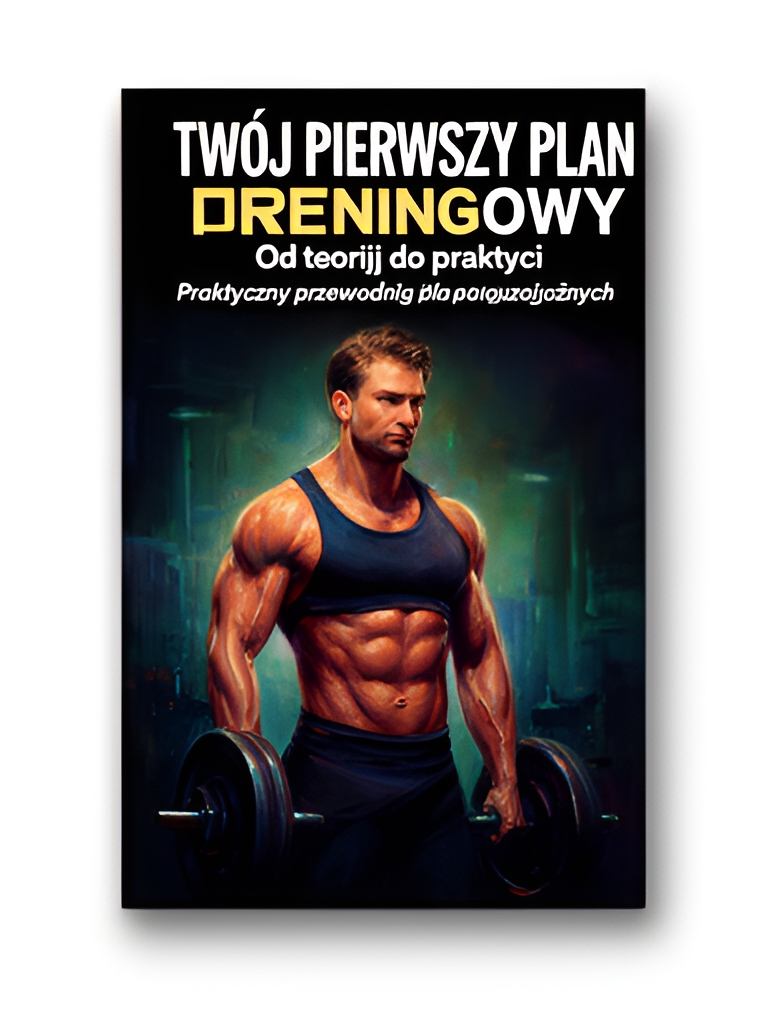
TWÓJ PIERWSZY PLAN TRENINGOWY Od teorii do praktyki Praktyczny przewodnik dla początkujących
by Łukasz Niedźwiedź
5 chapters40 min read
Chapter 1
Starting Strong: Motivation and Realistic Goals
Finding Your Why
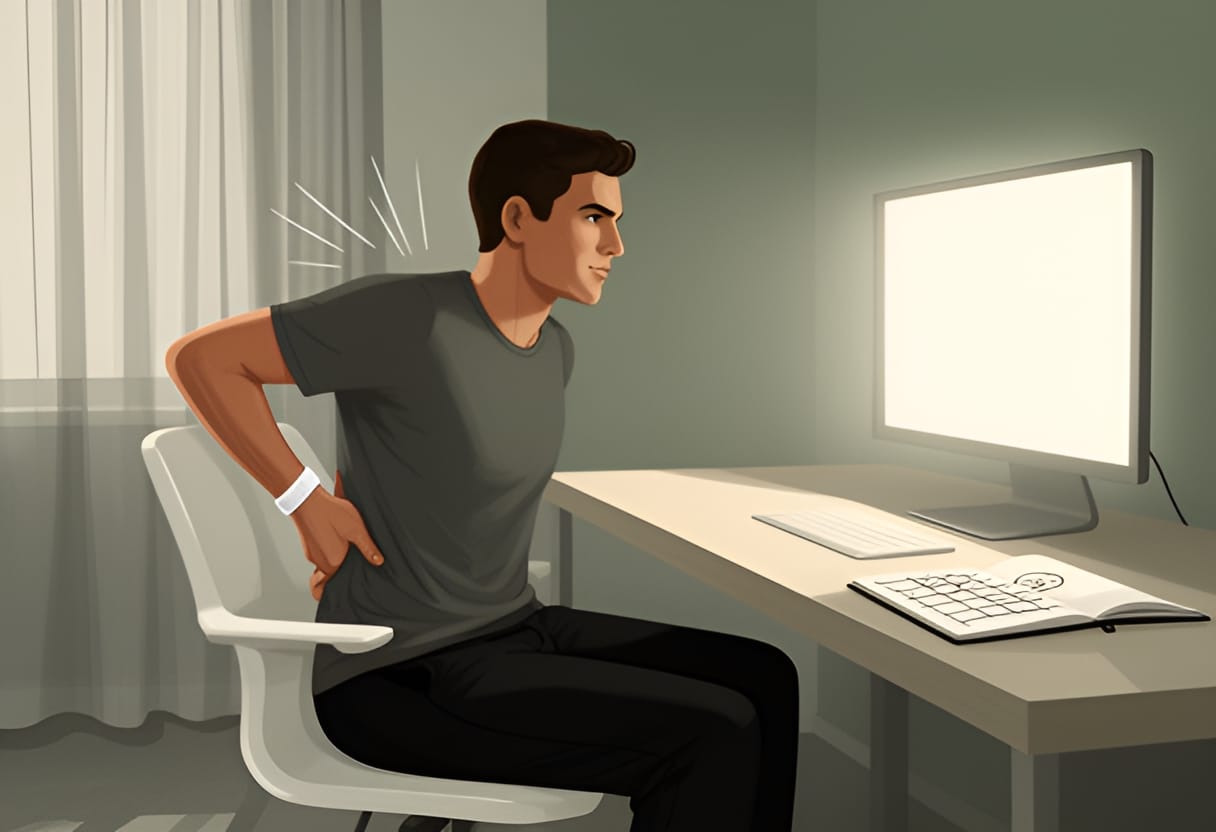
Alex Novak patrzył na ekran swojego komputera o 15:00, gdy znajomy ból w dolnej części pleców nasilił się, przesuwając się w fotelu ergonomicznym. Kolejne popołudniowe zmęczenie dało o sobie znać, jego koncentracja rozpraszała się mimo zbliżającego się terminu. Masował ramiona, zauważając, jak napięcie pełznie w górę od kręgosłupa – codzienny rytuał, który stał się tak rutynowy jak sprawdzanie poczty e-mail. To nie było tylko zmęczenie; to było ciche pogarszanie jego zdolności do pełnego zaangażowania w pracę i życie poza nią.
Próbował już dostosować stanowisko pracy, brać krótkie spacery, nawet korzystać z aplikacji mindfulness, ale problem utrzymywał się. Nie chodziło o osiągnięcie określonej wagi na wadze czy zmieszczenie się w stare spodnie. To, czego naprawdę pragnął, to poczucie sprawczości – możliwość siedzenia przez spotkanie bez niekomfortowego przesuwania się, zabawy z siostrzenicą bez zadyszki, budzenia się wypoczętym zamiast sztywnym i ospałym. Nie były to mgliste życzenia; to konkretne, funkcjonalne pragnienia zakorzenione w tym, jak chciał przechodzić przez swoje dni.
Wyjaśnianie swojej podstawowej motywacji
Motywacje wewnętrzne – te związane z wewnętrznymi doświadczeniami takimi jak energia, nastrój lub zdolność funkcjonalna – okazują się znacznie bardziej trwałe niż zewnętrzne napędy takie jak wygląd czy akceptacja innych. Badania konsekwentnie wykazują, że osoby ćwiczące dla tego, jak im się czują lub funkcjonują, są nawet trzy razy bardziej skłonne do utrzymywania rutyn w dłuższej perspektywie w porównaniu do tych skoncentrowanych wyłącznie na wynikach estetycznych. To nie oznacza, że cele związane z wyglądem są nieważne, ale kiedy stoją same, często zawodzą, gdy postępy zatrzymują się lub życie staje się bardziej wymagające.
Dla Alexa przełom nastąpił, gdy przestał zadawać sobie pytanie „Jak chcę wyglądać?” i zaczął pytać „Jak chcę się czuć i funkcjonować?” Jego niski poziom energii nie był tylko uciążliwy; zakłócał jego wydajność w pracy i obecność w domu. Jego postawa nie dotyczyła wyglądu pewności siebie; chodziło o zapobieganie przewlekłemu bólowi, który mógłby ograniczyć jego mobilność za kilka lat. Przypinając swoją motywację do tych wewnętrznych nagród – codziennej witalności, łatwości ruchu, utrzymanej koncentracji – stworzył cel, który przetrwa nawet wtedy, gdy motywacja osłabnie.
Aby to uwidocznić, poświęcił dziesięć minut na napisanie osobistego oświadczenia dlaczego. Nie było to mgliste marzenie typu „stać się zdrowszym”, lecz konkretne, wypowiedziane w czasie teraźniejszym oświadczenie: «Chcę mieć energię, aby skupić się przez cały dzień pracy bez popołudniowego spadku oraz postawę, aby siedzieć i stać bez dyskomfortu, żeby być bardziej zaangażowanym w pracę i obecnym dla rodziny».
Illustration
Alex Novak, a 32-year-old office worker with tired eyes and slight forward head posture, sits at his desk mid-afternoon. One hand rests on his lower back, the other hovers over the keyboard. Soft daylight filters through blinds, casting long shadows. A half-drunk coffee cools beside an open notebook with doodles and a to-do list. The screen shows a blurred spreadsheet and a clock reading 15:00.
Illustration
Close-up of Alex Novak’s hands writing in a notebook at a kitchen table. The pen moves deliberately across lined paper. Sunlight catches dust motes in the air. The visible text reads: „Chcę mieć energię, aby skupić się przez cały dzień pracy bez popołudniowego spadku oraz postawę, aby siedzieć i stać bez dyskomfortu...” A steaming mug and a half-eaten oatmeal cookie sit nearby.
To oświadczenie działało, ponieważ było:
- Osobiste: Używało „Ja” i odzwierciedlało jego unikalny styl życia
- Specyficzne: Nazywało energię, postawę i zaangażowanie jako rezultaty
- Nastawione na działanie: Łączyło fitness z codziennymi zachowaniami, które cenił
- Emocjonalnie rezonujące: Łączyło się z tym, jak chciał czuć się w swoim życiu
Unikał ogólnych fraz typu „bądź sprawny” lub „schudnij”, skupiając się zamiast tego na fizycznych poprawach, których pragnął. Gdy czytał je na głos, wydawały się prawdziwe – nie aspiracyjne w odległej perspektywie, ale opisowe stanu, którego mógł zacząć dochodzić od razu.
Budowanie odpowiedzialności poprzez połączenie
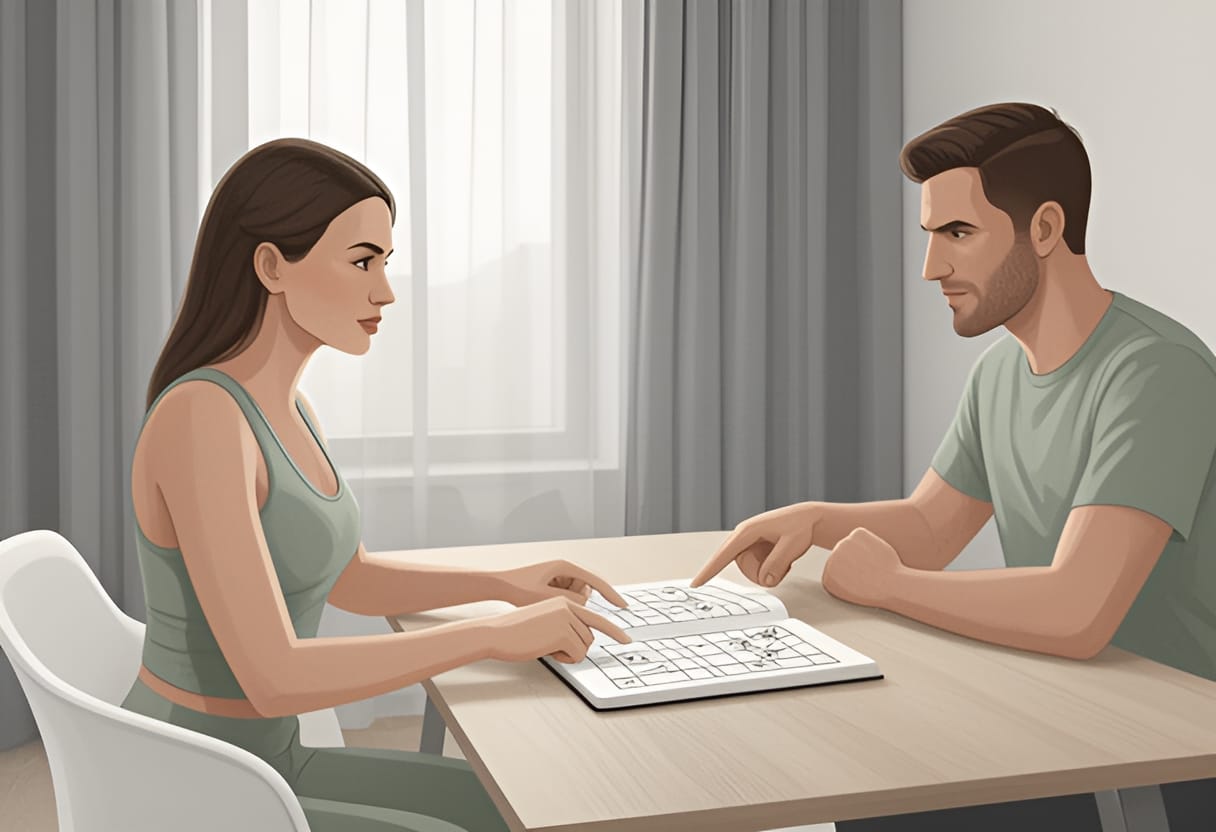
Napisanie oświadczenia było tylko pierwszym krokiem. Aby przekształcić intencję w zobowiązanie, Alex potrzebował uczynić swoje dlaczego widocznym i podzielić się nim z kimś, komu ufał. Wybrał swoją przyjaciółkę Lenę, nie dlatego że była ekspertką od fitnessu, ale dlatego że dobrze znała jego rutynę i zauważyłaby, gdyby zaczął wprowadzać zmiany. Przy kawie podzielił się swoim oświadczeniem i wyjaśnił, dlaczego te konkretne rezultaty są dla niego ważne.
Lena nie udzielała rad ani nie dopingowała – po prostu słuchała, a następnie zapytała: „Co jedno małe rzeczy możesz zrobić w tym tygodniu, co będzie zgodne z tym?” To pytanie utrzymało skupienie na działaniu zamiast na wyniku, redukując presję jednocześnie wzmacniając poczucie sprawczości. Dziękując podzielenie się swoim dlaczego, Alex stworzył cichą formę odpowiedzialności: Lena mogła przypadkowo zapytać, nie oceniając postępów, lecz odbijając jego własne słowa – „Hej, jak idzie ten cel związany z energią?”
Illustration
Alex Novak and Lena sit at a small corner table in a sunlit café. Steam rises from two ceramic mugs. Alex leans forward, palms up, expressing sincerity. Lena listens attentively, one elbow on the table, chin resting on her hand. Chalkboard menu blurs in the background. A half-eaten croissant lies on a plate between them.
Takie podejście unika pułapek publicznych deklaracji, które mogą wywoływać niepokój związany z wydajnością. Zamiast tego wykorzystuje więź społeczną jako lustro, pomagając mu pozostać zgodnym z celem bez przekształcania jego drogi w test. Badania potwierdzają, że dzielenie się celami z jedną zaufaną osobą zwiększa wywiązywanie się znacznie bardziej niż trzymanie ich dla siebie, podczas gdy ogłaszanie ich szerokiej publiczności często zmniejsza zaangażowanie ze względu na presję społeczną lub odczuwaną ocenę.
Alex przykleił wydrukowane oświadczenie do wewnętrznej strony swojego planera – pierwszej rzeczy, którą widział, gdy je otwierał każdego rano. Później dodał kopię do lustra w łazience. Celem nie było stałe motywowanie, ale regularne przypomnienie dlaczego zaczął, szczególnie w dni, kiedy kanapa wydawała się bardziej kusząca niż siłownia.
Illustration
Alex Novak’s bathroom mirror in soft morning light. A small square of paper is taped to the glass at eye level. The handwritten Polish text is legible: „Chcę mieć energię, aby skupić się przez cały dzień pracy bez popołudniowego spadku oraz postawę, aby siedzieć i stać bez dyskomfortu, żeby być bardziej zaangażowanym w pracę i obecnym dla rodziny.” Toothbrush and toothpaste sit in the foreground. Steam lingers from a recent shower.
Oparłszy swoją drogę fitnessową na wewnętrznej motywacji i wzmacniając ją poprzez osobistą refleksję oraz selektywne dzielenie się, Alex przeniósł się poza życzeniowe myślenie. Teraz miał wyraźny, wewnętrzny kompas, który kierował jego działaniami – taki, który pomoże mu wybierać konsekwencję zamiast intensywności oraz cel zamiast chwilowego entuzjazmu. Ta podstawa okaże się niezbędna, gdy zacznie przekładać swoje dlaczego na konkretne, osiągalne cele.
Setting SMART Fitness Goals
Alex stared at his why statement taped to the bathroom mirror as he brushed his teeth that morning. The words felt solid now, not just hopeful scribbles. He wanted energy to power through his workday and posture that let him sit and stand without aching. But how did he turn that into something he could actually do? Lena’s question echoed in his mind: What’s one small thing you could do this week that aligns with that? He needed a bridge between his why and his actions—a way to make progress visible and achievable.
Turning Motivation into Measurable Targets
Vague intentions like “get stronger” or “feel better” lack the specificity needed to guide daily choices. Without clear markers, it’s easy to mistake motion for progress—showing up at the gym but doing random exercises with no plan, or skipping sessions because there’s no sense of what “enough” looks like. This is where the SMART framework transforms aspiration into action. SMART goals are Specific, Measurable, Achievable, Relevant, and Time-bound. They force clarity: instead of “I want to lift weights,” you define what you’ll lift, how much, how often, and by when.
For Alex, relevance was already built in—his why statement guaranteed any goal would connect to his deeper purpose. He focused on the two pillars from his statement: energy and posture. To improve energy, he needed better stamina for sustained focus; for posture, he needed strength and awareness to maintain alignment without fatigue. Rather than chasing abstract fitness, he chose concrete behaviors that would build those qualities.
He decided to target his squat form—not because it was trendy, but because the movement mirrored daily actions like sitting down and standing up. If he could squat with control, knees tracking over toes and spine neutral, he’d be building the very capacity his why described. He made it SMART: By week 4, I will perform three sets of ten bodyweight squats with knees tracking over toes and neutral spine. It was specific (squat form), measurable (three sets of ten reps), achievable (starting from his current ability), relevant (directly tied to posture and functional movement), and time-bound (four weeks).
To illustrate how vague aims become actionable, consider this comparison:
| Vague Goal | SMART Goal | Why It Works |
|---|---|---|
| Get stronger | Add 5kg to my goblet squat in 6 weeks | Specifies the exercise, load increase, and timeframe |
| Improve posture | Hold a wall sit for 60 seconds with lower back flat by week 3 | Defines the position, duration, success metric, and deadline |
| Have more energy | Complete two full-body workouts weekly for 4 weeks without afternoon crash | Links behavior to outcome, sets frequency and duration |
Notice how each SMART goal includes a behavior (doing the workout, holding the position) rather than just an outcome. This shifts focus to what Alex can control—his actions—rather than factors like sleep, stress, or genetics that influence results but aren’t directly manipulable.
Balancing Process and Outcome Goals
Alex initially thought his goal was simply to “have better posture.” But posture isn’t something you do; it’s a result of consistent habits. If he only measured success by how straight he stood, he might get discouraged on days when fatigue or stress made him slump, even if he’d trained well. That’s why distinguishing between process goals and outcome goals is crucial.
Process goals describe the actions you commit to—working out twice weekly, practicing hip hinge drills for five minutes daily. They’re within your direct control and build consistency. Outcome goals describe the results you hope to achieve—reducing back pain, increasing squat depth. They depend on multiple variables and offer feedback but shouldn’t be your sole focus.
Alex paired his outcome goal (improved squat form) with process goals that would get him there:
- Complete two full-body workouts per week for the next four weeks.
- Spend five minutes before each workout practicing the hip hinge with a dowel to reinforce neutral spine.
These process goals created a feedback loop. Each workout became a data point: Did he maintain form? Did he feel less strain in his lower back? Over time, he could see whether his efforts were moving the needle toward his outcome goal. If he missed a workout, he didn’t judge himself as failing—he adjusted his process for the next week. This flexibility prevented the all-or-nothing thinking that derails many beginners.
He also set a short-term horizon—four weeks—because shorter cycles provide timely feedback. Long-term goals (like “deadlift my bodyweight in six months”) are important for direction, but they’re too distant to adjust course. Short-term goals (two to four weeks) let you test assumptions, celebrate small wins, and recalibrate before frustration builds. Alex knew that if he could hit his four-week squat target, he’d have proof that his approach worked—and motivation to keep going.
He wrote his plan in a dedicated notebook, the same one where he’d jotted down his why statement. Seeing it in his own handwriting made it feel real, not just a thought. By week 4, I will perform three sets of ten bodyweight squats with knees tracking over toes and neutral spine. Underneath, he added his weekly process goals and a simple log:
- Week 1: Learn hip hinge with dowel; two workouts (Mon, Thu)
- Week 2: Add bodyweight squats to warm-up; focus on depth
- Week 3: Introduce slow tempo (3 seconds down, 1 up)
- Week 4: Test goal: three sets of ten with perfect form
Each Sunday, he’d spend five minutes reviewing the past week and adjusting the next. No guilt, just course correction—like a sailor checking the wind and trimming the sail.
Try This
Take your why statement and turn it into your first SMART goal using these steps:
- Pick one behavior from your why that you can observe or measure (e.g., “sit without discomfort” → practice sitting tall for increasing durations).
- Make it specific: define the exact action, quantity, and standard (e.g., “sit with lower back against chair for 5 minutes”).
- Attach a timeframe: choose 2–4 weeks to test it (e.g., “by the end of week 3”).
Write it down. Then, identify one process goal that supports it—something you’ll do regularly to build toward that target.
Key Takeaways
- SMART criteria convert vague desires into clear, actionable targets by specifying what, how much, and by when.
- Process goals (actions you control) build consistency; outcome goals (results you hope for) provide feedback but depend on multiple factors.
- Short-term goals (2–4 weeks) create feedback loops for adjustment; long-term goals (3+ months) sustain overall direction.
- Writing goals down and reviewing them weekly turns intention into a flexible plan, not a rigid test.
- Aligning goals with your why statement ensures every effort connects to what truly matters to you.
Chapter 2
How Strength Training Changes Your Body
The Neurological Phase of Early Gains
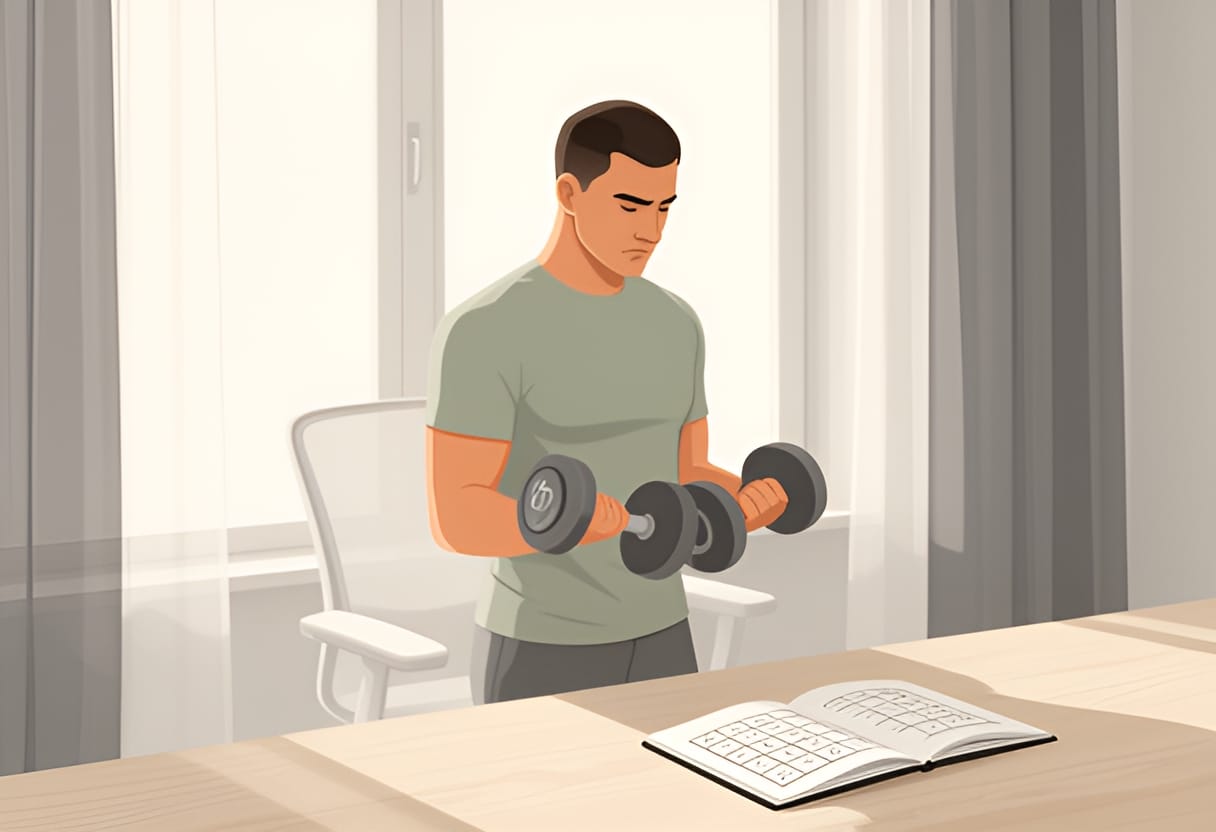
Alex Novak felt the familiar burn in his arms as he lowered the 12-kilogram dumbbell after his third set of biceps curls. Two weeks into his strength training routine, he could now complete the movement with a weight that had felt impossible on day one. Yet when he flexed in the mirror, his arms looked unchanged. Frustration flickered—was he wasting his time?
Maja Kowalska noticed his hesitation during their Thursday session. “What’s going through your mind?” she asked, wiping her hands on a towel.
“I’m lifting heavier, but I don’t see any difference,” Alex admitted. “If I’m getting stronger, why don’t my muscles look bigger?”
She smiled, recognizing a common point of confusion. “That’s actually a great sign. What you’re experiencing is the neurological phase of strength gains. Your muscles aren’t growing much yet—your nervous system is learning to use what you already have more efficiently.”
The Brain-Muscle Upgrade
In the first six to eight weeks of resistance training, the majority of strength improvements come from enhanced neural communication rather than increases in muscle size. The brain becomes better at recruiting the right motor units—groups of muscle fibers controlled by a single nerve—and fires them more synchronously and frequently. Think of it like upgrading the wiring in a house before adding new appliances: the existing system works harder and smarter before any structural expansion occurs.
For Alex, this meant his body was learning to activate a higher percentage of his biceps fibers during each curl. Early in his training, many fibers remained dormant during the lift. Now, with practice, his nervous system could call on more of them to generate force. Additionally, the timing of these signals improved—motor units fired in tighter unison, reducing internal resistance and allowing smoother, more powerful contractions.
This neural adaptation explains why beginners often see rapid strength jumps early on, even without visible changes. It also means progress isn’t always reflected in the mirror or on the scale. Relying solely on appearance can lead to discouragement during this critical phase, when the foundation for long-term gains is being laid.
Tracking What Matters
To help Alex see his progress objectively, Maja encouraged him to focus on performance metrics rather than aesthetics. “Let’s track what you can do, not just how you look,” she said, pulling out his notebook. “Write down the weight, sets, and reps for each exercise every session. That’s your real scoreboard.”
Alex began recording his biceps curl weights in detail:
| Exercise | Week | Weight (kg) | Sets | Reps |
|---|---|---|---|---|
| Biceps Curl | 1 | 8 | 3 | 10 |
| Biceps Curl | 2 | 10 | 3 | 10 |
| Biceps Curl | 3 | 12 | 3 | 10 |
Seeing the numbers climb gave him tangible proof of improvement. He also noted how the movement felt—less wobble at the elbow, better control during the lowering phase—and how everyday tasks like carrying groceries or lifting his backpack felt easier.
Maja reminded him that hypertrophy would come later, typically after eight to twelve weeks of consistent stimulus, as muscle fibers gradually increased in size in response to repeated tension. But for now, the priority was mastering technique and trusting the nervous system’s quiet work.
By the end of his third week, Alex no longer questioned whether he was making progress. He understood that strength begins in the brain, and every rep was refining the signal that would eventually build the body he wanted—not just for appearance, but for the energy and posture to engage fully in his work and family life.
He also began to notice subtle shifts in how his body responded to fatigue. During his Thursday workout, he managed to complete an extra set of goblet squats with the same 10-kilogram kettlebell he’d struggled with just days before. His legs didn’t feel stronger in the traditional sense—there was no visible swelling or tightness—but his hips and knees moved with greater stability, and he didn’t need to pause between reps to regain balance. Maja pointed out that this, too, was neural: improved coordination between his core, glutes, and ankle stabilizers allowed him to maintain posture under load without wasted motion.
Alex started applying this awareness outside the gym. When he sat at his desk, he’d consciously engage his glutes and gently brace his midsection, mimicking the tension he used during deadlifts. When he stood to greet his daughter after work, he noticed he could hinge at his hips without rounding his lower back—a movement pattern that had once felt awkward and painful. These weren’t signs of muscle growth, but evidence that his nervous system was wiring in better movement habits, one repetition at a time.
By week’s end, he recorded another increase: 14 kilograms for three sets of ten biceps curls. He didn’t flex in the mirror. Instead, he smiled, closed his notebook, and headed home, already planning how he’d use that extra reserve of strength to carry both grocery bags in one trip—so he’d have a free hand to hold his daughter’s on the walk upstairs.
Muscle, Bone, and Metabolic Adaptations
Maja Kowalska waited until Alex had hung up his jacket and poured himself a glass of water before speaking. “You’ve seen how your nervous system upgrades first,” she began, leaning against the counter. “Now let’s talk about what happens to your muscles, bones, and metabolism when you keep showing up.”
Alex nodded, curious. He’d felt stronger carrying groceries, but he wondered if there was more happening beneath the surface.
Structural Reinforcement: Tendons, Ligaments, and Bone
“Strength training doesn’t just build muscle,” Maja explained. “It remodels your connective tissue and skeleton. Tendons and ligaments—which connect muscle to bone and bone to bone—adapt to repeated load by increasing collagen density and fiber alignment. This makes them stiffer and more resilient, reducing strain risk over time.”
She pulled up a diagram on her phone showing a tendon under microscopic magnification. “See how the fibers run parallel? With training, they organize better and cross-link more effectively. It’s like upgrading from a frayed rope to a steel cable.”
Alex recalled the discomfort he’d felt in his elbows during early biceps curls. “That makes sense. My joints used to ache after lifting, but now they feel more solid.”
“Exactly,” Maja said. “And bone responds similarly. Mechanical loading from resistance training stimulates osteoblasts—the cells that build bone—while suppressing osteoclasts, which break it down. Over months, this increases bone mineral density, especially in the hips, spine, and wrists.”
She tapped the screen to highlight those regions. “This is why strength training is one of the most effective non-pharmacological interventions for osteoporosis prevention. It’s not just about muscle—it’s about building a frame that lasts.”
Alex thought of his sedentary office job and the occasional twinge in his lower back after long hours. “So lifting weights could actually help protect my skeleton?”
“Yes,” Maja affirmed. “And the adaptations are site-specific. Squats and deadlifts load the spine and hips; pressing movements stress the wrists and shoulders. Consistency matters more than intensity—progressive overload over time signals your body to reinforce those areas.”
Metabolic Efficiency: Lean Mass and Resting Burn
Maja shifted her tone slightly. “Now, let’s talk about metabolism. Most people assume cardio is king for burning calories, but strength training plays a quieter, longer-term role.”
She explained that muscle tissue is metabolically active—it burns more calories at rest than fat tissue. “When you gain or preserve lean mass through resistance training, you elevate your basal metabolic rate (BMR). That means your body uses more energy just to maintain basic functions, even when you’re not exercising.”
Alex frowned slightly. “But I haven’t gained much muscle yet, have I?”
“Not visibly,” Maja agreed. “But you’re preventing loss. Without stimulus, adults lose about 3–8% of muscle mass per decade after age 30. Training reverses or slows that decline. And even small gains in lean tissue add up.”
She pulled up a simple calculation. “Let’s say you gain two kilograms of muscle over several months. That tissue burns roughly 13 extra calories per kilogram per day at rest. So 2 kg × 13 kcal = 26 additional calories burned daily. Over a year, that’s nearly 9,500 kcal—equivalent to over a kilogram of fat.”
Alex did the math in his head. “So it’s not about huge burns in a single session—it’s about shifting your baseline.”
“Precisely,” Maja said. “And there’s another benefit: resistance training improves insulin sensitivity. Your muscles become better at pulling glucose from the bloodstream, which supports long-term energy balance and reduces metabolic disease risk.”
Alex recalled how he used to feel sluggish after lunch. “That might explain why I’ve had fewer energy crashes lately.”
“Likely,” Maja said. “You’re not just stronger—you’re more efficient.”
Connecting Adaptations to Daily Life
Alex remembered his recent deadlift practice. “I’ve noticed my lower back feels less stiff after hinging movements. Is that related?”
“Absolutely,” Maja said. “The posterior chain—your glutes, hamstrings, and erector spinae—is getting stronger and more resilient. Tendons in those areas are adapting to handle load, and your nervous system is coordinating them better. Less stiffness means your tissues are tolerating stress without guarding or fatigue.”
She smiled. “That’s the goal: not just lifting heavier in the gym, but moving through life with less discomfort and more confidence.”
Alex thought about lifting his daughter into her car seat or reaching for a box on a high shelf. “So every rep is reinforcing more than just muscle.”
“Every rep is a signal,” Maja corrected. “To your nerves, your tendons, your bones, your metabolism. You’re not just training for today—you’re building a foundation for how you feel and function years from now.”
He closed his notebook, feeling a quiet satisfaction. The changes weren’t always visible, but they were real—and they were adding up.

Try This
This week, take note of how your body feels during everyday movements—not just in the gym. Pick one habitual action, like lifting a bag or standing from a chair, and observe:
- Whether you can perform it with smoother coordination or less effort than before
- If your joints feel more stable or supported during the motion
- Whether you notice less stiffness or fatigue afterward
Record your observations in your notebook. Over time, these subtle shifts will reflect the deeper adaptations taking place.
Key Takeaways
- Resistance training increases tendon and ligament stiffness and resilience, reducing injury risk through improved collagen organization and load tolerance
- Mechanical loading from strength training stimulates bone formation, increasing mineral density in the hips and spine to help prevent osteoporosis
- Gaining or preserving lean mass elevates basal metabolic rate, supporting long-term energy balance even at rest
- Improved neuromuscular coordination and tissue resilience lead to better movement quality and reduced stiffness in daily activities
- Strength gains reflect systemic adaptation—not just muscle growth—making functional progress a reliable marker of long-term health benefits
Chapter 3
Your First Gym Visit: Preparation and Etiquette
Packing Your Gym Bag and Choosing Attire
Alex Novak lay awake the night before his first gym visit, replaying the list Maja had sent him: shoes, shirt, shorts, towel, water, lock, deodorant. He stared at the ceiling, wondering if he’d forgotten something vital. The physiological adaptations from Chapter 2—how nerves learn to fire more efficiently, how connective tissue thickens in response to load—suddenly felt abstract without the right preparation. He needed to translate that knowledge into action, starting with what he carried into the facility.
Packing the Essentials
Alex spread everything on his bed and began with footwear. He chose his flat-soled canvas trainers—minimal cushioning, a firm rubber sole, and zero heel-to-toe drop. Unlike his old running shoes, which had thick, compressible midsoles designed for forward propulsion, these would keep his feet planted during squats and deadlifts. Maja had explained that instability from cushioned soles forces the ankles and knees to compensate, increasing shear stress and reducing force transfer. With flat soles, Alex could feel the floor, drive through his heels, and maintain a neutral spine under load—key for the motor learning adaptations discussed previously.
Next, he selected a moisture-wicking polyester shirt and nylon-elastane shorts. Cotton, he remembered, absorbs sweat and clings to the skin, increasing friction and the risk of chafing during repetitive movements like rowing or lunges. The synthetic fabric pulled moisture away, dried quickly, and allowed a full range of motion without binding. He folded them neatly beside a small, quick-dry towel—large enough to wipe equipment but compact enough to fit in a side pocket.
He filled his BPA-free water bottle with cool water and added electrolytes, anticipating sweat loss during his planned full-body circuit. Hydration supports blood volume and nutrient transport, both critical for the intracellular signaling that drives muscle protein synthesis. Without it, even optimal neural adaptations could falter.
Alex packed a combination lock—necessary for securing valuables in the locker room—and a travel-sized stick deodorant. He skipped perfume or cologne; strong scents can linger in enclosed spaces and distract others during heavy lifts. A small pack of antibacterial wipes went in an inner compartment, not for show, but to honor the unspoken rule of leaving equipment cleaner than he found it.
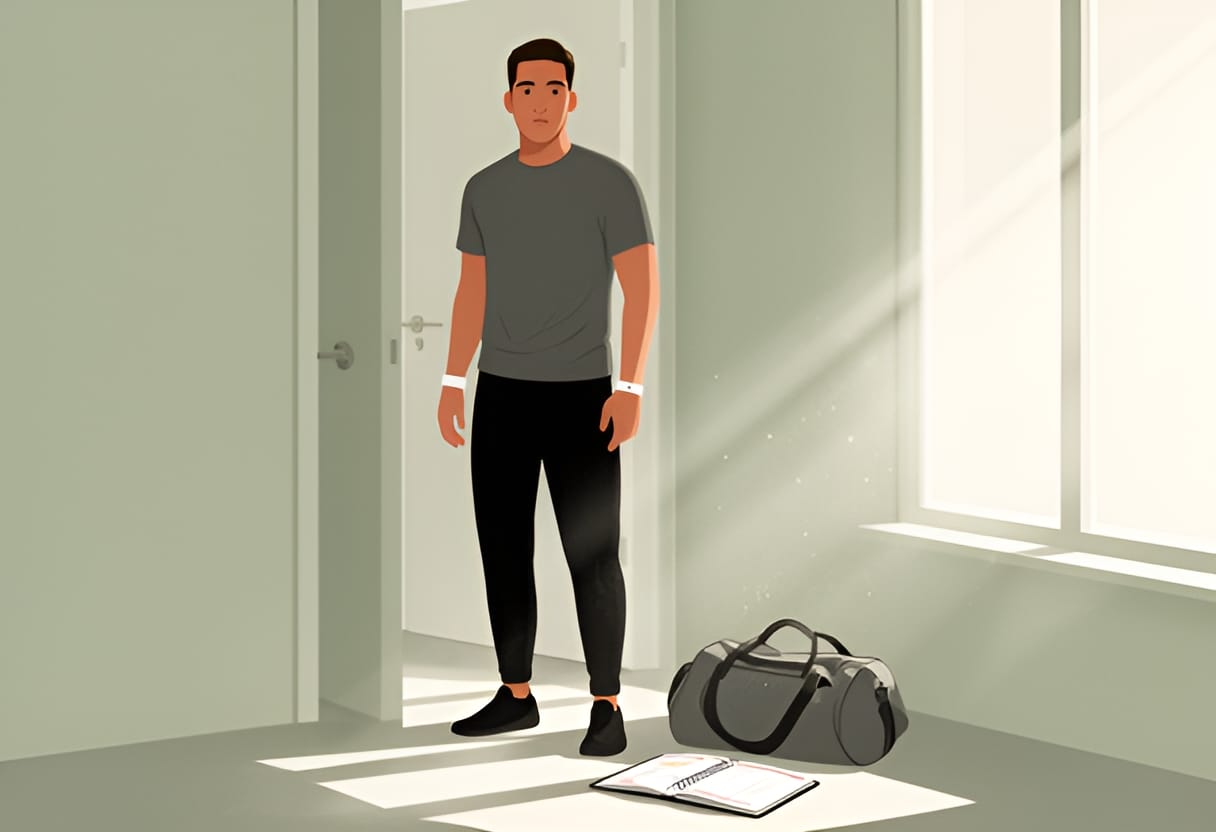
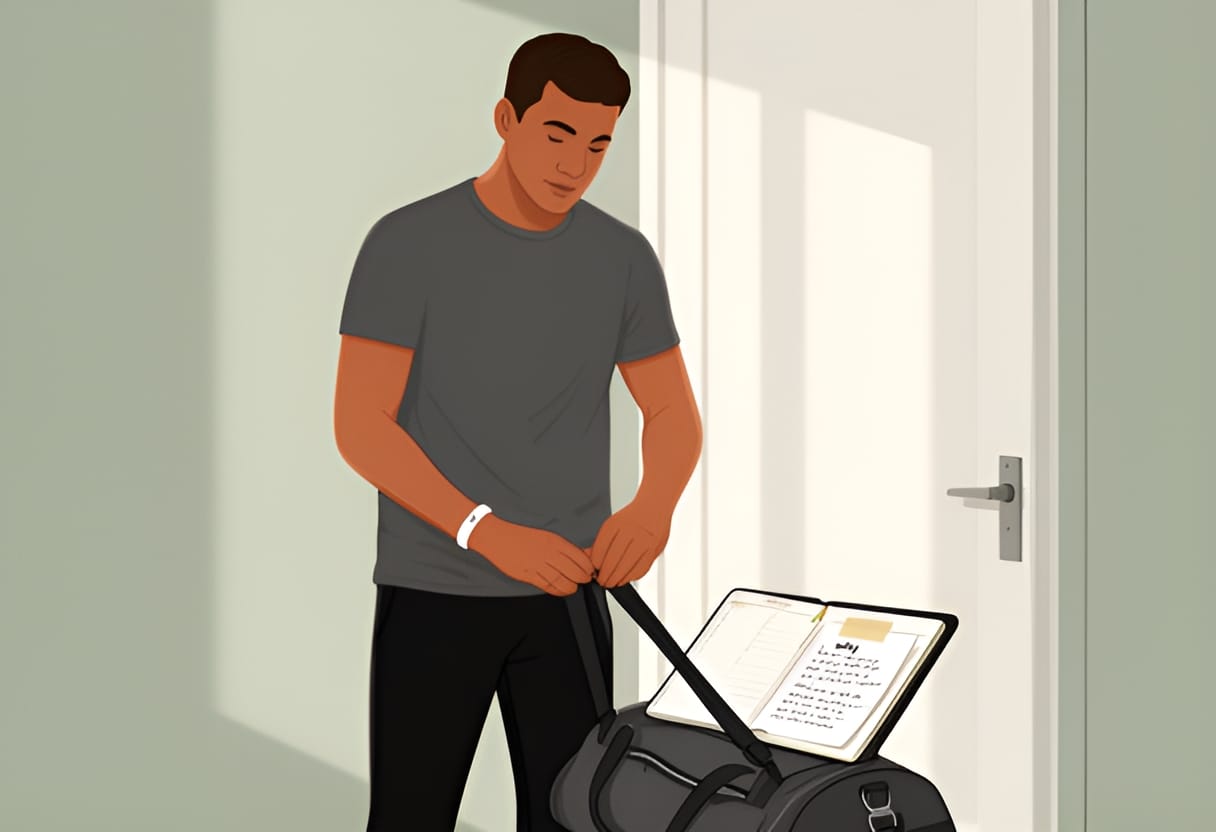
He zipped the bag, ran his fingers over each item, and mentally checked them off: shoes, shirt, shorts, towel, water, lock, hygiene. The weight of the bag on his shoulder felt purposeful—not a burden, but a toolkit. He placed it by the door, next to his planner where his why statement taped inside reminded him why he was doing this: to have the energy to focus through his workday and the posture to sit and stand without discomfort.
Illustration
A close-up view of a packed gym bag lying open on a bed, showing flat-soled trainers, a folded moisture-wicking shirt and shorts, a rolled microfiber towel, a filled water bottle, a combination lock, and a stick deodorant. Each item is labeled with a thin callout line pointing to it.
The next morning, Alex slung the bag over his shoulder as he left his apartment. The canvas soles whispered against the pavement. He didn’t feel self-conscious—he felt ready. Not because he had the fanciest gear, but because each item served a function aligned with his goal: to move well, feel strong, and show up consistently. As he approached the gym doors, he took one last breath, adjusted the strap, and stepped inside—no longer imagining what it would be like, but beginning to live it.
Inside, the hum of treadmills and the clink of weights greeted him. He headed straight to the locker room, placed his bag in an empty unit, and spun the lock until the numbers aligned. The cool metal clicked into place—a small ritual that marked the transition from outside life to training time. He changed quickly, slipping into his shirt and shorts, tying his shoes snug but not tight. The flat soles felt firm against the rubber flooring as he walked back out, towel draped over his shoulder, water bottle in hand.
Maja met him near the stretching area, her smile calm and approving. “You packed well,” she said, nodding at his shoes. “Those will help you feel the ground. That’s where strength starts.” Alex smiled back, feeling a quiet pride—not in how he looked, but in how prepared he felt. He had translated intention into action, and the bag at his feet was proof. Now, with his body warmed and his mind focused, he was ready to begin.
Navigating the Floor and Practicing Etiquette
Alex Novak followed Maja toward the weight area, his eyes scanning the room as they walked. The gym unfolded in zones he’d only seen in online tours: rows of treadmills and ellipticals faced the front windows, their consoles glowing with metrics and entertainment screens. Beyond them, a cluster of resistance machines lined one wall, their seats and pads adjusted for various heights. To the left, near the stretching area where they’d started, rubber mats lay rolled against the mirrors, ready for mobility work or core circuits.
The heart of the space, however, lay toward the back and center—a expansive floor dotted with squat racks, benches, barbells, and racks of dumbbells and kettlebells. Platforms for deadlifts and Olympic lifts sat recessed into the rubber flooring, surrounded by chalk bowls and lifting straps. Maja led him to a clear patch near a power rack, where she paused to orient him.
“Notice how the cardio’s up front?” she said, gesturing toward the machines bathed in morning light. “Most people warm up there, then flow backward into the weights. It keeps traffic moving.” She pointed to a narrow aisle between two squat racks. “This is a main thoroughfare—don’t stand here chatting or stretching. Keep it clear so others can walk through with plates or a barbell.”
Alex nodded, stepping aside as a member carried a loaded barbell from a rack to a flat bench. The lifter moved with purpose, eyes forward, not blocking the path. Alex felt a flicker of anxiety—what if he got in the way? What if he didn’t know how to re-rack properly? Maja sensed his hesitation.
“Your first job isn’t to lift heavy,” she said. “It’s to learn the rhythm of the space. Watch where people go, how they share equipment, and how they leave things when they’re done. Gym etiquette isn’t about perfection—it’s about respect for the shared space and the people in it.”
She broke it down into four core habits, each tied to safety and flow.
First, re-racking weights. “If you take it off, put it back,” Maja said. “Plates on the bar? Return them to the weight tree in order—heaviest on the bottom, lightest on top. Dumbbells? Pair them up and return them to the same rack, facing the same way. It takes five seconds, and it saves someone else ten minutes of hunting.”
She demonstrated with a 10-pound plate, sliding it onto the peg of a vertical rack with a smooth motion. “See how it sits flush? No overhang, no wobble. That’s how you know it’s secure.”
Second, wiping down equipment. “After you use a bench, a machine, or even the handles of a rack, give it a quick wipe,” Maja said, handing Alex one of his antibacterial wipes. “Not because you’re dirty—because the next person deserves a clean surface. Sweat, chalk, even skin cells—it’s basic hygiene.”
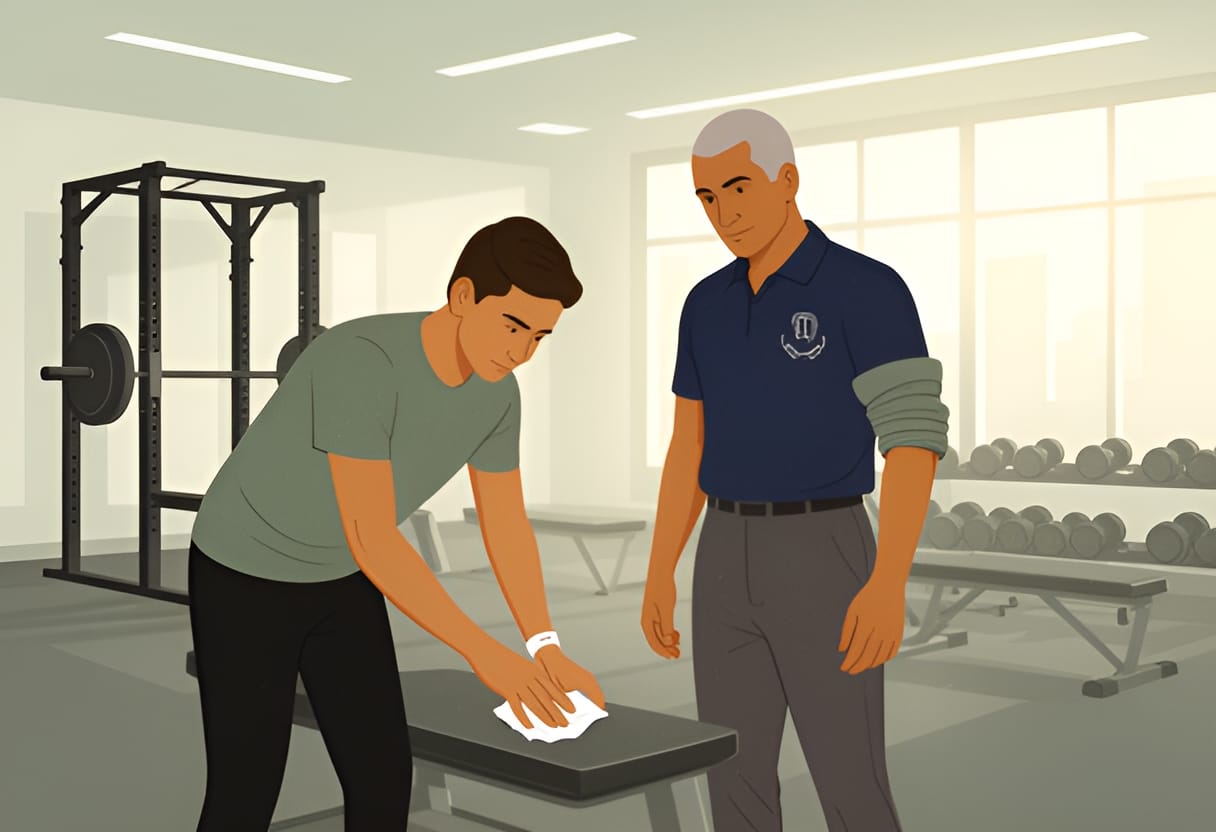
Alex wiped the vinyl pad of a flat bench, then the knurling of a barbell where his hands would grip. The action felt small but significant—a quiet acknowledgment of the others who would use the same space.
Third, allowing others to work in. “If someone’s resting between sets, it’s okay to ask if you can work in,” Maja explained. “But only if it makes sense—same exercise, similar weight, and you can adjust the equipment quickly. Never just jump on someone’s machine without asking.”
She illustrated with a scenario: “Say you’re doing goblet squats with a 20-pound dumbbell, and someone’s using the squat rack for barbell back squats. You wouldn’t ask to work in there—it’s not the same movement, and changing weights would take too long. But if they’re doing dumbbell presses on a bench, and you need the same bench for incline presses? That’s a chance to share—if you ask first.”
Fourth, avoiding curls in the squat rack. Maja’s tone turned firm but not unkind. “The squat rack is for squats, presses, and lifts that need the barbell to start from the rack. If you’re doing bicep curls, use a bench or stand in the open floor. Tying up a rack for curls when someone’s waiting to squat? That’s a quick way to frustrate people—and it’s unsafe if you’re blocking the safety bars.”
Alex absorbed the rules, feeling less like an outsider and more like a participant learning the language of the space. Maja then guided him through his first circuit, reinforcing each habit as they went.
They began with goblet squats. Alex approached the dumbbell rack, selected a 20-pound weight, and performed two sets of 14 reps, resting 75 seconds between sets. After each set, he returned the dumbbell to its proper spot—paired with its match, handle facing outward. When he finished, he wiped the dumbbell handle with a wipe before returning it to the rack.
Next, the glute bridge. He lay on a mat near the stretching area, performed two sets of 15 reps, then folded the mat neatly and placed it back against the wall. No equipment to re-rack, but he made sure the space was tidy.
For the incline dumbbell press, he used an adjustable bench. After his sets, he returned the dumbbells to the rack, wiped the bench pad and handles, and reset the bench to flat for the next user.
The seated cable row required more attention. He adjusted the pin to 30 pounds, grasped the handle, and completed two sets of 13 reps. When done, he slowly released the tension, returned the handle to its hook, and wiped both the handle and the seat pad. He left the pin in place—no need to reset it unless the next user needed a different weight.
Finally, the forearm plank. He held two sets of 25 seconds on a mat, resting 50 seconds between sets. When finished, he rolled the mat loosely and returned it to its spot, smoothing out any wrinkles.
Throughout, Maja reminded him to breathe, stay aware of his surroundings, and yield the space when needed. Once, a member waited patiently at the squat rack while Alex finished his cable row. Alex caught their eye, gave a small nod, and finished his set promptly. The member smiled and began loading the bar—a silent exchange of mutual respect.
By the end of the session, Alex felt the same pleasant fatigue he’d noted in his planner—muscles engaged, not shattered. He had completed his circuit without blocking equipment, leaving weights scattered, or ignoring the unspoken flow of the gym. As he wiped down the cable row handle one last time, Maja approached.
“You did exactly what a beginner should do,” she said. “You focused on form, respected the space, and listened to your body. That’s how you build consistency—not by lifting the most, but by showing up the right way.”
Alex packed his bag, slipped on his trainers, and headed toward the locker room. The hum of the gym followed him out the door—not as noise, but as the sound of a place he was learning to belong to.
Try This
This week, practice one etiquette habit each time you train:
- Before your workout, spend two minutes observing how people move through the space—where they walk, how they share equipment, and where they place items when done.
- Choose one habit to focus on: re-racking weights, wiping equipment, or asking to work in. Apply it consistently during your session.
- Afterward, reflect: Did it feel awkward at first? Did anyone acknowledge your effort? Notice how small actions shape your experience in the gym.
Key Takeaways
- Gyms are organized into zones: cardio up front, weights in the back or center, and stretch areas in the corners or along walls—knowing this helps you navigate with purpose.
- Core etiquette includes re-racking weights, wiping down equipment after use, allowing others to work in when appropriate, and avoiding curls in the squat rack.
- When in doubt, pause, observe, and ask staff or fellow members politely—prioritizing safety and shared space over ego builds confidence and respect.
Chapter 4
Mastering the Foundational Movements
Squat and Hinge: Lower Body Foundations
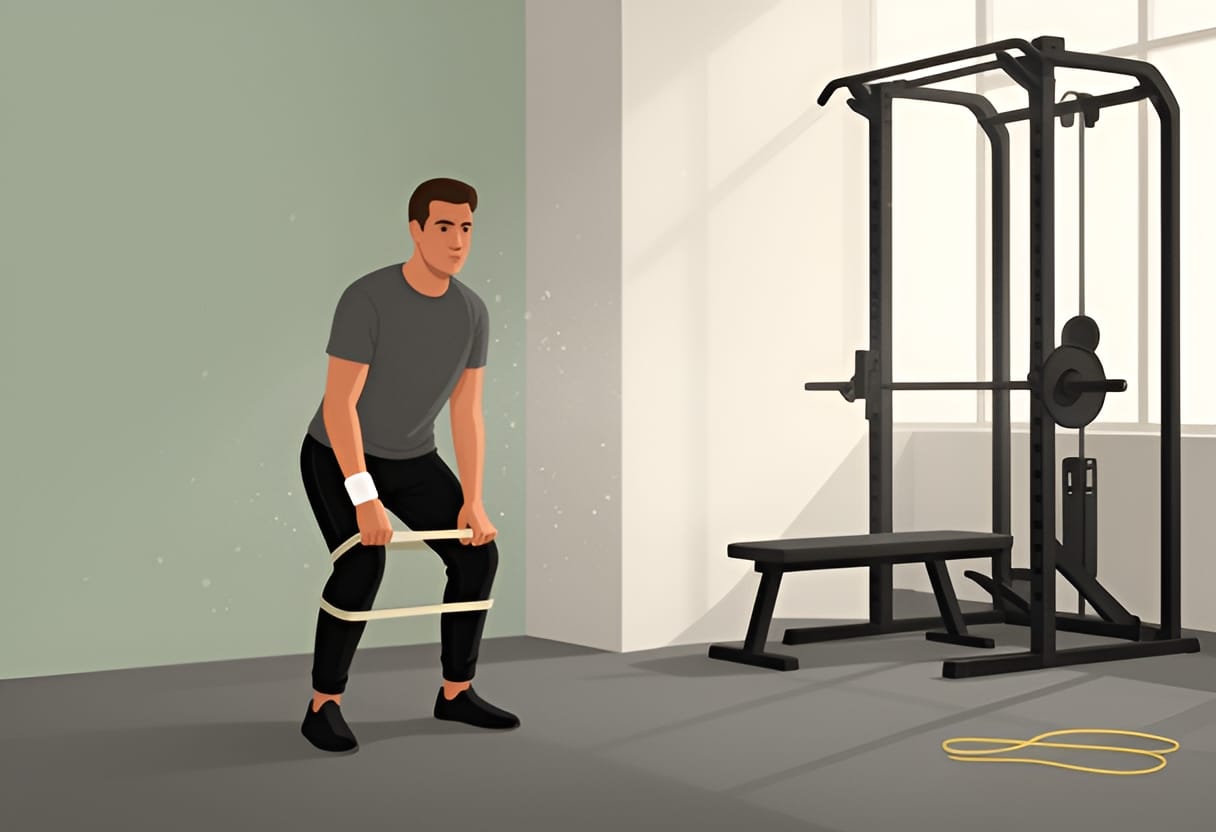
Alex Novak stood in the empty corner of the gym, a light resistance band looped around his thighs just above the knees. The morning light filtered through the high windows, catching dust motes in the air. He had come early, before the after-work rush, to practice without an audience. Maja had shown him the box squat the day before, but today he wanted to feel the movement on his own terms, using only his bodyweight and the feedback from the band.
He lowered himself slowly, resisting the band’s pull as it tried to draw his knees inward. The cue “push the floor away” echoed in his mind from Maja’s demonstration. Instead of leading with his knees, he initiated the movement by sending his hips back, as if closing a car door with his buttocks. His torso leaned forward slightly, maintaining a neutral spine, and his weight stayed balanced across his whole foot. When his thighs touched the box, he paused, then drove upward by squeezing his glutes and pushing through his heels.
The band provided constant feedback—if his knees caved, it snapped inward; if he pushed them out too far, it flared uncomfortably. After three sets of ten, he noticed less wobble at the bottom and a deeper engagement in his glutes and hamstrings. He recorded the session in his notebook: Box squat, 3x10, band resisted knees out. Felt stable, no knee pain. Depth consistent.
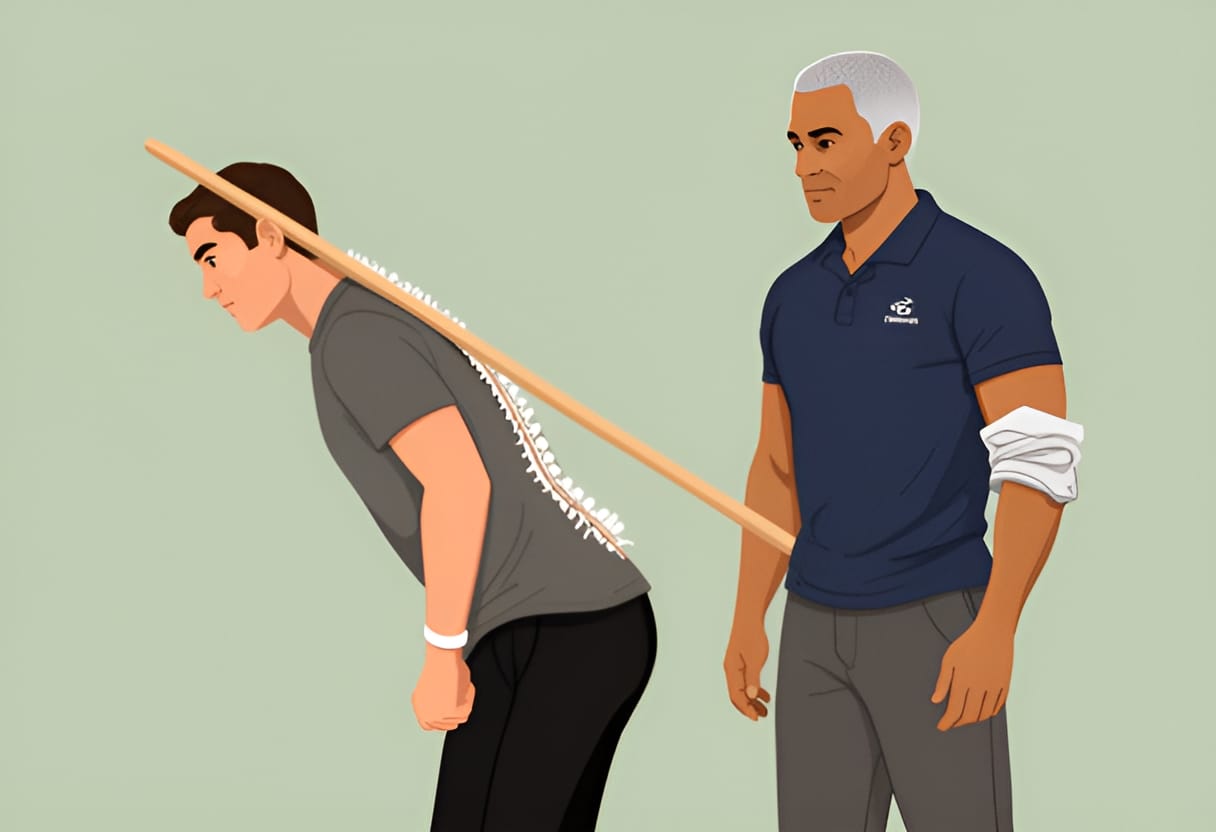
Later that afternoon, Maja met him near the stretching area with a wooden dowel. “Let’s lock in the hip hinge,” she said, placing the dowel along his spine so it touched his head, upper back, and tailbone. “Your job is to keep all three points in contact as you move.”
Alex softened his knees slightly and pushed his hips back, feeling a stretch in the backs of his legs. The dowel remained steady against his head and pelvis, but as he leaned too far forward, it lost contact with his tailbone—a clear sign his lower back was rounding. He adjusted, reducing the depth until the contact points held. “It’s not about how far you go,” Maja reminded him. “It’s about how well you maintain the position.”
He practiced the hinge for five minutes, each rep deliberate. On the way up, he thought of Maja’s cue: hinge at the hips like a door. The motion wasn’t a squat; there was minimal knee bend, and the primary movement came from the hips sliding backward and then forward. When he stood, he engaged his glutes to restore upright posture, not his lower back.
That evening, Alex taped a small note to his water bottle: Hinge first, squat second. It was a reminder that even in daily life—picking up a bag, tying a shoe—he could choose to move from his hips, sparing his spine. He had not lifted a weight yet, but he was building the foundation for every lift to come.
The next morning, Alex applied the hip hinge to a real-world task: lifting his laptop bag from the floor. Instead of rounding his back to grab it, he pushed his hips back, kept his spine long, and reached down with a slight knee bend. The bag came up smoothly, and he felt the work in his glutes and hamstrings, not his lower back. He repeated the motion when setting it down, maintaining control throughout.
Later, at work, he noticed himself instinctively using the same pattern when picking up a dropped pen. His colleague Lena, who had heard about his training, remarked, “You look like you’re moving with purpose now.” Alex smiled, realizing the hinge was becoming more than an exercise—it was a habit.
That evening, he returned to the gym to refine the squat. Without the box, he aimed for consistent depth, using the band to keep his knees tracking over his toes. On the third set, he paused at the bottom for two seconds, feeling the tension in his quads and the stretch in his adductors. He stood explosively, driving through his heels. Maja, observing from a distance, gave a thumbs-up.
He recorded the session: Bodyweight squat, 3x10, 2-sec pause at depth. Knees stable, chest up. Felt stronger in the hole. The notes were simple, but they reflected progress—not in weight lifted, but in movement quality. Each rep was a reinforcement of the pattern: hips back, spine neutral, knees aligned.
By the end of the week, Alex had completed four practice sessions focused solely on the squat and hinge. He hadn’t added load, but he had gained something more fundamental: the ability to distinguish between movement at the hips and movement at the spine. This awareness, he realized, would protect him long after he started adding weight. It was the quiet victory of mastering the basics—no fanfare, just better movement, one rep at a time.
Push, Pull, and Carry: Upper Body and Stability
Alex Novak rolled out his mat beside the squat rack, the morning gym still quiet except for the hum of the ventilation system. Maja met him there, holding a pair of light resistance bands and a small step bench. “Today we add the upper body patterns,” she said. “Push, pull, and carry. They complete the foundation.”
Alex nodded, recalling how the squat and hinge had begun to feel less like exercises and more like ways of moving through the world. He was ready to see how the upper body followed the same principles—initiation from the right joints, control through the full range, and awareness of what was working.
Push: Building Pressing Strength from the Floor Up
Maja placed the bench flat on the floor and demonstrated an elevated push-up. “Hands on the bench, shoulders over wrists, body in a straight line from head to heels,” she instructed. Alex positioned himself, feeling the incline reduce the load while allowing him to focus on form. “The key is scapular movement,” Maja continued. “As you lower, let your shoulder blades glide together—retract. As you press up, spread them apart—protract. Your elbows should track at about 45 degrees from your torso, not flared out.”
Alex lowered himself slowly, chest leading the movement as Maja had cued. He felt his shoulder blades slide toward his spine, the tension building in his chest and the front of his shoulders. At the bottom, he paused briefly, then pushed up, imagining he was pushing the floor away. The band around his thighs from the earlier squat practice reminded him to keep his lower body engaged, preventing his hips from sagging.
After three sets of eight, Maja adjusted the bench to a lower height. “Now we reduce the incline,” she said. “Same cues: chest leads, elbows at 45°, scapulae move with the motion.” Alex found the increased load challenging but manageable. He focused on keeping his neck neutral, his gaze slightly forward rather than down at his hands. On the last rep of the second set, he felt a familiar burn in his chest—not pain, but the deep engagement of muscles working as intended.
Later, Alex practiced the movement against a wall at home, using the same cues. He noticed how the wall push-up allowed him to slow the tempo even further, feeling each phase of the motion. By the end of the week, he could complete three sets of ten elevated push-ups on the bench with steady form, his chest leading, his elbows tracking correctly, and his core braced throughout.
Pull: Activating the Posterior Chain of the Upper Body
For the pulling pattern, Maja anchored a resistance band to the squat rack at about waist height. “We’ll start with band pull-aparts to wake up the rear delts and rhomboids,” she said, handing Alex a light band. “Hold it with both hands, arms straight in front, palms down. Pull the band apart by squeezing your shoulder blades together, not by bending your elbows.”
Alex followed the cue, focusing on initiating the movement from his mid-back. As he pulled, he felt the muscles between his shoulder blades engage—a sensation he hadn’t noticed much before. He kept his elbows slightly bent but fixed, avoiding the temptation to turn the motion into a curl. When his hands reached the sides of his ribcage, he paused, then slowly returned to start, maintaining tension in the band throughout.
After two sets of fifteen, Maja moved to a seated band row. “Same principle,” she said. “Feet planted, torso tall, pull from the shoulder blades.” Alex sat on the floor, legs extended, band looped around his feet. He initiated each rep by drawing his shoulder blades together, feeling his elbows drift back naturally. He imagined squeezing a pencil between his scapulae at the peak of the contraction. The motion felt less like pulling with his arms and more like transmitting force from his back through his arms to the band.
He completed three sets of twelve, noting in his notebook: Band pull-apart, 3x15, light band. Felt rear delts and mid-back engage. No trap shrug. Later, he tried the same movement standing, using the band anchored at eye level for a face pull variation. The external rotation at the end of the pull added a new layer—he felt the small muscles of his rotator cuff fire as he externally rotated his wrists, bringing his hands toward his ears.
Carry: Stability in Motion
To close the session, Maja handed Alex two full water bottles. “Farmer’s carry,” she said simply. “Walk slowly, tall posture, shoulders down, grip firm.” Alex walked the length of the gym and back, focusing on not letting the bottles pull his shoulders forward. He engaged his core as if bracing for a light punch, kept his eyes ahead, and took short, deliberate steps.
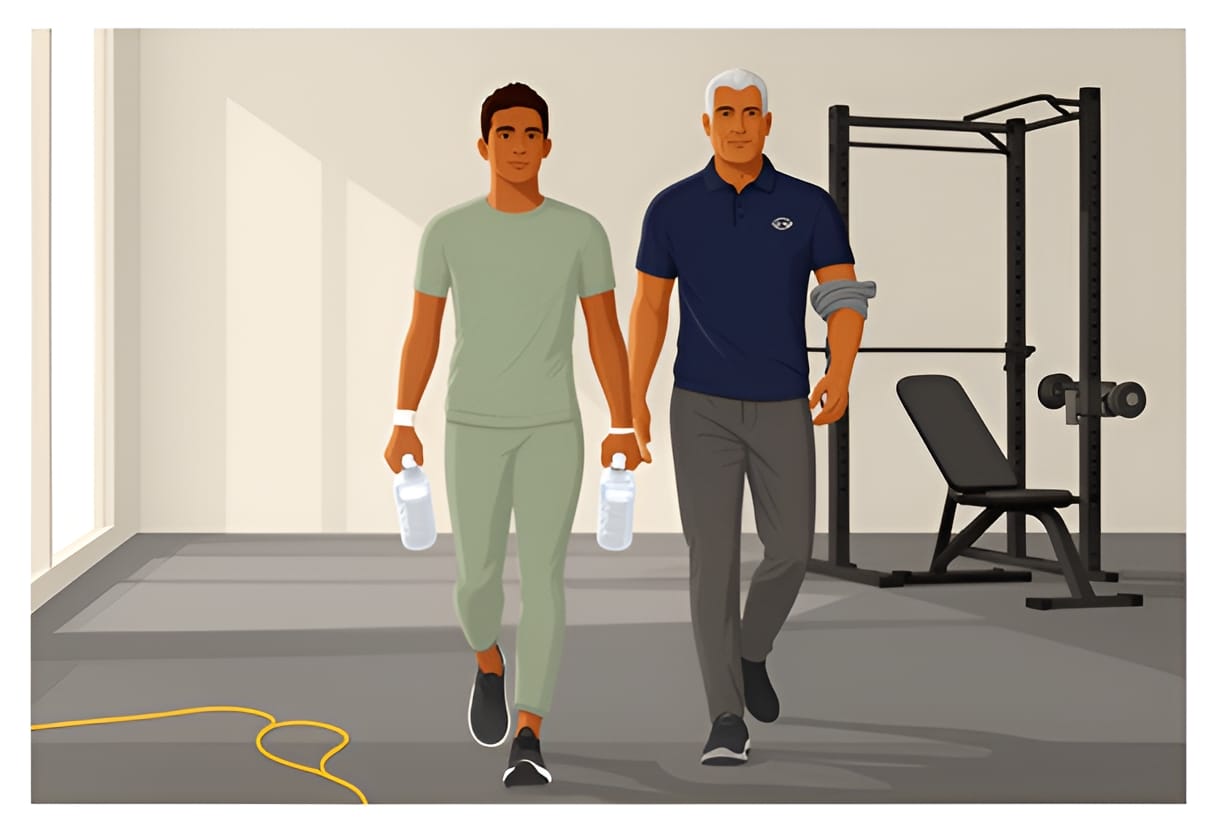
The first time, he noticed his grip fatiguing before his core—his fingers aching after just thirty seconds. On the second attempt, he consciously relaxed his grip just enough to delay fatigue, focusing instead on keeping his torso stable. By the third round, he could walk for forty-five seconds with upright posture, his shoulder blades gently retracted, and his breathing steady.
Later that day, Alex carried two grocery bags from the store to his apartment using the same principles. Instead of letting the weight drag him forward, he stood tall, engaged his midsection, and took shorter steps. His forearms burned, but his lower back remained neutral. He realized the carry wasn’t just about grip or core—it was about maintaining integrity under load, a skill that applied every time he lifted, pushed, or carried something in daily life.
Try This
This week, practice each pattern with intention:
- Perform 3 sets of 8–10 elevated push-ups (using a bench, table, or wall), focusing on chest leading and elbows at 45°.
- Complete 3 sets of 12–15 band pull-aparts or seated band rows, initiating each rep by squeezing your shoulder blades together.
- Walk for 2–3 rounds of 30–45 seconds with a loaded carry (water bottles, books, or light dumbbells), maintaining tall posture and steady breathing.
Key Takeaways
- The horizontal push requires chest-led movement, scapular protraction and retraction, and elbows tracking at approximately 45 degrees to protect the shoulders.
- The horizontal pull initiates from the shoulder blades, with minimal elbow bend and conscious engagement of the mid-back muscles to counteract forward posture.
- Loaded carries develop core stability, grip endurance, and postural control under dynamic conditions, translating directly to real-world tasks like carrying groceries or moving furniture.
Chapter 5
Building Your First Workout Plan
Designing a Balanced Full-Body Session
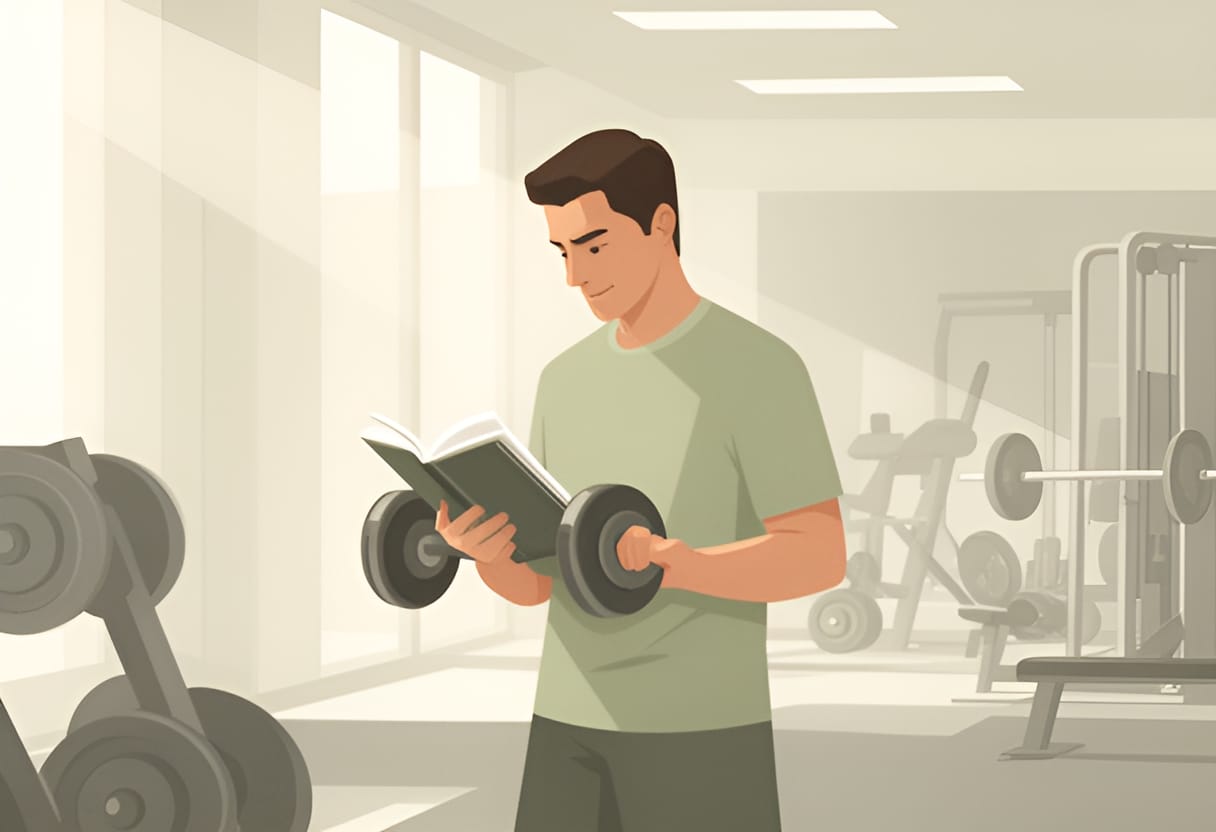
Alex Novak stood at the edge of the free-weight area, dumbbells in hand, reviewing the notes Maja had given him after their last session. The five movement patterns they’d practiced—squat, hinge, push, pull, and core—now felt familiar under his grip. What remained was turning those individual skills into a single, coherent workout. He wondered how to arrange them so none felt rushed or neglected, and how hard to push without leaving himself drained for the rest of the day.
Selecting One Movement Per Pattern
A balanced beginner session starts with choosing one exercise for each of the five foundational patterns. This ensures no major muscle group is overworked while others are ignored, promoting even development and reducing injury risk. For Alex, Maja recommended the goblet squat for the squat pattern, the glute bridge for the hinge, the incline dumbbell press for push, the seated cable row for pull, and the forearm plank for core. Each movement could be performed with equipment readily available in most gyms and scaled to his current ability.
He began with the goblet squat, holding a 12-kilogram dumbbell close to his chest. After two sets of 14 repetitions, he moved to the glute bridge, lying on a mat and lifting his hips until his body formed a straight line from shoulders to knees. He completed two sets of 15 reps, focusing on squeezing his glutes at the top. Next came the incline dumbbell press on an adjustable bench set to 30 degrees. Using 10-kilogram dumbbells, he pressed upward for two sets of 12 reps, keeping his elbows at a 45-degree angle to his torso. Then, at the cable machine, he adjusted the seat so the handles aligned with his midsection and performed two sets of 13 seated cable rows, drawing his elbows back and squeezing his shoulder blades together. Finally, he dropped to the mat for the plank, holding the position for two sets of 25 seconds, maintaining a neutral spine and engaged core.
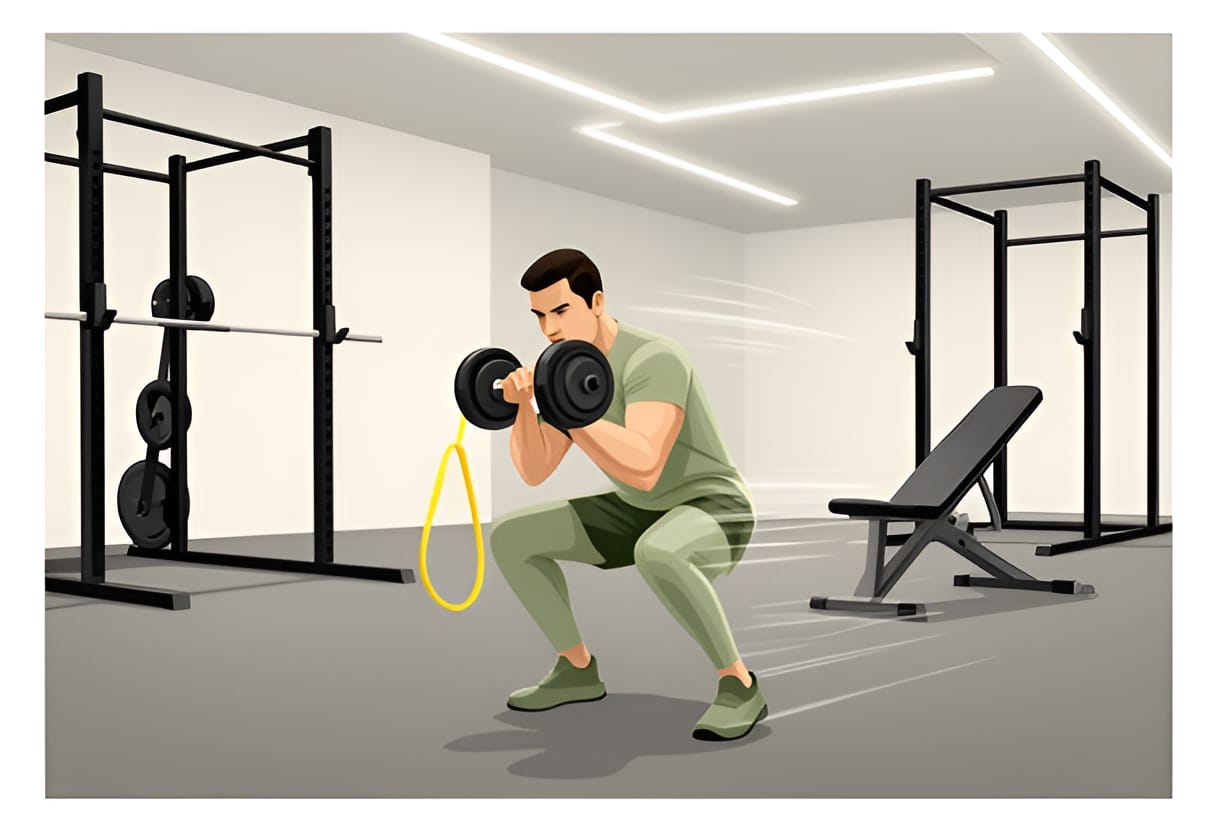
This selection followed a logical flow: starting with a compound leg movement, transitioning to a posterior chain exercise, then moving into upper-body pushing and pulling, and finishing with a core stabilizer. The order allowed larger muscle groups to work first while preserving energy for technique-focused movements later in the session.
Sets, Reps, and Rest for Work Capacity
For beginners, the priority is not maximal strength or hypertrophy but building work capacity and refining motor learning. Two sets of 12 to 15 repetitions per exercise strike this balance. This rep range is high enough to reinforce proper form through repetition but low enough to maintain intensity and avoid excessive fatigue that could break down technique. Alex found that by the second set of goblet squats, his quads were warm and his breathing steady, but he could still complete each rep with his knees tracking over his toes and his spine neutral.
Rest periods of 60 to 90 seconds between sets provide sufficient recovery for phosphagen stores to replenish while keeping the session dense enough to maintain focus and elevate heart rate moderately. Alex used a timer on his phone, starting it as soon as he racked the weight. During those intervals, he walked slowly, shook out his limbs, and reviewed his cues for the next set—chest up on the squat, hips squeezed on the glute brace, shoulder blades retracted on the row. This active recovery kept him engaged without letting his heart rate drop too low.
To illustrate how these variables work together, consider the following structure for Alex’s first full-body session:
| Exercise | Sets | Reps | Rest | Primary Focus |
|---|---|---|---|---|
| Goblet Squat | 2 | 12–15 | 60–90 sec | Squat pattern, knee alignment |
| Glute Bridge | 2 | 12–15 | 60–90 sec | Hinge pattern, glute engagement |
| Incline Dumbbell Press | 2 | 12–15 | 60–90 sec | Push pattern, scapular stability |
| Seated Cable Row | 2 | 12–15 | 60–90 sec | Pull pattern, back contraction |
| Forearm Plank | 2 | 20–30 sec | 45–60 sec | Core stability, spinal neutrality |
Note that the plank uses time-based sets since it’s an isometric hold. Alex adjusted his rest after core work to 45–60 seconds, as the demand on his stabilizing muscles was lower than after heavy compound lifts.
By the end of the session, Alex felt a pleasant fatigue in his muscles—not the shaky exhaustion of overtraining, but the satisfying awareness that he had worked each major movement pattern with intention. He wiped his brow, took a long drink of water, and noted in his planner: Completed first full-body session. Felt strong, not sore. Ready for next time. The workout had challenged him without breaking him, exactly what he needed to build consistency over the coming weeks.
Progressive Overload and Workout Logging
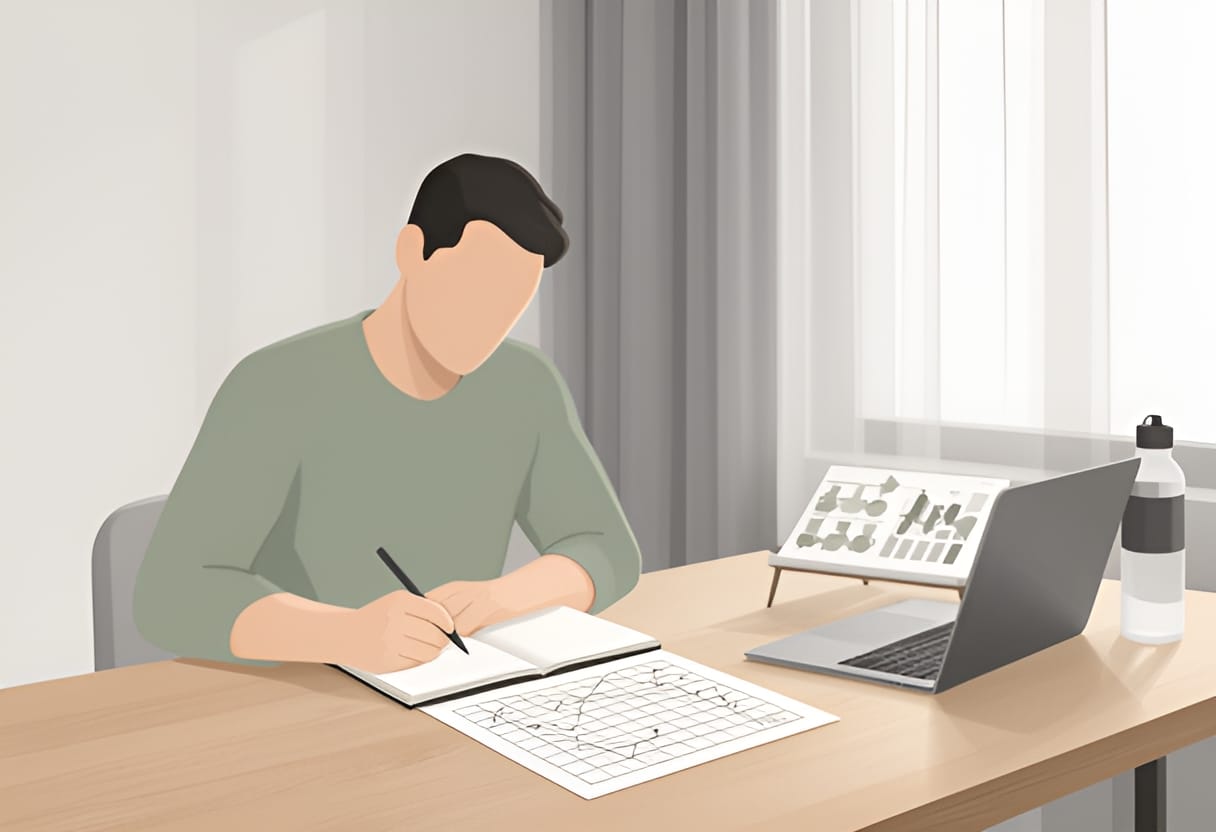
Alex Novak opened his notebook to a fresh page, the grid lines waiting for his first entry. The session had ended with a sense of accomplishment, but he knew that repeating the same workout indefinitely would stall progress. Maja had mentioned the principle of progressive overload during their cool-down stretch, explaining that the body adapts to stress only when that stress gradually increases. Without it, gains in strength, endurance, or movement efficiency would plateau. He leaned back on the bench, pen in hand, and began to understand how to apply it.
Understanding Progressive Overload
Progressive overload is the systematic increase of demand placed on the musculoskeletal system to continually make gains in muscle size, strength, or endurance. For a beginner like Alex, this doesn’t mean lifting heavier every session. Instead, it means manipulating variables such as weight, repetitions, sets, or rest periods in a controlled way—only when the current workload feels manageable with proper form. The key is to avoid rushing progression, which can compromise technique and increase injury risk, while also avoiding stagnation, which halts adaptation.
Maja had given him a simple rule: only increase the demand when he could complete the top of his prescribed rep range for two consecutive sessions with good form. For his goblet squat, that meant hitting 15 reps on both sets with a neutral spine, knees tracking over toes, and chest up. If he managed that, he could consider adding weight, increasing reps, or adding a set—but only one variable at a time. This approach ensured that his body adapted gradually, reinforcing motor patterns before increasing load.
He thought about his first session: two sets of 14 goblet squats with a 12-kilogram dumbbell. He had finished with steady breathing and no form breakdown. The next time, he aimed for 15 reps. If he achieved that, he’d stay at the same weight but aim for two sets of 15 again the following week. Only then would he consider moving to a 14-kilogram dumbbell. This slow, deliberate progression felt sustainable—aligned with his why statement of building energy and comfort without crashing.
The Workout Log as a Feedback Tool
To track whether he was ready to progress, Alex needed a way to record what he did and how it felt. Maja suggested a simple log: date, exercise, sets, reps, weight used, and a Rating of Perceived Exertion (RPE) on a scale of 1 to 10, where 10 was maximal effort. This didn’t need to be fancy—a small notebook or a notes app would suffice. What mattered was consistency. By reviewing his log weekly, he could see trends: Was the same weight feeling easier? Was his RPE dropping for the same workload? These signals told him when it was safe to increase demand.
He opened his notebook and created a table for his first week:
| Date | Exercise | Sets x Reps | Weight | RPE |
|---|---|---|---|---|
| Oct 26 | Goblet Squat | 2 x 14 | 12 kg | 7 |
| Oct 26 | Glute Bridge | 2 x 15 | Bodyweight | 6 |
| Oct 26 | Incline DB Press | 2 x 12 | 10 kg | 7 |
| Oct 26 | Seated Cable Row | 2 x 13 | 20 kg | 6 |
| Oct 26 | Forearm Plank | 2 x 25 sec | — | 5 |
He rated the goblet squat a 7—challenging but sustainable. Two days later, he repeated the session. This time, he completed two sets of 15 goblet squats with the same 12-kilogram dumbbell. His RPE dropped to 6. He noted it in his log:
| Date | Exercise | Sets x Reps | Weight | RPE |
|---|---|---|---|---|
| Oct 28 | Goblet Squat | 2 x 15 | 12 kg | 6 |
| Oct 28 | Glute Bridge | 2 x 15 | Bodyweight | 6 |
| Oct 28 | Incline DB Press | 2 x 12 | 10 kg | 7 |
| Oct 28 | Seated Cable Row | 2 x 13 | 20 kg | 6 |
| Oct 28 | Forearm Plank | 2 x 25 sec | — | 5 |
Seeing the RPE drop from 7 to 6 on the squat confirmed he was adapting. Since he had now hit the top of his rep range (15) for two sessions in a row with good form, he was ready to progress. Following Maja’s guidance, he decided to increase the weight—but only for the goblet squat, and only by the smallest practical increment. The next session, he would try a 14-kilogram dumbbell, aiming for two sets of 12 reps. If he could complete those with good form, he’d stay there until he could again hit 15 reps for two sessions.
Two weeks later, his log showed the progression:
| Date | Exercise | Sets x Reps | Weight | RPE |
|---|---|---|---|---|
| Nov 11 | Goblet Squat | 2 x 12 | 14 kg | 7 |
| Nov 11 | Glute Bridge | 2 x 15 | Bodyweight | 6 |
| Nov 11 | Incline DB Press | 2 x 12 | 10 kg | 7 |
| Nov 11 | Seated Cable Row | 2 x 13 | 20 kg | 6 |
| Nov 11 | Forearm Plank | 2 x 25 sec | — | 5 |
The RPE was back to 7—a sign the new weight was appropriately challenging. He had successfully applied progressive overload: increased load only after mastering the previous level, tracked the change objectively, and avoided guessing. Over time, this log would show not just numbers, but a story of growing capability—one that matched his why statement more closely with each session.
He closed his notebook, feeling the quiet satisfaction of having a system. Progress wasn’t about dramatic leaps; it was about showing up, recording honestly, and letting small, deliberate steps accumulate. That, he realized, was how strength—both physical and otherwise—was truly built.
Try This
This week, take these three steps to apply progressive overload and logging to your own routine:
- Choose one exercise from your current workout and perform it with the same weight and reps for two sessions, aiming to hit the top of your rep range both times with good form.
- After each session, record the date, exercise, sets, reps, weight used, and your RPE (1–10) in a notebook or phone note.
- If you complete the top of your rep range for two consecutive sessions with good form, increase the weight by the smallest practical increment (e.g., 2.5–5 lbs or 1–2.5 kg) for that exercise next time, keeping sets and reps the same.
Key Takeaways
- Progressive overload means gradually increasing weight, reps, or sets over time to drive continued adaptation, but only when current targets are met with good form.
- A simple workout log tracking date, exercise, sets, reps, weight, and RPE reveals objective trends and prevents guesswork in progression.
- Beginner programs prioritize building work capacity and motor learning through moderate rep ranges (12–15) and controlled rest, forming the foundation for long-term gains.
- Consistency in tracking and honest self-assessment are more valuable than intensity—small, measurable improvements compound into meaningful change.
- Aligning training with a personal “why” statement transforms exercise from a chore into a purposeful practice that supports energy, posture, and presence in daily life.